
Views: 255 Author: Long Win Display Publish Time: 2026-09-14 Origin: Site


Content Menu
● What Is a Custom Quarter Pallet Display?
● Typical Custom Quarter Pallet Display Lead Time
● The Complete Production Timeline
>> 1. Product Briefing and Retail Requirements
>> 2. Structural Design and 3D Rendering
>> 3. Sampling and Functional Testing
>> 4. Artwork Approval and Production Release
● What Can Delay Quarter Pallet Display Production?
● How to Shorten the Lead Time for Custom Quarter Pallet Displays
>> Use a "Retail Launch Backward Plan"
>> Approve Structure Before Perfecting Graphics
>> Provide Print-Ready Artwork
>> Choose the Right Sample Strategy
>> Consider Assembly and Shipping Early
● Quality Checks That Should Never Be Rushed
● A Practical Buyer Checklist Before You Place an Order
● Why Early Planning Protects Retail Sales
● Start Your Custom Quarter Pallet Display Project Early
>> 1. How long does it take to produce a custom quarter pallet display?
>> 2. How long does it take to receive a quarter pallet display sample?
>> 3. What information does a manufacturer need before designing a quarter pallet display?
>> 4. Can a cardboard quarter pallet display hold heavy products?
>> 5. Should I choose flat-packed or pre-assembled quarter pallet displays?
When retail buyers, brand managers, and sourcing teams ask about custom quarter pallet display lead time, they are usually trying to protect a much bigger deadline: a new product launch, a supermarket promotion, a seasonal campaign, or a multi-store retail rollout.
In practice, the answer is not simply "10 days" or "three weeks." The production time for a custom quarter pallet display depends on the level of customization, structural complexity, artwork readiness, testing requirements, order volume, packing method, and shipping destination. A well-managed project can move quickly. However, a project with incomplete specifications, late artwork revisions, or unclear retailer requirements can lose valuable days before production even starts.
As a China-based designer and manufacturer of custom cardboard displays, Long Win Display understands that a quarter pallet display is not just printed corrugated board. It is a retail merchandising tool that must protect products, communicate a brand message, fit a retailer's floor plan, survive transportation, and remain stable during customer interaction.
For most standard custom projects, buyers should plan for approximately 2–5 working days for samples, 10–15 working days for bulk production, and additional time for international shipping, customs clearance, distribution-center delivery, and store rollout. This guide explains the complete timeline and shows how to reduce risk at every stage.

A custom quarter pallet display is a compact point-of-purchase retail display designed to occupy approximately one-quarter of a standard pallet footprint. It is commonly used in supermarkets, club stores, pharmacies, convenience stores, and promotional retail areas.
Unlike a standard cardboard floor display, a quarter pallet display is often designed around retailer pallet standards, distribution-center handling requirements, product case dimensions, and in-store replenishment needs.
It may include:
- Corrugated cardboard shelves or trays
- A printed pallet skirt or branded base wrap
- Retail-ready trays or shelf-ready packaging
- Header cards, side panels, or promotional signage
- Product dividers and retention features
- Reinforced base structures
- Pre-filled or pre-packed product configurations
- Flat-packed, partially assembled, or fully assembled shipment options
The purpose is simple: help brands create a high-impact retail presence without consuming the floor space of a half-pallet or full-pallet display.
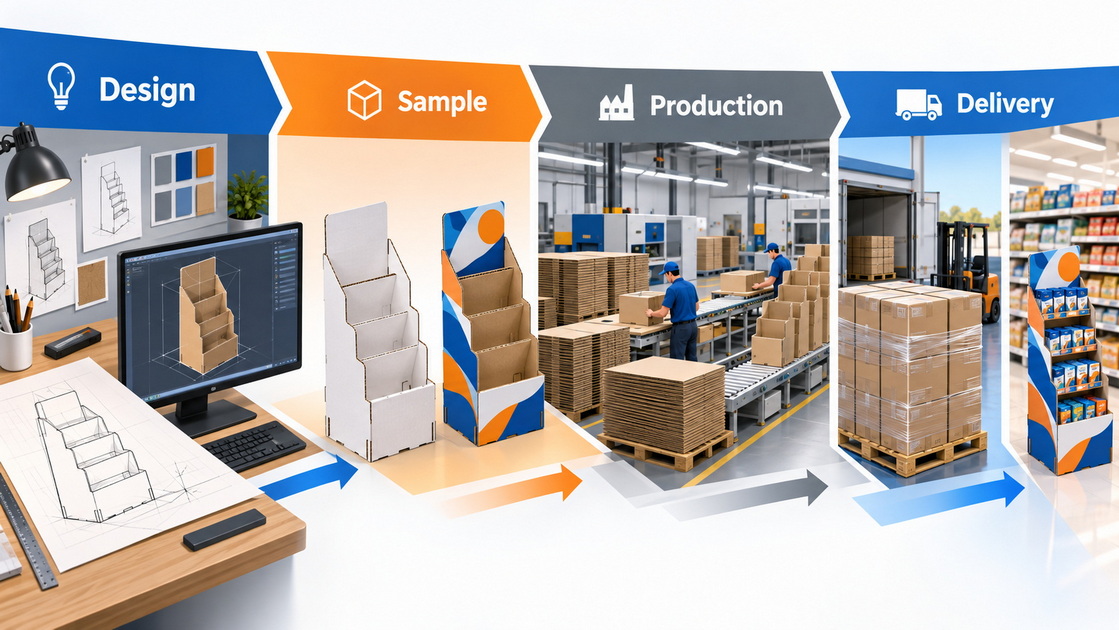
For a custom program with approved artwork and clear specifications, the production process generally includes design, sampling, approval, bulk manufacturing, packing, and shipping.
| Project Stage | Typical Timeframe | What Happens During This Stage |
|---|---|---|
| Project briefing and quotation | 1–3 working days | Product dimensions, target quantity, retail requirements, material options, and pricing are confirmed |
| Structural design and 3D rendering | 1–3 working days | Engineers create a display structure and visual mockup |
| White sample or structural prototype | 1–2 working days | A plain sample is produced to verify dimensions, fit, loading, and assembly |
| Printed color sample | 3–5 working days | Printed graphics, finishes, and final visual details are tested |
| Artwork review and approval | 1–7+ working days | Buyer, brand team, or retailer confirms graphics and construction |
| Bulk production | 10–15 working days | Printing, die-cutting, gluing, packing, inspection, and loading are completed |
| Ocean freight or air freight | Varies by destination | Transit, customs, port handling, and final delivery occur |
| Distribution and store rollout | Varies by retailer | Displays are received, allocated, and sent to retail locations |
For standard orders, a typical manufacturer production window is 10–15 working days after final artwork approval and deposit confirmation. Samples are often available within 2–3 working days, depending on whether the buyer needs a plain structural sample or a full-color printed sample.
However, buyers should distinguish between factory lead time and total project lead time. The factory may complete production in two weeks, but the total calendar time from concept to retail floor can easily become six to ten weeks once sampling, approvals, freight, customs, warehouse scheduling, and retail distribution are included.
The fastest projects start with a complete brief. Before the structural design team begins, the manufacturer needs enough information to engineer a display that is visually appealing, safe, functional, and suitable for transport.
A complete briefing package should include:
- Product dimensions, weight, and quantity per display
- Product photos or physical samples
- Desired display size and target retail location
- Retailer pallet footprint or display guidelines
- Number of shelves, trays, hooks, or compartments
- Expected replenishment method
- Brand logo, colors, copy, and artwork files
- Required order quantity
- Preferred shipping method and destination
- Launch date or required warehouse delivery date
A missing product weight is one of the most common causes of structural redesign. If the display will hold bottled beverages, glass containers, metal accessories, cosmetics, or heavy multipacks, the base and shelves may require reinforcements, stronger corrugated flute, hidden support bars, or a redesigned load path.
Expert insight: Do not approve a visual design before confirming the product loading plan. A beautiful pallet display that cannot safely carry the required retail inventory creates expensive delays later.
Once the brief is clear, structural engineers create a display layout. This is where the manufacturer determines the shelf spacing, base footprint, product-facing capacity, header height, reinforcement method, die-cut pattern, and assembly sequence.
A professional custom pallet display manufacturer should assess more than appearance. The display must also consider:
- Load-bearing capacity
- Center of gravity
- Product access and replenishment
- Flat-pack efficiency
- Protection during transport
- Retail aisle clearance
- Shelf or tray compression resistance
- Ease of store assembly
- Branding visibility from multiple angles
Digital 3D renderings are useful because they allow the brand team to review the display before physical sampling. They can identify issues with logo placement, product visibility, color balance, shelf spacing, or promotional messaging before printing begins.
For relatively simple quarter pallet displays, structural design and rendering can often be completed in one to three working days. More complex programs may take longer, especially when they include multiple SKUs, product trays, pallet skirts, retail compliance requirements, or pre-filled packaging plans.
Sampling is the stage that protects buyers from large-scale mistakes.
A white sample is normally used to confirm:
- Overall dimensions
- Shelf width and depth
- Product fit
- Shelf loading
- Base stability
- Assembly steps
- Carton size
- Product-facing quantity
A printed sample goes further. It lets the buyer inspect color reproduction, graphics alignment, logo quality, coatings, and finished retail appearance.
For many display programs, a white structural sample can be prepared within one to two days, while a color-printed sample may require three to five days. The exact time depends on printing process, material selection, finishing requirements, and shipping arrangements for the sample.
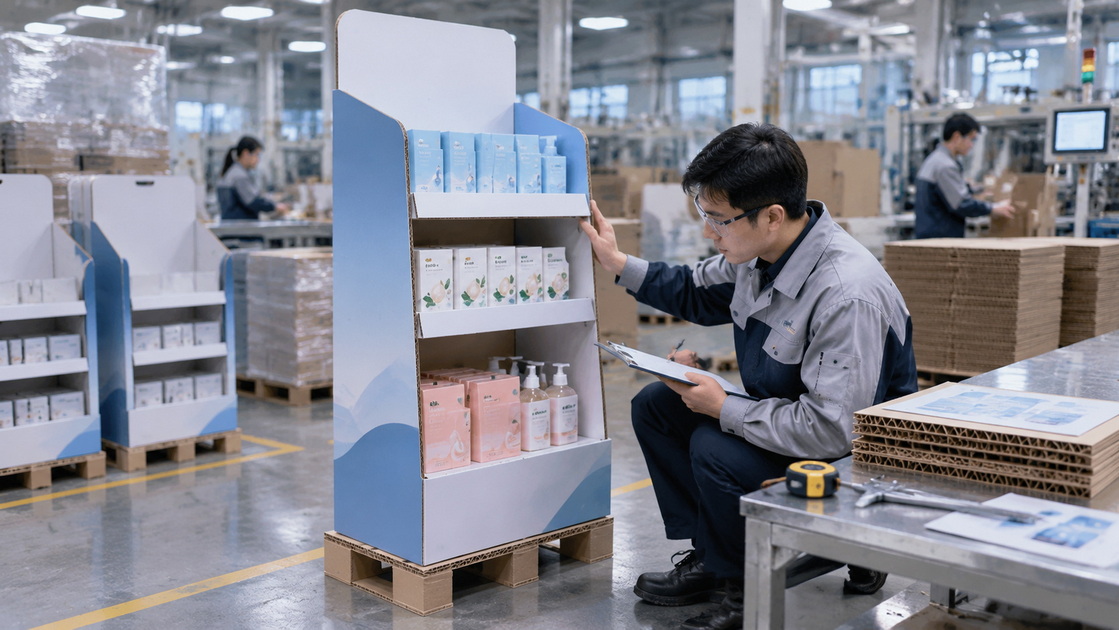
The most valuable step is to test the sample with real products. The buyer should load the exact bottles, boxes, pouches, jars, or cartons that will be displayed in stores.
This stage often causes the largest hidden delay.
Even when the display structure is complete, bulk production cannot begin until the buyer has approved the final dieline artwork. For branded retail displays, artwork approval may involve multiple stakeholders:
- Brand marketing team
- Packaging designer
- Product manager
- Retail buyer
- Compliance team
- Legal or regulatory reviewer
- Distributor or fulfillment partner
To prevent artwork delays, buyers should assign one decision-maker who can consolidate feedback. Sending separate, conflicting comments from several departments can result in repeated artwork revisions.
Before approving artwork, check:
1. Product names, SKU details, and promotional copy
2. Barcode location and scanability
3. Brand colors and logo clear space
4. Retailer-required claims or symbols
5. Product orientation on shelves
6. Dieline placement and bleed areas
7. Language versions for each market
8. Packaging warning statements, if applicable
Practical rule: Treat final artwork approval as the true production start date. A supplier's quoted production lead time generally begins only after artwork is approved and commercial requirements, including deposit terms where applicable, are satisfied.
The most reliable way to shorten lead time is to identify risk before production begins. Below are the issues that most frequently extend a cardboard pallet display lead time.
| Delay Factor | Why It Causes Delays | How to Prevent It |
|---|---|---|
| Incomplete product specifications | Engineers cannot confirm shelf strength or product capacity | Provide product size, weight, and loaded quantity at the beginning |
| Multiple artwork revisions | Printing and die-cut files cannot be finalized | Use one internal approval owner and a firm sign-off deadline |
| Complex structure | More parts, reinforcements, and assembly steps require additional engineering | Balance visual ambition with practical construction |
| Late sample feedback | Production cannot start without approval | Test samples immediately upon receipt |
| Peak seasonal demand | Factory schedules may become crowded before major retail seasons | Reserve production capacity early |
| Special finishes | Foil, embossing, special coating, or complex lamination can add steps | Confirm finishing requirements before quoting |
| Pre-filled displays | Product packing and co-packing introduce additional logistics steps | Confirm product delivery schedule and packing method early |
| International freight | Port congestion, customs, and destination handling add uncertainty | Build a freight buffer into the retail launch calendar |
The key lesson is that display manufacturing is not a single event. It is a sequence of approvals, physical production steps, and logistics decisions. The buyer who manages the handoffs will usually achieve a more reliable delivery date.
A fast project does not mean skipping important quality checks. It means reducing avoidable waiting time.
Start with the date when displays must arrive at the retailer's distribution center—not the date when you want the factory to finish production.
Then work backward.
For example, if a retailer needs displays delivered by September 1, your timeline may need to include:
- Retailer distribution-center appointment: September 1
- Domestic delivery and receiving buffer: 3–7 days earlier
- Customs and port buffer: 5–14 days earlier, depending on freight mode
- International freight transit: based on route and shipping method
- Factory production: 10–15 working days
- Sample approval and artwork release: 1–2 weeks
- Structural design and quotation: 3–5 working days
This backward-planning method gives the buyer a realistic "go/no-go" decision point before committing to a promotion.
It is efficient to confirm the display's loading, dimensions, and assembly method before spending too much time refining visual details. Structural changes after color artwork is complete can force expensive rework of the dieline.
If your brand team already has professional artwork, ask the manufacturer for the correct AI or PDF dieline template. Files should include bleed, color specifications, linked images, outlined fonts where required, and clearly marked non-print areas.
A professional manufacturer should be able to provide dielines and 3D visual support to help the buyer apply artwork correctly.
Not every project needs the same sample process.
- Choose a white sample when product fit, shelf loading, and assembly are the main concerns.
- Choose a printed sample when brand color, premium finishes, retailer presentation, or executive approval are critical.
- Use both when launching a high-volume retail program, an unfamiliar product format, or a display carrying heavy products.
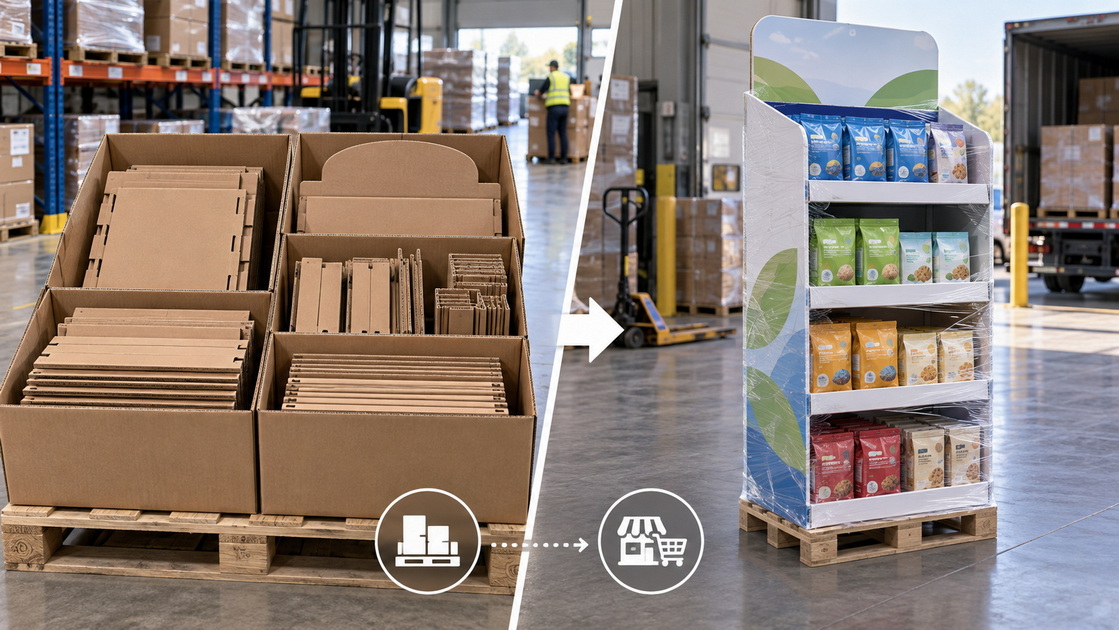
Flat-packed displays can reduce shipping volume, but they require assembly at the destination. Pre-assembled or pre-filled programs may save store labor but can increase packing complexity and freight volume.
The right solution depends on:
- Retailer assembly capability
- Number of store locations
- Labor budget
- Freight budget
- Required launch speed
- Product loading method
- Distribution-center requirements
Long Win Display recommends discussing this decision during structural design, not after the display has already been engineered.
A short lead time is valuable only if the displays arrive in usable condition. For quarter pallet display programs, quality control should include structural, visual, and packaging checks.
Important checks include:
- Material grade verification
- Color consistency inspection
- Die-cut accuracy
- Adhesive and gluing inspection
- Shelf alignment
- Load-bearing testing
- Assembly testing
- Product-fit verification
- Master-carton strength
- Drop resistance and transit protection
- Pre-shipment inspection
Manufacturers may use quality systems, sampling procedures, and third-party standards as part of their quality-control process. PopDisplay publicly states that it supports structural engineering, sample development, load testing, pre-shipment inspection, and standards or certifications including ISO 9001, FSC-related material positioning, SGS testing references, BSCI, Sedex, and ISTA package testing. Buyers should request project-specific documentation rather than assuming every certificate or test applies automatically to every order.
Before you approve a custom quarter pallet display order, confirm the following:
- Retail deadline: What is the required distribution-center delivery date?
- Product data: Have you provided accurate size, weight, and quantity information?
- Display capacity: How many product units must each display hold?
- Retail footprint: Does the design meet the retailer's pallet or aisle requirements?
- Sample approval: Has your team tested a loaded physical sample?
- Artwork: Is the final print file approved by all necessary stakeholders?
- Shipping plan: Will the displays move by sea, air, rail, or local truck?
- Assembly method: Will displays be flat-packed, pop-up, pre-assembled, or pre-filled?
- Quality standard: Have you agreed on inspection requirements and acceptance criteria?
- Contingency buffer: Have you allowed time for weather, customs, port delays, or retailer appointment changes?
The real cost of a delayed display is not limited to expedited freight. A missed retail window can mean lost shelf space, canceled promotional support, wasted campaign inventory, and missed seasonal demand.
For example, imagine a snack brand launching a limited-edition holiday product. If the quarter pallet display arrives after the promotion begins, the brand may lose the impulse-purchase advantage it planned to create at the aisle entrance or promotional zone. In that situation, saving two days during artwork approval may be more valuable than negotiating a small reduction in unit cost.
A well-planned custom quarter pallet display program protects both the physical display and the commercial opportunity behind it.
The typical manufacturing lead time for a custom quarter pallet display is often manageable: approximately 2–5 working days for sampling and 10–15 working days for standard bulk production after final artwork approval. But successful retail launches require more than factory production time. They require early engineering, fast sample review, decisive artwork approval, appropriate shipping selection, and realistic logistics buffers.
Long Win Display designs, customizes, manufactures, and pre-assembles cardboard POP displays for brands that need reliable retail execution. Whether you need a compact corrugated quarter pallet display, a supermarket promotional display, a retail-ready tray system, or a complete multi-store rollout solution, our team can help you evaluate structure, loading capacity, sample requirements, production timing, and packing options.
Contact Long Win Display today to request a custom 3D concept, structural recommendation, sample plan, and production schedule for your next quarter pallet display program.
For standard custom projects, bulk production commonly takes around 10–15 working days after final artwork approval and commercial confirmation. Structural and printed sample stages should be added before bulk production, as should shipping and destination logistics time.
A plain white structural sample may take approximately one to two working days, while a printed color sample often takes around three to five working days. Complex structures, special finishes, or international sample shipping may extend the full calendar timeline.
Provide product dimensions, unit weight, number of products per display, target retailer, desired display footprint, artwork or brand guidelines, order quantity, shipping destination, and required delivery date. Physical product samples are especially useful for accurate structural design.
Yes, but the structure must be designed for the actual product load. Heavy bottles, cans, glass products, and multipacks may require reinforced shelves, stronger corrugated material, internal supports, or a more robust base. Always test a loaded sample before approving bulk production.
Flat-packed displays are generally more freight-efficient and require store or distribution-center assembly. Pre-assembled displays reduce setup time but may take more shipping space. The best option depends on your freight budget, store labor, distribution process, and launch requirements.
1. [PopDisplay — Custom Cardboard Display Manufacturer] — Public information on custom corrugated POP display manufacturing, design process, 3D rendering, samples, bulk production, quality-control claims, certifications, assembly options, and stated production lead times. [popdisplay]
2. [Long Win Display — Custom Cardboard Display Manufacturer] — Public company information describing custom cardboard display and POP display manufacturing capabilities, factory-direct positioning, and industry experience. [longwindisplay]
3. [International Safe Transit Association (ISTA)] — Industry resource on packaging performance testing and transit testing concepts relevant to retail display shipping and distribution.
4. [Forest Stewardship Council (FSC)] — Information on responsible forest management and FSC certification concepts relevant to paper and corrugated material sourcing.
5. [International Organization for Standardization — ISO 9001] — Overview of ISO 9001 quality-management-system principles relevant to manufacturing process consistency.
6. [GS1 Standards] — Industry standards reference for product identification, barcodes, and supply-chain information used in retail distribution.


