
Views: 222 Author: Long Win Display Publish Time: 2026-06-01 Origin: Site


Content Menu
● What exactly is aqueous coating?
● How aqueous coating works from a production perspective
>> Composition and film formation
● Types of aqueous coating finishes and where they fit
● Benefits of aqueous coating for packaging boxes
>> 1. Protection and durability
>> 4. Production efficiency and cost
● Aqueous coating vs UV coating vs varnish
● Practical considerations and "hidden" risk factors with AQ
>> Storage, handling and viscosity
>> Foaming and application defects
● Internal "insider" check rarely discussed: using gloss and weight as a process health indicator
● When should you specify aqueous coating on your next packaging job?
● FAQ
>> 1. Is aqueous coating safe for food packaging?
>> 2. Does aqueous coating affect recyclability of paper boxes?
>> 3. How do I decide between gloss and matte AQ for my brand?
>> 4. Can aqueous coating be combined with foiling, embossing and spot UV?
>> 5. What should I ask my supplier to check their AQ process capability?
If you work with printed package boxes, you have almost certainly approved artwork that used aqueous coating—even if no one explicitly called it out. Aqueous (AQ) coating has become the "default" protective finish in modern printing and packaging because it balances print quality, durability, cost, and sustainability better than most alternatives. From my experience reviewing thousands of print proofs for brands and retailers, understanding AQ at a practical level is one of those small technical skills that prevents big headaches later. [pakfactory]
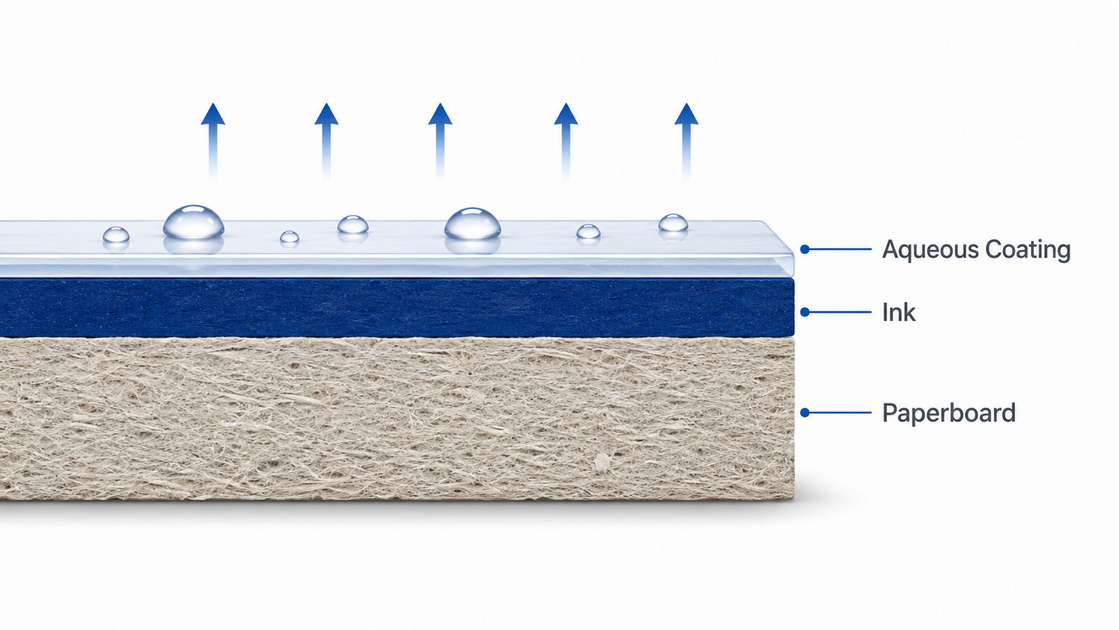
In packaging and commercial printing, aqueous coating is a clear, water‑based protective layer applied over printed paperboard or paper to enhance appearance and protect the surface. It is typically applied inline on the press, immediately after the ink, and then dried by heated air, forming a thin, transparent film. [packhit]
Key characteristics:
- Water‑based formulation using water and water‑soluble polymers rather than solvent systems. [verive]
- Fast drying, making it suitable for high‑volume packaging runs. [pakfactory]
- Improved durability against scuffing, fingerprints and minor moisture. [midatlanticpackaging]
- Multiple finishes such as gloss, matte, satin and soft‑touch. [cosmochem]
- More eco‑friendly than many solvent‑based coatings due to lower VOC emissions and compatibility with recycling streams. [midatlanticpackaging]
For most folding cartons, retail boxes and many POP displays, AQ is now the standard finishing baseline rather than an exotic upgrade. [packwins]
From a converter's point of view, AQ is a carefully controlled liquid film that must be stored, mixed and applied within tight process windows. This often doesn't show up in marketing brochures, but it directly affects your box quality.
A typical AQ formulation includes:
- Water as the primary carrier.
- Water‑soluble polymers as binders that form the solid film after drying. [packhit]
- Additives for slip, scuff resistance, gloss level, and wetting.
During drying, water evaporates, leaving a thin, uniform polymer film that locks onto the printed surface. The thickness is small, but enough to create a noticeable difference in feel and protection. [verive]
In most offset or flexo setups, AQ is:
1. Applied inline via a dedicated coating unit after the last ink unit. [pakfactory]
2. Metered through anilox or roller systems to maintain consistent film weight.
3. Dried in hot‑air/IR units before sheets are stacked or rewound.
For converters like Long Win Display, which produce custom package boxes and POP displays, AQ can be combined with specialty effects (foiling, embossing, spot UV) by sequencing operations correctly and choosing compatible formulations. [longwindisplay]
Different AQ formulations can dramatically change how your box looks and performs. As a buyer, being specific about the finish helps your supplier avoid guesswork.
- Gloss AQ
- High reflectivity and vibrant colors, especially for photographic or brand‑color‑heavy designs. [bpkc]
- Good for cosmetics, food, electronics and premium retail packaging where shelf impact matters.
- Matte or satin AQ
- Lower reflectivity, more subtle and premium feel with better readability under strong lights. [cosmochem]
- Suitable for minimalist, natural or eco‑oriented brands and luxury product lines.
- Soft‑touch AQ
- Velvet‑like tactile sensation combined with protective properties. [cosmochem]
- Often used for high‑end gift boxes and subscription boxes to elevate perceived value.
- Scuff‑resistant AQ
- Enhanced resistance to abrasion and friction, particularly important in shipping and high‑touch retail environments. [cosmochem]
- Common for heavier boxes, logistics‑intensive programs, or dark solid colors that show scratches easily.
Discussing finish type upfront—rather than simply saying "coated"—reduces the risk of misaligned expectations between brand, designer and printer.

From both technical and commercial viewpoints, AQ offers a strong combination of advantages.
AQ significantly improves resistance to:
- Scuffs and rub marks during production, packing and transit. [midatlanticpackaging]
- Fingerprints and minor moisture for retail handling and end‑user use. [bpkc]
For display boxes and retail POP units, this can be the difference between a pristine in‑store presence and a worn‑looking display just a few weeks into a promotion. [packwins]
AQ can make printed colors look richer and more even, especially with gloss formulations. This is particularly visible on: [packwins]
- Deep solid colors (e.g., dark blues and blacks).
- High‑resolution product photography.
- Metallic or foil elements that benefit from a unified surface finish.
While not "perfect," AQ is generally considered more sustainable than many solvent‑based alternatives because:
- It is water‑based and has lower VOC emissions. [packhit]
- It is broadly compatible with mainstream paper and board recycling processes when used in standard coat weights. [verive]
Brands pursuing circular‑economy goals often prefer AQ over plastic laminations for exactly this reason.
For converters, AQ:
- Dries quickly, enabling higher press speeds and faster job turnaround. [pakfactory]
- Integrates easily into inline processes, avoiding extra offline coating steps.
From a buyer's perspective, AQ is typically more cost‑effective than special coatings like UV or film lamination, making it a good "default plus" for many packaging programs. [bpkc]
To make informed trade‑offs, it helps to compare AQ with other common finishes.
| Property | Aqueous Coating | UV Coating | Traditional Varnish |
|---|---|---|---|
| Base | Water‑based polymers (packhit) | UV‑curable resins | Oil‑based or solvent‑based resins |
| Drying / curing | Heat and air, fast (pakfactory) | Instant cure under UV light | Oxidation / absorption, slower |
| Gloss potential | Medium to high (depending on type) (cosmochem) | Very high | Low to medium |
| Durability | Good scuff and fingerprint resistance (midatlanticpackaging) | Excellent hardness and chemical resistance | Moderate |
| Sustainability | Lower VOC, recyclable with paper (midatlanticpackaging) | More complex recycling, energy‑intensive | Depends on formulation |
| Typical use | Folding cartons, retail boxes, POP, print collateral | Premium packaging, specialty effects | Cost‑sensitive print jobs |
For most everyday retail cartons and display boxes, I recommend AQ as the default; UV and other specialty coatings should be reserved for situations where the extra gloss or durability clearly justifies the added cost and process complexity.
Aqueous coating sounds simple, but on press it is a technical process with several potential pitfalls that experienced buyers pay attention to.
Manufacturers of AQ coatings typically recommend:
- Storage at room temperature around 20–22 °C, avoiding freezing or excessive heat. [corkindustries]
- Thorough mixing before use and routine viscosity checks (e.g., Zahn cup) for every batch. [corkindustries]
- Stable circulation using appropriate pumps to avoid foam, which otherwise leads to uneven coating and defects. [blog.apexinternational]
When you assess a packaging supplier, asking how they manage AQ storage and viscosity control is a surprisingly effective way of gauging their process discipline.
Foaming during AQ application can cause:
- Pinholes or voids in the coating layer.
- Inconsistent gloss.
- Potential adhesion issues.
Common root causes include pump setup, return‑line splash, and worn end seals in chamber systems. Good converters proactively manage these factors; if your QA team sees recurring spot defects in coated areas, AQ process control is one of the first things to audit. [blog.apexinternational]

One practical but under‑shared method that experienced packaging buyers use is to periodically measure both gloss level and sheet weight on coated runs as a proxy for process control.
Instead of assuming "AQ is on," they:
- Measure surface gloss at defined points using a gloss meter and compare with approved references.
- Record coated sheet or carton weight and compare with baseline samples where only board weight changed.
Significant deviations can indicate problems like under‑applied coating (leading to weaker protection) or over‑applied coating (risking blocking, longer drying, or color shifts). Combined with visual inspection, these simple checks help catch subtle process drift in long‑running programs.

Based on real procurement experiences, AQ is usually the right choice when:
- You are printing on paperboard or corrugated for consumer‑facing packaging.
- You need better durability and appearance than uncoated print, but don't require extreme UV‑level resistance.
- Sustainability and recyclability are important to your brand or your retail partners.
- You want good value and efficient lead times.
Where you might consider alternatives:
- Very high‑end luxury packaging that demands ultra‑deep gloss or special tactile effects (consider UV, soft‑touch films, or hybrid systems).
- Applications exposed to aggressive chemicals or extended outdoor use.
In practice, many programs use AQ as the main workhorse, with small selected areas finished in UV or other special effects for visual contrast.
If you are planning new packaging or POP campaigns and want to optimize finish, durability and sustainability, it's worth reviewing your current coating specifications. Share your key SKUs, retail channels and performance requirements with a technical partner like Long Win Display, and ask for coating and structural recommendations—not just price quotes. A short technical review before the next print run can prevent costly reprints and elevate shelf impact across your entire program. [longwindisplay]
Standard AQ formulations are widely used on the outside of food packaging and can comply with relevant food‑contact guidelines when specified correctly. For direct food contact or primary inner layers, always confirm with your supplier and request documentation. [midatlanticpackaging]
In typical coat weights, AQ is compatible with standard paper and board recycling streams and is considered more recycling‑friendly than most plastic films. Local recycling capabilities can vary, so global brands should still validate with regional waste partners. [packhit]
Use gloss AQ when vibrant colors and high shelf impact are critical; choose matte or satin AQ when you want a softer, more premium or eco‑oriented look and better readability under bright retail lighting. [packwins]
Yes, but sequence and formulation matter. Many high‑end boxes use a base AQ layer for protection plus local foils, embossing or spot UV effects. Your converter should confirm compatibility and outline the process flow. [bpkc]
Ask how they store and mix AQ, how often they measure viscosity, what type of pumps and circulation setup they use, and how they monitor gloss and film weight during production. Clear, detailed answers are usually a good sign of process maturity. [blog.apexinternational]
1. PakFactory – "What is Aqueous Coating for Printing and Packaging?"[pakfactory]
2. PackHit – "Aqueous Coating in Packaging: Process, Types, Benefits"[packhit]
3. BPKC – "What Is Aqueous Coating In Packaging Printing?"[bpkc]
4. Mid Atlantic Packaging – "What Is Aqueous Coating?"[midatlanticpackaging]
5. CosmoChem – "Aqueous Coatings: The Key to Meeting Consumer Expectations in Packaging" [cosmochem]
6. Verive – "Factsheet: Aqueous lining, a water-based coating" [verive]
7. Cork Industries – "Aqueous Coatings: Storing, Handling & Using" [corkindustries]
8. Packwins – "What is Aqueous Coating in Printing for Retail Display" [packwins]
9. Long Win Display – "Custom Cardboard Display, Display Stand & Packaging" [longwindisplay]
10. Long Win Display – "Customized Rigid Gift Box Manufacturer & Factory" [longwindisplay]


