
Views: 252 Author: Long Win Display Publish Time: 2026-10-21 Origin: Site


Content Menu
● What Does PDQ Mean in Retail Packaging?
>> What Makes a Display Genuinely Retail Ready?
● PDQ Display vs POP Display vs Shelf Ready Packaging
● Common Types of PDQ Displays
>> PDQ Trays Within Larger Displays
● When Does a Custom PDQ Display Make Sense?
● How to Specify a Corrugated PDQ Display
>> Define More Than Board Thickness
>> Balance Structure and Product Access
>> Validate Environmental Performance
● Where Packaging Projects Commonly Fail
>> Watch the Fold and Tear Areas
>> Approve Product Fit With Real Samples
● Preassembled vs Preloaded PDQ Displays
● Approval Samples May Not Represent Production
● How to Test a PDQ Display Before a Retail Rollout
>> Test the Complete Packaged Product
>> Select Tests Around the Distribution Route
● Measure PDQ Value Beyond the Unit Price
● Retailer Approval and Recycling Claims
>> Obtain the Actual Retail Brief
>> Assess the Complete Material System
● What This Guide Changes From the Original Article
● Develop Your PDQ Packaging With Long Win Display
>> 1. What does PDQ stand for?
>> 2. Is a PDQ display the same as a POP display?
>> 3. Must a PDQ arrive filled with products?
>> 4. Can a PDQ replace a shipping carton?
>> 5. How do buyers determine the correct load capacity?
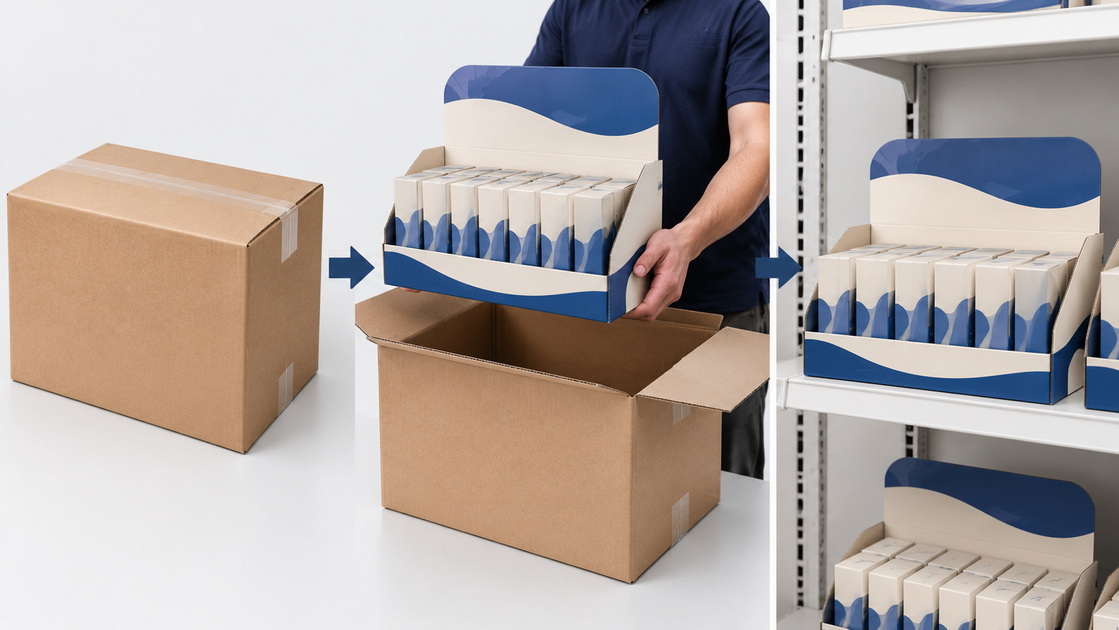
A PDQ display is a retail-ready merchandising tray or compact display designed to move products onto a shelf, counter, or other approved retail location with minimal handling. PDQ commonly stands for "Pretty Darn Quick," reflecting the format's main purpose: making products quick to deploy and easy to shop.
Typically made from corrugated board or paperboard, a PDQ display can combine product organization, branded presentation, and convenient replenishment. Some arrive filled with merchandise; others require assembly or loading.
For procurement teams, the defining benefit is readiness. A successful design works across packing, distribution, store installation, shopping, and replenishment—not just in a presentation rendering.
This guide explains how PDQ packaging works, where it differs from other display formats, and what buyers should verify before ordering custom production.

"Pretty Darn Quick" is the common industry expansion. Suppliers sometimes use alternative wording, but the practical meaning remains rapid retail deployment.
A typical PDQ display holds several saleable units in a structured tray. Depending on the design, store employees may remove a protective cover, open a shipping case, or place a preloaded tray directly into position.
PDQ is not a separate technical acronym meaning a particular CAD blueprint or engineering method.
A useful PDQ should be:
- Easy for staff to identify.
- Straightforward to open and position.
- Accessible for shoppers.
- Practical to replenish.
- Convenient to remove after use.
The number of assembly steps matters more than the label. A product described as "PDQ" can still create unnecessary labor if its structure is complicated.
These terms overlap, but describe different aspects of retail merchandising.
| Term | What it describes | Typical examples |
|---|---|---|
| PDQ display | A merchandising format emphasizing quick deployment | Preloaded trays, countertop units, shelf displays |
| POP display | The broader point-of-purchase display category | Counter units, sidekicks, endcaps, floor stands |
| Shelf-ready packaging | Packaging designed for efficient shelf placement | Trays with removable covers, tear-away cases |
| Retail-ready packaging | Packaging supporting store handling and merchandising | Shelf-ready packs and other approved retail formats |
A PDQ can be a type of POP display. POP does not refer exclusively to large floor merchandisers.
Likewise, a PDQ and shelf-ready package may be the same physical unit. Buyers should describe the required structure and handling process instead of relying on terminology alone.
These sit within regular shelving and organize products into clear facings.
They suit boxed personal care products, food packs, and other merchandise that benefits from an orderly presentation. Shelf depth, vertical clearance, and product-removal space must be checked together.
Counter units present small products in an approved counter location.
Their footprints must respect the available working area. Visibility is important, but a display should not obstruct transactions, equipment, or customer circulation.
A protective panel or cover is removed to reveal a merchandising tray.
The opening feature must separate predictably without tearing the visible graphics or disturbing the products. Opening instructions should be understandable without lengthy training.
Individual trays may form part of an endcap, floor display, or pallet presentation.
Each tray must work on its own and within the larger structure. Fit, replenishment access, and load support should be assessed at both levels.
A custom PDQ display is worth considering when it solves a specific operational or merchandising problem.
| Business requirement | Potential PDQ benefit | What to verify |
|---|---|---|
| Frequent shelf replenishment | Products move as a tray rather than individually | Actual handling time |
| Small or unstable packs | Dividers help maintain organization | Performance as stock depletes |
| Product launches | A defined presentation groups the assortment | Approved placement and messaging |
| Seasonal promotions | Graphics support a time-limited occasion | Delivery and removal dates |
| Multiple product variants | Clearly defined positions reduce confusion | Correct loading and replenishment |
These are potential advantages, not guaranteed sales outcomes. A display cannot compensate for unavailable stock, an unsuitable price, or placement that the retailer has not approved.
"Strong cardboard" is not a sufficient production specification.
Record the board construction, flute profile where applicable, liner requirements, finished dimensions, reinforcement, printing method, and surface treatment.
Edge Crush Test, or ECT, measures resistance to edgewise compression. It can inform material selection, but an ECT rating alone does not establish the finished tray's load capacity or distribution performance.
A high front wall can support merchandise while hiding important product information. A low wall can improve visibility but provide insufficient retention.
Dividers may keep packs upright, yet reduce usable space or slow loading if poorly designed.
The correct arrangement depends on product dimensions, weight, friction, stability, and customer handling.
Humidity and temperature can affect corrugated board's mechanical behavior.
However, that does not justify adding a universal one-millimeter clearance to every locking feature. Excess clearance may weaken a connection or introduce movement.
Structural tolerances should reflect the selected material, converting process, assembly method, and expected environment, then be verified through samples.
A dieline defines the cut and crease geometry used to manufacture the display.
It should account for board thickness, fold behavior, assembly sequence, and the intended equipment. Artwork should be applied to the approved structural version—not used to establish engineering dimensions.
Keep critical text, barcodes, and product claims away from vulnerable folds and removable sections.
Check whether a protective hood hides the identification needed by warehouse staff. Also ensure that opening the unit does not remove essential shopper-facing information.
A nominal product dimension may not capture flexible bags, projecting caps, hang tabs, or variations in packed shape.
Use actual products when possible. Review clearance, stability, removal, and replenishment—not merely whether the units fit inside.
These services are different.
A preassembled display has been erected before delivery. A preloaded display also contains merchandise.
| Supply format | Main advantage | Main trade-off |
|---|---|---|
| Flat packed | Compact transport and storage | Assembly and loading at destination |
| Preassembled, empty | Reduced structural setup | More shipping volume; loading remains |
| Preloaded | Fewer store-level handling steps | More complex packing and transit validation |
Long Win Display supports custom packaging and display development, production, and preassembly. Merchandise-loading requirements should be confirmed separately, including product supply, counting, inspection, and traceability responsibilities.
The most convenient store format is not automatically the lowest-cost supply-chain format.
A hand-built sample can conceal problems that appear during repeat manufacturing.
For example, an operator may manually reinforce corners, adjust slots, or use adhesive differently from the planned production process.
Before approval, ask whether the sample uses production-intended materials and assembly methods.
Record:
1. Drawing and artwork revisions.
2. Material construction.
3. Adhesive and reinforcement locations.
4. Assembly sequence.
5. Product loading arrangement.
6. Shipping configuration.
Require authorization for substitutions. Retain an approved reference sample and compare it with first-off production.
This provides more protection than approving appearance alone.

If the PDQ travels inside a master carton, test that arrangement. If it forms part of a pallet load, evaluate the relevant load configuration.
A successful test of an empty tray does not prove a preloaded unit will survive distribution.
ISTA guidance emphasizes understanding how products are shipped, stored, and handled before choosing a test procedure.
Parcel delivery, palletized distribution, and distribution-center-to-store movements present different conditions. There is no single universal test for every PDQ program.
Agree on damage criteria for both merchandise and display appearance.
After transport evaluation, check:
- Opening and installation.
- Product stability during depletion.
- Replenishment.
- Graphic condition.
- Removal and disposal.
Use staff unfamiliar with the design where practical. Their difficulties can reveal instructions or assembly steps that the design team has overlooked.
A practical cost model includes display production, tooling, freight, storage, assembly, loading, damage, and store handling.
Consider this hypothetical example:
A preloaded format saves 45 seconds of store handling per tray. Across 10,000 trays, that releases 125 labor hours.
At an illustrative loaded labor cost of $20 per hour, the theoretical labor value is $2,500.
That is not automatically a cash saving. The value depends on whether the released time reduces paid hours, avoids overtime, or supports other work.
If preloading and freight add more than the realized benefit, the project needs another justification. Compare the complete workflow rather than selecting the lowest display price.
Confirm placement, dimensions, labeling, case configuration, and replenishment expectations with the retailer.
Do not assume every floor presentation uses a particular pallet footprint, or that one accessibility measurement universally defines a countertop display.
Applicable requirements depend on the location, activity, jurisdiction, and retailer program.
Paper-based construction does not mean every finished display is recyclable everywhere.
Coatings, adhesives, plastic components, and other non-fiber elements may affect processing. Specify removable accessories where practical and check destination collection arrangements.
Use environmental claims supported by the actual material configuration, not generic statements about cardboard.
The source article raises useful issues around assembly, tolerances, humidity, and deployment.
This reconstruction corrects the PDQ–POP distinction and avoids treating a fixed clearance, pallet footprint, or setup time as universally applicable.
It also excludes unverified performance percentages and personal anecdotes. No separate customer reviews were provided, so no testimonials or customer outcomes have been invented.
Long Win Display designs, customizes, produces, and preassembles paper-based packaging and retail display solutions.
PDQ commonly stands for "Pretty Darn Quick." In retail packaging, it describes a format designed for rapid deployment and convenient merchandising.
Not exactly. POP is the broader category. A PDQ display can be one type of point-of-purchase display.
No. Preloaded formats are common, but some units arrive empty or flat packed. Confirm assembly and loading responsibilities.
Sometimes, with an appropriate protective cover or outer structure. The complete package must be validated for its distribution route.
Evaluate the actual structure with representative products, loading patterns, environmental conditions, and duration. Board thickness or ECT alone is insufficient.
1. PopDisplay. "What Is a PDQ Display?" Updated May 22, 2026. Original article reviewed for terminology, assembly, structural tolerances, and humidity-related claims. Unsupported percentages and anecdotes are not adopted as verified evidence. [popdisplay]
2. Smurfit Westrock. "PDQ Displays (Pretty Darn Quick)." Manufacturer explanation of retail-ready trays, shelf accessibility, prepacked formats, and rapid deployment. [smurfitwestrock]
3. President Container Group. "PDQ Display (Pretty Darn Quick): Pre-Packed Retail Merchandising." September 16, 2026. Explains preloaded trays, POP applications, and the connection with retail-ready packaging. [presidentcontainergroup]
4. Landaal Packaging Systems. "PDQ Displays for Retail." Describes tear-away cartons, countertop units, shelf trays, and placement within larger displays. [landaal]
5. Cornaggia, A., Gajewski, T., Knitter-Piątkowska, A., and Garbowski, T. "Influence of Humidity and Temperature on Mechanical Properties of Corrugated Board—Numerical Investigation." BioResources, 18(4), 7490–7509, 2023. Research supporting environment-dependent material behavior, not a universal clearance allowance. [bioresources.cnr.ncsu]
6. International Safe Transit Association. "Getting Started with Design & Testing." Official guidance on distribution-route assessment, test objectives, and procedure selection. [ista]
7. International Safe Transit Association. "Test Procedures." Explains the distinction between screening and distribution-simulation procedures. [ista]
8. American Forest & Paper Association. "Design Guidance for Recyclability." Guidance on non-fiber components and paper-packaging recycling. [afandpa]
9. Long Win Display. "Our Company," together with company information supplied for this article. Background on custom packaging, display development, production, and preassembly. [longwindisplay]


