
Views: 237 Author: Long Win Display Publish Time: 2026-09-26 Origin: Site


Content Menu
● Why Pallet Displays Matter in Retail
● Pallet Display, PDQ Pallet, and Display Ready Pallet
● Full, Half, and Quarter Pallet Displays
● Key Parts of a Successful Pallet Display
>> Pallet Base and Load Support
>> Corrugated Trays and Product Dividers
>> Protective Shroud or Outer Ship Case
>> Retail Graphics and Brand Color Control
>> Product Access and Shopper Safety
● A Pallet Display Must Work in Three Environments
>> 1. Manufacturing and Pre-Assembly
>> 2. Transportation and Distribution
● The Hidden Cost of Store Level Assembly
● Design for the Mid Sell Through Stage
● Treat Retailer Data as Part of the Display
● How to Design a Pallet Display Step by Step
>> 1. Start With Retailer Requirements
>> 2. Define the Commercial Goal
>> 3. Match Structure to Product Weight
>> 4. Create Retail First Graphics
>> 6. Pre-Assemble and Inspect Before Shipment
● Common Pallet Display Mistakes and How to Avoid Them
● FAQ
>> 1. What is the difference between a pallet display and a floor display?
>> 2. What is a PDQ pallet display?
>> 3. How do I choose between a full pallet, half pallet, and quarter pallet display?
>> 4. What materials are used for pallet displays?
>> 5. Can a pallet display ship fully assembled?
A pallet display is a freestanding retail merchandising unit built on a shipping pallet and designed to move products from distribution to the sales floor with minimal store handling. For retailers and consumer brands, it combines transport protection, product presentation, inventory organization, and high-visibility promotion in one display-ready format.
A well-engineered pallet display does more than hold cartons. It helps a product arrive safely, enter the store quickly, use floor space efficiently, and attract shoppers in high-traffic locations. For brands selling beverages, snacks, health and beauty products, household goods, toys, electronics accessories, seasonal items, or promotional bundles, the pallet display can be a powerful retail execution tool.
Long Win Display designs, customizes, manufactures, packs, and pre-assembles pallet display stands for brands entering supermarkets, club stores, discount chains, specialty retailers, and other retail channels. From a manufacturing perspective, the central question is not simply, "What does the display look like?" It is: Will the display survive the supply chain, meet retailer requirements, and still look compelling when shoppers see it?

A pallet display is a retail point-of-purchase structure built around a palletized shipping base. It is commonly made from corrugated cardboard, though brands may also use metal, wood, plastic, acrylic, or mixed materials depending on product weight, campaign duration, and retail environment.
The display is normally loaded with products before shipment. When it reaches the store, staff can place it directly in a designated selling area rather than unpacking every product and stocking individual shelves.
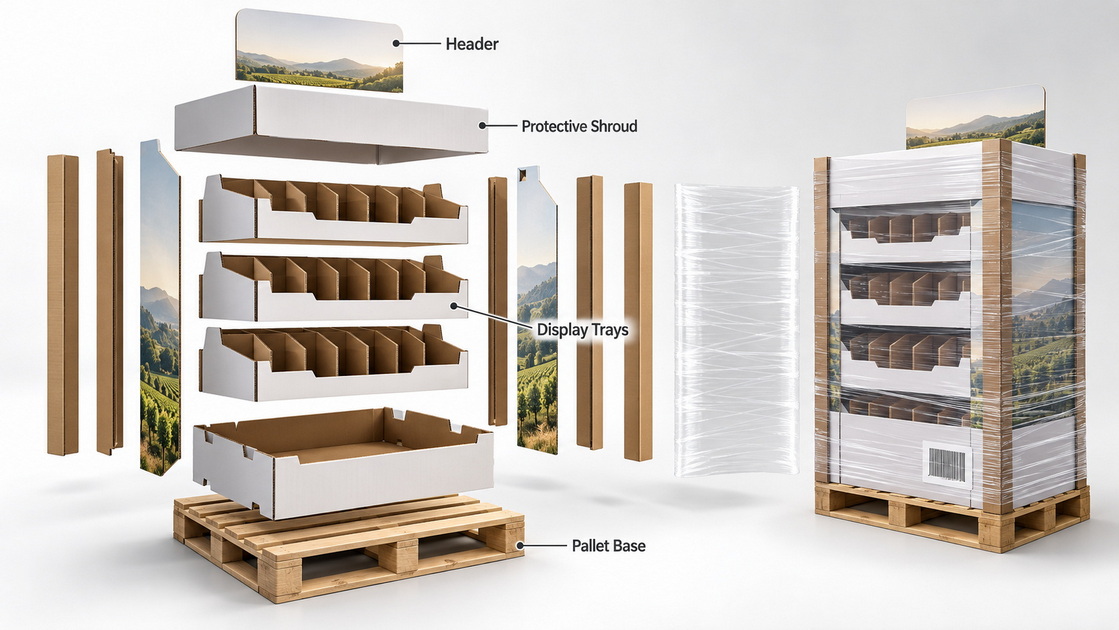
A pallet display typically includes:
- A pallet base for handling by forklift or pallet jack.
- Corrugated trays, shelves, bins, or dividers to hold products securely.
- Printed graphics that communicate brand, product benefit, price message, or campaign theme.
- A protective outer shipper or shroud for warehousing and transportation.
- A removable top, tear-away panel, or perforated wrap that exposes the retail display.
- Optional headers, side wings, price-ticket holders, and promotional panels.
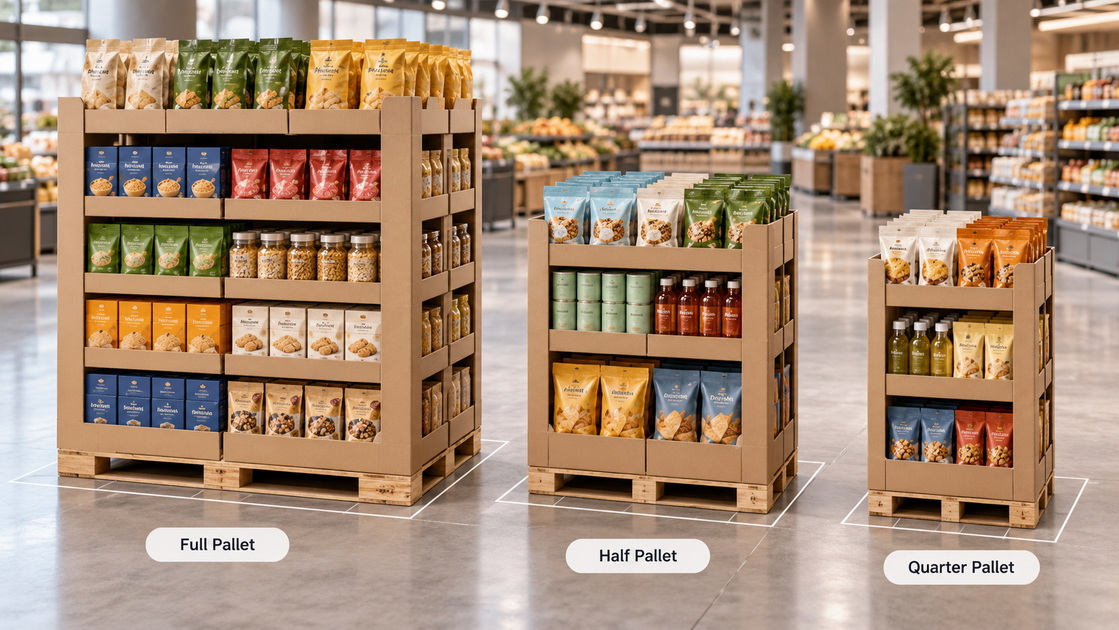
The display may be a full pallet, half pallet, quarter pallet, or custom footprint. The optimal choice depends on retailer rules, product size, store layout, replenishment needs, and campaign objectives.
GS1 defines a pallet as a shipping unit containing cases, inner packs, or individual products, while a display shipper is a self-contained display shipping unit that can contain one or more product types.
Retail floor space is limited. Store labor is also limited. A display that takes too long to build, requires separate tools, or arrives with damaged graphics may never reach the selling floor on time.
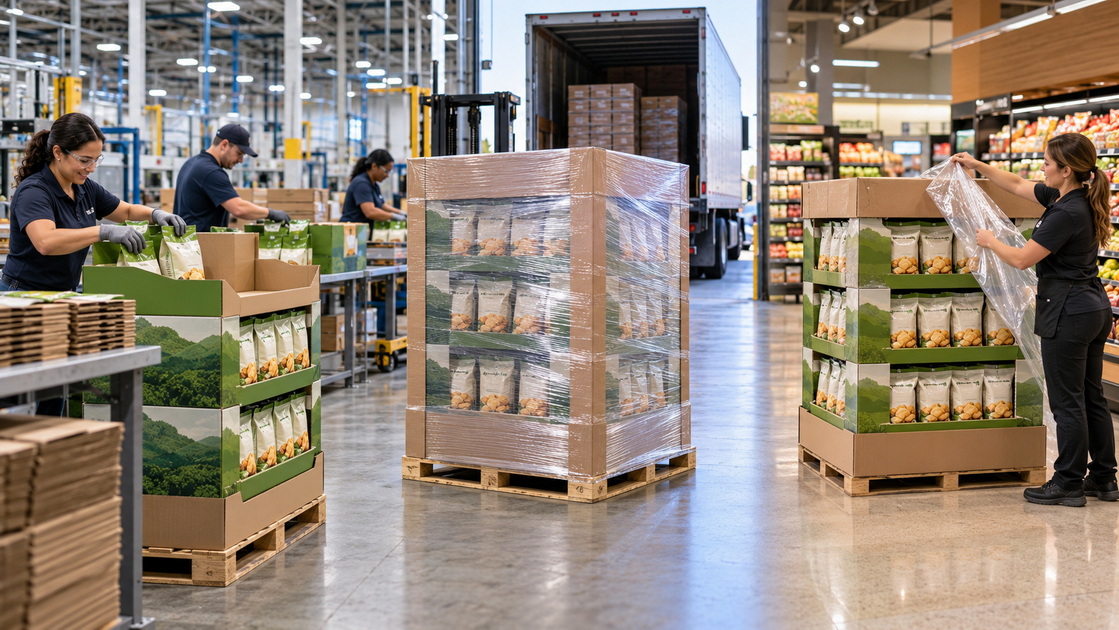
A display-ready pallet reduces this friction. It arrives pre-loaded and pre-assembled, allowing store teams to remove protective material and position the display quickly.
The commercial advantages are clear:
- Faster retail execution. Store staff do not need to build complex display components.
- Improved product visibility. Floor displays create additional exposure beyond standard shelf placement.
- Better promotional impact. A large printed display can support seasonal campaigns, new launches, bundles, and price promotions.
- Simplified replenishment. Products remain organized in trays, bins, or shelves.
- Less shelf-stocking labor. The display can sell products directly from its shipping configuration.
- Higher perceived brand presence. A clean, stable, well-printed unit can make a product look more established and retail-ready.
Retail-ready packaging is also commonly described as shelf-ready, ready-to-sell, or ready-to-merchandise packaging. GS1 notes that this type of secondary packaging can be placed directly onto a shelf without unpacking its internal contents; the same principle supports efficient pallet-display execution.
These terms overlap, but they are not always identical.
| Term | Meaning | Typical Retail Use |
|---|---|---|
| Pallet Display | A retail display built on a pallet base | Floor promotions, bulk merchandising, seasonal campaigns |
| PDQ Pallet | A pre-loaded display intended for quick deployment | Fast retail setup and promotional rollouts |
| Display Ready Pallet | A palletized shipping unit that converts into a display | Distribution-to-floor execution with removable outer protection |
| Retail Ready Packaging | Secondary packaging designed for easy store placement | Shelf trays, counter displays, display shippers, pallet units |
| Floor Display | A broad term for freestanding retail display structures | May or may not use a pallet base |
| Pallet Merchandise | Products merchandised and sold directly from a palletized structure | Bulk products, value packs, warehouse clubs, seasonal goods |
In practice, buyers often use these terms interchangeably. The important point is that the display should be designed as a single retail system, not as a shipping pallet plus an unrelated marketing display.
Display footprint affects retailer acceptance, freight efficiency, merchandise quantity, and shopper access. A larger display is not automatically better.
In North American retail logistics, the 48 × 40 inch GMA pallet is widely used as a standard base dimension. However, each retailer, distribution center, and market may have specific dimensional, height, weight, and handling requirements. Always obtain the retailer's current display specification before final structural design.
| Display Type | Typical Footprint | Best Use | Key Consideration |
|---|---|---|---|
| Full Pallet Display | Approx. 48 × 40 inches | High-volume promotions, warehouse retail, bulk products | Highest product capacity but requires substantial floor space |
| Half Pallet Display | Approx. half of a standard pallet footprint | Store aisles, promotional zones, medium-volume campaigns | Balances capacity with easier store placement |
| Quarter Pallet Display | Approx. one-quarter of a standard pallet footprint | New launches, impulse categories, compact formats | Useful where retailers limit promotional footprints |
| Custom Pallet Display | Retailer-specific dimensions | Special store formats, regional programs, unusual products | Requires early approval and accurate transit testing |
A new product launch often benefits from a smaller footprint. A quarter-pallet or half-pallet display can be easier for retail buyers to approve because it requires less floor space and can be placed in more locations.
The best footprint is the one that makes it onto the retail floor and remains there.
The base carries the entire unit through warehousing, loading, unloading, distribution, and in-store placement. It must be compatible with forklifts, pallet jacks, warehouse racking practices, and retailer handling rules.
The base may be wood, plastic, corrugated engineered board, or another approved structure. The right material depends on the shipment route, total load weight, climate exposure, retail program, and sustainability goals.
Trays organize products and prevent shifting. Dividers create stable rows and help maintain a clean appearance during transport and customer interaction.
For example, a small snack bag display may need shallow trays with easy front access. A bottled product may need stronger dividers and a lower center of gravity. A boxed electronic accessory may need structured shelves to prevent tipping.
The outer shipper protects the display during transportation. In the store, it may be removed completely or torn away along perforated lines.
A well-designed shroud should:
- Protect graphics from scuffing and compression.
- Resist dust, moisture, and handling damage where required.
- Open cleanly without tools.
- Avoid leaving torn paper or unattractive edges.
- Reveal a display that is ready for shoppers immediately.
Graphics create the shopper-facing message. They should work at three viewing distances:
- Long distance: The brand and product category should be recognizable.
- Medium distance: The display should communicate the promotion or product benefit.
- Close distance: Shoppers should be able to read product details, pricing cues, and calls to purchase.
Brands should not approve color only from a computer screen. Corrugated linerboard absorbs ink differently from coated paper, which can change the appearance of solid colors and fine details. For logos requiring a precise brand color, Pantone spot-color specifications, physical proofs, and controlled lighting evaluation are often more reliable than relying solely on screen previews.
The display must make products easy to take without causing items to fall forward, catch on packaging, or collapse as inventory decreases.
A practical design review should assess:
- Product reach range for shoppers.
- Front lip height and product retention.
- Sharp edges, loose parts, and exposed staples.
- Stability at different inventory levels.
- Accessibility for customers using mobility devices.
- Whether a child can pull products or display components unexpectedly.
One of the biggest planning mistakes is treating a pallet display as a store-only object. In reality, it must perform in three demanding environments.
The display must be efficient to produce, print, glue, pack, and load. Complex designs can look impressive in a render but create bottlenecks during assembly.
At Long Win Display, early engineering should consider:
- Number of components.
- Glue locations and curing needs.
- Manual versus automated assembly steps.
- Product-loading method.
- Barcode and label placement.
- Final quality-control checkpoints.
- Master-carton or shroud installation.
The display must withstand stacking, vibration, compression, directional changes, and repeated handling. Weak corners, unsupported headers, overloaded shelves, or poor stretch wrapping can lead to damage before the display reaches a store.
A retailer does not see the engineering effort behind a pallet display. It sees the final result. If the display arrives crushed, leaning, dirty, or difficult to open, the campaign has already lost value.
The final display must remain visually strong after shoppers remove products. It should not look empty, disorganized, or unstable halfway through the promotion.
Designers should ask:
- What will the unit look like at 100%, 50%, and 20% inventory?
- Will empty trays expose unattractive corrugated interiors?
- Does the display remain stable when one side sells faster?
- Can retail staff replenish it quickly?
- Can a shopper understand the product within a few seconds?
A pallet display may appear less expensive when shipped flat, but the initial material saving can create a major retail-execution risk.
When store staff must unpack, sort, fold, lock, tape, fill, and position a display, the brand depends on store-level labor availability and compliance. In busy retail environments, a complex display kit may stay in a stockroom because it takes too long to assemble.
A pre-assembled or partially pre-assembled display-ready pallet shifts critical work upstream to the manufacturing stage, where procedures are more controlled.
This approach can help brands achieve:
- More consistent presentation.
- Fewer missing parts.
- Faster store placement.
- Reduced interpretation by store staff.
- Cleaner graphics and structural appearance.
- More predictable launch timing.
PMMI's 2025 packaging-industry reporting identifies workforce constraints, automation, and operator-free systems as major themes shaping packaging and line-design decisions. That wider industry context reinforces an important retail-display lesson: design should reduce avoidable handling steps.
Many pallet displays look attractive when full and disappointing when half empty. This is a major but often overlooked point.
A professional display should be reviewed in at least three inventory conditions:
| Inventory Stage | Common Problem | Design Solution |
|---|---|---|
| Full Display | Products may be too tightly packed or difficult to remove | Test product pickability and tray access |
| Half Sold | Empty spaces make the display look neglected | Use stepped trays, angled product presentation, or controlled facings |
| Nearly Sold Out | Display may become unstable or visually weak | Add structural retention and preserve key graphics above the product zone |
For fast-selling products, consider stepped tiers, false bottoms, shorter tray depths, or engineered dividers that keep remaining units front-faced. The goal is not to hide low inventory. The goal is to keep the display orderly and stable until the campaign ends.
Retail execution depends on more than structure and graphics. It also depends on accurate product information.
GS1 standards provide a consistent method for measuring package dimensions and determining a product's default front. The standard also describes display-ready units and provides rules for products with tear-away tops.
Before mass production, buyers should confirm:
- Correct GTIN or UPC assignment.
- Accurate product, case, and display dimensions.
- Net and gross weights.
- Case-pack configuration.
- Retailer-compliant pallet labeling.
- Barcode orientation and scan position.
- Display photos for planograms or internal retail systems.
- Final shipper and pallet configuration.
GS1's image standards include specific recognition for pallet or display image states and encourage images that clearly reflect how products appear in real sales situations.
This matters because incorrect dimensions, weak labels, or inconsistent product data can delay listing, warehouse receiving, replenishment, and retail placement.
Ask for the retailer's latest guidelines before beginning structural design.
Confirm:
- Maximum footprint, height, and total weight.
- Approved pallet type and entry direction.
- Case-pack and layer configuration.
- Barcode, label, and orientation requirements.
- Fire-code or material requirements.
- Sustainability or recycled-content expectations.
- Rules for headers, signage, price communication, and promotional messaging.
- Delivery date and distribution-center requirements.
A display for a new product launch differs from a display for seasonal clearance.
Identify whether the display is intended to:
- Drive trial of a new product.
- Increase multi-pack or bulk purchases.
- Support a holiday or seasonal campaign.
- Improve brand visibility in an aisle.
- Move slow inventory.
- Introduce a premium product range.
- Support retailer-specific promotional pricing.
Do not choose the structure based on appearance alone.
A pallet display for lightweight snack packs needs different support from a unit carrying glass bottles, metal cans, personal-care products, or boxed appliances. The engineer should calculate product load, stack height, compression exposure, and center of gravity before finalizing board grade, tray shape, and reinforcement.
Design the graphic hierarchy for shoppers, not only for brand presentations.
Use:
- High-contrast product imagery.
- Clear brand recognition.
- A concise primary product benefit.
- Retailer-approved pricing or promotion space.
- Limited copy.
- Strong product-facing direction.
- Colors that reproduce effectively on corrugated substrates.
A digital rendering cannot prove pallet-display performance.
Review a physical prototype for:
- Product fit.
- Tray loading.
- Display stability.
- Tear-away opening experience.
- Header strength.
- Forklift or pallet-jack access.
- Stretch-wrap compatibility.
- Carton compression.
- Shopper product removal.
- Appearance after partial sell-through.
Pre-assembly must be controlled. The factory should inspect:
- Print quality and correct artwork.
- Glue strength and tray alignment.
- Product quantity by tray and layer.
- Correct SKU placement.
- Barcode visibility.
- Shroud installation.
- Pallet stability.
- Stretch-wrap quality.
- Corner protection.
- Shipping labels and destination marks.
| Common Mistake | Why It Creates Problems | Better Approach |
|---|---|---|
| Designing only for a full display | The unit looks poor after products sell | Review full, half-full, and near-empty conditions |
| Using weak corrugated board | Trays can crush or bow during transit | Match board grade and reinforcement to load calculations |
| Requiring store assembly | Units may remain in the stockroom | Use pre-assembled trays and display-ready conversion |
| Ignoring retailer size limits | The display may be rejected or relocated | Confirm retailer specifications before dieline approval |
| Overloading graphics with text | Shoppers cannot understand the offer quickly | Use a clear visual hierarchy and concise messaging |
| Treating shipping and display as separate systems | Damage occurs during conversion or transport | Engineer outer shroud, inner trays, and pallet as one system |
| Forgetting barcodes and data | Receiving or replenishment can be delayed | Validate labels, GTINs, case packs, and dimensions before shipment |
| Approving only digital colors | Printed colors may look dull or inconsistent | Review physical proofs and spot-color requirements |
A pallet display is not just a large cardboard structure on a wooden base. It is a retail execution system that must protect products, simplify logistics, meet retailer specifications, support product data accuracy, and persuade shoppers in seconds.
The most effective pallet displays are designed for the complete journey: factory production, product loading, distribution, store deployment, shopper access, replenishment, and partial sell-through. They reduce store labor, improve campaign consistency, and give brands a visible presence where purchase decisions happen.
Long Win Display helps brands develop custom pallet display stands that are engineered for transport strength, retail readiness, product accessibility, and high-impact presentation. If you are preparing a supermarket launch, retail promotion, warehouse-club campaign, or seasonal display program, share your product dimensions, quantity per display, target retailer, required footprint, packaging needs, and delivery timeline. A practical structural review before production can prevent expensive retail-floor problems later.
A pallet display is built on a palletized base and is usually designed to ship with products pre-loaded. A floor display is a broader category that includes any freestanding display placed on the retail floor. Some floor displays use a pallet base, while others are shipped flat or assembled in store.
A PDQ pallet display is a pre-loaded and display-ready retail unit designed for rapid store deployment. Retail staff typically remove a protective outer shroud or tear-away cover, then place the ready-to-sell display in the assigned retail location.
Choose based on retailer requirements, available floor space, product volume, weight, campaign duration, and desired store placement. Full pallets suit high-volume promotions. Half pallets provide a balance of capacity and flexibility. Quarter pallets are useful for compact launches, impulse zones, and retailers that limit promotional footprints.
Corrugated cardboard is widely used because it is printable, lightweight, recyclable, and adaptable. Depending on product weight and display duration, the design may also include wood, plastic, metal, acrylic, foam, or engineered corrugated reinforcement.
Yes. Many retail-ready pallet displays are pre-assembled and product-loaded at the factory. They are protected with an outer shroud, stretch wrap, corner guards, or other transit materials. At the store, staff remove the protective layer and place the display directly on the floor.
1. PopDisplay, [What Is a Pallet Display?]
2. GS1 US, [Packaging Levels in Data Hub]
3. GS1, [Package and Product Measurement Standard]
4. GS1, [Product Image Specification Standard]
5. GS1 US, [Foodservice and Retail Grocery Standards]
6. PMMI, [State of the Industry 2025]
7. Fibre Box Association, [Corrugated Packaging Industry Resources]


