
Views: 282 Author: Long Win Display Publish Time: 2026-09-08 Origin: Site


Content Menu
● What Is a Display Shipper in Retail?
● Why Brands Use Display Shippers
● Display Shipper vs Standard Shipping Carton
● The Anatomy of a Retail Display Shipper
>> Perforation and Opening System
>> Header and Brand Communication Area
● Choosing the Right Corrugated Material
>> ECT and Compression Strength
● Three High-Cost Display Shipper Failures
>> Failure 1: The Display Arrives Collapsed
>> Failure 2: The Perforation Opens Too Early or Too Poorly
>> Failure 3: Humidity Causes Tab and Slot Problems
● Display Shipper Design Process for Brands
>> 1. Define the Retail Objective
>> 2. Confirm Retailer Requirements
>> 3. Calculate Product Load and Distribution Conditions
>> 4. Build and Test a Structural Prototype
>> 5. Conduct Transit and Retail-Readiness Testing
>> 6. Approve a Pre-Production Sample
● Design for the Person Opening It
● How Long Win Display Supports Display Shipper Projects
>> 1. What is the difference between a display shipper and shelf-ready packaging?
>> 2. What corrugated board is best for a display shipper?
>> 3. Can a display shipper be shipped fully assembled and loaded with products?
>> 4. How do I test whether a cardboard display shipper can survive shipping?
>> 5. Why do cardboard display tabs become difficult to assemble after ocean shipping?
A display shipper is a corrugated packaging unit designed to protect products during distribution and then convert quickly into a retail display at the store. For brands, it combines transport packaging, merchandising structure, and product presentation into one retail-ready solution.
At Long Win Display, we design, customize, manufacture, and pre-assemble cardboard display stands and retail display shippers for brand campaigns. In practice, a successful display shipper is not simply a printed carton. It must survive stacking, vibration, humidity, handling, and retail distribution-center processes—then arrive ready for fast placement on the sales floor.
This article explains what a display shipper is, how it differs from standard retail packaging, how to select the right structure and material, and how brands can avoid expensive failures during shipping and store setup.

A display shipper, also called a retail-ready display, shipper display, shelf-ready packaging display, or corrugated POP display, is a pre-packed merchandising unit that performs two jobs:
1. It protects merchandise during transportation and warehousing.
2. It becomes an in-store product display with minimal unpacking or assembly.
The display may arrive at a retailer's distribution center as a complete unit. Store associates can remove a protective outer carton, open a perforated front panel, place the shipper in the planned location, and begin merchandising immediately.
Depending on the campaign, a display shipper can be designed as:
- A countertop display shipper.
- A floor-standing display shipper.
- A half-pallet display.
- A quarter-pallet retail display.
- A dump bin shipper.
- A shelf-ready tray display.
- A sidekick or power-wing display.
- A club-store-ready bulk merchandising display.
The primary commercial advantage is reduced retail-floor labor. Instead of asking store staff to unpack individual cartons, assemble a separate display, place products manually, remove waste packaging, and arrange merchandise, the shipper performs most of these functions before it reaches the store.
A display shipper can support both supply-chain efficiency and in-store visibility. It is especially useful for promotional items, seasonal products, new product launches, bundled offers, and impulse-purchase categories.
The practical benefits include:
- Faster store setup because products arrive pre-packed and organized.
- Lower replenishment labor compared with individual shelf stocking.
- Better visual consistency across multiple retail locations.
- Improved brand visibility outside the normal shelf position.
- Reduced handling of individual products during store setup.
- More controlled product arrangement at the moment of launch.
- Simpler campaign execution for regional, national, or international retail programs.
In-store merchandising remains important because buying decisions frequently occur after shoppers enter a retail environment. A POPAI Mass Merchant Shopper Engagement Study reported that 82% of shopping decisions were made in-store, while unplanned purchases represented 62% of decisions in that research sample. The research is older, but it remains a useful indicator of why physical displays continue to matter for retail activation.
A display shipper cannot guarantee sales on its own. Product value, price, placement, retailer support, shopper traffic, and campaign timing still matter. But a well-designed unit gives a product a stronger opportunity to be noticed and purchased.
A standard shipping carton is mainly engineered for protection. A display shipper must protect products and perform as a consumer-facing retail fixture.
| Feature | Standard Shipping Carton | Display Shipper |
|---|---|---|
| Primary purpose | Protect products in transit | Protect products and present them in-store |
| Retail appearance | Usually plain or minimally printed | Branded graphics, product messaging, and display-ready layout |
| Store setup | Products are unpacked and stocked manually | Usually opened, positioned, and displayed quickly |
| Structural design | Optimized mainly for transit | Balanced for transit, assembly, stability, and merchandising |
| Product organization | Products may be packed for shipment efficiency | Products are arranged for visibility and shopper access |
| Retail placement | Backroom or distribution use | Shelf, floor, endcap, counter, sidekick, or pallet placement |
| Brand impact | Limited | High potential for shopper attention and campaign consistency |
The key design challenge is balancing structural strength with retail usability. A heavy-duty shipping carton may protect products very well but be difficult for store staff to open. A visually attractive display may look excellent in a showroom but fail after pallet stacking or humid ocean transport.
For this reason, display shipper design should begin with the full distribution journey—not only the retail graphic concept.
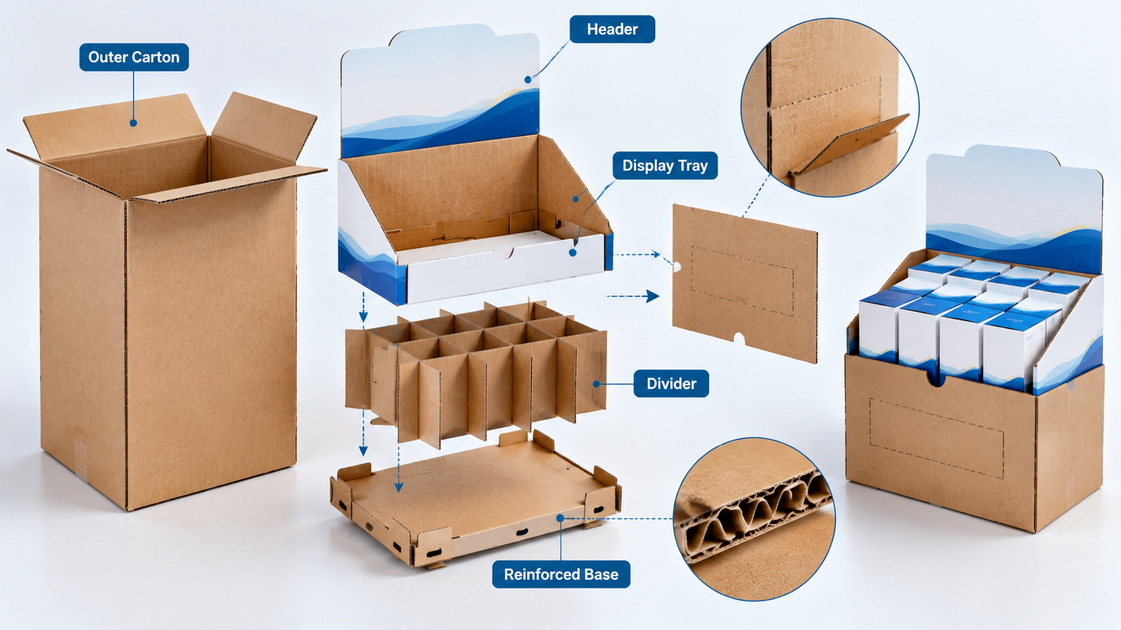
A display shipper normally contains several design elements working together.
The outer carton protects the display and product pack during transport. It may be a full cover, sleeve, top cap, wrap-around carton, or removable shipper case.
This outer layer should be designed around:
- Product weight.
- Stacking height.
- Pallet configuration.
- Warehouse handling.
- Distribution-center requirements.
- Transportation mode.
- Temperature and humidity exposure.
- Expected retail setup method.
The inner display is the retail-facing unit. It can include shelves, trays, dividers, product retainers, header cards, side panels, and reinforced base sections.
The structure should prevent product movement while still making items easy for shoppers to see and remove.
Many display shippers use perforated tear-away sections. Store staff remove a front panel, top panel, or protective sleeve to reveal the display.
The opening process must be simple and intuitive. If perforations are too weak, they can tear during transport. If they are too strong, store staff may use knives or excessive force, damaging printed graphics or the display structure.
The header is often the most visible part of a display shipper. It can communicate:
- Product category.
- Campaign message.
- Product benefits.
- Promotional offer.
- Flavor, color, or variant.
- Seasonal theme.
- Brand identity.
The header should be readable from the intended shopper distance. Avoid placing critical text too low, too small, or behind products.
The base carries the combined weight of the merchandise and display structure. It is one of the most overlooked parts of a cardboard display shipper.
A visually strong header cannot compensate for a weak base. If the lower structure crushes, bows, absorbs moisture, or loses its shape, the entire display can become unstable.
Corrugated packaging combines rigidity with cushioning properties, which is why it is commonly used to protect products during distribution. The Fibre Box Association also notes that corrugated material is derived from renewable resources and that roughly 90% is recovered and recycled into new paper products in the United States.
The board grade should be selected based on product weight, display size, transport route, stacking demand, desired print finish, and retailer handling requirements.
Common flute types include:
| Flute Type | Typical Use in Display Shippers | Main Benefit |
|---|---|---|
| E-Flute | Countertop displays, lightweight products, high-quality printing | Thin profile and good print surface |
| B-Flute | Retail trays, compact shippers, shelf-ready packaging | Good puncture resistance and practical strength |
| C-Flute | Medium-duty shipping and retail displays | Good cushioning and stacking performance |
| BC Double Wall | Heavy floor displays, bulk packs, larger products | Higher compression strength and improved rigidity |
| EB Double Wall | Premium printed displays requiring more strength | Combines print quality with structural support |
The correct flute is not selected only by display size. A small display carrying glass bottles can need more structural strength than a larger display carrying lightweight snack packs.
The Edge Crush Test, commonly called ECT, is used to indicate the edgewise compression strength of corrugated board. Higher ECT values generally indicate stronger resistance to edge crushing, which matters for pallet stacking and warehouse handling.
However, ECT alone does not guarantee display performance. Final performance also depends on:
- Box dimensions.
- Corrugated flute direction.
- Board moisture content.
- Die-cut pattern.
- Perforation design.
- Product weight distribution.
- Base reinforcement.
- Pallet stacking pattern.
- Outer-carton design.
- Actual distribution conditions.
A common mistake is choosing a higher ECT board but ignoring flute direction. For vertical stacking strength, corrugated flutes should normally run vertically along the walls that carry compression load. Incorrect flute orientation can reduce real-world performance even when the board grade appears adequate on paper.
A display shipper may collapse because the base is under-engineered, the outer carton does not provide enough protection, product weight is concentrated in one area, or the pallet load exceeds the structure's compression capacity.
Typical warning signs include:
- Bowed side panels.
- Crushed lower corners.
- Leaning headers.
- Split bottom panels.
- Products pushing through the front face.
- Visible compression marks after warehousing.
How to reduce risk:
- Confirm unit weight and total pallet weight.
- Reinforce high-load corners and base panels.
- Use correct flute direction.
- Consider double-wall board for heavy products.
- Specify pallet stacking limitations.
- Perform compression and transit tests before mass production.
A display shipper must stay closed during transport but open easily in the store. This is a difficult balance.
Poorly designed perforation can lead to:
- Premature opening in distribution.
- Torn graphics.
- Ragged retail edges.
- Store staff using knives.
- Excessive setup time.
- Customer-facing damage.
The solution is not simply "stronger perforation." The design must match board grade, print finish, opening direction, product weight, and how store staff will handle the unit.
Before a large rollout, conduct an opening test with people who were not involved in the design. If an unfamiliar user cannot open the unit correctly within seconds, the opening system likely needs refinement.
Corrugated board is hygroscopic, meaning it can absorb moisture from the surrounding environment. Changes in humidity can affect stiffness, dimensions, and assembly behavior.
This is especially relevant for ocean freight, high-humidity storage locations, and seasonal retail campaigns. A slot that fits perfectly during dry factory testing may become too tight after the board absorbs moisture. A tab forced into an undersized slot can tear printed liners or slow down pre-assembly.
Packaging test programs often include environmental conditioning, vibration, shock, drop, and compression testing because real transportation conditions are more demanding than static factory evaluation.
At Long Win Display, a practical approach is to test the actual board, print finish, product weight, and assembly design together. CAD dimensions should not be treated as a substitute for physical production testing.

A reliable display shipper project begins before artwork is finalized. The following process helps reduce costly redesigns and production delays.
Start with the intended retail role:
- Is the unit for a new product launch?
- Is it a temporary promotion?
- Is it for checkout placement?
- Will it sit on a shelf, counter, floor, or pallet?
- Does it need to carry multiple SKUs?
- Is it intended for replenishment?
- Is product trial or impulse purchase the objective?
The answer affects display dimensions, product capacity, header design, structural requirements, and shipping format.
Retailers may define restrictions for:
- Maximum display height.
- Footprint dimensions.
- Pallet size.
- Weight limits.
- Product barcodes.
- Case-pack quantity.
- Shelf compatibility.
- Safety requirements.
- Sustainability requirements.
- Delivery and distribution-center handling.
Do not assume that a display accepted by one retailer will be accepted by another. A club-store pallet display, a pharmacy counter display, and a supermarket shelf-ready tray often require different engineering logic.
Provide the display manufacturer with:
- Product dimensions.
- Unit weight.
- Case quantity.
- Total loaded-display weight.
- Primary packaging format.
- Retail destination.
- Shipping method.
- Pallet pattern.
- Expected stacking height.
- Required display life.
- Assembly preference.
These details determine the board grade, reinforcement, tray layout, dividers, protective carton, and freight configuration.
A digital rendering is useful for communication, but it cannot confirm real structural performance.
A physical prototype should test:
- Product fit.
- Shelf spacing.
- Display balance.
- Opening method.
- Tab-and-slot engagement.
- Base stability.
- Print placement.
- Shopper product access.
- Outer-carton protection.
- Assembly speed.
The International Safe Transit Association provides test procedures ranging from early screening tests to general simulations of distribution hazards. ISTA also recommends that test protocols be repeated periodically or when needed to maintain arrival-quality characteristics.
For retail display shippers, relevant testing may include:
- Compression testing.
- Vibration testing.
- Drop testing.
- Impact testing.
- Temperature and humidity conditioning.
- Pallet-load evaluation.
- Store-opening simulation.
- Replenishment testing.
Before mass production, approve a sample with the final:
- Dieline.
- Board grade.
- Print colors.
- Surface finish.
- Product configuration.
- Perforation pattern.
- Outer carton.
- Assembly method.
- Pallet arrangement.
- Barcode and retailer-required markings.
This final sample should become the quality reference for production.
A display shipper often fails at the last stage—not in the factory and not in transport, but in the hands of a busy store employee.
This is why openability is a commercial requirement, not a minor design detail.
A store employee may have limited time, no assembly instructions nearby, and multiple promotional units to place before opening hours. If the display requires several tools, unclear steps, excessive force, or careful alignment, it creates friction at the most important moment of the campaign.
Design for:
- One-person opening where possible.
- Clear tear-strip direction.
- Simple panel removal.
- No exposed sharp edges.
- Minimal loose parts.
- Stable positioning after the outer carton is removed.
- Easy product access.
- Clear orientation cues.
- Quick disposal of removed packaging.
A useful target is simple: the shipper should be understandable without a training session. If a retail team needs to guess, the design is not yet retail-ready.

Long Win Display specializes in the design, customization, production, and pre-assembly of cardboard display stands and POP display solutions for retail brands.
For a display shipper project, our team can support:
- Structural design based on product load and retail location.
- Custom dielines and 3D concepts.
- Corrugated board and flute recommendations.
- Countertop, floor, pallet, sidekick, and shelf-ready structures.
- Printed branding and campaign graphics.
- Product dividers, inserts, trays, and retainers.
- Pre-assembly and pre-packing support.
- Transit-focused packaging design.
- Sampling and production-quality checks.
- Export packing and shipment coordination.
The strongest projects begin with accurate product information. Share your product dimensions, unit weight, pack quantity, retail location, target market, desired display quantity, planned launch date, and any retailer guidelines. Long Win Display can then recommend a display shipper structure that supports both logistics performance and in-store presentation.
A display shipper is a retail-ready corrugated packaging solution that protects products during transport and converts into an effective in-store display. When engineered correctly, it can reduce store setup time, protect merchandise, improve visual consistency, and help brands gain stronger secondary placement in retail environments.
The most effective display shipper projects balance three priorities: transit strength, retail usability, and brand visibility. Weakness in any one area can undermine the campaign. A display that looks excellent but collapses in transit fails. A strong shipper that is difficult to open can remain in the backroom. A functional display with weak graphics may not attract enough shopper attention.
A display shipper is designed to protect products in transit and become a standalone retail display, often on a floor, counter, pallet, or secondary location. Shelf-ready packaging is typically designed to open and sit directly on an existing retail shelf, usually as a tray or retail-ready carton.
The best board depends on product weight, display size, shipping route, stacking height, retailer requirements, print quality, and display life. E-flute can suit lightweight countertop units, while B-flute, C-flute, BC double wall, or EB double wall may be more appropriate for heavier or larger displays.
Yes. Many display shippers are pre-assembled and packed with products before shipping. The outer transit carton protects the loaded display during distribution, and store staff remove the outer packaging to reveal the retail-ready unit.
Use a physical prototype with the actual products, then test compression, vibration, drops, pallet stacking, opening performance, and environmental conditions. ISTA test procedures are commonly used as a reference for evaluating packaging performance under transportation hazards.
Humidity can cause corrugated board to absorb moisture and change dimensionally. Tabs may become tighter, slots may narrow, and the board can lose some stiffness. Testing actual materials under expected transport and storage conditions helps identify these risks before mass production.
1. [Long Win Display, What Is a Display Shipper?] — Original article reviewed for core display-shipper concepts, corrugated structure, moisture-related assembly concerns, and retail execution context. [popdisplay]
2. [Fibre Box Association] — Corrugated packaging information, including protective qualities, renewable material context, and recycling information. [fibrebox]
3. [International Safe Transit Association, Test Procedures] — Overview of packaging-performance tests, including screening and distribution simulation procedures. [ista]
4. [ISTA, Getting Started With Design and Testing] — Guidance on current simulation testing, documented results, test sequencing, and repeat testing. [ista]
5. [UL Solutions, ISTA Packaging Test and Certification] — Description of ISTA series and transportation test conditions, including vibration, impact, drop, and temperature testing. [ul]
6. [Intertek, Retail Packaging Testing for Big Box Compliance] — Retail packaging test context, including ISTA methods, ASTM D7386, compression, vibration, shock, and environmental conditioning. [intertek]
7. [POPAI Mass Merchant Shopper Engagement Study] — Research on in-store shopping decisions and unplanned purchase behavior. [cdn2.hubspot]


