
Views: 277 Author: Long Win Display Publish Time: 2026-09-05 Origin: Site


Content Menu
● What Is a Display Shipper in Retail?
>> Common Names for Display Shippers
>> A Display Shipper Is Not the Same as a Freight Shipper
● Why Display Shippers Matter in Modern Retail
● Display Shipper vs Standard Shipping Carton
● The Four Core Functions of a Display Shipper
>> 1. Product Protection During Transport
>> 3. Strong Shopper Communication
>> 4. Compliance With Retail and Distribution Requirements
>> Countertop Display Shippers
>> PDQ Displays
● Materials and Structural Details That Affect Performance
>> Corrugated Board and Flute Selection
>> Perforations and Tear-Away Panels
>> Product Weight and Shelf Deflection
● A Practical Display Shipper Development Process
>> Step 1: Define the Retail Objective
>> Step 2: Share Product and Logistics Data
>> Step 3: Develop a Structural Concept
>> Step 4: Approve a White Sample
>> Step 5: Approve a Pre-Production Sample
>> Step 6: Validate Production and Delivery
● Expert Insight: Design for the First 60 Seconds in Store
● Sustainability and End-of-Campaign Disposal
● FAQ
>> 1. What is the difference between a display shipper and a PDQ display?
>> 2. Can a display shipper be delivered with products already inside?
>> 3. Which products are suitable for display shippers?
>> 4. How strong should the corrugated board be for a pallet display stand?
>> 5. How can I stop a tear-away display shipper from opening in transit?
A display shipper is a pre-packed retail unit that protects products during transport and converts into a ready-to-sell merchandising display at the store. Also called a shipper display, PDQ display, or retail-ready display, it helps brands reduce store setup work while improving product visibility at the point of purchase.
For brands entering supermarkets, club stores, pharmacies, convenience chains, or promotional retail zones, a display shipper is not simply a corrugated box with graphics. It is a combined logistics, merchandising, and retail-execution system. It must survive handling, fit supply-chain requirements, communicate the brand clearly, and make products easy for shoppers to take.
At Long Win Display, we design, customize, manufacture, and pre-load cardboard POP displays, including pallet display stands, PDQ units, counter displays, floor displays, dump bins, and retail-ready packaging. In real projects, the best display shipper is usually the one that eliminates unnecessary handling between the factory, distribution center, store stockroom, and retail floor.
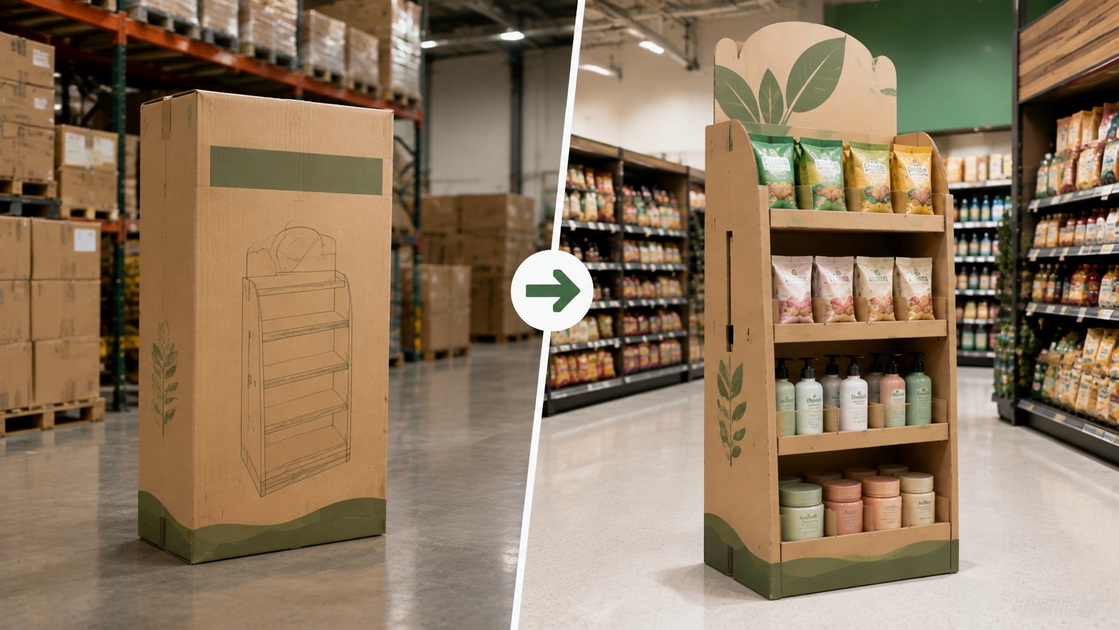
A display shipper is corrugated packaging engineered to perform two functions:
1. Protect and transport products through warehouses, trucks, containers, and distribution centers.
2. Transform into a retail display that can be placed directly on a shelf, counter, pallet, endcap, or promotional floor area.
The key difference between a normal shipping carton and a display shipper is that a display shipper is designed to remain visible after delivery. Instead of being discarded in the stockroom, it becomes part of the shopper-facing retail environment.
Retail-ready packaging, also called shelf-ready packaging, is designed to help retailers stock and present products more efficiently. It can include corrugated POP displays and other merchandising units that arrive ready to be placed on the retail floor.
Different retailers, regions, and packaging teams use different terminology. The final structure may be similar even when the name changes.
| Term | Typical Meaning | Common Retail Use |
|---|---|---|
| Display Shipper | A shipping carton that becomes a display | General retail, supermarkets, pharmacies |
| Shipper Display | Another name for a display shipper | FMCG, convenience retail, promotional programs |
| PDQ Display | “Pretty Darn Quick” retail-ready display | Club stores, mass retailers, temporary promotions |
| Retail Ready Packaging | Packaging designed for fast shelf placement | Grocery, pharmacy, consumer products |
| Shelf Ready Packaging | Open-and-place packaging for shelves | Food, beverage, health, beauty, stationery |
| Pallet Display Stand | Product display built on or around a pallet | Warehouse clubs, supermarkets, large-format retail |
| Corrugated POP Display | Branded corrugated display for point-of-purchase use | Endcaps, promotional aisles, store entrances |
| Pre-Packed Display | A display loaded with products before delivery | High-volume multi-store retail rollout |
The word "shipper" can create confusion.
In logistics, a shipper may mean the company that sends goods. In retail packaging, a shipper often means the physical display unit that carries goods from the supplier to the store and then becomes part of the merchandising setup.
For procurement teams, the clearest wording in an RFQ is often:
"We require a pre-packed corrugated retail display that can ship as a protective outer case and convert into a store-ready product display."
That sentence immediately clarifies that you are not requesting a logistics service provider. You are requesting a retail display structure with shipping capability.
Retailers want products to arrive in a format that is easy to receive, identify, move, open, place, and replenish. Store teams have limited time. A merchandising unit that takes 15 minutes to unpack and assemble may be delayed, incorrectly installed, or never placed on the sales floor.
A well-designed display shipper supports a simpler process:
1. The store receives the pre-packed unit.
2. Staff move it to the intended location.
3. They remove the outer transport protection or tear-away panel.
4. They unfold the header or activate the display function.
5. The unit is ready for shoppers.
This is why display shippers are especially useful for promotional programs with multiple stores, short launch windows, and limited store labor.
Faster setup. Store employees do not need to individually unpack and arrange every product.
Better presentation consistency. Each store receives the same pre-arranged product layout, graphics, header, and display structure.
Improved product visibility. A dedicated display gives the product more brand presence than a crowded standard shelf.
Lower handling risk. Fewer touches can reduce the chance of damaged products, missing units, or incorrect shelf placement.
Campaign flexibility. Brands can use display shippers for limited editions, seasonal assortments, new product introductions, sampling, bundle offers, and impulse-purchase programs.
For many consumer products, standard shelf placement means sharing visual space with several direct competitors. A display shipper creates a more focused branded zone.
It can help brands:
- Introduce new SKUs.
- Separate limited-edition products from permanent ranges.
- Encourage multi-unit purchase.
- Group related items into a bundle.
- Support seasonal storytelling.
- Place products in high-traffic areas.
- Improve brand recognition at the moment of selection.
A branded display does not guarantee sales. However, it gives the product an opportunity to be discovered, understood, and selected more easily than when it is hidden within a busy shelf set.
The main difference is not only printing. It is the entire design intention.
| Feature | Standard Shipping Carton | Display Shipper |
|---|---|---|
| Primary purpose | Product protection and transportation | Transportation, product protection, and retail merchandising |
| Shopper visibility | Not designed for shopper viewing | Designed to be visible in-store |
| Graphic design | Basic handling marks and shipping information | Branded graphics, product communication, header panels |
| Product access | Products removed in stockroom | Products remain accessible to shoppers |
| Assembly | Usually discarded after opening | May tear open, unfold, or convert into a display |
| Store labor requirement | Higher, because staff unpack and stock products | Lower, because products can remain inside the unit |
| Typical placement | Warehouse, stockroom, backroom | Shelf, counter, endcap, pallet, retail floor |
| Structural requirement | Must survive transportation | Must survive transportation and remain stable in use |
| Retail measurement | Delivery accuracy and damage rate | Sell-through, availability, shopper interaction, display compliance |
A successful display shipper must perform several jobs simultaneously.
The shipper must protect goods from compression, vibration, drops, punctures, moisture exposure, and handling stress.
This includes:
- Outer carton strength.
- Internal dividers or trays.
- Shelf locking structure.
- Product spacing.
- Corner protection.
- Pallet stability.
- Stretch-wrap compatibility.
- Correct orientation during transit.
International Safe Transit Association 3-Series procedures are general-simulation tests designed to replicate damage-producing motions, forces, conditions, and sequences that packages may encounter in transport.
For parcel-shipped products weighing 150 pounds or less, ISTA 3A is commonly used as a simulation procedure for individual packaged products transported by air or ground.
Not every retail display shipper requires formal ISTA testing. However, the principle is valuable: evaluate the complete packed system, not only the empty display.
A display shipper should not force retail staff to interpret complex instructions or search for loose parts.
The best setup process is clear and short:
- Remove the outer hood.
- Tear along marked perforations.
- Fold out the header.
- Lock the base if required.
- Place the display in the designated area.
For small PDQ displays, the goal may be "open and place." For a pallet display stand, the process may include removing a protective sleeve, unfolding a header, and removing transport straps.
The display must communicate quickly. In many retail situations, shoppers will not read long paragraphs.
Use the display's front, header, side panels, and tray fronts to answer basic questions:
- What is the product?
- Who is it for?
- What is the key benefit?
- What promotion applies?
- What options are available?
- Where should the shopper look or reach?
A display shipper should not become a crowded brochure. Clear visual hierarchy is more effective than excessive text.
Retail requirements may involve:
- Case dimensions.
- Weight limits.
- Pallet footprint.
- Barcode location.
- SSCC labels.
- Store identification.
- Promotional dates.
- Shipping marks.
- Product-facing orientation.
- Safety and accessibility rules.
- Retailer-specific assembly instructions.
GS1 identifies the Serial Shipping Container Code, or SSCC, as an 18-digit identifier used to identify logistics units such as cases and pallets. The SSCC is commonly encoded in a GS1-128 barcode and used on a GS1 logistics label to support tracking and warehouse processing.
The physical display structure may be visually impressive, but it can still be rejected or delayed if the logistic label, barcode, case count, or pallet configuration does not match the retailer's instructions.
Countertop display shippers are compact units placed near checkout counters, service desks, pharmacy counters, and cash wraps.
They work best for:
- Cosmetics
- Lip balms
- Small accessories
- Candy
- Batteries
- Stationery
- Travel-size products
- Gift cards
- Small electronics accessories
They are often made with E-flute or B-flute corrugated board, depending on product weight and required print quality.
A floor display shipper is a free-standing unit designed to hold more products and create stronger in-store presence.
It may include:
- Multiple shelves.
- Product trays.
- Branded header.
- Side panels.
- Divider systems.
- Hook areas.
- Reinforced base.
- Tear-away transport cover.
Floor displays are useful for snacks, beverages, toys, seasonal products, pet products, health products, cleaning supplies, and promotional bundles.
A pallet display stand is designed around a standard pallet footprint or a retailer-approved pallet configuration. It can arrive as a pre-loaded retail unit, reducing store-level setup work.
Pallet displays are particularly useful for:
- Club-store promotions.
- Supermarket seasonal campaigns.
- Beverage programs.
- Bulk-pack consumer goods.
- Warehouse retail.
- Large-volume launches.
- Multi-SKU promotional assortments.
Pallet displays must consider load distribution, product weight, stretch-wrap protection, pallet height, fork access, and safe shopper reach.

PDQ displays are generally compact, practical, and designed for quick placement. They can be used on shelves, counters, or pallet decks.
The term "PDQ" is frequently interpreted as "Pretty Darn Quick," reflecting the intention that the display should be easy for retail teams to open and place.
A good PDQ display should minimize:
- Loose components.
- Complex folding steps.
- Unclear instructions.
- Separate headers.
- Additional tools.
- Product re-packing.
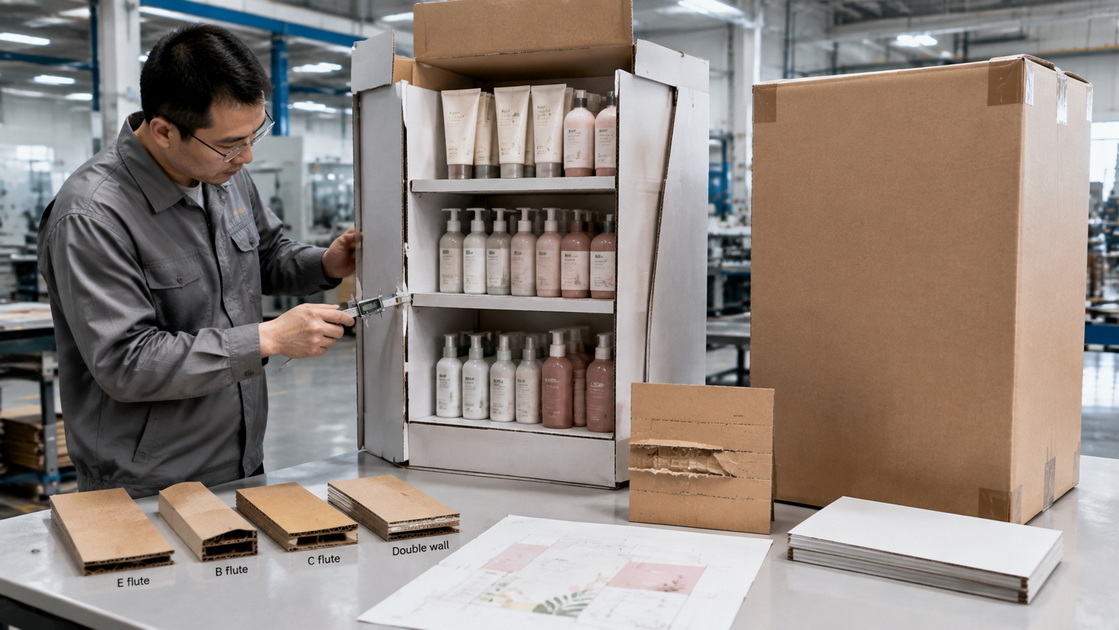
A display shipper needs the right balance between shipping strength, easy tear-away performance, print quality, and retail appearance.
| Material Option | Typical Strength | Suitable Applications |
|---|---|---|
| E-Flute Corrugated Board | Thin profile with good print surface | Counter displays, lightweight cosmetics, small retail trays |
| B-Flute Corrugated Board | Practical balance of strength and printability | PDQ displays, shelf-ready packaging, medium-weight products |
| C-Flute Corrugated Board | More cushioning and vertical compression support | Shipping cases, larger product displays |
| EB Double-Wall Board | Stronger support with good display potential | Larger floor displays, heavier product assortments |
| BC Double-Wall Board | High structural performance | Pallet display stands, heavy products, long logistics routes |
| Litho-Laminated Corrugated Board | Premium graphic appearance | Beauty, electronics, premium food, branded launches |
The correct material should be selected after evaluating the product weight, units per shelf, shelf span, transit distance, campaign duration, expected store conditions, and desired graphic finish.
A display shipper often relies on perforations to convert from transport mode to retail mode.
Poor perforation design can cause two costly failures:
- The display opens during shipping.
- The display tears unevenly when retail staff remove the transport panel.
Ask the supplier to test the tear-away process using the final board grade, print treatment, humidity condition, and packing method. A perforation that works on a dry factory sample may behave differently after ocean freight, warehouse storage, or pallet compression.
Do not approve a display simply because it holds products during a short factory demonstration.
Ask:
- What is the safe load per shelf?
- What is the total rated load?
- How much shelf deflection is acceptable?
- Has the display been tested when fully loaded?
- Does the base remain stable after products are removed unevenly?
- Can the display still stand if shoppers remove products from only one side?
For pallet display stands, product placement should be balanced. Heavy products should generally be positioned lower, while lighter products can be placed higher.
The best display programs start with the product and distribution plan, not only a visual concept.
Clarify whether the unit will support:
- A new-product launch.
- Seasonal promotion.
- Impulse purchase.
- Sampling.
- Bundle offer.
- Club-store volume program.
- Shelf disruption.
- Brand storytelling.
- Retailer-exclusive promotion.
Provide the manufacturer with:
- Product dimensions.
- Product weight.
- Units per SKU.
- Units per display.
- Number of SKUs.
- Target display location.
- Required display life.
- Retailer requirements.
- Delivery destination.
- Shipping method.
- Pallet requirement.
- Target retail launch date.
The supplier should create:
- 2D dieline.
- 3D rendering.
- Product layout.
- Board recommendation.
- Header design.
- Shelf construction.
- Packing plan.
- Pallet configuration.
- Estimated assembly process.
A white sample is an unprinted structural prototype.
Use it to verify:
- Product fit.
- Shelf depth.
- Product visibility.
- Product removal.
- Display height.
- Base stability.
- Assembly steps.
- Tear-away function.
- Outer-carton dimensions.
The pre-production sample should use the approved board, final artwork, printing method, finishes, packing method, and product-loading arrangement.
This stage is where many hidden problems become visible:
- Artwork placed across a fold line.
- Barcode hidden after opening.
- Header too tall for transport carton.
- Product labels facing the wrong direction.
- Display too large for store doors.
- Perforations tearing the printed surface.
- Pallet stack height exceeding warehouse limits.
Before shipment, verify:
- Material grade.
- Print quality.
- Dimensions.
- Product count.
- Barcode readability.
- Carton labels.
- Pallet loading.
- Stretch-wrap condition.
- Shipping marks.
- Drop-test or handling-test results where required.
One of the least discussed risks in display shipper development is that the supplier may design primarily for manufacturing efficiency, while the retailer needs setup efficiency.
A display can be low-cost to manufacture but expensive to execute in stores.
The most important retail period is often the first minute after the display reaches the floor. Store staff must understand what to remove, where to pull, how to unfold the header, and whether the display is ready to place.
A practical "first 60 seconds" test is simple:
1. Give the packed display to a person who did not help design it.
2. Provide only the final instruction sheet.
3. Ask them to open and place the display.
4. Measure the time required.
5. Record mistakes, confusion, damaged graphics, loose parts, and product movement.
6. Improve the design before mass production.
If the unit requires special knowledge, tools, excessive force, or a long instruction manual, it may fail at retail even if its factory build quality is excellent.
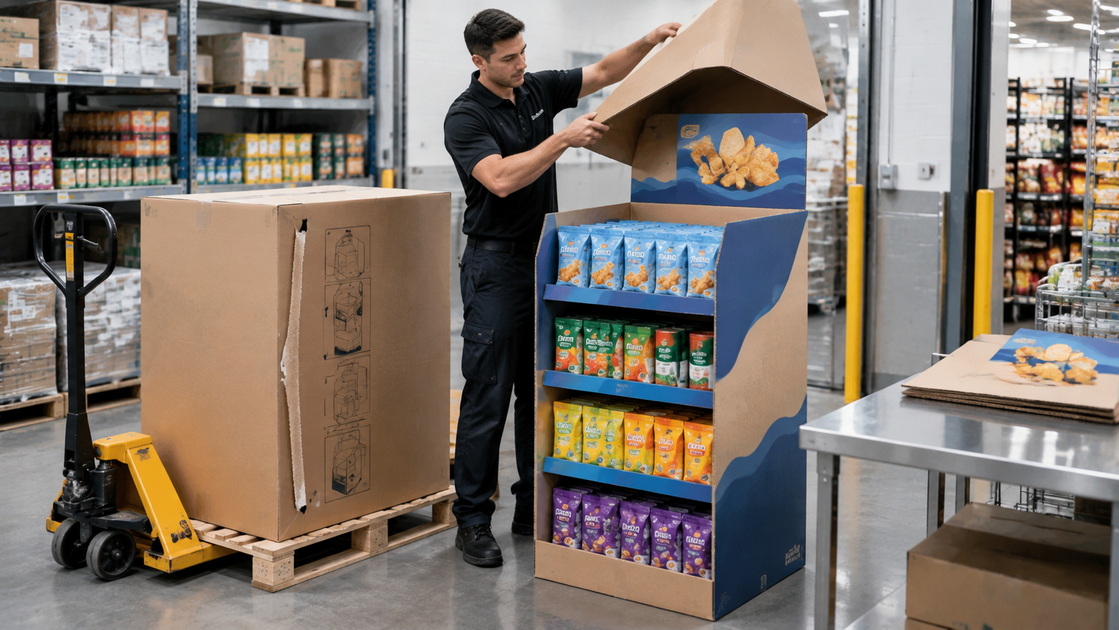
Corrugated display shippers can support paper-based retail programs because they can be shipped flat or pre-packed, printed directly, and often recycled through existing cardboard-recovery streams.
The Fibre Box Association's Fibre Box Handbook covers corrugated applications, box styles, testing procedures, and environmental considerations for corrugated packaging.
However, sustainability depends on the whole structure.
To improve end-of-campaign recyclability:
- Use mono-material corrugated board where possible.
- Avoid unnecessary plastic clips and mixed-material decorations.
- Use paper-based locking systems.
- Specify FSC-certified materials when suitable.
- Reduce plastic lamination where it is not essential.
- Design the display for easy flattening.
- Print simple disposal instructions for store teams.
- Match material strength to campaign duration.
Long Win Display can support more practical material choices by simplifying structures, reducing raw-material waste, and optimizing packing to lower material and logistics consumption. The company reports full-process capability across design, prototype development, printing, production, and delivery, with experience in cardboard displays, counter displays, pallet displays, PDQs, display boxes, and other retail display formats.
A display shipper is a retail tool built around a logistics reality. It must protect products during shipping, meet distribution requirements, reduce store setup time, present products clearly, and remain stable while shoppers interact with it.
The strongest display shipper programs are designed from the beginning around product weight, retailer requirements, packing sequence, pallet configuration, product visibility, and store-level usability. They are not ordinary cartons with extra printing.
For brands planning a supermarket launch, club-store pallet program, pharmacy promotion, convenience-store rollout, or seasonal retail campaign, Long Win Display can help develop a custom display shipper or pallet display stand from concept through structural design, sampling, production, and product pre-loading. Share your product dimensions, product count, retail location, delivery requirements, and campaign schedule to begin evaluating a practical display solution.
A display shipper is a general term for a shipping unit that converts into a retail display. A PDQ display is usually a compact, quick-to-place retail-ready format. Many PDQ displays are display shippers, but the term display shipper can also include larger floor displays and pallet display stands.
Yes. This is called a pre-packed or pre-loaded display shipper. Products are arranged inside the display before shipping, so store employees can open, place, and merchandise the unit with minimal additional work.
Display shippers work well for snacks, beverages, cosmetics, personal care products, toys, consumer electronics accessories, stationery, pet products, health products, and seasonal gift packs. The structure must be engineered for the product weight and packaging shape.
The correct board grade depends on total product weight, number of layers, pallet footprint, shipping distance, stacking pressure, moisture exposure, and retailer requirements. Heavier products often require reinforced bases, double-wall corrugated board, and internal supports.
Use properly engineered perforation patterns, adequate tie points, strong structural panels, correct grain direction, protective transport hoods, and appropriate stretch-wrap or outer-carton protection. Test the complete loaded unit under realistic handling conditions before mass production.
1. [What Is a Display Shipper? — PopDisplay]
Source article reviewed for terminology, retail-ready display context, logistics-versus-merchandising distinction, and display shipper use cases.
2. [Long Win Display Company Profile]
Information on Long Win Display's stated design, customization, production, pre-loading, product range, facilities, quality-control process, and global retail project experience.
3. [ISTA Test Procedures — International Safe Transit Association]
Information on ISTA 3-Series general-simulation performance testing for package transport environments.
4. [ISTA 3A Testing by Standard — Smithers]
Overview of the ISTA 3A procedure for individual packaged products shipped through parcel-delivery systems.
5. [GS1 Logistic Label Guideline]
Guidance on logistics labels and automatic data capture for SSCCs.
6. [Serial Shipping Container Code SSCC — GS1 US]
Information on SSCC identification, GS1-128 barcodes, and logistics-unit tracking.
7. [The Complete Guide to Retail Ready Packaging — Jamestown Container]
Overview of retail-ready packaging and its application to corrugated POP displays.
8. [The Fibre Box Handbook — Fibre Box Association]
Industry resource covering corrugated applications, box styles, testing, and environmental considerations.


