
Views: 219 Author: Long Win Display Publish Time: 2026-09-23 Origin: Site


Content Menu
● What Is a Cardboard Wall Called?
● What Is Corrugated Board Made Of?
>> Why the Fluted Middle Layer Matters
● Cardboard Wall vs Corrugated Display Panel: What Is the Difference?
● Common Types of Cardboard Walls Used in Retail Displays
>> 1. Back Panels for Cardboard Display Stands
>> 2. Side Panels and Sidewalls
>> 3. Corrugated Display Backdrops
>> 4. Pallet Display Skirts and Surround Panels
>> 5. Cardboard Partitions and Product Dividers
● How Corrugated Board Becomes a Cardboard Display Stand
>> 1. Define the Retail Objective
>> 2. Build the Structural Design
>> 3. Develop Retail-First Graphics
>> 4. Test, Produce, and Inspect
>> 5. Pre-Assemble and Prepare for Retail
● How to Choose the Right Corrugated Board for a Retail Display
>> Expert Recommendation: Start With Load, Not Artwork
● Sustainability: Are Cardboard Display Walls Recyclable?
>> Practical Sustainable Display Checklist
● Information Gaps in Typical "Cardboard Wall" Content
● Cardboard Display Wall Design Checklist for Brand Owners
● Choose the Right Name and the Right Display Partner
● FAQ
>> 1. Is a cardboard wall the same as corrugated board?
>> 2. What is the difference between cardboard and corrugated cardboard?
>> 3. Can corrugated cardboard support heavy products?
>> 4. Are cardboard display stands recyclable?
>> 5. What is a back panel on a cardboard display stand?
A cardboard wall is most accurately called a corrugated board panel, corrugated cardboard wall, or, in retail-display applications, a corrugated display panel. It is not merely a flat piece of "cardboard": it is an engineered paper-based structure made from linerboard and a fluted medium that provides strength, printability, and lightweight performance.
For retail brands, the term may also describe the large vertical panels used in a Cardboard Display Stand, POP display, pallet display, temporary retail backdrop, or branded in-store campaign. At Long Win Display, we design, manufacture, customize, and pre-assemble corrugated POP displays in China for brands entering major retail channels. In practice, the correct name depends on what the "cardboard wall" is meant to do: divide space, support products, communicate a brand message, or create a complete retail merchandising experience.
The general term is corrugated board or corrugated cardboard when the material contains a fluted paper layer between flat liner sheets.
However, the correct professional term changes according to function:
| If the Cardboard Wall Is Used For | Common Industry Term |
|---|---|
| A flat structural sheet | Corrugated board panel |
| A temporary room divider | Cardboard partition or corrugated partition |
| A printed retail background | Corrugated display backer or display backdrop |
| The upright rear wall of a display | Back panel or backer panel |
| The side wall of a floor display | Side panel or sidewall |
| A large freestanding promotional structure | Corrugated display wall or cardboard display wall |
| A product-selling retail fixture | Cardboard display stand, POP display, or POS display |
| A warehouse or pallet retail structure | Pallet display skirt, pallet display side panel, or display surround |
For most B2B buyers searching for custom retail fixtures, "cardboard wall" is usually an informal description. A display manufacturer will normally use more precise technical terms such as back panel, side panel, corrugated display wall, display header, or structural corrugated component.
The original topic correctly identifies a cardboard wall as corrugated board. However, that definition alone does not fully address how brands, retailers, designers, and manufacturers use corrugated panels in real display programs.
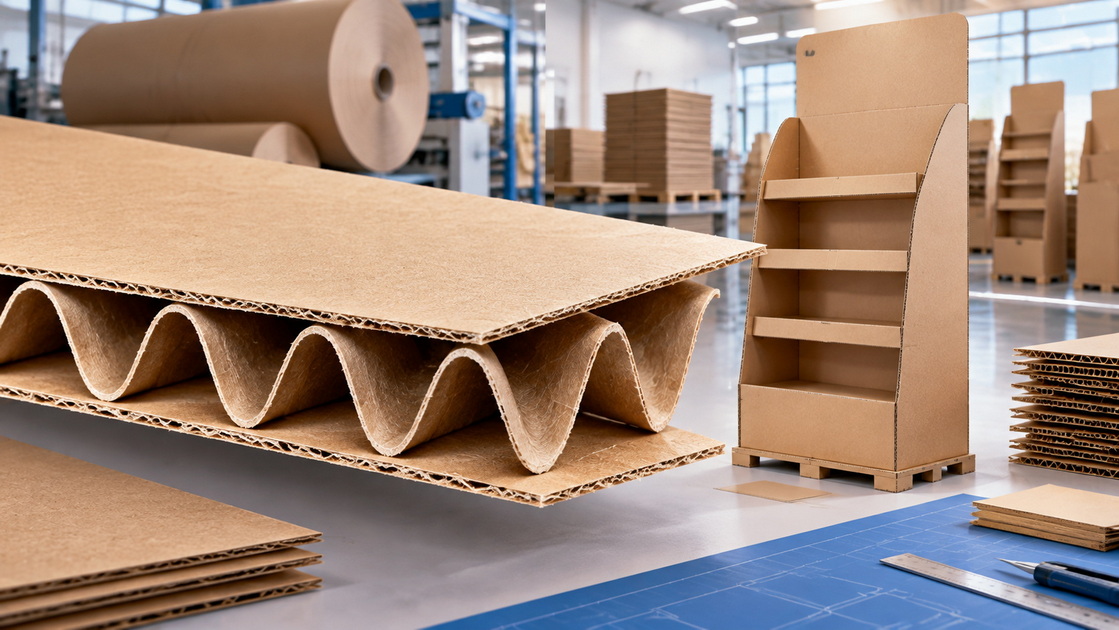
Corrugated board is a layered paper-based material. Its strength comes from the combination of flat liners and a wavy inner layer called fluting.
The most common construction includes:
- An outside linerboard that provides a printable outer surface.
- A fluted corrugated medium that creates cushioning and compression strength.
- An inside linerboard that completes the basic three-layer board structure.
This structure is different from simple paperboard or chipboard. Paperboard is generally flatter and thinner, while corrugated board has an internal fluted layer that gives it more rigidity, better impact resistance, and stronger load-bearing capability.
The fluted middle layer is not decorative. It works like a series of small arches.
That geometry helps corrugated board:
- Resist compression during shipping.
- Protect products from vibration and impact.
- Support display shelves, trays, and headers.
- Maintain shape during retail handling.
- Use less material than a solid board of equivalent thickness.
- Remain relatively lightweight for transportation and store setup.
For a temporary retail display, the goal is not simply to use thicker cardboard. The goal is to use the right board grade, flute type, structural layout, locking method, and load-bearing design.
A lightweight cosmetics display may require a different material structure from a floor display carrying beverage bottles, pet products, bulk snacks, or household goods. This is why professional corrugated display engineering begins with product weight, dimensions, retail placement, shipping method, and expected shelf life.
A cardboard wall is a broad, informal phrase. A corrugated display panel is a more accurate manufacturing and merchandising term when the panel is part of a retail display structure.
The difference is mainly about purpose.
| Feature | Cardboard Wall | Corrugated Display Panel |
|---|---|---|
| Typical meaning | General cardboard barrier, divider, or backdrop | Engineered panel used in a POP or retail display |
| Main purpose | Separation, decoration, temporary construction | Branding, structure, product support, merchandising |
| Graphic requirement | May be plain or lightly printed | Usually designed for high-impact retail graphics |
| Structural requirement | Depends on the application | Designed around product weight and display geometry |
| Retail use | Temporary events, partitions, backdrops | Floor displays, pallet displays, endcaps, dump bins |
| Manufacturing approach | Basic cutting or folding may be sufficient | CAD structure, die-cutting, printing, testing, assembly |
| Buyer focus | Size, appearance, basic durability | Retail compliance, sell-through, logistics, shopper access |
For example, a large printed panel behind a snack display may look like a cardboard wall. But in manufacturing terms, it is usually a back panel or display backer. If it includes a branded top section, it may also function as a header panel.
The terminology matters because it affects the design brief, quotation, material selection, die-line development, print method, packaging plan, and quality-control process.
Not all cardboard walls perform the same job. Below are the most common configurations used in custom cardboard display stands.
A back panel is the vertical wall at the rear of a display.
It may be used to:
- Carry the main brand message.
- Support shelves, hooks, or product trays.
- Add vertical rigidity to the structure.
- Create a visual boundary around products.
- Hold a die-cut logo, header, or campaign graphic.
A strong back panel is particularly important in floor-standing displays. If it is too narrow, too weak, or poorly connected to the base, the display can lean, twist, or lose its visual shape during transport and store use.
Side panels form the left and right sides of a display.
They can improve:
- Structural stability.
- Product containment.
- Brand visibility from aisle traffic.
- Protection against product shifting.
- The perceived premium quality of the display.
Side panels are valuable when the display is placed where shoppers approach from an angle. A shopper may not see the front of a floor unit until they are already beside it. In this situation, side graphics can carry the product category, value message, or campaign colors.
A display backdrop is usually a large printed panel placed behind products or an event activation.
It can be used for:
- New product launches.
- Retail sampling events.
- Seasonal campaigns.
- Trade-show activations.
- Photo opportunities.
- Promotional endcaps.
- Branded pop-up retail areas.
Unlike a permanent wall, a corrugated backdrop can be designed for flat packing, low-cost transportation, quick assembly, and short-term retail use.
For pallet displays, corrugated panels may surround the pallet base and convert a basic product stack into a branded retail destination.
These panels can:
- Cover pallet wood or plastic components.
- Improve brand presentation.
- Add promotion graphics.
- Protect product edges.
- Make the display more recognizable from a distance.
Pallet display structures need a careful balance between visual impact and logistics. A floor unit may need to align with a standard 48 × 40-inch GMA pallet footprint for North American retail handling, depending on the retailer and program requirements.
Partitions are internal cardboard walls.
They help separate products, organize multiple SKUs, prevent shifting, and make displays easier to shop. They are commonly used in snack displays, cosmetics units, beverages, electronics accessories, toys, and promotional bundles.
A partition may not be highly visible to shoppers, but it can be critical to display performance. A poorly designed divider can allow products to tip, mix together, or become damaged in transit.

A successful Cardboard Display Stand is not created by simply printing graphics onto a cardboard sheet. It requires coordinated work between structural designers, graphic designers, packaging engineers, quality-control teams, co-packing staff, and logistics planners.
At Long Win Display, the process typically involves five connected stages.
The first question is not "What should the display look like?"
The first question is: What must the display achieve in the retail environment?
A buyer should clarify:
- Target retailer or retail channel.
- Product category and product weight.
- Product dimensions and case-pack configuration.
- Expected order quantity.
- Store location, such as endcap, aisle, checkout, or promotional zone.
- Campaign timing and expected display life.
- Shipping destination and distribution model.
- Required assembly level.
A display for a beauty product launch will require different engineering from a display for heavy bottles or large family-size household products.
The display manufacturer develops the structure using CAD-based design tools and physical prototyping.
Key design questions include:
- How much weight must each shelf hold?
- How will the display lock together?
- Can the display ship flat, semi-assembled, or fully assembled?
- Will it require internal reinforcement?
- How will it remain stable when partially sold down?
- Will store associates need to assemble it?
- Does it fit the designated pallet, aisle, or counter space?
One common mistake is assuming a large display can simply be scaled down into a countertop unit. Structural behavior, shelf strength, product access, and retailer requirements do not automatically scale proportionally.
Graphics must help shoppers understand the product quickly.
A cardboard display wall should not become a large block of unreadable marketing copy. Strong retail graphics usually feature:
- A clear product category signal.
- A visible brand identity.
- One main value proposition.
- A simple call to action.
- Strong contrast between text and background.
- Product images or color coding where useful.
- Essential promotional information.
For a floor display, avoid placing the main selling message too low. The display should be designed around the shopper's normal viewing height and product-reach behavior.
A display should be tested before mass production, especially when it carries heavy products or will move through international supply chains.
Testing and quality checks may include:
- Shelf-load evaluation.
- Compression and stacking review.
- Product fit checks.
- Transit simulation.
- Print-color approval.
- Die-cut accuracy inspection.
- Assembly-time review.
- Barcode and labeling checks.
- Final packed-display inspection.
Pre-assembly is often one of the most valuable services for a large retail program.
Instead of asking store staff to construct multiple displays manually, the manufacturer can prepare display components, load trays, pre-glue key sections, and pack displays in a retail-ready configuration.
This can improve:
- Store labor efficiency.
- Display consistency.
- Campaign launch speed.
- Product-facing quality.
- Retail compliance.
- Overall brand presentation.

The term "corrugated cardboard" is not specific enough for an engineering brief. Brands should work with a manufacturer to select the appropriate board based on actual conditions.
| Selection Factor | Why It Matters |
|---|---|
| Product weight | Determines shelf strength and reinforcement needs |
| Number of products | Influences total display load and base stability |
| Display size | Affects panel rigidity and shipping efficiency |
| Retail duration | Longer programs may require more durable materials |
| Shipping route | Ocean freight and long-distance distribution require stronger protection |
| Humidity exposure | Moisture can reduce corrugated strength |
| Print finish | Influences graphic quality and recyclability |
| Retail location | Floor, pallet, endcap, counter, and checkout displays have different needs |
| Assembly method | Determines whether pre-glued, self-locking, or modular construction is best |
From a manufacturer's perspective, one of the most important decisions is to calculate the display load before the artwork is finalized.
For instance, if a floor display contains 48 bottles at 1.2 lb each, the display must safely support at least 57.6 lb of product weight before accounting for packaging, dynamic movement, uneven shopper removal, and a suitable safety margin.
48×1.2 lb=57.6 lb
A display that looks premium in a 3D render but cannot reliably support its loaded weight is not a successful retail display. The structure must come first; graphics should enhance—not hide—the engineering.
Corrugated display panels can be a practical material choice for temporary retail programs because they are paper-based, lightweight, and often compatible with existing recycling streams. However, recyclability depends on the full material specification—not just the word "cardboard."
A display may be easier to recycle when it uses:
- Corrugated board with recycled fiber content.
- Water-based inks where appropriate.
- Water-based coatings where appropriate.
- Paper-based locking mechanisms.
- Easily removable non-paper components.
- Limited plastic lamination.
- Minimal mixed-material attachments.
The corrugated industry reports that roughly 90% of corrugated material produced in the United States has been recovered and recycled in recent years, and the average corrugated box contains approximately 52% recycled fiber.
That said, sustainability claims should remain precise. A recyclable board can become harder to recycle if it is combined with plastic films, foils, magnets, metal fixtures, non-paper coatings, or permanently attached mixed materials. Brands should discuss end-of-life requirements with both their display manufacturer and retail partner.
- Use right-sized structures to avoid unnecessary material.
- Avoid excessive plastic lamination where possible.
- Design for fast disassembly.
- Separate non-paper components when needed.
- Optimize flat-pack shipping where suitable.
- Use only the reinforcement required for the real product load.
- Confirm whether the retailer has specific recycling or waste-stream requirements.

Many articles that answer "What is a cardboard wall called?" stop after defining corrugated board. This leaves several practical questions unanswered for B2B buyers.
A stronger guide should also explain:
- The difference between basic cardboard and engineered corrugated display structures.
- The different names of display panels based on their role.
- How corrugated walls support shelves, products, and retail graphics.
- Which board factors affect strength and cost.
- How international shipping changes structural requirements.
- How pre-assembly improves retail launch execution.
- Which design choices support recycling goals.
- Why a professional display manufacturer should review load, packaging, and logistics before production.
These points turn a simple definition article into a useful procurement and retail-merchandising resource.
Before requesting a quote for a corrugated display stand, provide the following information to your manufacturer:
1. Product dimensions, weight, and packaging format.
2. Target retailer, country, and intended display location.
3. Number of SKUs and units per display.
4. Target display size and footprint.
5. Expected campaign duration.
6. Artwork files, brand guidelines, and print requirements.
7. Shipping method and destination port or warehouse.
8. Preferred assembly level: flat-packed, semi-assembled, or pre-assembled.
9. Retailer requirements for pallet size, labeling, barcodes, and packaging.
10. Sustainability or recycling requirements.
The more detailed the brief, the more accurately a manufacturer can balance visual design, structural reliability, production cost, and retail readiness.
A cardboard wall is generally called corrugated board when referring to the material. But in a retail environment, it may be more accurately described as a corrugated display panel, back panel, sidewall, display backdrop, pallet skirt, or part of a complete Cardboard Display Stand.
For brands, the terminology matters because every panel has a job. It may carry a message, hold product weight, stabilize a structure, improve shopper visibility, protect products during transit, or make a promotional campaign feel more premium.
Long Win Display helps brands convert product and retail requirements into custom POP display solutions. From structural design and prototype development to printing, manufacturing, pre-assembly, and export packaging, we focus on creating cardboard display stands that are practical for retail teams and effective for shoppers.
Not always. "Cardboard wall" is a general description, while corrugated board is a specific engineered material made of flat linerboard sheets and a fluted internal medium. In a retail display, the wall may be called a back panel, side panel, display backdrop, or corrugated display wall.
Basic cardboard or paperboard is usually flatter and thinner. Corrugated cardboard includes a fluted middle layer between liners, giving it more rigidity, cushioning, compression resistance, and suitability for shipping boxes and retail display stands.
Yes, when it is properly engineered. The correct board grade, flute type, shelf geometry, reinforcement, base construction, and product-loading pattern must be selected according to the total product weight and expected retail conditions.
Many are recyclable, particularly when they use corrugated paper-based components and are designed to minimize difficult-to-separate plastic, metal, or laminated materials. However, the final recyclability depends on the complete material specification and local recycling system.
A back panel is the upright rear section of a display. It can add strength, carry graphic messaging, support shelves or hooks, and make the display more visible from a distance.
1. PopDisplay. "[What Is a Cardboard Wall Called?]." Referenced for the foundational definition of a cardboard wall as corrugated board. [popdisplay]
2. PopDisplay. "[The Ultimate Guide for Brand Owners and Retailers]." Referenced for POP display categories, retail display functions, floor-unit considerations, pallet footprint discussion, and the relationship between retail display engineering and in-store merchandising. [popdisplay]
3. Careers in Corrugated. "[Our Sustainability Story]." Referenced for corrugated recovery and recycled-fiber figures. [careersincorrugated]
4. Packaging Strategies. "[Corrugated Packaging: An Extraordinary Recycling Success Story]." Referenced for historical U.S. corrugated recycling and recycled-content context. [packagingstrategies]
5. Frank Mayer and Associates. "[Building an Eco-Friendly Retail Display]." Referenced for the importance of material selection and separation when designing recyclable retail displays. [frankmayer]
6. U.S. Access Board. "[ADA Standards for Accessible Design]." Referenced as a general compliance resource for brands evaluating accessibility considerations in U.S. retail-display environments.


