
Views: 262 Author: Long Win Display Publish Time: 2026-09-02 Origin: Site


Content Menu
● POP vs POS: What Is the Difference?
● Why POP Displays Matter in Retail
>> Dump Bins
● Cardboard POP Displays: Why Brands Choose Them
>> Key Benefits of Cardboard Display Stands
● How to Design an Effective POP Display
>> 2. Define the Retail Location
>> 3. Use the Three-Second Message Rule
>> 4. Engineer for Full Product Load
>> 5. Plan Replenishment Before Production
● POP Display Metrics: How to Measure Performance
>> Use a Control-Store Approach
● POP Does Not Always Mean Point of Purchase
● Why Work With a POP Display Manufacturer?
● FAQ
>> 1. What does POP stand for in retail?
>> 3. What is the difference between POP and POS displays?
>> 4. What products are best for cardboard POP displays?
>> 5. Are cardboard displays recyclable?
POP means "Point of Purchase" in retail. It refers to the physical or digital location where shoppers encounter merchandise, evaluate an offer, and may decide to buy. A POP display is the branded display, fixture, sign, tray, stand, or merchandising structure placed at that decision point to increase product visibility and encourage purchase.
For retail brands, supermarkets, convenience stores, pharmacies, beauty retailers, specialty stores, and distributors, POP is more than a marketing abbreviation. It is a practical in-store sales tool. A well-designed cardboard POP display can create extra product facings, support a new-product launch, improve cross-selling, communicate a promotion, and help a brand stand out from standard shelf merchandising.
At Long Win Display, we design, customize, manufacture, and pre-assemble cardboard display stands for retail programs. From countertop units and sidekick displays to floor displays, dump bins, pallet displays, and retail-ready POP structures, our work starts with the same commercial question: What should the shopper see, understand, and do at the moment they encounter the product?
This guide explains what POP means in retail, how POP displays differ from POS displays, which display formats fit different products, and how brands can develop effective custom cardboard displays for retail rollout.
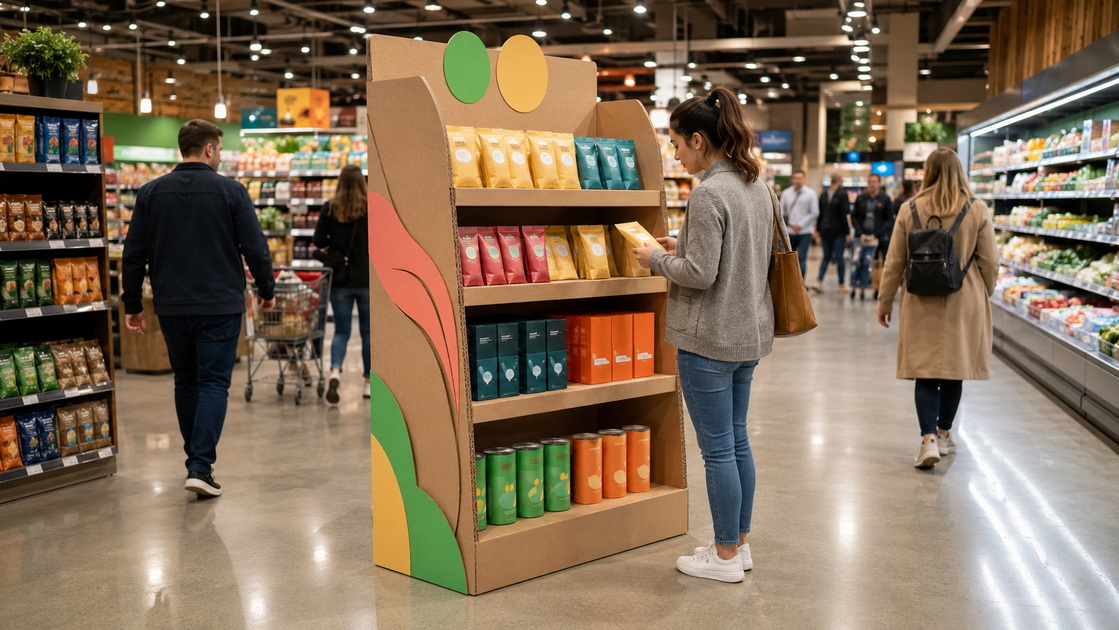
In retail, POP stands for Point of Purchase.
A point of purchase is any location in a store where a shopper sees, handles, compares, or considers buying a product. It can be at a shelf, aisle end, entrance, checkout queue, promotional area, or product demonstration zone.
A POP display is the physical or digital marketing material used at that location to attract attention and guide a purchasing decision.
Common POP display elements include:
- Cardboard floor displays
- Countertop display units
- Endcap displays
- Sidekick or power-wing displays
- Dump bins
- Shelf talkers
- Pallet displays
- Promotional header cards
- Product trays
- Peg-hook displays
- Digital retail screens
- Price or offer signage
Retail industry sources describe point-of-purchase displays as physical or digital displays placed in stores to advertise merchandise and encourage shoppers to make buying decisions. These fixtures can range from small shelf signs and dump bins to larger display units and digital installations.
The simplest way to understand POP is this:
POP is where a customer meets the product and makes a buying decision. A POP display is the tool that makes that meeting more noticeable, clear, and persuasive.
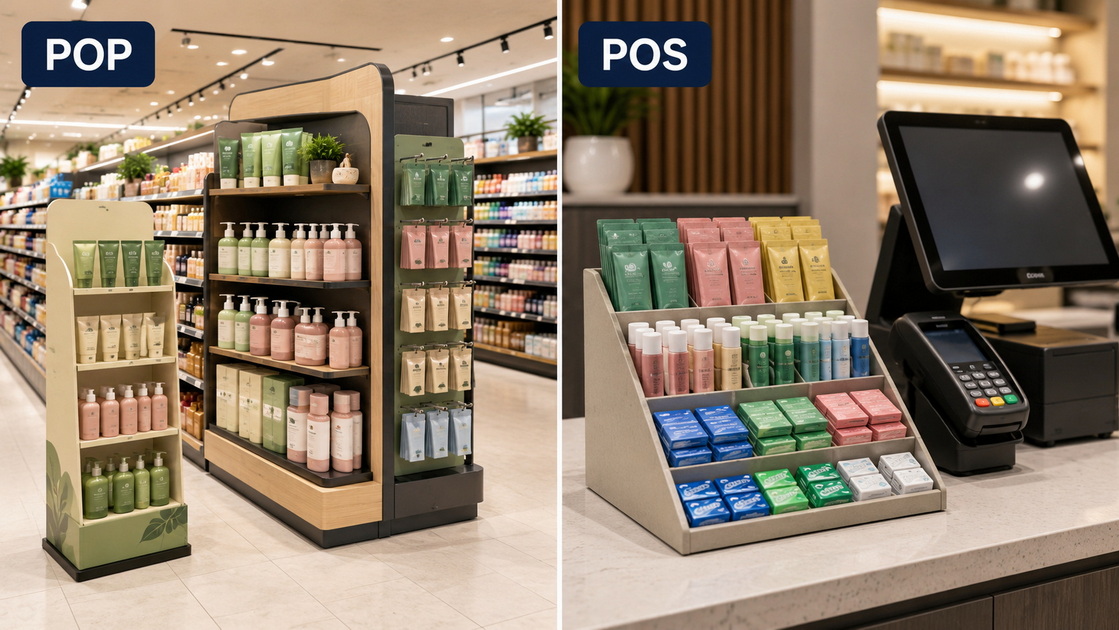
The terms POP and POS are often used interchangeably, but they refer to different retail locations.
POP means Point of Purchase. It describes the broader area where shoppers encounter a product and decide whether to buy it.
POS means Point of Sale. It usually refers to the exact place where the financial transaction happens, such as a checkout counter, cash register, self-service checkout, or payment terminal.
| Factor | POP Display | POS Display |
|---|---|---|
| Full meaning | Point of Purchase | Point of Sale |
| Primary location | Anywhere shoppers evaluate or encounter products | At or immediately beside the checkout transaction point |
| Main objective | Build visibility, communicate value, prompt product selection | Encourage last-minute add-on purchases at payment |
| Typical formats | Floor displays, endcaps, sidekicks, dump bins, shelf displays | Counter displays, cash-wrap units, queue-line displays |
| Product types | New launches, seasonal goods, bundled products, category promotions | Small impulse products, low-cost accessories, snacks, trial-size items |
| Shopper decision stage | Product discovery and consideration | Final transaction and last-minute purchase |
A key retail distinction is that the point of purchase can happen throughout the store, while the point of sale is normally the specific location where payment occurs. POP displays often create additional product exposure outside standard aisle shelves, while POS displays focus on checkout or queue areas.
For example:
- A cardboard floor stand holding a new snack product in the main aisle is a POP display.
- A small countertop display holding chewing gum beside the card terminal is a POS display.
- A sidekick display of batteries attached beside a toy aisle may be a POP display.
- A small tray of travel-size hand sanitizer at checkout is a POS display.
This distinction matters when briefing a display manufacturer. Retailers may have different size limits, structural requirements, placement rules, and approval processes for POP and POS programs.
A standard shelf can hold a product. A POP display gives the product a reason to be noticed.
Retail stores are visually crowded. Shoppers may pass hundreds or thousands of products during a visit. A well-placed point of purchase display helps a brand interrupt habitual shopping behavior without making the store difficult to navigate.
POP displays can help brands:
- Increase product visibility
- Create additional facings outside the regular shelf
- Support new-product launches
- Encourage impulse buying
- Promote limited-time offers
- Build brand recognition
- Cross-sell complementary products
- Improve seasonal merchandising
- Test a product in selected retail locations
- Support retailer-specific campaigns
- Simplify product discovery
POP displays are designed to highlight particular products and offers inside the store, where shoppers are already making choices. They can make a promotional item more visible and help communicate key product benefits at the moment of consideration.
However, a display does not succeed simply because it is colorful or large. It must answer three shopper questions quickly:
1. What is this product?
2. Why should I care?
3. How do I take or buy it?
If the message is unclear, the product is difficult to reach, or the display is poorly stocked, even a premium-looking display can underperform.
The best POP display format depends on product size, product weight, number of SKUs, campaign duration, retail location, replenishment needs, and available floor space.
A floor display, also called a freestanding display unit or FSDU, stands directly on the store floor. It can include shelves, trays, hooks, bins, dividers, headers, and large graphics.
Best for:
- New-product launches
- Seasonal promotions
- Heavy or larger packaged products
- Multiple SKUs
- High-volume retail campaigns
- Retail entrances and promotional zones
- Supermarkets, mass merchants, and specialty stores
Advantages:
- High product capacity
- Large graphic area
- Strong visual impact
- Flexible structural design
- Suitable for multi-SKU displays
Considerations:
- Requires dedicated floor space
- Must remain stable under full product load
- Needs efficient transport and assembly planning
- Must comply with retailer dimensions and shopper-flow requirements
A countertop display sits on a checkout counter, service desk, café counter, or other small retail surface. It is commonly used for small, lightweight, high-margin products.
Best for:
- Snacks
- Cosmetics
- Accessories
- Gift cards
- Trial-size products
- Stationery
- Small health and beauty items
- Batteries and electronic accessories
Advantages:
- Located near payment
- Strong impulse-purchase potential
- Compact and economical
- Easy to replenish
- Suitable for retail trials
Considerations:
- Limited product capacity
- Strict counter-space limits
- Must not obstruct staff or payment equipment
- Retailer approval is often required
An endcap display is placed at the end of a retail aisle or gondola. Endcaps are valuable because they are visible from more than one direction and can capture shoppers entering a category zone.
Best for:
- Seasonal campaigns
- Promotions with high inventory
- Cross-category bundles
- New product launches
- Brand takeovers
- Retailer-supported programs
Advantages:
- Strong visibility
- Larger product capacity than shelf displays
- Suitable for bold campaign graphics
- Can communicate multiple products or benefits
Considerations:
- Endcap space is competitive
- Retailers may charge for placement
- Planogram and replenishment coordination are important
A sidekick display, also known as a power-wing display, is mounted on the side of a retail gondola, shelf, endcap, or fixture. It uses vertical space rather than requiring a large floor footprint.
Best for:
- Small and lightweight products
- Cross-selling
- Narrow retail aisles
- Accessories
- Snacks
- Beauty products
- Seasonal add-on items
Advantages:
- Saves floor space
- Supports category-adjacent selling
- Can be fast to install
- Helps create extra product facings
Considerations:
- Requires a secure attachment method
- Has lower load capacity than many floor displays
- Must not block shelf labels, shopper flow, or replenishment access
A dump bin is an open-top display unit designed for customers to browse and pick up products easily. It is commonly used for value items, promotional stock, toys, seasonal products, accessories, and individually packaged goods.
Best for:
- High-volume promotions
- Low-cost impulse products
- Seasonal retail events
- Mixed product assortments
- Bulk packaged items
Advantages:
- Easy product access
- Strong visual volume
- Efficient for large quantities
- Often easy to assemble
Considerations:
- Product can become disorganized
- The bin must retain structural stability as inventory decreases
- Messaging must remain visible even when shoppers browse
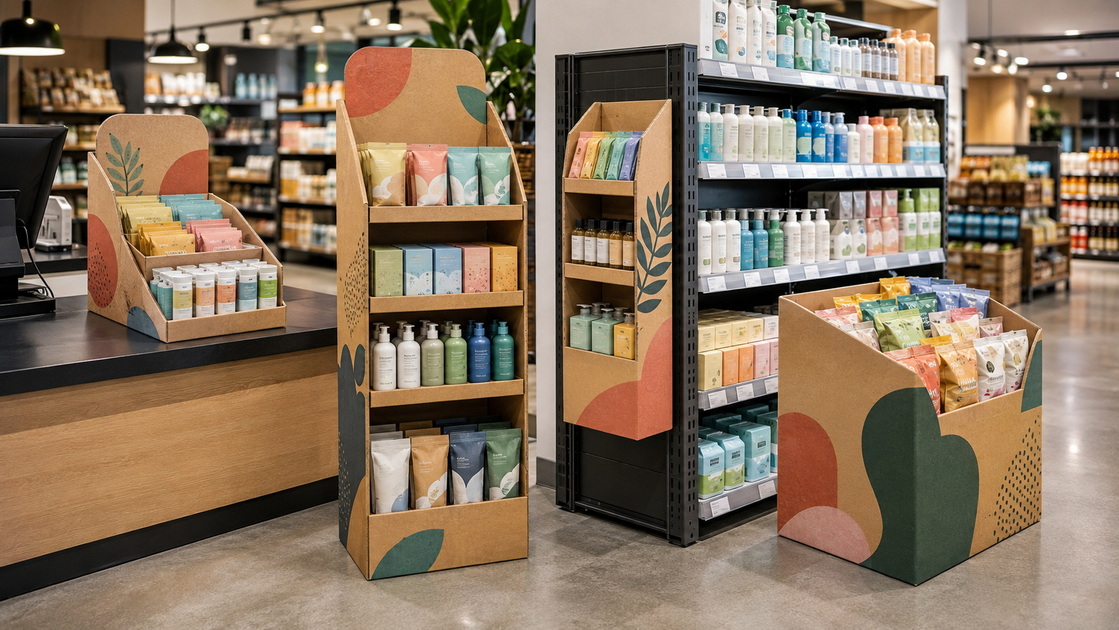
Cardboard POP displays are widely used because they combine retail impact with practical production and logistics benefits. Corrugated cardboard can be die-cut, printed, folded, reinforced, flat-packed, pre-assembled, and customized into many shapes and display formats.
For short-term, seasonal, and retailer-specific campaigns, cardboard displays can provide a flexible alternative to permanent metal, plastic, or wood fixtures.
- Custom branding: Full-color printing can align with packaging, campaign graphics, and retail guidelines.
- Flexible structures: Designers can create shelves, trays, hooks, bins, gravity-feed lanes, and shaped headers.
- Lower transport volume: Flat-pack or partially assembled formats can improve shipping efficiency.
- Fast retail setup: Pre-assembled displays can reduce store labor and setup errors.
- Scalable production: Suitable for regional pilots or large store rollouts.
- Campaign flexibility: Effective for new products, holidays, promotions, and retail exclusives.
- Material options: Corrugated board may include recycled content and can often be recycled, depending on inks, coatings, accessories, and local recycling systems.
Industry sources commonly describe cardboard merchandising displays as practical and cost-effective for retail product visibility. They are often made from recyclable materials, but actual recyclability depends on the final display structure and material mix.
Important sustainability note: Do not describe every cardboard display as fully recyclable without reviewing its coatings, laminations, adhesives, plastic parts, metal hooks, and local recycling requirements. A more defensible claim is: "Designed for recycling where local facilities accept the materials," or "Remove non-paper components before recycling."
A successful POP display must perform in three different environments:
- During shipping
- During store setup
- During shopper interaction
That is why effective display design requires more than attractive graphics.
Before choosing a display shape, define:
- Product dimensions
- Unit weight
- Number of units per display
- Primary packaging strength
- Product orientation
- Shelf-life requirements
- SKU count
- Replenishment frequency
- Shopper target
- Retail price point
A display designed for lightweight snack pouches will not necessarily support glass bottles, cosmetic jars, batteries, electronics, or heavy household products.
Placement affects everything: structural design, display footprint, graphic visibility, capacity, and retailer approval.
Ask:
- Will the display sit on the floor, counter, shelf, endcap, or pallet?
- How much space is available?
- Is the aisle narrow or wide?
- Does the store use carts, baskets, or mobile replenishment equipment?
- Is there a height limit?
- Can the display use hooks or fixture attachments?
- Is the display placed near a checkout, entrance, or category shelf?
A shopper should understand the display in roughly three seconds.
The display should communicate:
- Brand or product category
- Core benefit, occasion, or offer
- Clear product access
Avoid overcrowding the graphics with long paragraphs, too many icons, or multiple competing claims. The product itself should remain visible. In many retail settings, a strong product image, clear color blocking, and one concise headline work better than dense text.
A cardboard display may look stable when empty but fail after stocking. Structural design should account for product weight, shelf span, center of gravity, shipping vibration, humidity, customer handling, and the final days of the campaign when stock levels may become uneven.
For floor displays, test:
- Base strength
- Tipping resistance
- Shelf deflection
- Product retention
- Compression strength
- Assembly locks
- Transit durability
For countertop displays, test:
- Counter footprint
- Product-facing angle
- Display balance
- Ease of replenishment
- Cashier access
- Product removal
For sidekick displays, test:
- Hook and hanger strength
- Back-panel reinforcement
- Fixture compatibility
- Product weight distribution
- Tear resistance
- Aisle clearance
A display can lose its selling power if it becomes empty, messy, or difficult to refill.
Design for:
- Easy carton opening
- Simple shelf refill
- Clear SKU separation
- Low product-fall risk
- Retail staff instructions
- Reasonable pack-out quantity
- Efficient replenishment access
Many brands measure only unit sales after a POP campaign. Sales matter, but they do not show the entire picture. To improve future display programs, evaluate retail execution and shopper interaction as well.
| KPI | What It Measures | Why It Matters |
|---|---|---|
| Sales uplift | Change in sales versus a baseline period or control store | Indicates commercial impact |
| Sell-through rate | Percentage of display inventory sold during the campaign | Shows whether stock quantity and placement were appropriate |
| Units per store per week | Product movement by location | Helps compare stores and refine allocation |
| Display compliance rate | Percentage of stores with the display installed correctly | Identifies rollout and retailer-execution issues |
| Out-of-stock rate | Frequency of empty or low-stock displays | Reveals replenishment gaps |
| Shopper engagement | Product pickup, scan, or interaction data where available | Helps assess display attraction |
| Damage rate | Displays or products damaged during shipping or in-store use | Supports structural improvement |
| Setup time | Labor time needed for assembly and installation | Influences total campaign cost |
| Recycling recovery | Percentage of displays properly recovered or recycled | Supports credible sustainability reporting |
For a more reliable evaluation, compare stores that received the POP display with similar stores that did not.
For example:
1. Select comparable stores by size, customer profile, location, and category performance.
2. Install the display in the test group.
3. Keep product price, promotional activity, and distribution as consistent as possible.
4. Measure sales before, during, and after the campaign.
5. Compare the test group against the control group.
6. Review stockouts, display compliance, and local execution before drawing conclusions.
This approach helps prevent a common mistake: attributing all sales growth to the display when the increase may have been caused by price promotions, seasonal demand, broader advertising, or better stock availability.
Expert insight: A POP display should be evaluated as a retail execution system, not only as a printed cardboard structure.
Avoid these frequent problems when planning a custom point of purchase display:
- Designing graphics before confirming product dimensions and weight
- Using too much text
- Selecting a display format that does not fit the retail location
- Ignoring shopper-flow and aisle-width constraints
- Underestimating full product load
- Overloading sidekick displays
- Choosing a floor display for a narrow aisle
- Forgetting retail fixture specifications
- Creating a display that is difficult to assemble
- Shipping without adequate protection
- Hiding the product behind graphics
- Failing to plan display replenishment
- Making unsupported sustainability claims
- Measuring only sales without checking store compliance
The acronym POP has different meanings in different industries. In retail and merchandising, it normally means Point of Purchase. In other contexts, it can mean something else.
| Industry | POP Meaning |
|---|---|
| Retail and marketing | Point of Purchase |
| Email technology | Post Office Protocol |
| Music and entertainment | Pop music or popular music |
| Environmental science | Persistent Organic Pollutants, often written as POPs |
| Manufacturing and packaging | Usually Point of Purchase when discussing retail displays |
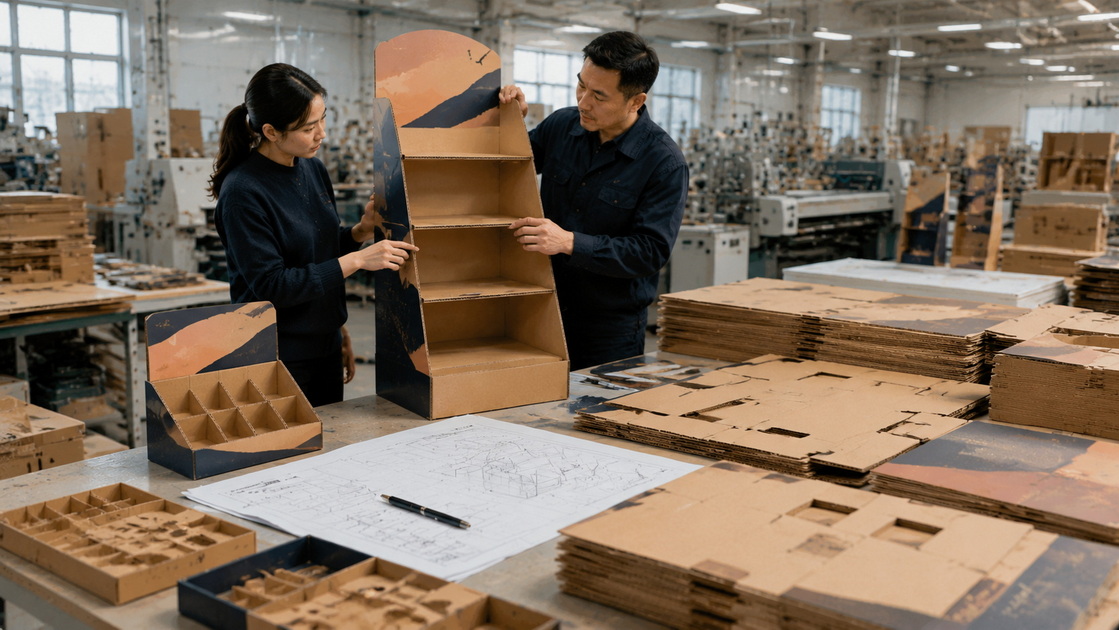
A professional POP display manufacturer helps turn a marketing concept into a retail-ready structure.
Long Win Display supports brands through the full cardboard display development process:
- Retail display concept development
- Structural design
- Graphic adaptation
- Material selection
- Product-load engineering
- Prototype sampling
- Pre-production testing
- Offset and digital printing
- Die-cutting
- Pre-assembly
- Flat-pack or assembled shipping
- Retail rollout support
The right manufacturing partner should ask detailed questions about your product, store format, retailer, display location, load requirement, campaign duration, shipment method, and installation process. If a supplier only asks for a visual design, they may miss the structural and operational requirements that determine whether the display succeeds in store.
In retail, POP means Point of Purchase—the place where shoppers encounter a product and make a buying decision. A POP display is the physical merchandising tool that makes the product easier to notice, understand, access, and buy.
The best POP display is not always the biggest. It is the display that fits the store, supports the product, communicates one clear message, remains stable during the campaign, and helps retail staff replenish inventory efficiently.
For a small impulse product, a countertop display or sidekick may be ideal. For a larger launch, a cardboard floor display, endcap program, or pallet display may create greater visibility and product capacity. The correct format depends on the retail environment, product weight, campaign objective, and shopper journey.
POP stands for Point of Purchase. It refers to the location where a shopper encounters a product and may decide to buy it. POP can include retail aisles, endcaps, shelves, promotional zones, checkout queues, and other in-store shopping areas.
A POP display is a merchandising structure or promotional material used at the point of purchase. It can be a cardboard floor display, countertop display, endcap, sidekick, dump bin, shelf sign, pallet display, or digital screen designed to attract attention and encourage product purchase.
POP displays are placed where shoppers evaluate products throughout the store. POS displays are positioned at or near the payment location, such as a cash register or checkout counter. POP focuses on product consideration; POS focuses on the final transaction and last-minute add-on sales.
Cardboard POP displays can support many categories, including food, beverages, beauty products, household goods, toys, pet products, consumer electronics accessories, health products, stationery, seasonal gifts, and promotional bundles. The display structure must be engineered for the product's dimensions, weight, packaging, and quantity.
Many cardboard displays can be recycled if they use paper-based materials and local recycling facilities accept them. However, coatings, laminations, adhesives, plastic hooks, metal components, and mixed materials can affect recyclability. Ask your display manufacturer to design for material separation and local recycling requirements.
1. Shopify. "[Point of Purchase Displays: Types and Examples]." Defines point-of-purchase displays as physical or digital in-store marketing displays designed to capture attention and encourage purchase decisions. [shopify]
2. Displays2go. "[What Is a POP Display? Point of Purchase Retail Explained]." Explains POP display placement in high-traffic retail areas and differentiates POP from POS displays near checkout. [displays2go]
3. Repsly. "[The Ultimate Guide to Point of Purchase Displays]." Defines POP as store locations where customers engage with products and distinguishes point of purchase from point of sale. [repsly]
4. Repsly. "[30 Powerful Point of Purchase Displays to Make Your Products Pop]." Discusses how POP displays create additional product exposure beyond standard shelf placement. [repsly]
5. Displays2go. "[Cardboard Merchandising Displays]." Covers cardboard merchandising-display uses and recyclable-material positioning. [displays2go]
6. Creative Displays Now. "[Benefits of Using Corrugated Cardboard for Custom Displays]." Discusses corrugated cardboard, responsible material sourcing, and recyclable-display considerations. [creativedisplaysnow]
7. Topwell Display. "[Sustainable Cardboard Displays: FSC Board, Recycled Materials, Retail Design]." Explains why coatings, accessories, adhesives, and local collection infrastructure influence cardboard-display recyclability. [topwelldisplay]


