
Views: 273 Author: Long Win Display Publish Time: 2026-10-29 Origin: Site


Content Menu
● The Main Benefits of Using Endcap Displays
>> 1. Greater Visibility Outside the Main Shelf
>> 2. A Clearer Promotional Message
>> 3. Opportunities for Additional Purchases
>> 4. Support for Seasonal and Promotional Changes
>> 5. Additional Product Capacity
● Do Endcap Displays Increase Sales? What Research Actually Shows
● Endcap Displays vs Regular Shelving
● Cardboard Endcap Display Design: Fit Before Graphics
>> Confirm the Retailer's Actual Requirements
>> Build a Representative Load Test
>> Use Reinforcement Where the Design Requires It
● Flat-Pack, Assembled, or Prefilled Endcap Displays?
● An Empty Display Still Occupies Space
● How to Measure Endcap Display ROI Without Overstating Results
>> Measure Total Sales, Not Display Sales Alone
>> Include the Complete Campaign Cost
● A Practical Endcap Development Process With Long Win Display
● FAQ
>> 1. Is there a standard size for every endcap display?
>> 2. Can a cardboard endcap hold bottles or other heavy products?
>> 3. Will a distinctive shape automatically increase sales?
>> 4. Is a prefilled display always cheaper overall?
>> 5. How can we distinguish real growth from sales shifted off the regular shelf?
The benefits of using endcap displays include stronger product visibility, additional merchandising space, clearer promotional communication, and opportunities to increase sales. Positioned at the end of a retail aisle, an endcap display can introduce a new product, support a seasonal campaign, or bring related items together.
However, a prominent location does not guarantee a profitable promotion. Performance depends on the product, offer, store traffic, availability, structural design, and execution.
My recommendation is to evaluate endcaps through incrementality: do they generate additional profitable sales, or simply move purchases away from the regular shelf?
This guide develops the original article's visibility and engineering themes while correcting several limitations. It replaces universal dimensional rules, guaranteed sales claims, and unverified factory anecdotes with a practical framework for design, testing, replenishment, and measurement.
No independently verified customer reviews or campaign results were supplied. The recommendations below are proposed purchasing practices, not reports of firsthand testing.

An endcap display is a merchandising presentation at the end of a retail aisle.
It may use an existing gondola fixture, a freestanding cardboard structure, product trays, shelving, or a combination of these formats.
A cardboard endcap display can provide branded graphics and product organization without requiring a permanent fixture. Depending on the project, it may arrive flat-packed, assembled, or prefilled with merchandise.
These formats serve different operational needs. A display that is inexpensive to manufacture may still be costly to ship, assemble, replenish, or remove.
An endcap gives a product another opportunity to be noticed beyond its regular aisle position.
This can be valuable for a new brand, a seasonal range, or an item that is difficult to distinguish among similar packages.
However, not all aisle ends receive the same attention. Traffic routes, sightlines, neighboring fixtures, and store layout affect visibility.
Treat location as a variable to evaluate—not an automatic advantage shared equally by every endcap.
An endcap can bring product, price communication, and branding into one presentation.
Instead of competing with numerous shelf labels, the brand can organize the display around a focused proposition:
- A product launch.
- A limited-time offer.
- A seasonal occasion.
- A useful product combination.
- A distinctive product benefit.
The message should remain understandable at the actual viewing distance. Concise copy is a useful design principle, but a universal "three-second rule" is not a guaranteed performance standard.
A visible display may remind shoppers of an unplanned need or introduce something they had not considered.
For example, a cooking-themed presentation could group compatible products around a meal occasion.
This is a merchandising opportunity, not a reason to assume every category will produce the same impulse response. Price, relevance, household need, and shopping mission still matter.
Cardboard endcap displays can be designed around a defined campaign rather than a permanent store installation.
This makes them worth evaluating for holidays, limited editions, and product launches.
The practical benefit depends on execution. The design must still fit the retailer's requirements, hold the merchandise, and remain serviceable throughout the promotion.
An endcap can provide stock outside the regular shelf position.
That may help support a promotion, but capacity must be balanced with replenishment and structural performance.
Maximum loading is not necessarily optimal merchandising. An overcrowded display can obscure labels, make products difficult to remove, and increase the burden on shelves.
Published research supports the value of end-of-aisle placement, but it does not justify a universal sales guarantee.
A 2014 observational study at one UK grocery store examined beverage sales while accounting for price, price promotion, and the number of display locations.
It reported estimated increases associated with end-of-aisle placement of:
- 23.2% for beer.
- 33.6% for wine.
- 46.1% for spirits.
- 51.7% for carbonated drinks.
- 73.5% for coffee.
- 113.8% for tea.
These results illustrate category differences. They should not be presented as forecasts for another retailer, country, or product.
A separate study published in 2023 analyzed approximately 275 million transactions across 179 supermarkets. Products sold more when featured in placement promotions, but those promotions included several locations—not endcaps alone.
The useful conclusion is that placement can matter substantially. The size and profitability of the effect require campaign-specific measurement.
| Factor | Endcap display | Regular shelving |
|---|---|---|
| Main role | Promotional or additional merchandising | Established category shopping |
| Visibility | Depends on aisle-end location and sightlines | Depends on shelf position and category traffic |
| Branding | May support dedicated graphics | Often constrained by shared shelf space |
| Assortment | Usually benefits from a focused selection | Can accommodate a broader category range |
| Operations | Requires installation and campaign coordination | Usually follows routine replenishment |
| Cost | May include display, placement, freight, and setup | Uses the existing merchandising system |
| Measurement | Must distinguish additional sales from shifted sales | Provides a useful baseline |
Endcaps and regular shelving often work together. Removing the normal shelf allocation may change the shopper journey and complicate measurement.
Confirm the retailer's merchandising plan before deciding how the two locations should interact.
There is no single endcap width that guarantees installation across every store.
The original article recommends a universal 34.5-inch maximum. That should not replace a retailer-approved specification.
Obtain:
- Usable width, depth, and height.
- Fixture and bracket details.
- Required clearances.
- Base and pallet restrictions.
- Header limitations.
- Access and circulation requirements.
- Approved attachment methods.
Measure the complete assembled footprint, including graphics, feet, and projecting components.
A curved header or side panel must remain within the permitted envelope. Visual impact is not a reason to obstruct circulation.
Check whether shoppers can remove an item without disturbing adjacent products.
Consider package grip, shelf opening height, retaining lips, and visibility as stock decreases.
A display should work when partially depleted—not only when fully stocked for photography.
Flute type alone does not establish load capacity.
Performance depends on board specification, shelf span, folds, joints, reinforcements, load distribution, environmental conditions, and duration.
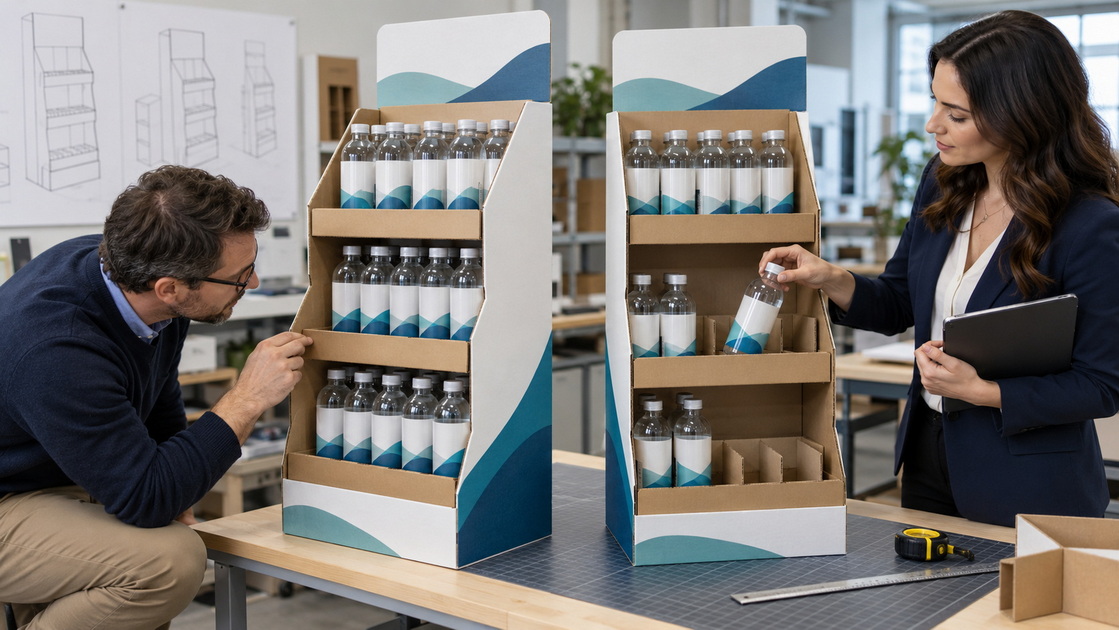
Agree on a test plan covering:
1. Actual products or equivalent loads.
2. Intended shelf arrangement.
3. Full and partially depleted conditions.
4. The campaign's service duration.
5. Relevant environmental exposure.
6. Acceptable deflection and stability.
Record the configuration and acceptance criteria before testing.
A short static test does not demonstrate performance throughout a longer promotion.
Possible solutions include revised shelf geometry, reduced spans, added supports, different board construction, or suitable reinforcement.
A metal bar is not a universal solution, and a particular thickness cannot be specified responsibly without the design context.
Reinforcement can also affect assembly, cost, weight, and end-of-life separation. Evaluate the complete system rather than optimizing one component in isolation.
| Delivery format | Potential advantage | Main trade-off |
|---|---|---|
| Flat-packed | Reduced shipping volume | Store or local assembly is required |
| Assembled but empty | Less structural setup at destination | Larger shipping footprint |
| Prefilled | Can simplify store deployment | Requires product coordination and transit protection |
Long Win Display's company-provided background includes design, production, customization, and preassembly of cardboard displays.
For each project, confirm whether preassembly means structure only or includes product loading. Do not assume that preassembly automatically includes co-packing services.
Transport validation should reflect the actual distribution route. Parcel delivery, palletized truckload, and mixed-freight networks create different demands.
One overlooked endcap risk is a promotion that works initially but cannot be replenished efficiently.
Fast early sales can leave empty facings. Staff may lack replacement stock, instructions, or time to rebuild the presentation.
The display then occupies valuable space while delivering little merchandising value.
Before launch, define:
- Opening stock.
- Replenishment location.
- Refill responsibility.
- Shelf capacity.
- Minimum presentation quantity.
- End-of-promotion handling.
A useful approval question is: "What will this display look like after half the stock has sold?"
That question often exposes practical weaknesses missed by a fully stocked rendering.

Units taken from the endcap are not automatically additional units.
Some shoppers may have purchased the same item from its normal shelf. Related products may also lose sales.
Review total SKU, brand, or category performance according to the campaign objective.
Where practical, compare similar test and control stores over comparable periods.
Record differences in pricing, promotions, availability, and execution. A simple before-and-after comparison can be distorted by seasonality or wider demand changes.
A practical calculation is:
Campaign ROI=(Incremental contribution before campaign costs−Campaign costs)/Campaign costs
Include relevant display production, freight, placement, installation, replenishment, removal, and disposal costs.
Define the calculation consistently so costs are not counted twice.
| Metric | What it helps assess |
|---|---|
| Total unit sales | Overall volume change |
| Contribution | Financial value after relevant variable costs |
| In-stock availability | Whether shoppers could buy |
| Installation compliance | Whether stores executed the plan |
| Replenishment frequency | Operational workload |
| Damage or structural issues | Fitness for the campaign |
| Residual stock | End-of-promotion consequences |
Based on company-provided information, Long Win Display is a China-based POP display designer and manufacturer specializing in customized cardboard display stands and preassembly.
For a productive inquiry, provide:
1. Retailer specifications.
2. Product dimensions and weights.
3. SKU quantities and assortment.
4. Campaign duration.
5. Artwork and messaging requirements.
6. Delivery format and distribution route.
7. Target store-arrival date.
Request a structural proposal, representative prototype, validation plan, and quotation covering the complete project.
No retailer approval, audited factory capability, or guaranteed sales outcome was supplied for this article. Those requirements should be confirmed for the actual order.
Endcap displays can improve visibility, clarify promotions, support product discovery, and provide additional merchandising capacity.
Their commercial value depends on fit, structure, stock availability, store execution, and additional profitable sales.
No. Fixture dimensions and retailer rules vary. Use the approved specification for the intended placement rather than a universal width assumption.
Potentially, but the completed design needs validation. Product weight, shelf span, duration, load distribution, and environmental conditions all matter.
No. Shape can support visibility, but relevance, messaging, product availability, price, and location also influence results. Test the design against the campaign objective.
No. Reduced store setup may be offset by freight volume, handling, or packing requirements. Compare total delivered and operational cost.
Measure total relevant sales across locations and use an appropriate comparison group where possible. Review availability, pricing, and other promotions before attributing the difference to the endcap.
1. PopDisplay. "What Are the Benefits of Using Endcap Displays?" Original article reviewed. Its general merchandising themes were retained; universal dimensions, guaranteed results, and unverified factory examples were not adopted as established facts. [popdisplay]
2. Nakamura, R., Pechey, R., Suhrcke, M., Jebb, S. A., and Marteau, T. M. "Sales Impact of Displaying Alcoholic and Non-Alcoholic Beverages in End-of-Aisle Locations: An Observational Study." Social Science & Medicine, 108, 68–73, 2014. Source for category-specific estimates from one UK store; not a universal forecast. [repository.cam.ac]
3. "In-Store Marketing and Supermarket Purchases: Associations Overall and Across Racial–Ethnic Groups." Published in 2023. Analyzed approximately 275 million transactions across 179 supermarkets; placement promotions included endcaps and other locations. [pmc.ncbi.nlm.nih]
4. "The Real Estate Value of Supermarket Endcaps: Why Location In-Store Matters." Published in 2018. Examines differences in foot traffic and visual reach between endcap locations. [researchnow.flinders.edu]
5. International Safe Transit Association. "Procedure 3A: Packaged-Products for Parcel Delivery System Shipment, 70 kg or Less," preview hosted by ANSI. Reference for the importance of matching transport testing to the distribution system; not a blanket test requirement for every display. [webstore.ansi]


