
Views: 277 Author: Long Win Display Publish Time: 2026-11-20 Origin: Site


Content Menu
● How We Evaluate Hook Display Stand Suppliers
● Why Source Hook Display Stands for the Australian Market?
>> What Recent Retail Data Actually Tells Buyers
● Supplier Shortlist: Overseas Partners and Australian Providers
>> 1. Long Win Display Shenzhen Limited
>> 2. Shenzhen XingKun Packing Products Co., Ltd.
>> 3. Xianda Printing Co., Ltd.
● Capacity, MOQ, and Certification Comparison
● Technical Buyer's Guide to Hook Display Stands
>> Specify the Load Path, Not Just Material Thickness
>> Test Real Products and Uneven Loading
>> Apply Certifications to the Correct Product
● The Hanging Package Is Part of the System
● How to Verify Samples, Factories, and Freight
>> 1. How can I verify whether an ISO certificate has expired?
>> 2. Does FSC-certified paper mean the finished display can carry an FSC label?
>> 3. What if the sample passes but bulk displays fail?
>> 4. How do I compare a cheap offshore quotation with a local quotation?
>> 5. Who owns the design and tooling after development?
Finding reliable hook display stand manufacturers and suppliers in Australia requires more than comparing photographs and unit prices. Professional buyers need to understand who designs the fixture, who manufactures it, how load capacity is verified, and who takes responsibility when a retail rollout encounters problems.
Australia-based suppliers offer advantages in local coordination, replenishment, and store execution. Overseas manufacturers can offer an alternative for custom printed displays, preloaded promotional units, and coordinated packaging projects.
This guide compares both sourcing routes. It begins with Long Win Display and four requested overseas businesses, followed by Australian suppliers with relevant display capabilities. These companies do not all have equivalent hook-display experience, and packaging specialists are identified separately rather than presented as proven fixture manufacturers.
This article is prepared for Long Win Display. Placement is editorial, not an independently audited ranking. Company information comes primarily from supplier websites; certification status, available capacity, and project suitability require verification before purchase.
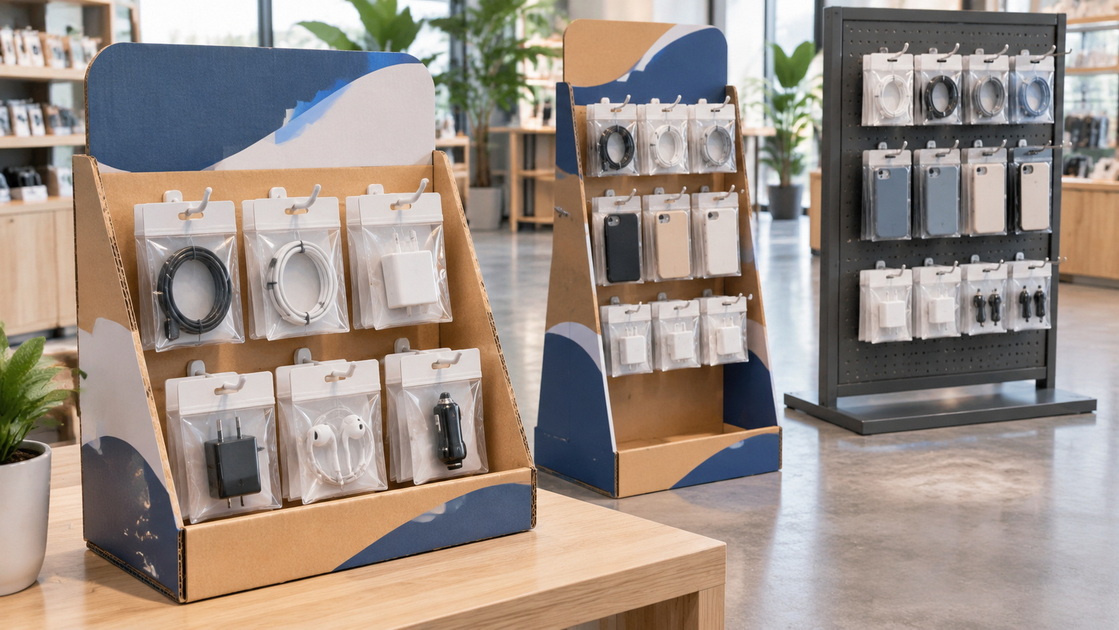
A useful shortlist should distinguish documented capabilities from attractive but unverified claims.
Our evaluation framework covers six areas:
1. Product relevance: Evidence of hook displays, countertop displays, merchandising fixtures, or closely related structural products.
2. Development capability: Structural design, prototyping, material selection, and revision support.
3. Manufacturing transparency: Identification of in-house processes and subcontracted operations.
4. Quality control: Incoming-material checks, assembly inspection, load testing, and traceable production approval.
5. Delivery readiness: Confirmed schedules, protective packaging, preloading options, and rollout coordination.
6. Compliance evidence: Current certificates with relevant scope—not simply certification logos.
No factory visits or comparative performance tests were conducted for this article. Missing information is marked as such rather than estimated.
Australian suppliers can be particularly useful when buyers need replacement hooks, established shopfitting systems, local warehousing, or coordination across multiple stores.
There is also a practical distinction between local manufacturing and local supply. An Australian business may combine domestic fabrication, imported components, and offshore production. Buyers should request the manufacturing location for the specific product, not infer origin from a local address.
Mills Group illustrates this mixed-capability model: it describes in-house plastic fabrication, printing, and metal fabrication across facilities in Victoria, New South Wales, and Queensland, alongside overseas sourcing.
These locations demonstrate an established retail-fixture supply network. They do not establish a formally measured Australian hook-display manufacturing cluster.
The Australian Bureau of Statistics reported seasonally adjusted retail turnover of A$37.91 billion in June 2025, up 4.9% from June 2024. The Shopping Centre Council of Australia also discussed those results in its July 2025 research note.
These figures provide retail-market context, not hook display stand market size. No independently verified 2025–2026 Australian hook-display-specific market estimate was established for this guide.
For procurement teams, the more actionable question is whether the display suits the retailer's footprint, replenishment process, and campaign duration.
Long Win Display is a Chinese POP display designer and manufacturer with a Shenzhen headquarters and production facilities that its website says moved to Yiwu, Zhejiang, after 2020.
Its timeline identifies company opening in 2018 and the founder's initial display-design experience in 2006. These dates should remain distinct.
The product range includes cardboard hook displays, countertop displays, pallet displays, and packaging. The company also describes semi-permanent and permanent displays produced with cooperating factories.
- Core strength: Custom structural development, printing, production, and preloading.
- Markets: The company identifies Asia, North America, Oceania, and Europe.
- OEM/ODM scope: Display dimensions, graphics, structures, packaging, and preloaded configurations.
- Potential fit: Small and growing brands seeking coordinated development and cost-conscious construction.
Its stated emphasis on simplified structures, reduced material waste, and compact packing supports a value-oriented positioning. Buyers should evaluate communication efficiency through revision turnaround and document control rather than assuming it from marketing language.
Established in 2004 according to its company information, XingKun offers custom printed products, including cardboard and acrylic display stands.
Its wider portfolio covers packaging, labels, cards, and printed materials. The company describes OEM/ODM support and service across more than 30 countries and regions.
- Core strength: Combining display graphics with related printed packaging.
- Markets: International; an Australian sales share is not disclosed.
- OEM/ODM scope: Custom structures, artwork, dimensions, and finishes.
- Buyer qualification: Request examples of loaded hook displays, not only general display photographs.
Published packaging sample and production lead times should not be assumed to apply to every hook-display project.
Xianda is primarily a custom packaging manufacturer serving categories including cosmetics, gifts, food, and consumer products.
Its homepage contains inconsistent establishment information: one section states 2006, while another states 2014. It also describes different production locations. Buyers should reconcile these details against the contracting entity's business registration.
- Core strength: Printed paper packaging and decorative finishing.
- Markets: Export-oriented; verified geographic sales proportions are unavailable.
- OEM/ODM scope: Custom boxes, inserts, artwork, and packaging structures.
- Buyer qualification: Hook-display engineering and production capability remain unverified.
Xianda is therefore a conditional packaging partner, not a confirmed specialist hook display stand manufacturer.
Maituohong Packaging, represented by mthpackagingbox.com, describes a Shenzhen factory producing custom paper packaging and lists POP displays among its solutions.
Its website reports more than 15 years of experience, but the reviewed page does not establish an exact founding year or independently verify the full registered company name.
- Core strength: Coordinating packaging structures, printing, and finishing.
- Markets: The company highlights North American and European requirements.
- OEM/ODM scope: Custom paper structures, inserts, dimensions, and branding.
- Buyer qualification: Request hook-display references, attachment details, and load-test records.
Factory-wide staffing and floor-area claims do not establish hook-display production capacity.
Bonito Packaging describes more than a decade of paper-packaging experience and customers across more than 20 countries and regions. An exact establishment year and full registered entity name were not established from the reviewed homepage.
Its stated offering centers on folding cartons, rigid boxes, gift boxes, and retail packaging.
- Core strength: Custom packaging development with published low-volume options.
- Markets: Global brands, retailers, and online sellers.
- OEM/ODM scope: Structural design, material selection, printing, and finishing.
- Buyer qualification: Dedicated hook-display capability is not demonstrated sufficiently.
Its advertised 100-unit starting quantity concerns packaging. It must not be quoted as a confirmed hook display stand MOQ.
SI Retail is an Australian-owned family business that traces its operations to 1974. It supplies display hooks, shelving, shop fittings, signage, and custom retail displays.
Its range includes hooks for pegboard, slatwall, metalboard, grid mesh, and display bars.
- Core strength: Established fixture systems and Australia-wide supply.
- Main market: Australian retailers, franchise groups, and retail brands.
- Custom scope: Retail displays developed around product and store-layout requirements.
- Buyer qualification: Confirm component compatibility, stock availability, and the manufacturing origin of custom products.
SI Retail is particularly relevant when the project must integrate with existing retail infrastructure.
Mills Group traces its origins to 1958 and describes operations supporting retail execution in Australia and the United Kingdom.
Its capabilities include design, local fabrication, overseas sourcing, warehousing, installation, and post-installation support. Hooks form part of its standard retail equipment offering.
- Core strength: Combining fixture development with rollout execution.
- Main markets: Australia and the United Kingdom.
- Custom scope: Prototypes, fabricated fixtures, signage, and rollout quantities.
- Buyer qualification: Identify which operations are domestic and which are sourced externally.
Mills merits consideration where deployment complexity matters as much as the fixture itself.
The table separates public disclosures from project-specific information. "Not disclosed" does not imply inadequate capability.
| Supplier | Relevant capacity information | Hook-display MOQ | Certification position |
|---|---|---|---|
| Long Win Display | Website states 10,000 pieces daily across its business; hook-specific output unverified | Request quotation | Current certificates require verification |
| XingKun | Printing and display production described; hook-specific output not disclosed | Request quotation | ISO 9001 and FSC claims require scope checks |
| Xianda | Packaging equipment and production lines described | Not verified | Request current documents |
| Maituohong Packaging | Factory and workforce figures published; hook-specific output not disclosed | Project-dependent; confirm | ISO 9001 and FSC claimed |
| Bonito Packaging | Packaging scalability described; no verified hook-display output | Not verified; packaging MOQ is not transferable | Multiple compliance claims require document-level review |
| SI Retail | Stock supply and custom projects; numerical capacity not disclosed | Product/project-dependent | Request relevant project documentation |
| Mills Group | Three Australian factories described; numerical output not disclosed | Project-dependent | Request applicable site and process evidence |
Neither BSCI audit participation nor REACH compliance should be treated as interchangeable with an accredited quality-management certificate.
For metal fixtures, define steel grade, wire diameter, sheet thickness, weld quality, coating, and hook attachment.
For corrugated displays, specify board construction, flute orientation, reinforcement, hook mounting, and anticipated humidity exposure. Board thickness alone does not prove performance.
For acrylic components, define material type, thickness, edge finishing, and cleaning compatibility.
The critical question is how product weight transfers from the hook through the panel and into the base.
Require a sample with actual merchandise or equivalent test loads.
Check:
- Fully loaded performance.
- Uneven and partially depleted configurations.
- Hook deflection and panel damage.
- Base stability during product removal.
- Repeated replenishment.
- Assembly without specialist tools.
Agree on acceptance criteria before testing. Do not invent a universal load rating or safety factor for all displays.
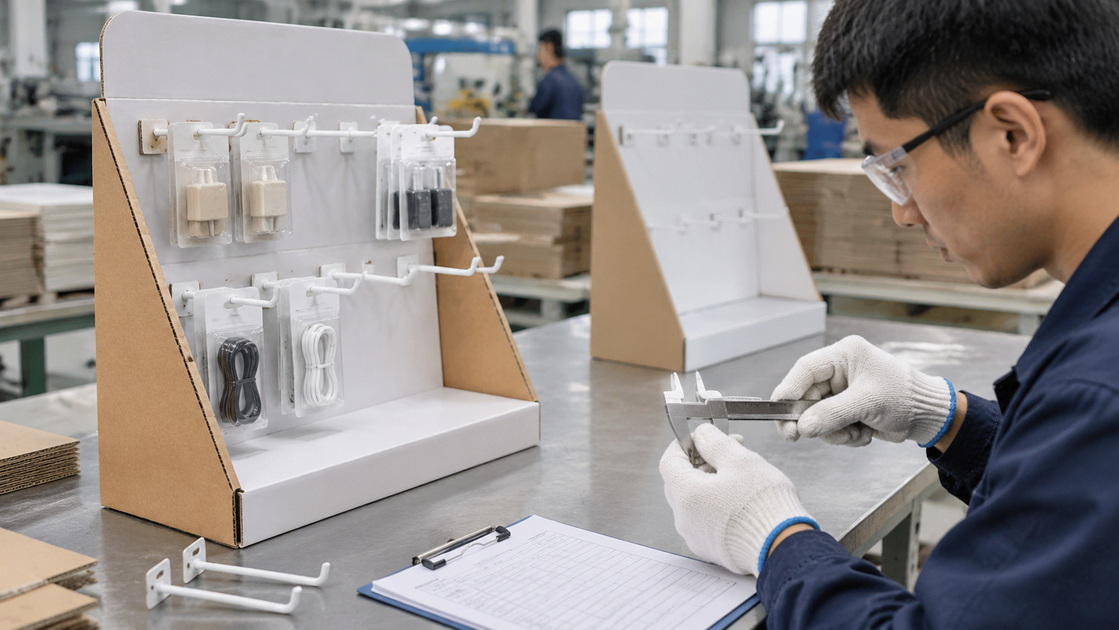
A passive cardboard or metal hook display does not automatically require CE marking. CE marking applies only where relevant European legislation requires it.
RoHS concerns electrical and electronic equipment, not an ordinary unpowered stand simply because it contains metal or plastic. Lighting, screens, or powered accessories can change the assessment.
For Australian installations, establish the applicable Australian requirements and retailer specifications separately. European documentation does not automatically establish Australian compliance.
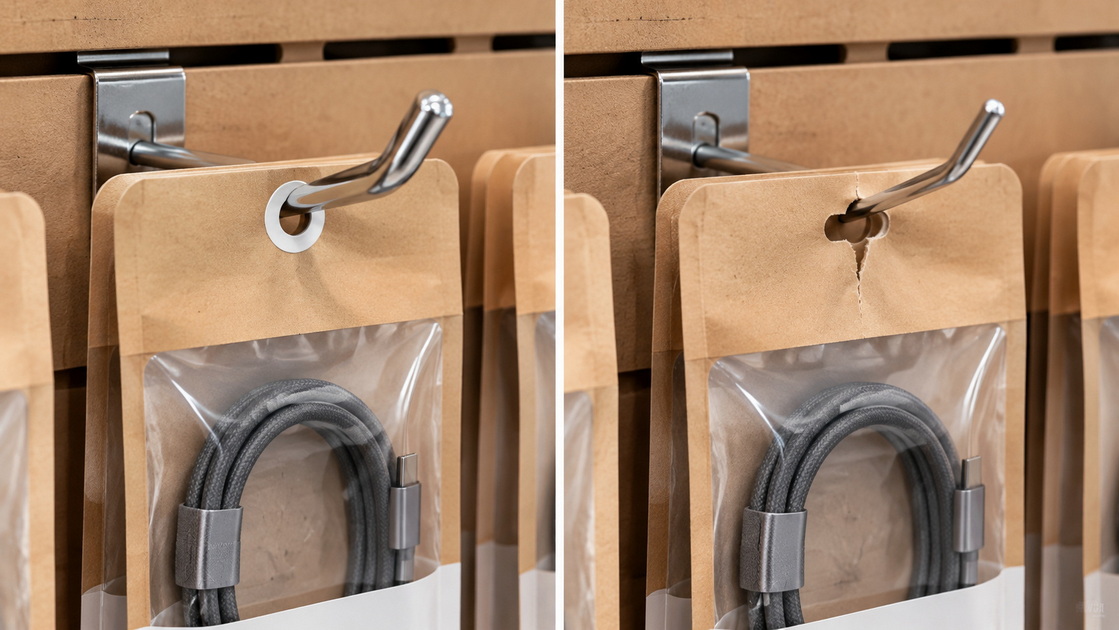
A hook can remain intact while the merchandise packaging fails.
A narrow hook may damage a weak hang hole. A longer hook can place greater leverage on the display panel. Products may also obscure price labels or catch on neighboring packs.
Approve the display and product packaging together.
Record the hook diameter, projection, tip shape, spacing, mounting arrangement, and approved package specification. Prohibit substitutions without written approval.
Also test partly emptied displays. A balanced full unit may behave differently after customers remove stock from one side.
This interface check is often more useful than approving an attractive empty prototype.
Use a staged approval process:
1. Confirm the contracting entity and production address.
2. Review a live factory walkthrough and identify outsourced processes.
3. Approve a structural prototype.
4. Test a decorated, production-representative sample.
5. Retain a signed reference sample and material specification.
6. Inspect finished goods against agreed sampling and defect criteria.
For logistics, compare flat-packed, assembled, and preloaded options using total landed cost and store labor.
Document carton dimensions, pallet configuration, moisture protection, Incoterms, importer responsibilities, and delivery appointments. Have a customs broker confirm classification and applicable import conditions rather than copying a previous shipment's tariff code.
Australian suppliers can offer local coordination and fixture-system support. Overseas manufacturers can be appropriate for customized promotional displays and integrated packaging programs.
Long Win Display is a relevant starting point for brands seeking custom POP development, preloading, and practical material optimization.
Match the supplier's legal name, address, scope, certificate number, and expiry date. Check the issuing certification body and IAF CertSearch where applicable. If records cannot be reconciled, contact the issuer directly; a PDF alone is insufficient.
Not automatically. Confirm the supplier's valid chain-of-custody scope and the transaction documentation supporting the specific product claim. Do not assume that purchasing certified raw material authorizes every downstream label.
Your agreement should define approved materials, permitted tolerances, inspection methods, substitution controls, and remedies. Request batch traceability and production inspection records. A reference sample is valuable only when its construction is documented.
Include freight, import charges, inspection, storage, assembly, store distribution, replacement stock, and failure costs. Compare identical specifications and responsibilities. A low ex-factory price can become expensive when store staff must repair or assemble the fixture.
Specify ownership of structural drawings, artwork, cutting tools, molds, and production files in the purchase agreement. State whether the supplier may reuse the design and whether tooling can be transferred if the relationship ends.
1. [Long Win Display Shenzhen Limited — Our Company]. Primary source for the company timeline, Shenzhen headquarters, Yiwu production information, product categories, preloading, cooperating factories, geographic markets, and stated production figures. Figures are supplier-reported, not independently audited. [longwindisplay])
2. [Shenzhen XingKun Packing Products Co., Ltd. — About Us] and [Company Website]. Sources for the registered company name, 2004 establishment statement, display range, customization services, international reach, and certification claims. [xkdisplay]
3. [Xianda Printing Co., Ltd. — Company Website]. Source for packaging capabilities and the conflicting establishment and location statements identified in the article. Dedicated hook-display manufacturing capability was not established. [xiandagiftbox]
4. [Maituohong Packaging — Company Website]. Source for its Shenzhen location, experience claim, POP display listing, quality-control descriptions, market positioning, and certification claims. Exact founding date and full registered entity name require confirmation. [mthpackagingbox]
5. [Bonito Packaging — Company Website]. Source for packaging specialization, international customer coverage, customization, and the advertised 100-unit packaging starting quantity. This quantity is not evidence of a hook-display MOQ. [bonitopack]
6. [SI Retail — Official Website]. Source for its 1974 history, Australian ownership, display-hook systems, custom retail displays, locations, and customer categories. [siretail]
7. [SI Retail Pty Ltd — Industry Directory Profile]. Supplementary source identifying the company's full legal-style name and retail display activities. [spec-net.com]
8. [Mills Group — Official Website]. Source for its 1958 origins, Australian and UK operations, three Australian factories, fabrication processes, sourcing, and retail execution services. [millsgroup.com]
9. [Australian Bureau of Statistics — Retail Trade, Australia, June 2025]. Official source for June 2025 seasonally adjusted retail turnover of A$37,906.6 million and 4.9% annual growth. These are retail figures, not display-manufacturing or export statistics. [abs.gov]
10. [Shopping Centre Council of Australia — June 2025 Retail Trade Research Note]. Industry-association commentary published July 31, 2025, distinguishing trend and seasonally adjusted retail performance. [scca.org]
11. [IAF CertSearch — Certificate Search]. Verification resource covering certificate status, organization, scope, certification body, and accreditation information. [iafcertsearch]
12. [Danish Environmental Protection Agency — Electrical and Electronic Equipment: RoHS]. Government guidance supporting the distinction between RoHS requirements for electrical/electronic equipment and ordinary passive fixtures. [eng.mst]
13. [myDPP — Which Products Require CE Marking?]. Supplementary explanation of product-specific CE marking obligations and why ordinary furniture and packaging do not automatically require the mark. [mydpp]


