
Views: 235 Author: Long Win Display Publish Time: 2026-08-06 Origin: Site


Content Menu
● How to Evaluate a Quality Counter Display Supplier
● Technical Considerations for Counter Displays
>> Process Standards and Finishing
>> Compliance and Sustainability
● Australia's Role in Counter Display and Retail Fixtures
● Leading Counter Display Manufacturers and Suppliers Connected with Australia
>> Long Win Display (China, Global Counter Display Partner)
>> XK Display (China – Counter Display and POP Stand Solutions)
>> Xianda Gift Box (China – Packaging‑Led Counter Displays)
>> MTH Packaging Box (China – Structural Packaging and Counter Units)
>> Bonito Pack (China – Printed Packaging and Display Components)
>> Popform (Australia – Local POP Display and Counter Units)
● Comparative Overview of Supplier Focus
● Common Sourcing Pitfalls and Internal Avoidance Tips
● Buyer's Guide: Verifying Factories and Managing Counter Display Projects
>> Verifying Factory and Documents
>> Sample and Pilot Procedures
>> Logistics, Packing, and Delivery
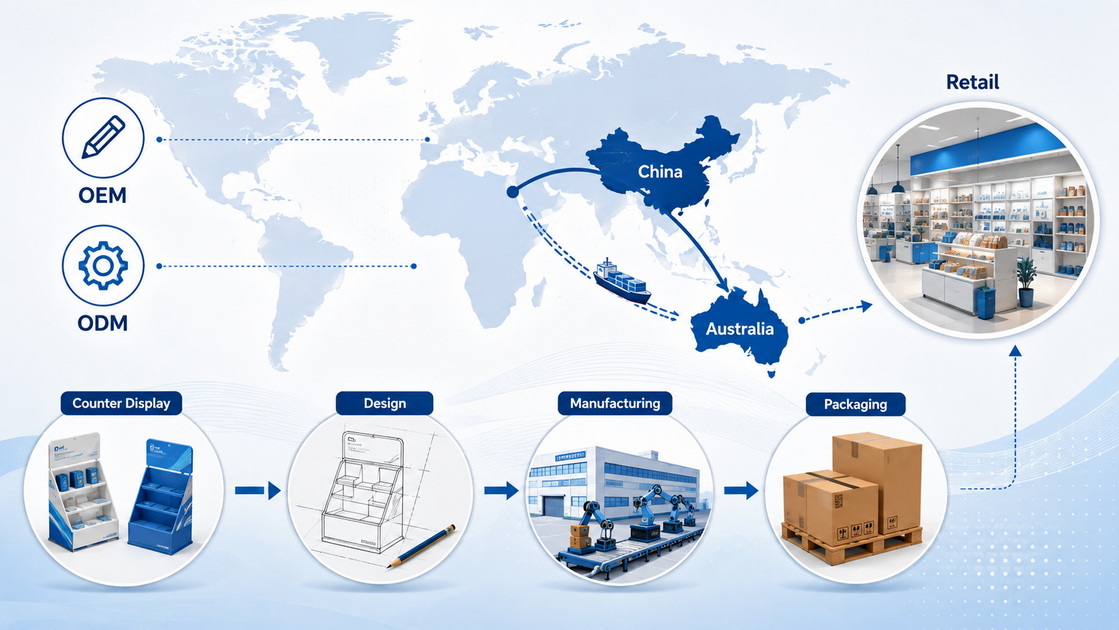
For global buyers, counter displays have become a critical part of in‑store branding and category management. Instead of simple cardboard structures, procurement teams now look for engineered countertop units that combine visual impact, durability, and cost control. Based on extensive experience with POP display projects and long‑term OEM and ODM cooperation, this guide reviews key counter display manufacturers and suppliers connected with the Australian retail market, outlines practical selection criteria, and shares internal sourcing insights that are rarely discussed publicly.
Choosing a reliable counter display partner starts with a clear evaluation framework. Professional buyers typically focus on four dimensions:
Factory certification and compliance
Suppliers should provide valid and recent factory certifications, such as ISO‑style quality systems and documented environmental policies. Product‑level compliance, including material safety and electrical conformity where displays integrate lighting, should be supported with test reports and clear records.
R&D and structural design capability
Strong display partners support more than printing and cutting. They can develop structural drawings, optimize dielines, conduct load‑bearing tests, and refine assembly methods for store staff. This design capability determines whether a display will perform well in real retail conditions.
QC and process control
Reliable factories maintain consistent incoming material inspection, in‑process checks, and final inspection procedures. Clear documentation of color checks, dimension control, and packaging standards reduces the risk of deformation, color deviation, and transit damage.
Supply reliability and lead time stability
Stable production planning and realistic lead time commitments are vital for campaign launches and seasonal promotions. Suppliers that provide transparent capacity information and communicate early about risks are easier to work with over multiple cycles.
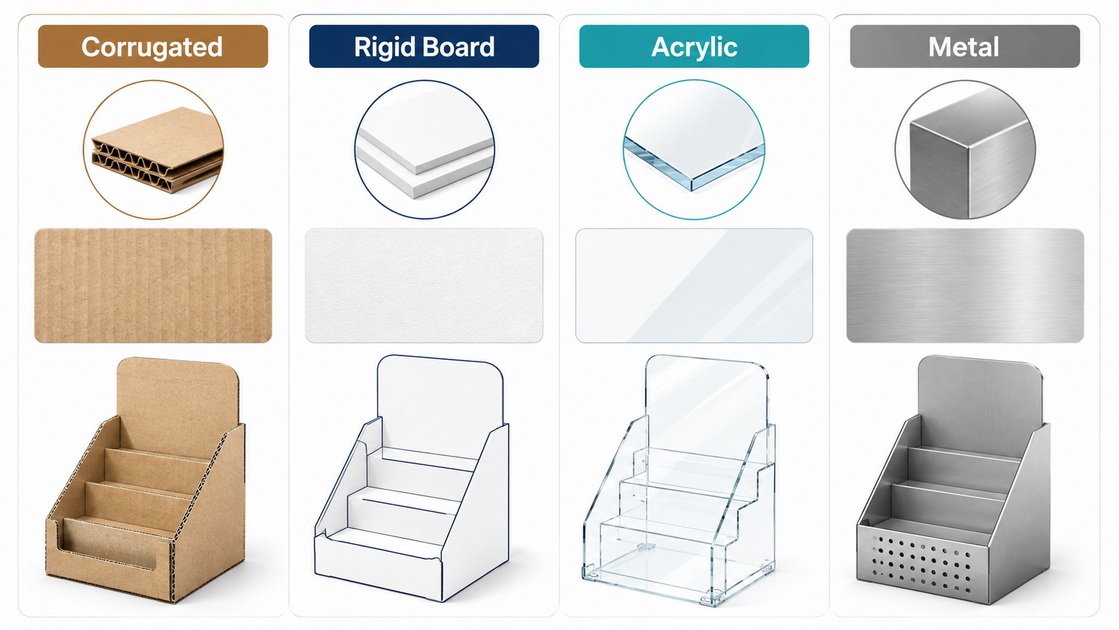
Industrial countertop units typically use a combination of:
- Corrugated cardboard (E‑flute, B‑flute, F‑flute) for temporary and short‑term campaigns.
- Rigid board and specialty paperboard for premium presentation units.
- Acrylic, metal, MDF, or PVC foam for semi‑permanent or permanent counters in cosmetics, electronics, and beverages.
- Special coatings and inks where moisture resistance, food contact, or specific retail requirements apply.
Material grade has a direct impact on load capacity, appearance after several weeks in store, and the risk of edge curling or structural collapse. Large retail chains often define minimum board grades and basic mechanical tests in their specifications.
Key process and finishing aspects include:
- Precision die‑cutting and creasing for clean folds and quick assembly.
- Offset or high‑quality digital printing with controlled color profiles for brand consistency.
- Surface treatment such as lamination, varnish, or film to reduce scuffing and improve resistance to humidity.
- Pre‑assembly and pre‑loading services when displays must reach distribution centers ready to be placed on counters.
Suppliers that can document these standards and share sample inspection data build confidence for repeated campaigns.
Retailers increasingly expect:
- Recyclable and lower‑impact materials for temporary displays.
- Conformity with internal policies on plastic content and waste reduction.
- Compliance for any integrated lighting modules or electrical components.
At the same time, the global point‑of‑purchase display market continues to expand, driven by brand investment in in‑store visibility and consumer engagement. This environment favours suppliers that combine manufacturing efficiency with transparent sustainability practices.
Australia has a mature retail system with strong investment in commercial fixtures, including shelving, signage, and POP elements. The commercial display segment is projected to grow steadily over the coming years, reflecting ongoing store upgrades and the integration of physical retail with online channels.
From a procurement perspective, this means:
- National and regional chains continue to upgrade in‑store presentation, creating demand for well‑engineered counter units.
- Brands use countertop displays for new launches, seasonal promotions, and targeted campaigns at checkout and service counters.
- Buyers combine local service providers for fast turnaround and installation with international manufacturers for volume production and specialized structures.
Understanding this context helps procurement teams decide whether to rely primarily on domestic partners or integrate overseas manufacturing into their supply strategy.
Long Win Display is a China‑based POP display designer and manufacturer specializing in countertop display stands, floor display units, and packaging‑linked displays. With years of experience in global projects, the company focuses on:
- Design and customization of counter displays in cardboard, rigid board, and mixed materials.
- Deep support for OEM and ODM programs, including structure development, artwork adaptation, and campaign planning.
- Pre‑assembly and pre‑loading services, which simplify rollout for brands and distributors by delivering ready‑to‑place units.
Long Win Display is well positioned for small and medium brands and regional distributors entering or expanding in Australian retail. Its flexible approach to minimum order quantities, efficient communication, and emphasis on engineering support makes it suitable for long‑term cooperation where counter displays need to be adapted repeatedly across categories and campaigns.
Website: www.xkdisplay.com
XK Display focuses on POP display stands, including counter units and floor stands commonly used in retail and promotional environments. Typical strengths include:
- Capability to produce custom cardboard counter units with branded graphics and tailored structures.
- Experience in high‑volume temporary displays, often for fast‑moving consumer goods.
- Emphasis on cost‑effective solutions, making them attractive for short‑term promotions and trial programs.
Buyers who prioritize unit cost and volume for impulse and seasonal campaigns often consider XK Display for projects where simple structures and rapid turnaround are more important than complex engineering or high levels of pre‑assembly.
Website: www.xiandagiftbox.com
Xianda Gift Box is primarily a gift box and premium packaging producer, but their capabilities frequently extend into counter display formats, especially for beauty, luxury food, and gifting. Core strengths:
- Detailed work on rigid boxes and presentation packaging that can be configured as countertop units.
- Custom finishes such as embossing, foil, and special coatings that support premium positioning.
- Integrated approach where packaging and display are designed as a unified brand experience.
For brands that need counter displays to function as part of high‑end packaging, Xianda Gift Box offers a packaging‑centric path that can deliver upscale countertop units aligned with primary product presentation.
Website: www.mthpackagingbox.com
MTH Packaging Box operates at the intersection of packaging engineering and display design. Their typical projects include:
- Structurally optimized cartons and boxes that convert into counter displays.
- Balancing protective packaging needs with effective in‑store presentation.
- Support for export projects with clear documentation and tooling coordination.
This approach is particularly valuable when counter space is limited and packaging must perform double duty as a compact display, reducing material use and simplifying the supply chain.
Website: www.bonitopack.com
Bonito Pack specializes in printed packaging and display components that contribute to branded countertop presentations. Key capabilities:
- High‑quality printing and finishing across cartons, inserts, and small display elements.
- Color management and alignment between packaging and display graphics.
- Project support for international buyers seeking integrated visual consistency.
When display requirements are tightly linked to packaging aesthetics, Bonito Pack can support counter display programs where the unit and packaging must share a cohesive graphic language and finish profile.
Website: www.popform.com.au
Popform is an Australian company managing the design, production, and distribution of POP displays, including counter displays, floor stands, and complete merchandising systems. Its advantages for the Australian market include:
- Direct familiarity with local retail standards and store formats.
- Fast design and prototyping cycles for campaigns and category updates.
- Ability to deliver integrated retail solutions, combining countertop units with other fixtures and signage.
For international brands entering Australian retail or launching regional campaigns, Popform provides local alignment and in‑store execution, while overseas manufacturers such as Long Win Display can supply large‑volume display components.
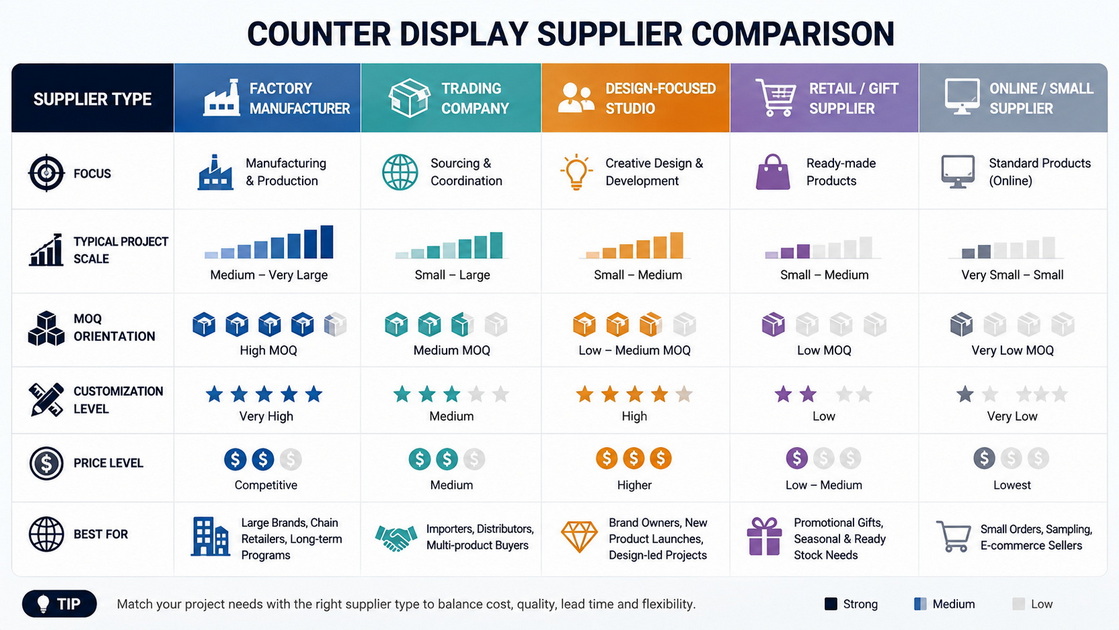
The table below offers an indicative comparison of key attributes. Exact values depend on specific projects and must be confirmed directly with each supplier.
| Supplier | Main Focus | Typical Project Scale | MOQ Orientation | Key Strengths |
|---|---|---|---|---|
| Long Win Display | Custom POP and counter display stands | Mid to large global campaigns | Flexible, SME‑friendly | Design depth, OEM/ODM support, pre‑assembly |
| XK Display | Cardboard counter and floor displays | High‑volume temporary campaigns | Medium to high MOQs | Cost‑efficient structures, mass production |
| Xianda Gift Box | Premium packaging and box‑style displays | Mid‑size, high‑value items | Project‑based, design‑driven | Luxury finishing, packaging‑display integration |
| MTH Packaging Box | Structural packaging that doubles as display | Medium volume, engineered packs | Negotiable based on structure | Structural optimization, protective presentation |
| Bonito Pack | Printed packaging and display elements | Medium campaigns and brand sets | Medium MOQs, branding focus | Print quality, color consistency across materials |
| Popform | Local POP systems for Australian retail | Regional chain campaigns | Retail‑project dependent | Local design, in‑store alignment, full POP systems |
One issue often discussed privately among experienced buyers is material downgrading. Display projects might be quoted using a certain board grade or grammage, but production can switch to lower‑grade material to reduce costs. Effects include:
- Loss of structural stability after a short period in store.
- Warping edges and visibly weakened display walls.
- Increased risk of displays collapsing when heavily loaded.
An effective countermeasure is to request material specification sheets and sample board swatches and to conduct random thickness and grammage checks on delivered displays. Over time, any systematic deviation becomes visible.
Displays that look impressive in renderings can be too complex for store staff to assemble. Internal feedback from merchandisers often highlights:
- Excessive folding steps or unclear instructions.
- Missing or weak locking tabs.
- Increased assembly time, causing incomplete or incorrect setups.
One practical internal guideline is to run assembly tests with non‑technical staff before approving designs. If assembly cannot be completed quickly and correctly without detailed guidance, structural simplification should be considered.
Another risk lies in expired or mismatched certifications. Certificates may reference an older factory address or a previous legal entity.
Experienced buyers routinely ask for original certificate copies showing issue and expiry dates and verify them through certification body websites or direct contact. Any inconsistencies trigger deeper investigation before proceeding.
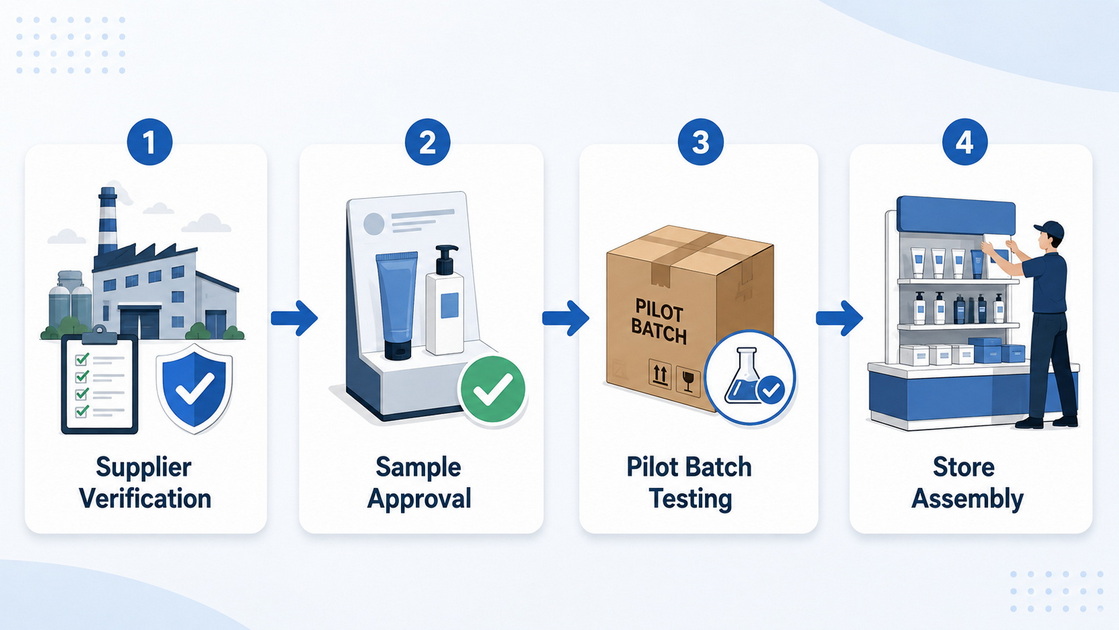
A structured verification process typically includes:
- Checking company registration and scope through recognized registries or platforms.
- Requesting a factory profile with equipment list, floor layout, and production photos.
- Reviewing recent quality audit summaries and process descriptions.
- Conducting remote video tours or on‑site audits when possible.
This approach helps confirm that the factory environment matches the representation in proposals and sales materials.
Before committing to full production:
- Approve unprinted structural samples to confirm dimensions and assembly.
- Review printed samples for color accuracy and finishing quality.
- Run pilot batches to check stability under realistic loading and handling.
Keeping structured feedback from these stages builds a clear reference for later mass production.
Counter displays are often shipped flat‑packed and may be combined with product or sent separately. Key logistics checks include:
- Confirming carton dimensions and packing method to match warehouse and retailer requirements.
- Assessing protection measures for high‑risk elements such as fragile printed surfaces and locking tabs.
- Aligning delivery schedules and Incoterms with campaign timelines and distribution plans.
Clear agreements on these points reduce damage, handling issues, and timing conflicts.
Counter displays play a central role in how brands present products at retail in Australia and beyond. For procurement teams, selecting manufacturers and suppliers involves a balance between cost, design capability, production reliability, and alignment with retail requirements.
By focusing on factory certification, structural design, QC processes, and supply reliability, buyers can identify partners able to deliver consistent countertop units across multiple campaigns. Combining overseas manufacturing expertise from companies like Long Win Display and related packaging‑display specialists with local Australian POP service providers creates a robust supply network that supports both speed and scale. Over time, this approach helps brands maintain stable in‑store presence and manage display investments effectively.
1. How can I confirm whether a supplier's ISO certificate is still valid?
Request the latest certificate showing the issue date, expiry date, and certification body. Then verify the certificate number via the certifier's official website or customer service. If the certificate lists a different factory address or legal entity than the current supplier, ask for an explanation.
2. What is a practical method to test the load capacity of a cardboard counter display?
Place the expected product quantity in the display, simulate typical handling and vibration, and observe performance over several days. Check for sagging shelves, deformed panels, or failure at joints. For large campaigns, consider lab testing for compression and stacking strength.
3. How can I keep color consistent between packaging and counter displays across multiple runs?
Use standardized color references, approve master print proofs, and record key print settings. Ensure that the same or compatible printing technology is used and keep a color history for each brand or campaign so variations can be traced and corrected.
4. What clauses should be included in OEM and ODM contracts for counter displays?
Contracts should cover design ownership, tooling and die‑cut rights, revision procedures, quality criteria, lead time commitments, and handling of defective goods. Clear terms on change orders, extra costs for urgent changes, and dispute resolution mechanisms are also important.
5. How can I combine local Australian POP services with overseas manufacturing without losing control?
Define responsibilities precisely: use local partners for design adaptation, store‑specific requirements, and installation, while assigning high‑volume production to overseas manufacturers. Maintain shared specifications, joint QC checklists, and regular coordination meetings to ensure alignment across all parties.
1. Long Win Display – Company Profile and POP Display Capabilities
[https://www.longwindisplay.com/]
2. XK Display and Related POP Counter Display Listings
[https://www.made-in-china.com/products-search/hot-china-products/Pop_Counter_Displays.html]
3. Xianda‑Related Packaging and Counter Display Solutions
[https://www.cardboard-display-stand.com/]
4. Popform – POP Displays and Merchandising Systems in Australia
[https://www.popform.com.au/pop-displays]
5. Global Point of Purchase Display Market Projection
6. Australia Retail Display Sector and Commercial Fixture Trends
7. Point‑of‑Purchase Displays Market Outlook
[https://www.persistencemarketresearch.com/market-research/point-of-purchase-pop-displays-market.asp]


