
Views: 272 Author: Long Win Display Publish Time: 2026-07-18 Origin: Site


Content Menu
● How to Evaluate High‑Quality Cosmetic Display Stand Suppliers
● The UK's Role in Cosmetic Display Stand Manufacturing
● Top Cosmetic Display Stand Manufacturers and Suppliers in UK (Plus One Strategic Partner)
>> 1. Long Win Display (China) – Strategic Manufacturing Partner for Global Cosmetic Displays
>> 2. JC Metalworks (UK) – Bespoke Metal Cosmetic Display Stands
>> 3. Luminati (UK) – Acrylic Countertop Cosmetic Displays
>> 4. Wrights Plastics (UK) – Sustainable Cosmetic Display Solutions
>> 5. Additional UK and European Cosmetic Display Resources
● Capacity, MOQ and Certification Considerations
● Industry Pain Points and How to Avoid Them
>> Material downgrades and substitutions
>> Inconsistent finishing and colour
>> Over‑complex assembly at store level
>> Hidden logistics and handling constraints
● Insider Pitfall: Silent Tooling Reuse
● Buyer's Guide: Practical Steps for Procurement Managers
>> Step 1: Define technical and commercial requirements
>> Step 2: Build and filter a supplier longlist
>> Step 3: Verify credentials and gather evidence
>> Step 4: Develop and test samples
>> Step 5: Plan logistics and rollout
>> Step 6: Monitor performance and improve
The UK has become an important hub for premium cosmetic display stands, especially for brands targeting European retail channels and higher‑end beauty segments. This guide looks at practical selection criteria and profiles several representative UK manufacturers, together with one strategic offshore partner, to help buyers build a reliable medium‑ to long‑term sourcing base.
Serious buyers of cosmetic display stands need a structured approach that goes beyond catalog browsing or trade‑show impressions. A robust evaluation framework should focus on three pillars: factory credentials, operational capability, and project communication.
Start by checking whether the manufacturer operates its own production facilities and what certifications are in place. Key points include:
- Documented quality‑management systems, often reflected in formal standards for process control and traceability.
- Environmental and safety practices that align with your brand's compliance obligations in target markets.
- Independent audit records, if available, which show real capacity and process discipline rather than outsourced assembly.
Request copies of certificates and audit summaries, and verify that the scope covers the exact plant that will produce your cosmetic display stands.
Cosmetic display stands are multi‑disciplinary products that combine structural stability, aesthetic appeal, and retail practicality. Useful indicators of capability include:
- In‑house design and engineering teams able to read and create technical drawings, not just interpret marketing sketches.
- Experience with mixed materials such as metal, acrylic, wood, glass, and printed graphics, including how these behave in retail environments over time.
- Established processes for prototyping, pilot runs, and full production, with realistic lead times for each stage.
Ask for typical monthly output, peak‑season capacity, and historical on‑time delivery performance over the last 12–24 months.
Even technically strong factories can create problems if communication is weak. Look for:
- Dedicated project managers who can discuss technical requirements, revisions, and packaging in clear English.
- Structured feedback loops that cover drawings, samples, and first production runs.
- A clear escalation path for resolving issues such as design changes, cosmetic defects, or schedule risks.
Factories that respond quickly and consistently to detailed questions usually perform better under pressure during major retail launches.

The UK is not a classic mass‑production base, but it has strong industrial clusters in precision metalwork, plastics, and retail display design. This combination makes it attractive for brands and retailers that value design quality, controlled volumes, and proximity to European stores.
Several features characterise the UK cosmetic display stand landscape:
- Precision sheet‑metal and fabrication companies in central regions produce robust, custom metal displays for beauty and health‑and‑beauty chains.
- Acrylic specialists design and manufacture countertop and tester units for makeup, skincare, and perfume brands, often in close collaboration with retail design agencies.
- Retail point‑of‑sale specialists combine structural design, shopper‑flow understanding, and material know‑how to deliver complete display programs, from concept to installation.
For global procurement managers, UK suppliers are particularly useful when a project demands European production, short lead times within the region, and designs tailored to local retail formats.

Long Win Display is a China‑based specialist in countertop display stands and broader point‑of‑purchase solutions. Its relevance to UK‑focused buyers lies in the combination of engineering‑driven OEM/ODM services and competitive production costs, which make it a practical manufacturing backbone for projects initiated by UK or European design agencies.
Long Win Display works across design, customisation, production, and pre‑assembly of cosmetic display stands. Typical projects include countertop makeup stands, floor units for multi‑brand zones, testers and sample displays, and coordinated campaigns that must roll out across multiple retail chains. The company emphasises:
- R&D and engineering support, helping brands and agencies translate design concepts into structurally sound, manufacturable solutions.
- Flexible handling of small and mid‑sized brands, with MOQs that accommodate pilot programs and phased launches rather than requiring only very large orders.
- Integrated production flows, which support stable quality and predictable lead times for repeat campaigns.
For procurement managers, Long Win Display is useful when they want to keep creative and project control near the target market while using offshore capacity to scale production volumes. The company typically aligns materials and finishing processes with the compliance requirements of target markets, and works with clients to meet relevant safety and environmental expectations.
JC Metalworks, based in Loughborough, is a long‑established precision manufacturer of custom metal displays. It produces bespoke cosmetic display stands, units, and holders tailored to the requirements of retailers and beauty brands.
JC Metalworks combines:
- Sheet‑metal fabrication, wire and tube work, and integration with acrylic and printed components.
- In‑house finishing, including powder‑coating for brand‑specific colours and durable surfaces suitable for high‑traffic stores.
- Structured inspection procedures, with checks at key production steps and verification of technical specifications before dispatch.
The company frequently collaborates with retail design agencies and brand teams to turn design intent into robust hardware suitable for installation across multiple stores. Buyers who need metal‑intensive cosmetic displays—such as free‑standing units, wall bays, and heavy‑duty testers—can benefit from this focus on structural integrity and finishing consistency.
Luminati is a UK manufacturer specialising in acrylic retail displays, including a broad range of cosmetic countertop stands. It offers both catalog products and custom solutions.
Standard ranges cover makeup displays, perfume stands, sample plinths, and storage units designed for counters, salons, and beauty corners. Custom projects extend this range by incorporating unique branding, forms, and lighting to match client requirements. Key attributes include:
- Deep expertise in acrylic fabrication, from cutting and polishing to bonding and shaping.
- Attention to clarity and edge quality, which is critical for premium cosmetic presentations.
- UK‑based production, enabling shorter lead times and easier alignment with UK and nearby European retail calendars.
Luminati can be particularly effective for buyers focusing on smaller footprint displays, testers, and promotional units that must be visually clean and brand‑consistent across multiple locations.
Wrights Plastics is a specialist in retail point‑of‑sale displays with a notable emphasis on sustainability. Its cosmetic display solutions target brands and salons that want to combine visual impact with more environmentally conscious materials and processes.
The company's approach typically includes:
- Use of recyclable plastics and efforts to reduce waste in cutting and forming operations.
- Design of displays that balance brand presentation, shopper interaction, and ease of installation in stores and salons.
- End‑to‑end services covering design, manufacture, and often logistics support, which simplifies rollout management for buyers.
For procurement managers, Wrights Plastics is a useful option when sustainability targets are explicit, or when retailers demand evidence of more responsible materials and production methods for in‑store fixtures.
Beyond these named manufacturers, buyers can use several business‑to‑business platforms and directories to map the wider supplier landscape. These platforms list multiple companies offering cosmetic displays and related stands across the UK and Europe. They are useful as a starting point for longlists and for gathering basic information on company size, activity, and product scope before conducting deeper evaluations.
When using such platforms, it is important to treat them as initial discovery tools rather than as proof of competence. Serious projects should still proceed through direct factory visits, audit reports, and sample evaluations.
Although exact figures vary by project, several common patterns are useful for early planning:
- Offshore OEM specialists often provide higher overall capacity and more flexible MOQs, especially for brands that need phased launches across multiple countries.
- UK metal and acrylic manufacturers tend to work on a project basis, with MOQs defined by economic batch sizes rather than rigid catalog rules.
- Cosmetic‑focused UK manufacturers frequently align with quality and environmental standards expected by European retailers and brand owners, but confirmation should always be requested at project level.
During initial discussions, ask each supplier to outline typical monthly output for cosmetic displays, minimum economic order quantities for new tooling, and how certification and testing are handled for new designs and material combinations.

Purchasing cosmetic display stands exposes buyers to several recurring challenges. Recognising these upfront can prevent costly mistakes.
One common problem is unapproved material changes. Examples include reducing acrylic thickness, switching to lower‑density wood panels, or changing metal gauge without proper notification. These changes can lead to warping, instability, or premature wear in retail environments.
Mitigation steps:
- Lock material specifications, including grade, thickness, and surface requirements, in signed technical documents.
- Require pre‑production samples that use production‑intent materials, and test these under realistic loads and handling.
- Perform random incoming inspections on delivered batches to verify that materials match agreed specifications.
Cosmetic displays rely heavily on surface quality, colour matching, and print clarity. Inconsistent powder‑coating, uneven gloss levels, and poorly aligned graphics can undermine brand presentation.
Mitigation steps:
- Define colour standards using recognised systems and keep master samples for reference.
- Approve finishing samples before full production and use them as the benchmark for incoming inspection.
- Encourage suppliers to retain controlled samples from each batch to support objective comparisons when issues arise.
Displays that look impressive in renderings can turn into burdensome assemblies for store staff. Excessive parts, unclear instructions, or tool‑dependent steps increase the risk of incorrect assembly and damage.
Mitigation steps:
- Insist on assembly trials that simulate real store conditions, including limited time and personnel.
- Specify pre‑assembly of certain sub‑assemblies at the factory, where practical.
- Provide clear, visual assembly guides, preferably included in the packaging and accessible digitally.
Large or irregularly shaped displays can conflict with retailer requirements for palletisation, back‑room storage, or in‑store handling. This may lead to unexpected charges, delays, or even rejection of displays at distribution centres.
Mitigation steps:
- Design displays within standard pallet footprints and consider carton sizes that fit retailer guidelines.
- Validate packaging designs to protect fragile components such as acrylic and coated metal surfaces.
- Align shipment timing and consolidation rules with retailer delivery windows at the planning stage.
A lesser‑discussed but important risk is silent reuse or modification of tooling between projects. To reduce internal cost, some manufacturers may adapt existing jigs or fixtures from previous work instead of building tooling exactly as specified for a new project. While the differences are often small, they can affect:
- How products fit into recesses or slots designed for testers and primary packs.
- The alignment of printed graphics or branding elements with physical features of the stand.
- The repeatability of dimensions across batches.
To address this:
- Require clear documentation of tooling numbers linked to your project.
- State that any significant tooling changes must be approved in writing, with new samples supplied before further mass production.
- Use dimensioned inspection reports during first article and subsequent batches to detect deviations early.
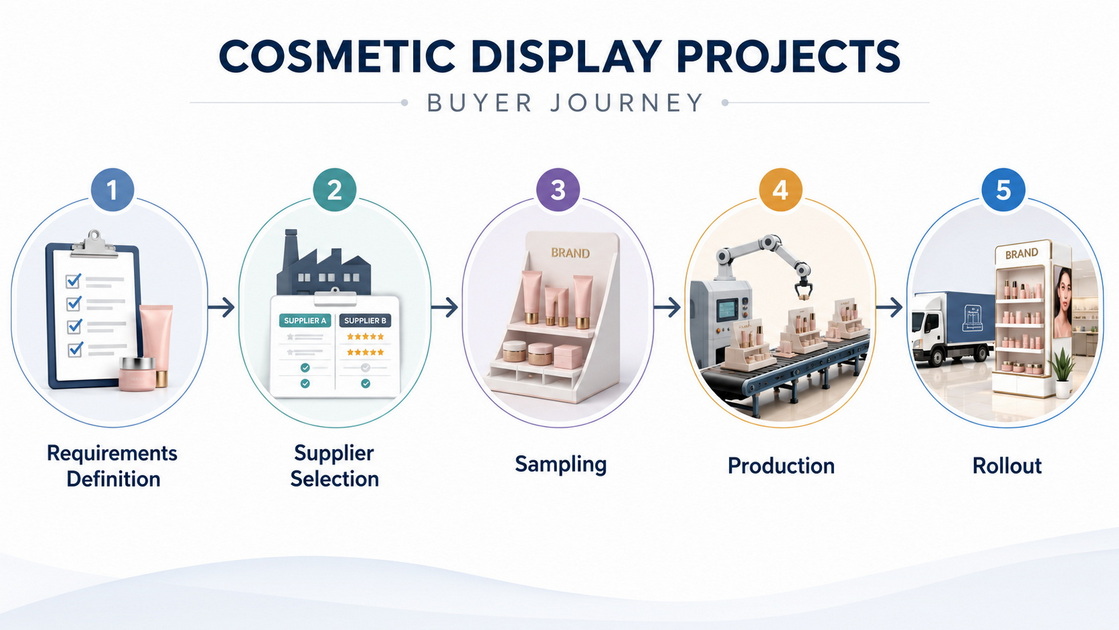
The following practical steps can help procurement teams move from supplier mapping to stable, long‑term cooperation.
Clarify what the display program must achieve:
- Product categories and SKUs per stand, including future expansion room.
- Preferred materials, visual style, durability expectations, and any lighting or interactive elements.
- Target markets, store types, and retailer requirements that will influence size, load limits, and signage.
Put these requirements into a concise specification document and use it consistently when discussing with suppliers.
Combine direct manufacturer research with directory searches to create an initial list. Then filter based on:
- Demonstrated experience in cosmetic or beauty displays.
- Manufacturing capabilities compatible with your chosen materials and formats.
- Geographic fit with your logistics plans.
Eliminate suppliers that cannot provide recent project examples or that rely entirely on third‑party workshops for critical processes.
For shortlisted suppliers, ask for:
- Copies of relevant certifications and a brief description of their quality‑control process.
- At least two recent case studies in cosmetic or beauty‑related displays.
- Information on typical lead times and capacity ranges for projects similar to yours.
Where possible, cross‑check public information with what appears in official registers or reputable business‑information sources.
Work collaboratively to develop detailed drawings and renders, then request samples that reflect production‑intent materials, tooling, and finishing. Evaluate samples for:
- Structural integrity and load‑bearing capacity.
- Surface quality, colour consistency, and graphics alignment.
- Ease of assembly and packing‑to‑installation flow.
Use structured feedback to refine the design before committing to full tooling and mass production.
Once designs and suppliers are chosen:
- Agree packaging specifications that protect displays while meeting retailer handling rules.
- Plan shipment batches, consolidation points, and delivery windows with the supplier's logistics team.
- Establish performance indicators for on‑time delivery, defect rates, and store feedback.
For mixed sourcing models—such as UK design combined with offshore manufacturing—ensure that responsibilities and communication paths are clearly mapped.
After rollout, collect feedback from stores and field teams about assembly, durability, and shopper interaction. Use this data to:
- Fine‑tune future production runs and design variants.
- Adjust quality standards if recurring issues appear.
- Decide whether to deepen cooperation with the current supplier base or explore alternatives.
1. How can I confirm that a factory's quality‑management certification is current and covers the right site?
Request a complete certificate copy and check the listed site address, scope, and validity period. If the certificate references multiple sites, confirm that the specific location producing your displays is included.
2. How do I manage compliance for cosmetic displays that include lighting or electronic elements?
Ensure that the design process identifies applicable electrical and substance requirements early. Ask for test reports and declarations specific to the final display configuration, not generic components alone, and integrate these documents into your internal compliance files.
3. What is a practical way to combine UK‑based design with offshore mass production without losing control?
Keep ownership of master drawings, specifications, and revision control within your organisation. Let UK partners handle design and prototyping, then brief offshore manufacturers with the same controlled documents. Regularly synchronise changes across all parties and align sampling from both sides.
4. How can I detect subtle downgrades in material thickness or density across multiple batches?
Create a simple incoming inspection routine that includes random measurement of thickness and, where relevant, density or weight per unit. Compare results to the specifications and to a reference sample kept from the approved first batch.
5. What should I do when different retailers impose conflicting rules on display size, materials, or packaging?
Segment your program into clear variants linked to specific retailers or regions. Use modular design so shared components remain consistent, while dimensions, packaging, or certain materials vary to meet local constraints. Maintain separate documentation for each variant to avoid confusion in production and logistics.
1. Luminati – Cosmetic Display Stands. https://www.luminati.co.uk/retail-point-of-sale/counter-display/cosmetic-displays/
2. JC Metalworks – Cosmetic Display Stands. https://www.jcmetalworks.co.uk/bespoke-metal-work-solutions/retail-display/cosmetic-display-stands/
3. Wrights Plastics – Cosmetic Display. https://www.wrightsplastics.co.uk/cosmetic-display/
4. Europages – Display Stands for Cosmetics. https://www.europages.co.uk/en/showroom/display-stands-for-cosmetics
5. Europages – Cosmetic Display Manufacturers. https://www.europages.co.uk/companies/manufacturer%20producer/cosmetic%20display.html
6. Kompass – Display Stands Companies in England. https://gb.kompass.com/a/display-stands/56780/r/england/gb_gbr09/page-3/
7. POP Display for Cosmetics & Personal Care Market Overview. https://www.360iresearch.com/library/intelligence/pop-display-for-cosmetics-personal-care
8. Long Win Display – Company Information. https://www.longwindisplay.com/our-company.html#joBorKojirjiriinkrm


