
Views: 242 Author: Long Win Display Publish Time: 2026-07-12 Origin: Site


Content Menu
● How to Evaluate a High-Quality Cosmetic Display Supplier
● Technical Essentials for Cosmetic Display Stands
>> Compliance and Environmental Considerations
● Why Australia Matters in Cosmetic Display Manufacturing
● Top Cosmetic Display Stand Manufacturers and Suppliers in Australia
>> 1. Long Win Display (China) – Supporting Australian and Global Buyers
>> 2. R&T Plastic Fabricators (Sydney) – Australia
>> 3. A.C. Acrylic (Melbourne) – Australia
>> 4. Holland Plastics (Gold Coast) – Australia
>> 5. P&M Plastics (Gold Coast) – Australia
>> 6. Advanced Display Systems (ADS) – Australia
>> 7. Genesis Retail Displays – Australia
>> 8. Australian Plastic Fabricators – Australia
>> 9. Ausfab Group (National Acrylic Fabrication Partner) – Australia
● Snapshot Comparison of Key Suppliers
● Common Pitfalls When Sourcing Cosmetic Display Stands
● Insider "Avoid-the-Pitfall" Tactic (Rarely Discussed)
● Buyer's Guide: Due Diligence, Sampling and Logistics
>> 1. Verifying Factories and Certifications
>> 2. Sampling and Engineering Alignment
● Conclusion and Call to Action
● FAQ
Australia offers a mature ecosystem of cosmetic display stand manufacturers, combining strong acrylic fabrication expertise with rigorous local compliance standards, making it a compelling sourcing base for premium in-store cosmetic merchandising. At the same time, many buyers successfully complement Australian suppliers with cost-efficient partners like Long Win Display in China to balance budget, capacity, and lead time for large-scale roll-outs. [longwindisplay]
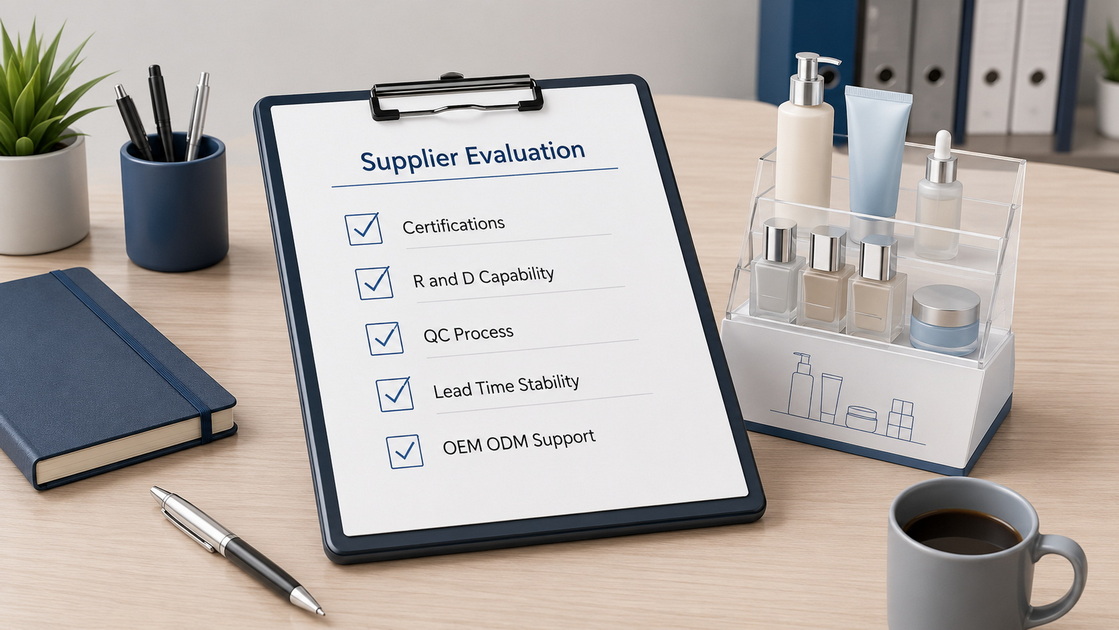
Professional buyers increasingly use a structured, evidence-based framework to shortlist cosmetic display stand manufacturers and suppliers in Australia. The same framework also applies when you introduce an offshore partner such as Long Win Display for hybrid sourcing programs. [longwindisplay]
Key evaluation dimensions include:
- Factory certifications and audits:
- Look for ISO-based quality systems (e.g., ISO 9001) and any industry-specific audits related to plastics fabrication or POP displays.
- For projects involving lighting, verify CE and RoHS coverage on the electrical modules rather than relying on generic certificates.
- R&D and engineering depth:
- Strong vendors can work from brand guidelines, rough sketches or mood boards and turn them into manufacturable cosmetic display structures, including counter-top testers, gondola heads and freestanding units.
- Expect them to ask detailed questions on acrylic type (cast vs extruded), thickness per panel, load requirements per shelf, and print/branding processes.
- Process control and QC:
- Mature factories rely on CNC routing and laser cutting for tight tolerances, coupled with documented QC checkpoints for bonding strength, optical clarity and dimensional accuracy.
- Request sample-based QC data (e.g., pass rates for bubble-free joints, scratch acceptance criteria) at the prototyping phase.
- Material traceability and environmental compliance:
- Insist on material certificates for acrylic, metal and printed components and check compliance with frameworks such as REACH and RoHS for relevant parts.
- For projects shipping into the EU, clarify whether any electronic modules within the display require CE marking and RoHS declarations.
- Capacity, scalability and lead time stability:
- Australian suppliers such as Ausfab Group and Advanced Display Systems typically handle both custom projects and national retail roll-outs, making capacity planning data critical.
- For global programs, many buyers dual-source with Australian and Chinese factories to combine agile local support with high-volume offshore capacity. [longwindisplay]
Cosmetic display stands look simple in-store, but technical details around materials, processes and certification directly impact lifetime performance and compliance. When you are building a long-term supplier base in Australia, aligning on these fundamentals early can prevent costly redesigns later.
- Acrylic grades (cast vs extruded)
- Premium cosmetic displays benefit from cast acrylic, which offers better optical clarity, cleaner flame-polished edges and higher scratch resistance compared with extruded sheets.
- For price-sensitive fixtures, extruded acrylic may still be acceptable, but you should explicitly specify which components can use it and under what conditions.
- Thickness and structural design
- Common retail display thicknesses range from 3 mm to 10 mm depending on load requirements and panel spans.
- Under-engineered shelves can warp or crack over time, so suppliers should perform basic load calculations and, for large programs, share simple engineering rationales or test reports.
- Hybrid materials
- Many Australian manufacturers combine acrylic with metal frames or MDF carcasses to improve rigidity and reduce acrylic usage.
- For cosmetic brands, this allows you to mix clear acrylic testers with powder-coated steel bases or branded wooden back panels while maintaining structural stability.
- Cutting and forming
- High-quality cosmetic displays are typically produced with laser cutting or CNC routing followed by heat bending or drape forming for curves.
- Tight tolerance control is critical for multi-component assemblies, especially when trays must align perfectly with cosmetic SKUs and testers.
- Bonding and edge finishing
- Solvent bonding is common for general-purpose fixtures, while UV bonding is preferred where joint transparency is paramount.
- Edge finishes (as-cut, flame-polished, diamond-polished) should be specified per visible edge type, as they significantly influence perceived quality in beauty retail environments.
- Regulatory context in Australia
- Cosmetic products sold in Australia must adhere to mandatory ingredient labelling standards enforced via the Australian Consumer Law (ACL) and ACCC product safety frameworks. [industrialchemicals.gov]
- While stand structures themselves are not usually regulated as cosmetics, your displays must not interfere with product labelling visibility and must respect any retailer-specific safety standards. [freyrsolutions]
- CE/RoHS and other certifications
- For displays incorporating LEDs, power supplies or digital elements, ensure the electrical assemblies carry relevant CE and RoHS declarations; this is particularly important when supplying international chains.
- Buyers increasingly request documentation on recyclable materials and packaging with reduced plastic content to align with corporate sustainability commitments.
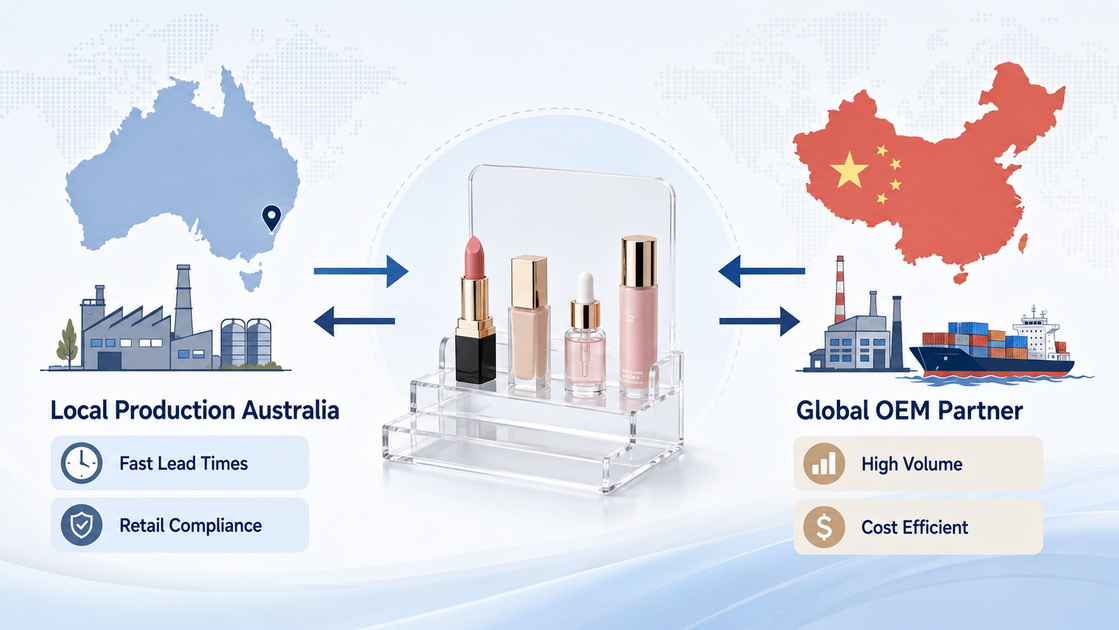
Australia's cosmetic display capabilities sit within a broader plastics fabrication and shopfitting industry that has matured alongside supermarket, pharmacy and specialty beauty chains since the late 1980s. These firms blend plastics engineering with retail fixture know‑how, giving them a strong understanding of beauty merchandising standards and in-store realities.
- Proximity to the market
- Local suppliers work directly with national retailers and brand agencies, making them familiar with store-specific test protocols, labelling visibility standards and OH&S guidelines.
- Shorter lead times and simplified logistics make Australian partners particularly attractive for new launches, seasonal campaigns and pilot tests.
- Role in hybrid sourcing strategies
- For high-complexity or time-critical projects, brands often rely on Australian fabricators for initial runs and localized production.
- For volume roll-outs across APAC or global networks, many buyers complement local partners with cost-competitive Chinese factories like Long Win Display, achieving a balanced cost and risk profile. [longwindisplay]
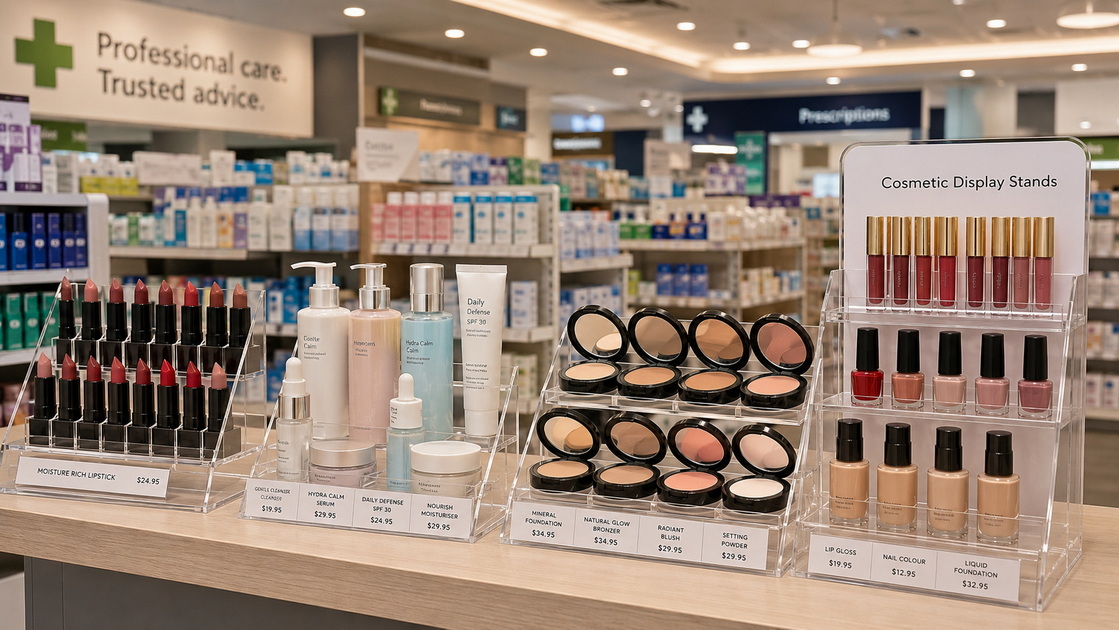
Below are key suppliers and partners that align strongly with cosmetic and general retail display projects in Australia. Where their primary focus is acrylic or multi-material displays, cosmetic fixtures often form a natural extension of their capabilities.
Although based in China, Long Win Display is a strategic POP partner for many Australian and global buyers seeking cost-efficient, high-volume production of cosmetic and general display stands. The company has more than 20 years of experience in custom display design, production and pre-loading, covering cardboard, acrylic and multi-material display fixtures. [longwindisplay]
- Founded: Over 20 years of operation as a POP display designer and manufacturer. [longwindisplay]
- Location: China, serving clients worldwide including Australia. [longwindisplay]
- Strengths:
- Broad POP portfolio including counter-top displays, floor stands and pallet units tailored to cosmetic and FMCG categories. [longwindisplay]
- Internationally recognized certifications and ethical audits that align with large retailers' compliance frameworks. [longwindisplay]
- OEM/ODM scope and value proposition:
- Particularly suitable for small and medium-sized brands thanks to flexible MOQs, rapid prototyping and deep OEM customization supported by efficient English-language communication.
- Many buyers deploy a hybrid model: Australian partners for urgent or localized projects, and Long Win Display for high-volume cosmetic display production destined for broader APAC or global markets. [longwindisplay]
R&T Plastic Fabricators is a Western Sydney plastics fabrication firm providing custom acrylic display boxes and Perspex fixtures to businesses of varying sizes. Its laser-cut acrylic products lend themselves well to compact cosmetic counter stands and tester trays.
- Founded: Operating for more than a decade.
- Location: Western Sydney, New South Wales.
- Strengths:
- Flexible support for small and large batches, which is attractive for niche beauty brands and test programs.
- Focus on made-to-order displays allows for tailored cosmetic layouts.
- OEM/ODM scope:
- Accepts customer drawings and supports bespoke display development, particularly for smaller runs or promotional units.
A.C. Acrylic is a Melbourne-based manufacturer specializing in acrylic display boxes, sneeze guards and thermoplastic products. Its experience in fabricating clear enclosures and formed acrylic makes it suitable for premium cosmetic displays requiring high-clarity viewing windows or protective housings.
- Founded: Active for several decades.
- Location: Melbourne, Victoria.
- Strengths:
- Expertise in acrylic molding and fabrication, including custom shapes and protective structures.
- Ability to combine display and protective functions, useful for high-value skincare or fragrance units.
- OEM/ODM scope:
- Offers custom sizing and configurations for display stands and boxes, supporting branded cosmetic roll-outs.
Holland Plastics operates from the Gold Coast with over 35 years of plastics fabrication experience, supplying acrylic display cases, signage and industrial plastic components. Its capabilities align with both permanent cosmetic displays and back-of-house fixtures.
- Founded: 35+ years in operation.
- Location: Gold Coast, Queensland, serving major Australian cities.
- Strengths:
- Custom acrylic display cases and signage, suitable for premium cosmetic and skincare environments.
- Proven track record across retail, signage and industrial applications.
- OEM/ODM scope:
- Provides consultative design support for bespoke displays, integrating branding and signage requirements.
P&M Plastics fabricates high-clarity acrylic display cases, stands and risers for retail, museum and corporate environments nationwide. Its precision cutting and bonding capabilities make it a strong candidate for flagship cosmetic counters and hero displays.
- Founded: Operating for several decades.
- Location: Gold Coast, Queensland.
- Strengths:
- Uses precision laser cutting, CNC routing, heat bending and solvent bonding to create structurally sound and visually clean displays.
- Experience with museum-grade cases translates into high aesthetic standards for beauty retail.
- OEM/ODM scope:
- Strong in custom-designed display stands and cases, including complex cosmetic layouts.
Advanced Display Systems is an Australian manufacturer and distributor of shopfitting systems, including slatwall and a range of retail display components. While not purely focused on acrylic cosmetics displays, its infrastructure products play a key role in larger beauty merchandising roll-outs.
- Founded: Established in 1987.
- Location: Australia-wide operations.
- Strengths:
- Integrated shopfitting and retail display systems that can host cosmetic shelving, acrylic trays and headers.
- Access to European display equipment adds design flexibility.
- OEM/ODM scope:
- Offers project-based design and configuration, often combining metal, timber and acrylic elements into full cosmetic fixture bays.
Genesis Retail Displays is a POP display agency that manages design, prototyping, manufacturing and installation of custom retail displays for global brands. It coordinates acrylic and mixed-material production through its manufacturing partners, including cosmetic-focused campaigns.
- Founded: Over ten years of POP project delivery.
- Location: Australia, serving domestic and international brand campaigns.
- Strengths:
- End-to-end project management from concept through installation, particularly valuable for multi-store cosmetic launches.
- Strong creative capabilities for brand-specific storytelling in-store.
- OEM/ODM scope:
- Provides structural design (ODM) and orchestrates OEM manufacturing for acrylic and multi-material cosmetic displays.
Australian Plastic Fabricators focuses on acrylic and PETG cut-to-size services and custom fabrication of retail displays, museum cases and LED lightboxes. Its portfolio naturally overlaps with cosmetic display needs for pharmacies and beauty retailers.
- Founded: Established in 1995.
- Location: Multiple sites in Sydney (Ultimo and Silverwater).
- Strengths:
- Retail displays, museum cases and LED-integrated fixtures, suitable for illuminated cosmetic stands.
- Recognized as a market leader in acrylic cut-to-size and custom display fabrication in its region.
- OEM/ODM scope:
- Supports customized display concepts and integration with lighting and graphics, relevant for premium cosmetics.
Ausfab Group is a long-established acrylic fabrication specialist with over 40 years' experience serving large Australian retail chains. Its capabilities span acrylic display stands, boxes, shelving and other fixtures that can be configured into cosmetic counters and tester units.
- Founded: Operating since the 1980s.
- Location: Australia-wide service, headquartered in Australia.
- Strengths:
- Retail-focused acrylic fixtures with quick-turn cut‑to‑size services for acrylic, polycarbonate, PETG and ABS.
- Design‑to‑manufacture capability suitable for category‑specific cosmetic end caps and counter units.
- OEM/ODM scope:
- Supports custom design, prototyping and production based on brand guidelines, making it suitable for long-term cosmetic merchandising programs.
The table below summarizes key parameters that procurement managers typically compare when building a cosmetics display supplier panel. Values are indicative, based on public information and observed practices. [longwindisplay]
| Supplier | Region / Founded | Indicative MOQ (Custom Cosmetic Displays) | QA / Certifications (indicative) | Technical Focus | OEM/ODM Strength |
|---|---|---|---|---|---|
| Long Win Display | China, 20+ yrs (longwindisplay) | Low–high, flexible for SMEs and chains | ISO and ethical audits (indicative) (longwindisplay) | POP design, multi‑material displays (longwindisplay) | High – deep OEM/ODM, pre‑loading (longwindisplay) |
| Ausfab Group | Australia, ~1980s | Medium, project‑based | Internal QA; retailer standards | Acrylic retail fixtures, cut‑to‑size plastics | High – design‑to‑manufacture |
| R&T Plastic Fabricators | Sydney, >10 yrs | Low–medium, small and larger batches | Job‑based QC systems | Custom acrylic boxes, displays | Medium–High (bespoke) |
| A.C. Acrylic | Melbourne, decades | Medium, made‑to‑order | Local fabrication QA | Acrylic boxes, formed components | Medium (custom sizing) |
| Holland Plastics | Gold Coast, 35+ yrs | Medium, project‑focused | In‑house QA, long‑term track record | Display cases, signage, industrial plastics | Medium (consultative) |
| P&M Plastics | Gold Coast, decades | Medium, project‑based | Precision QC for museum/corporate work | CNC, laser cutting, high‑clarity joints | High (custom display) |
| Australian Plastic Fabricators | Sydney, est. 1995 | Medium, retail/museum projects | Internal QA, retail and museum standards | Acrylic & PETG displays, lightboxes | High (integrated displays) |
| Advanced Display Systems | Australia, since 1987 | Medium–high, shopfitting projects | Manufacturing QA; EU system distribution | Shopfitting systems, integrated displays | Medium (project‑based) |
| Genesis Retail Displays | Australia, >10 yrs | Campaign‑scale, project‑based | Brand & retailer compliance frameworks | POP design and project management | High (concept‑to‑rollout) |
Even experienced buyers encounter recurring problems that can erode margins or damage brand perception; many of these pitfalls mirror those seen in broader acrylic display sourcing. Addressing them systematically can dramatically improve total cost of ownership.
- Material downgrading (cast vs extruded)
- Suppliers may quietly substitute specified cast acrylic with cheaper extruded sheets, leading to stress crazing, lower optical clarity and weaker edges.
- Countermeasure: demand material certificates, include cast vs extruded requirements in contracts and conduct destructive tests on first-batch samples for large programs.
- Under-engineered shelves and testers
- Insufficient load calculations can result in sagging shelves, cracked testers or unsafe cantilevered trays, especially in warm or high-traffic environments.
- Countermeasure: provide max load per shelf, ask for basic structural calculations or test reports and embed rigidity checks in your inspection criteria.
- Inconsistent bonding quality
- Poorly controlled bonding may cause bubbles, visible seams and weak joints that fail during transport or in-store use.
- Countermeasure: define acceptable bubble levels and joint quality thresholds in your quality agreement and review macro photos of joints at sample stage.
- Outdated or irrelevant certifications
- Some suppliers present expired ISO certificates or documents unrelated to display manufacturing.
- Countermeasure: verify certificate numbers and scopes directly with issuing bodies and ensure they explicitly cover manufacturing of display or plastic products. [freyrsolutions]
- Packaging not aligned with retail handling
- Inadequate packaging leads to scratched surfaces and cracked edges, especially during long-distance shipping.
- Countermeasure: co-develop packaging solutions with suppliers and validate them via small trial shipments and drop tests.
A widely used but rarely documented tactic among experienced buyers is to test how a supplier handles technical ambiguity in your RFQ during the first 72 hours. This serves as a proxy for their engineering depth and risk management culture.
- If you deliberately leave one parameter open (e.g., "edge finish: standard" or "joint type: to be proposed"), high-quality suppliers will respond with clarifying questions, explain options and outline cost/quality implications.
- Suppliers that respond with a single lump-sum price and no questions often rely on default, low-cost choices, increasing the risk of later "value engineering" and uncontrolled changes.
This simple stress test, applied before awarding any sample order, helps separate consultative partners from opportunistic vendors.
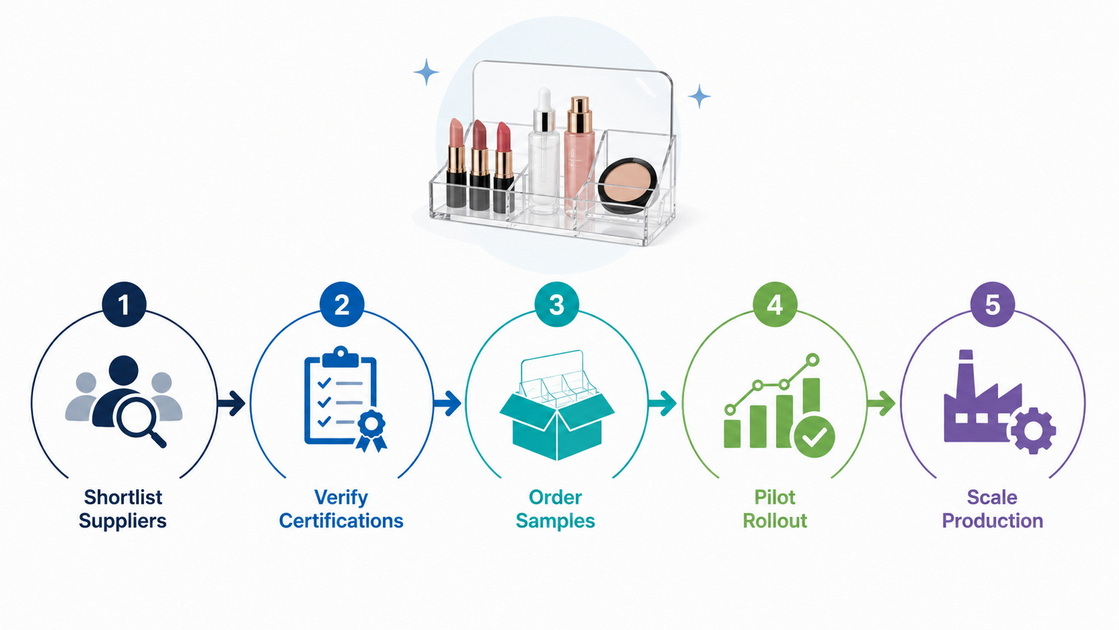
A structured buyer's journey significantly reduces risk when building a long-term supplier roster for cosmetic display stands. The steps below combine best practices from Australian projects and international programs involving partners like Long Win Display. [longwindisplay]
- Multi-channel background checks
- Review the supplier's website, third-party industry directories and social media activity to confirm consistent capabilities and project history. [ensun]
- ISO and compliance validation
- Request high-resolution copies of ISO certificates, check issue and expiry dates and validate serial numbers via the issuing body's public database or email. [freyrsolutions]
- Ensure the scope explicitly references manufacturing or plastics processing, not just trading or unrelated services.
- Reference projects and retailer approvals
- Ask for anonymized case studies or references for similar programs in cosmetics or adjacent categories, including project scale and lead times.
- RFQ completeness
- Include detailed drawings, material specs (cast/extruded acrylic, thickness, metal coatings), edge finishing, printing requirements, packaging expectations and regulatory constraints (e.g., CE for integrated LEDs).
- Sample hierarchy
- Start with material and joint samples to lock finishes and bonding quality, then move to full prototypes for each cosmetic display type.
- Define acceptance criteria (scratches, bubbles, color variation, dimensional tolerances) before approving mass production.
- Local vs offshore trade-offs
- Australian suppliers reduce transit risk and customs complexity, which is valuable for urgent cosmetic campaigns and high-value fixtures. [ensun]
- Offshore partners like Long Win Display can significantly reduce unit cost for large-scale roll-outs, provided packaging and inspection frameworks are robust. [longwindisplay]
- Packaging validation
- Require photo/video documentation of packing procedures and run controlled pilot shipments before scaling volumes. [longwindisplay]
Australia offers a robust ecosystem of cosmetic display stand manufacturers and POP specialists, from in-house acrylic fabricators to turnkey POP agencies, capable of supporting both localized beauty campaigns and broader retail programs. By applying transparent selection criteria, conducting disciplined due diligence and leveraging hybrid sourcing with partners like Long Win Display, procurement managers can build a resilient, cost-effective supply base for cosmetic displays across Australia and beyond. [longwindisplay]
1. How can I verify whether a supplier's ISO certification is current and truly applies to cosmetic display manufacturing?
Request a scanned certificate, check the scope and expiry date, then confirm the certificate number on the issuing body's public database or through direct email. Ensure the scope includes manufacturing of plastics or display products rather than generic trading activities. [freyrsolutions]
2. How do I confirm that cast acrylic is actually being used instead of cheaper extruded sheets?
Ask for original material certificates from the acrylic sheet supplier that explicitly state cast vs extruded and cross-check supplier names and batch numbers. For high-volume programs, consider cutting small sections from received displays for physical testing or independent lab verification.
3. What's the best way to assess if a supplier can handle national retail roll-outs in Australia?
Review their past projects with national chains, ask for monthly capacity figures, QC headcount and historical roll-out schedules and, where possible, speak with existing retail clients. Suppliers already serving major retailers are more likely to understand the operational and compliance demands of national campaigns.
4. Which RFQ information is essential to avoid later change orders and disputes?
Provide complete drawings with dimensions, detailed material specs (type, thickness, color), finishing levels, joint types, printing/graphics requirements, packaging definitions, target volumes and any retailer-specific fixture standards or test protocols. A structured RFQ dramatically improves quoting accuracy and reduces mid-project changes.
5. How can I manage quality risk when combining Australian design with Chinese mass production (e.g., Long Win Display)?
Lock the design and reference sample with your Australian partner or internal team, then require the offshore factory to match that standard within defined tolerances and QC criteria. Conduct pre-shipment inspections on initial batches and maintain a formal NCR and corrective-action process with the offshore partner. [longwindisplay]
1. Australian Industrial Chemicals Introduction Scheme (AICIS) – Labelling, SDS and Packaging Guidance
Official Australian government guidance on labelling, safety data sheets and packaging obligations for industrial and cosmetic chemicals, with links to relevant regulatory frameworks.
https://www.industrialchemicals.gov.au/help-and-guides/labelling-sds-and-packaging [industrialchemicals.gov]
2. LegalVision – Understanding Beauty Labelling Laws in Australia
Legal overview explaining mandatory standards for displaying cosmetic product labels in Australia, including placement and content requirements under Australian Consumer Law.
https://legalvision.com.au/beauty-labelling-laws [legalvision.com]
3. Freyr – Cosmetic Label Requirements in Australia
Regulatory article outlining cosmetic label requirements in Australia and the interplay between TGA and AICIS rules for cosmetic and borderline therapeutic products.
https://www.freyrsolutions.com/blog/cosmetics-label-elements-regional-requirements [freyrsolutions]
4. Auskin Lab – Cosmetic Product Labelling Requirements Australia Guide
Practitioner-focused guide that summarizes core labelling rules for cosmetics in Australia, including ingredient lists, warnings and consumer information standards.
https://www.auskinlab.com.au/blog/cosmetic-product-labelling-requirements-australia [auskinlab.com]
5. Long Win Display – Company Profile and Capabilities
Corporate site of Long-Win Display, a China-based POP display manufacturer with over 20 years' experience in custom cardboard and permanent display stands, boxes and packaging serving global markets including Australia.
https://www.longwindisplay.com [longwindisplay]
6. Long Win Display – Top Acrylic Display Stand Manufacturers and Suppliers in Australia
Long-Win Display editorial page profiling leading acrylic display stand manufacturers serving the Australian market, with insights into capabilities, materials and sourcing strategies.
https://www.longwindisplay.com/top-acrylic-display-stand-manufacturers-and-suppliers-in-australia.html [longwindisplay]
7. Ensun – Top Display Stand Manufacturers in Australia
Business directory listing top display stand manufacturers in Australia, including companies active in POP, retail fixtures and display systems serving B2B buyers.
https://ensun.io/search/display-stand/australia [ensun]
8. Accio – Cosmetic Product Display Stands Trends and Top Picks 2026
Market-facing article discussing global trends in cosmetic display stands, including sustainable materials, customization and technology integration relevant to 2026.
https://www.accio.com/business/cosmetic-product-display-stands [accio]
9. Australian Government / ACCC – Product Safety and Cosmetic Labelling Information
Official resources from Australian authorities providing product safety and mandatory cosmetic ingredient labelling information under the Australian Consumer Law.
https://www.productsafety.gov.au (core ACCC product safety portal; used in conjunction with AICIS and TGA resources) [industrialchemicals.gov]


