
Views: 263 Author: Long Win Display Publish Time: 2026-08-31 Origin: Site


Content Menu
● Why China Is a Major Standee Display Hub
● Top 10 Standee Display Manufacturers
>> 10. Grandfly / Shenzhen Shengxiang Display Products
● Technical Requirements for Standee Displays
● The Hidden Procurement Risks
>> 2. "Capacity" That Is Actually Subcontracting
>> 3. Underestimated Assembly Time
>> 4. Attractive Unit Price, Expensive Freight
>> 5. Certification Misrepresentation
● Insider Tip: The "Loaded Display" Test
● Buyer's Guide: How to Source Safely
>> Step 1: Prepare a Complete RFQ
>> Step 2: Request Two Prototype Stages
>> Step 3: Validate the Factory
>> Step 4: Define Quality in Writing
>> Step 5: Plan Logistics Early
>> 1. How can I verify whether a supplier's ISO certificate is still valid?
>> 2. Is FSC certification mandatory for cardboard standee displays?
>> 3. What is a realistic MOQ for a custom standee display?
>> 4. How do I prevent a cardboard floor display from collapsing in store?
>> 5. Should I choose flat-packed, pre-assembled or pre-loaded standee displays?
China remains one of the most practical sourcing bases for custom standee displays, cardboard POP displays, floor display units, dump bins, counter displays, pallet displays, and retail-ready packaging. Its advantage is not simply lower factory pricing. More importantly, mature supply chains can integrate structural design, prototyping, offset printing, corrugated-board conversion, die-cutting, assembly, pre-loading, export packaging, and retailer-oriented quality control within one coordinated project workflow.
For procurement managers, however, choosing a standee display manufacturer is not a "find the cheapest supplier" exercise. A display that looks good in a 3D rendering can still fail during retail rollout because of insufficient board strength, unstable bases, inaccurate color matching, poor carton engineering, missed delivery windows, or an inability to meet retailer-specific packing requirements.
This guide reviews ten notable China-based suppliers and related packaging manufacturers that may be relevant for custom retail-display projects. It is designed for international sourcing teams looking for a capable long-term partner—not for buyers looking for a generic stock cardboard stand.
China's paper and paperboard production reached approximately 164.1 million tonnes in 2025, according to figures attributed to China's National Bureau of Statistics, providing a substantial domestic material base for corrugated displays, printed carton structures, and paper-based retail packaging. Market research also projects that China's display-packaging segment will grow faster than several other major markets through 2035, driven by retail modernization, supermarket development, and convenience-store expansion.
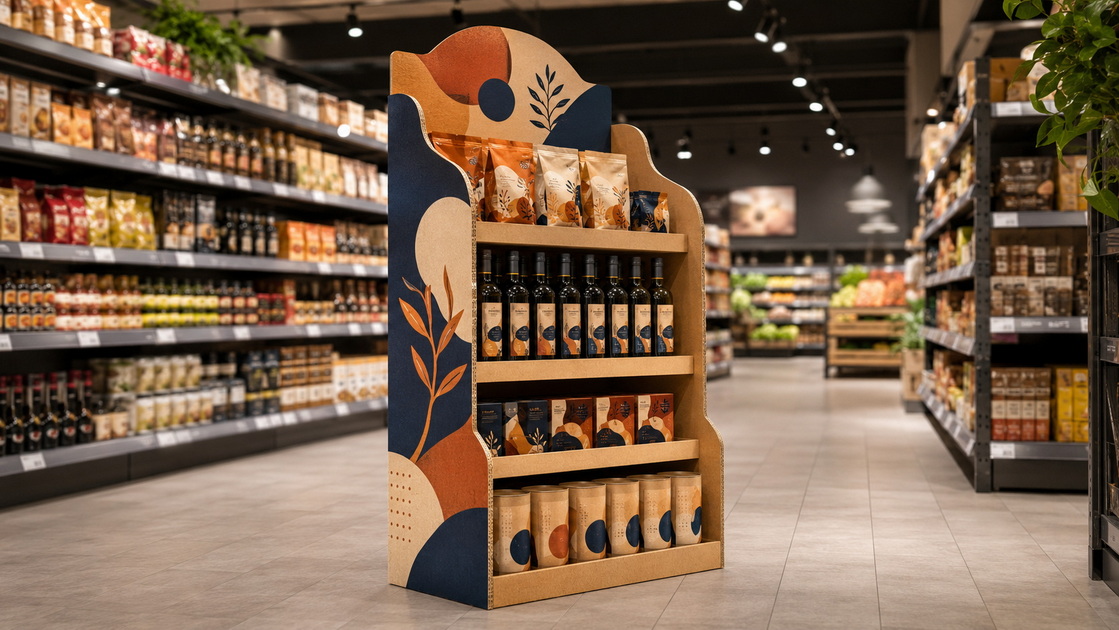
A responsible supplier comparison should not imply that every factory is suitable for every retail-display program. A small consumer-goods brand launching in 300 stores needs different support from a multinational retailer placing a pallet-display program into thousands of locations.
The manufacturers in this guide were assessed using the following transparent criteria:
| Evaluation Dimension | What Buyers Should Verify | Why It Matters |
|---|---|---|
| Product specialization | Standee displays, floor displays, FSDUs, counter units, dump bins, PDQ trays, pallet displays | A general box supplier may not understand retail-display load-bearing design |
| Structural engineering | CAD design, 3D renderings, prototypes, assembly instructions and transit testing | A display must survive shipping, assembly and in-store use |
| OEM/ODM capability | Artwork adaptation, dieline development, material selection and retail customization | Standee displays are usually project-specific rather than standard products |
| Quality-control process | Incoming-board inspection, print checks, die-cut checks, assembly inspection and final AQL inspection | Prevents weak shelves, color drift, incorrect inserts and missing components |
| Production stability | Equipment, workforce, production lines, seasonal capacity planning and backup material options | Promotional campaigns usually have non-negotiable launch dates |
| Export readiness | Export packing, labeling, palletization, container loading and destination-market documentation | Improves delivery reliability and reduces freight damage |
| Compliance discipline | FSC chain-of-custody, ISO management systems, social-audit records or retailer-required documentation | Certificates must be genuine, current and relevant to the actual facility |
| Communication quality | Engineering response time, quotation clarity, risk disclosure and project-management process | Poor communication is one of the most expensive hidden sourcing risks |
| Commercial fit | MOQ, sampling cost, lead time, payment structure and willingness to support small brands | The right supplier depends on the program size and complexity |
A key point: CE and RoHS are not blanket certifications for cardboard displays. They may become relevant if a standee includes lighting, electronic components, powered screens, sensors, or other electrical parts. For a conventional paperboard standee, buyers should focus first on board specifications, ink safety where applicable, FSC chain-of-custody requirements, restricted-substance declarations, retailer packaging rules, and factory quality systems.
China's cardboard display industry is concentrated around several manufacturing clusters rather than one single city.
- Shenzhen and Dongguan, Guangdong: Strong in export-oriented POP displays, retail packaging, printed paperboard products, electronics-related displays, cosmetics merchandising, and global client communication.
- Yiwu, Zhejiang: Known for international trade infrastructure, broad supplier access, relatively efficient cost structures, and export logistics support for consumer-goods programs.
- Xiamen and Fujian: Relevant for paper displays, retail fixtures, packaging and export manufacturing.
- Shanghai, Suzhou and the Yangtze River Delta: Important for larger-scale industrial supply networks, printing resources, logistics and multinational sourcing programs.
- Zhangjiagang and nearby Jiangsu manufacturing zones: Better suited to certain long-term retail-fixture and mixed-material display projects, especially when brands need cardboard, metal, wood or semi-permanent structures.
The value of these clusters is supply-chain density. A competent display manufacturer can source multiple corrugated board grades, litho-laminated sheets, water-based or conventional inks, hooks, plastic accessories, metal reinforcements, acrylic components, cartons, pallets, and fulfillment services without forcing the buyer to manage multiple disconnected vendors.
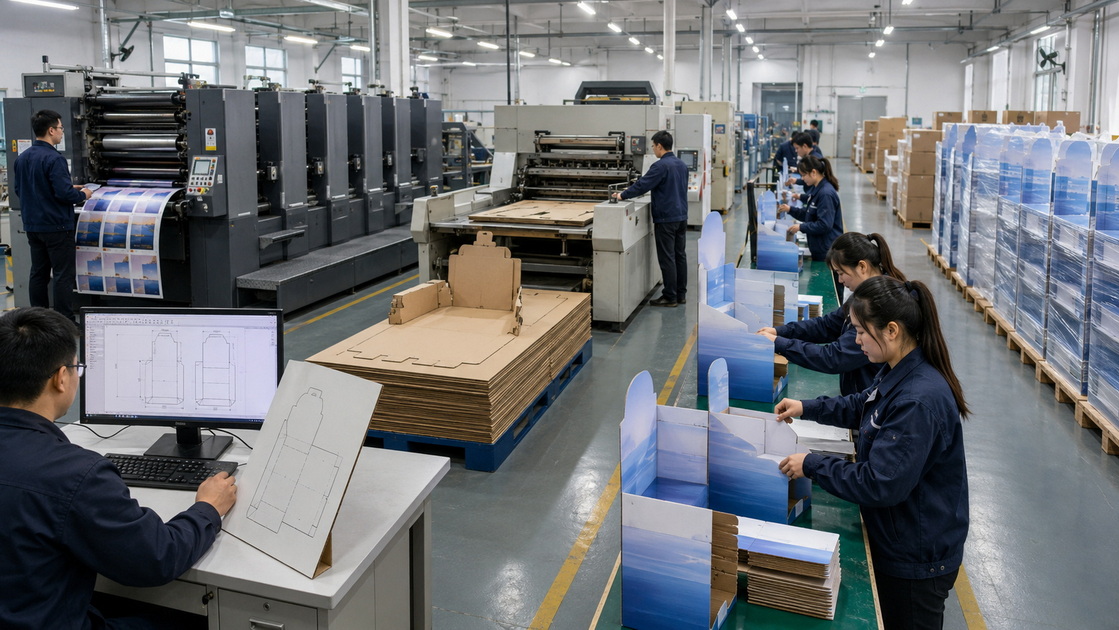
The following list is arranged to help buyers compare different supplier profiles. It is not a universal quality ranking. Before awarding production, buyers should validate the legal entity, factory address, production scope, current certificates, references, and project-specific capacity.
| Rank | Manufacturer | Core Focus | Suitable Buyer Profile | MOQ / Capacity Note | Compliance Verification |
|---|---|---|---|---|---|
| 1 | Long Win Display | Custom cardboard POP displays, standees, retail packaging, pre-loading | Small to mid-sized brands and retail programs needing flexible OEM support | Project-dependent; reported daily output up to 10,000 pieces | Request current facility-specific documentation |
| 2 | XK Display | Custom retail displays and related POP-display projects | Buyers seeking display-focused customization | Confirm by display structure and order volume | Verify certificate scope and factory location |
| 3 | Xianda Gift Box | Gift boxes, paper packaging and potential display-packaging integration | Brands combining promotional packaging with retail presentation | Confirm whether standee engineering is handled in-house | Verify display-specific production capability |
| 4 | Maituohong Packaging | Custom paper packaging, corrugated boxes and one-stop packaging | Brands requiring packaging plus selected paper-display components | Suitable for project-based OEM work | Ask for ESG and project-specific compliance files |
| 5 | Bonito Packaging | Premium custom paper packaging, folding cartons, rigid boxes and display boxes | Growing brands requiring flexible branded packaging | Project-dependent; confirm MOQ before quotation | Request material and factory documentation |
| 6 | PDS Display | POP/POS displays, shop fittings and mixed retail-display solutions | Larger programs requiring broader fixture categories | Larger factory profile; confirm available display capacity | Reported ISO, Sedex and other credentials—verify directly |
| 7 | WOW Display | Cardboard POP/POS displays and packaging | Retail, cosmetics, electronics and promotional display buyers | Confirm current run size and lead time | Request current audit and board specifications |
| 8 | Topwon Group | Cardboard displays, retail packaging and turnkey projects | Brands needing floor, counter and pallet-display formats | Reported 12,000+ sqm factory; confirm current availability | Verify documentation and display load testing |
| 9 | Solid Displays | Custom POP/POS displays | Buyers seeking paper-display specialization from Xiamen | Confirm MOQ by structural complexity | Request factory and compliance records |
| 10 | Grandfly / Shenzhen Shengxiang Display Products | Paper displays, POS solutions and retail packaging | Buyers requiring paper-based display and packaging integration | Confirm order thresholds and retailer experience | Ask for ISO/FSC/social-audit validity |
Important procurement note: MOQ, daily output and certifications can change by facility, product type, season, subcontracting arrangement and audit renewal date. Treat all figures as initial screening signals, not final purchasing commitments.
Long Win Display is a China-based POP display designer and manufacturer specializing in cardboard display stands, counter displays, pallet displays, display boxes, gift boxes, packaging boxes, and selected semi-permanent display options. Its operations combine a Shenzhen headquarters with production facilities in Yiwu, Zhejiang, a location that can be useful for cost management, export coordination, and access to broader packaging supply chains.
For brands that need a cost-conscious but custom-built standee display, Long Win Display is particularly relevant because it positions itself around design, customization, production, and pre-loading rather than offering only printed cartons. The company reports more than 20 years of display-related experience, with its overseas business expansion identified as beginning in 2018 and a Yiwu branch established in 2020.
Its product range includes:
- Cardboard floor displays and standee displays
- Counter displays and PDQ-style retail units
- Pallet displays and sidekick displays
- Display boxes, gift boxes and retail packaging
- Acrylic, metal-wire and PVC foam-board display options through cooperating factories
- Design, prototyping, printing, manufacturing, assembly and pre-loading support
Long Win Display reports more than 10 production lines, approximately 60 employees, 20 main facilities, 8,000 square feet of factory space, and stated production capacity of up to 10,000 pieces per day. These figures should be confirmed against the buyer's exact display design, because a small counter unit and a fully assembled floor stand do not consume equivalent production time or shipping volume.
The company also states experience supporting retail-entry programs involving retailers such as Walmart, Woolworths, Costco, Coles, Tesco, 7-Eleven and Circle K. Procurement teams should treat this as a starting point for reference validation: ask whether the factory manufactured directly for the retailer, supplied a brand entering that retailer, or worked through an agency or importer.
Core strength: Flexible custom OEM support for brands that need practical structural engineering, responsive communication, cost optimization and help moving from concept to retail-ready delivery.
Best fit: Small and medium-sized brands, promotional agencies, consumer-goods importers, food-and-beverage companies, health-and-beauty brands, and retail programs that require lower waste, export-efficient packing, and close communication during design revisions.
OEM/ODM scope: Structural design support, prototype development, custom printing, board-material selection, retail packaging, pre-loading, shipping-carton optimization and display assembly planning.
Buyer due diligence questions:
- Can the supplier provide an engineering drawing showing shelf load, base structure and assembly method?
- Is pre-loading completed at the Yiwu facility or another location?
- Which parts of a mixed-material display are manufactured directly and which are outsourced?
- Can the factory conduct drop testing or simulated transit testing for the packed display?
- Can the supplier provide a retained production sample and signed golden sample before mass production?
XK Display should be considered by buyers searching for a China-based supplier focused on custom display work and POP retail applications. Because display programs vary significantly in structural complexity, buyers should ask XK Display to demonstrate comparable projects rather than relying only on product-gallery images.
For a standee-display RFQ, request:
- Photos and videos of comparable assembled displays
- Dielines and material specifications for previous projects
- A physical sample or blank white prototype
- Details of printing technology and finishing processes
- Current capacity during the buyer's intended production month
- Evidence of retail-display assembly and export packing capability
Core strength: Potential fit for custom retail-display sourcing where project-specific design adaptation is important.
Established year and primary markets: These should be confirmed directly with the supplier and checked against its business registration, export documentation, and factory-audit information before onboarding.
OEM/ODM scope: Confirm whether the supplier can independently conduct structural design, prototyping, offset printing, lamination, die-cutting, gluing, packing and fulfillment—or whether parts of the process are subcontracted.
Xianda Gift Box is more relevant to buyers whose standee display projects overlap with premium paper packaging, gift-box programs, branded presentation boxes, inserts or retail-ready packaging. Not every gift-box manufacturer has the engineering depth needed for freestanding retail displays, so buyers should distinguish between "packaging design" and "load-bearing POS display engineering."
This supplier profile can be appropriate when a product launch requires both:
- Premium secondary packaging
- Shelf-ready or counter-ready display packaging
- Gift-box inserts and branded presentation elements
- Promotional display components coordinated with packaging artwork
Core strength: Potential integration of brand packaging and retail presentation.
Best fit: Cosmetics, fragrance, accessories, premium food, gifting, seasonal promotions and lifestyle brands that need packaging and presentation consistency.
Established year and primary markets: Confirm directly through the supplier's formal company profile, export history and third-party inspection documentation.
OEM/ODM scope: Ask for evidence of structural testing for floor-standing units. A rigid gift box can look premium but is not automatically designed to withstand dynamic retail loads, repeated shopper contact or long-distance container transport.
Maituohong Packaging, also associated with MTH Packaging Box, presents itself as a custom paper-packaging manufacturer that supports one-stop packaging solutions, including corrugated products and sustainability or ESG-related positioning.
This makes the company potentially suitable for buyers seeking corrugated packaging, branded cartons, retail packaging, inserts, display boxes, and selected paper-display applications. The company states that it aims to help businesses access sustainable packaging options and offers consultation on cost, efficiency and environmental impact.
Core strength: Packaging-oriented OEM integration, corrugated-box capability and sustainability-focused positioning.
Best fit: Brands that need a consistent packaging system and may combine carton packaging with display boxes, retail-ready trays, promotional packaging or simpler POS display formats.
Established year and primary markets: The available web material emphasizes custom packaging and sustainability. Buyers should request the company's exact incorporation date, manufacturing-site details, principal export destinations, and project examples involving standee or floor-display structures.
OEM/ODM scope: Custom corrugated packaging, printed boxes, display boxes, tissue paper, liners, inserts, and potentially display components depending on project engineering requirements. The supplier states more than 18 years of custom paper-packaging manufacturing experience on one product page.
Procurement consideration: If the project is a heavy-load floor stand with multiple shelves, ask whether structural engineering and load testing are handled internally. Do not assume that a corrugated-box supplier automatically has the same expertise as a specialist POP-display manufacturer.
Bonito Packaging is positioned as a China-based supplier of premium custom paper packaging, including folding cartons, rigid boxes, apparel boxes, paper bags, inserts, e-commerce mailers and display boxes. Its content emphasizes customization flexibility, sample prototyping and export-oriented OEM support, which may appeal to emerging and mid-sized brands.
For a standard retail standee, Bonito Packaging may be most relevant where the display project is closely tied to product packaging, branded folding cartons, rigid presentation boxes, counter displays or display boxes. Buyers should confirm whether the specific standee structure is produced internally or through an approved display-manufacturing partner.
Core strength: Flexible premium packaging customization, branded paper-based components and sampling support.
Best fit: Apparel, cosmetics, skincare, jewelry, electronics accessories, gifting, subscription-box and e-commerce brands that need packaging consistency alongside in-store display components.
Established year and primary markets: Confirm directly with Bonito Packaging. The available source material identifies it as a China-based manufacturer focused on premium custom paper packaging for international brands, but a buyer should validate production-site information, audit records and the exact export market mix.
OEM/ODM scope: Folding cartons, rigid gift boxes, custom packaging, branded bags, inserts, display boxes and retail-facing paper packaging.
Procurement consideration: A beautiful packaging mock-up is not enough for a freestanding display. Ask for proof of shelf-load calculations, base reinforcement recommendations, pack-out drawings, and a prototype test before approving a high-volume retail program.
PDS Display is a Dongguan-based manufacturer established in 2005 that offers POP/POS displays, shop fittings, window displays and related retail-fixture solutions. It reports a factory area exceeding 25,000 square meters, more than 350 employees, and export activity covering the United States, Europe, Australia and the Middle East.
The company's broader fixture profile can be useful for retailers and brands that need more than a temporary cardboard standee. Its offering may be relevant for combined cardboard, acrylic, metal, wood or semi-permanent display programs.
Core strength: Broader retail-fixture capability and scale for more complex, multi-material projects.
Best fit: Larger retail programs, agencies, international brands, store-fixture buyers and display programs that require a mix of temporary and semi-permanent formats.
Established year: 2005.
Primary markets: The company reports exports to the United States, Europe, Australia and the Middle East.
OEM/ODM scope: POP/POS displays, shop fittings, window displays and customized retail-display programs.
PDS Display reports ISO 9001, ISO 14001, ISO 45001, Sedex and other certifications or approvals. Buyers should verify certificate number, issuing body, validity dates, legal-entity name, factory address and scope before treating any certification as a sourcing qualification.
Shenzhen WOW Packaging Display Co., Ltd., generally known as WOW Display, describes itself as a custom POP and POS display manufacturer established in 2010. Its stated focus includes cardboard displays, promotional retail displays and packaging, serving industries such as retail, cosmetics and electronics.
WOW Display is relevant to buyers searching for cardboard floor displays, counter displays, retail display stands and campaign-driven POS programs. Its profile suggests experience with customizable paper-based merchandising tools rather than only generic packaging.
Core strength: Cardboard POP/POS focus, customization and application across multiple consumer-product categories.
Established year: 2010.
Primary markets: Buyers should request current export-market data, retailer references and destination-specific compliance experience directly from the company.
OEM/ODM scope: Cardboard displays, POP displays, POS displays, custom promotional units and display packaging.
Buyer due diligence questions:
- Can the supplier produce both litho-laminated and direct-print corrugated display options?
- What board flute combinations are recommended for a 15 kg, 25 kg or 40 kg product load?
- Does it conduct first-article inspection before mass production?
- Can it provide carton drop-test records and container-loading instructions?
- Are the display components packed flat, pre-assembled, or pre-loaded with products?
Shenzhen Topwon Group Co., Ltd. reports more than 14 years of experience in designing and manufacturing cardboard POP displays and specialty packaging. Its listed product coverage includes counter displays, floor displays, brochure holders, pallet displays, retail packaging and cardboard pop-up displays. The company also reports operating a factory of more than 12,000 square meters since 2008 and serving more than 500 brands.
This can make Topwon Group worth reviewing for larger display portfolios that require several structures within one retail campaign—for example, a floor stand, counter unit, shelf tray and branded packaging all coordinated under one visual system.
Core strength: Broad cardboard-display and specialty-packaging portfolio with a reported larger factory footprint.
Established year: Factory presence reported since 2008.
Primary markets: Confirm directly through export records, client references and destination-market case studies.
OEM/ODM scope: Cardboard displays, counter and floor displays, pallet displays, brochure holders, specialty packaging and integrated retail packaging.
Buyer consideration: Large facility size is not a guarantee that a buyer's order will receive priority. Request a written production plan that identifies sampling date, artwork-release deadline, board-order date, print date, assembly date, inspection date and cargo-ready date.
Solid Displays, located in Xiamen, states that it has specialized in custom POP and POS displays since 2008. Its specialization can make it relevant for buyers seeking a supplier focused specifically on retail-display applications rather than broad general packaging.
A display-specialist supplier may be better positioned to advise on structural design, retail footprint, shopper access, shelf layout, hook spacing, product replenishment and assembly speed—provided those capabilities are supported by real project evidence.
Core strength: Long-term focus on customized POP/POS displays.
Established year: 2008.
Primary markets: Confirm directly. Buyers should ask for market-specific examples, especially if they plan to sell through North American club stores, European discount retailers, Australian supermarkets or convenience-store networks.
OEM/ODM scope: Custom POP and POS display design and manufacturing.
Buyer consideration: Request a "retail deployment pack" during sampling. It should include the approved dieline, display dimensions, product-loading sequence, assembly instructions, master-carton dimensions, gross weight, pallet pattern and a photo of the final packed display.
Grandfly, identified as Shenzhen Shengxiang Display Products Co., Ltd., describes itself as a specialist in custom paper displays, retail packaging and point-of-sale solutions. Its published material identifies a 2009 founding date and highlights the importance of ISO, FSC, Sedex and BSCI-type documentation for projects entering major retailers or export markets.
This profile can be useful for brands seeking paper-based displays along with packaging and retail communication materials.
Core strength: Paper-display and packaging integration with awareness of retailer compliance expectations.
Established year: 2009.
Primary markets: Verify through customer references, shipping records where available, and supplier-provided case studies.
OEM/ODM scope: Custom paper displays, POS solutions, display packaging and retail promotional materials.
Buyer consideration: Ask whether FSC and social-compliance documentation apply to the exact legal entity and production site making your order. It is common for a sales company to present certificates belonging to an associated but different factory.
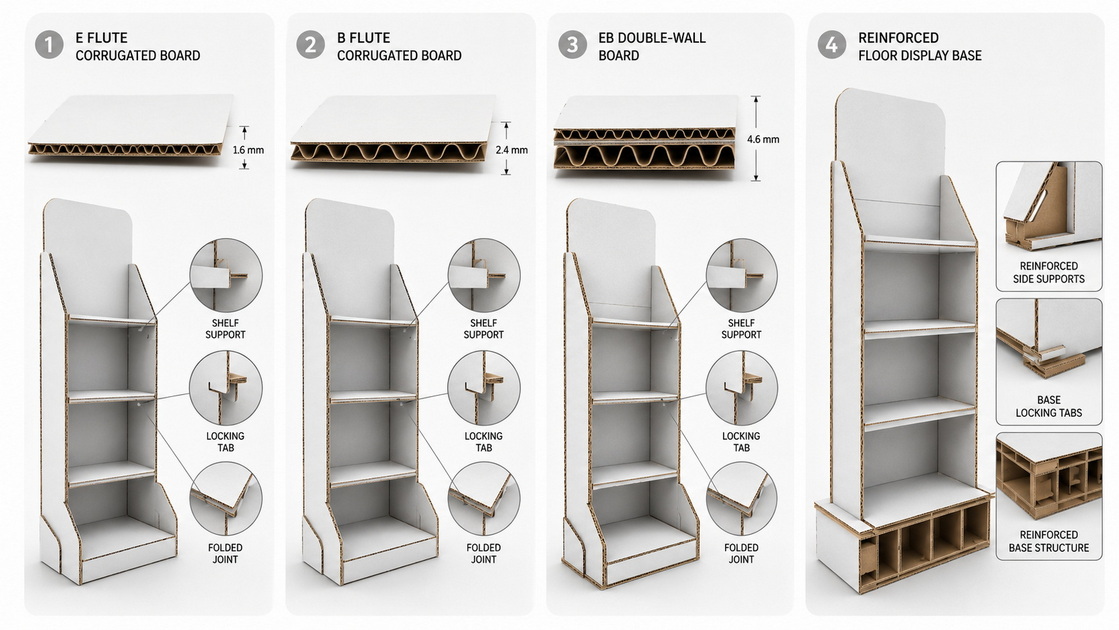
A standee display is often perceived as a simple printed cardboard structure. In reality, it is an engineered retail unit that must balance appearance, load capacity, footprint, cost, shipping efficiency, assembly time and recyclability.
The correct board grade depends on the product weight, number of shelves, retail duration, humidity exposure and transport route.
| Material / Construction | Typical Use | Main Advantage | Main Risk |
|---|---|---|---|
| E-flute corrugated board | Counter displays, smaller display trays, lightweight standees | Smooth print surface and compact structure | Can crush under heavy loads |
| B-flute corrugated board | Medium-duty retail displays | Better cushioning and compression strength | Surface may be less refined than E-flute |
| EB double-wall board | Floor displays, heavier products, reinforced base panels | Improved load-bearing strength | Higher material cost and larger shipping volume |
| BC double-wall board | Large floor stands, bulk product displays, pallet-ready structures | High stiffness and stacking performance | Requires careful die-cutting and carton planning |
| Litho-laminated corrugated board | Premium branded retail displays | Excellent graphic quality and shelf appeal | More complex process and possible delamination if poorly bonded |
| Recycled corrugated board | Sustainability-focused displays | Supports recycled-content objectives | Board strength can vary between batches |
| Honeycomb paperboard | Large or heavy displays | High compressive strength with low weight | Less suitable for detailed die-cut visual elements |
Do not accept vague wording such as "high-quality cardboard." A complete material specification should identify:
- Flute type and board construction
- Paper grammage for linerboard and medium
- Edge-crush-test or equivalent strength requirement where relevant
- Moisture-control requirements
- Recycled-content requirement, if applicable
- Surface-printing method
- Lamination or varnish type
- Reinforcement components, if used
- Load requirement per shelf and total display load
The most common options include:
- Offset litho printing mounted to corrugated board for premium retail graphics
- Flexographic direct printing for high-volume, cost-sensitive displays
- UV coating for stronger visual impact and surface protection
- Water-based varnish for lower-impact finishing options
- Matte or gloss lamination for visual and abrasion performance
- Spot UV, foil stamping or embossed elements for premium product launches
- Die-cut hooks, shelf lips, header cards, dividers and locking tabs
- Plastic, metal or paperboard reinforcements where product load requires them
For global retailers, color control should not be managed only by a computer screen. Use physical color targets, approved proofs, Pantone references where appropriate, and a signed production standard.
The most expensive problems in standee-display sourcing are frequently discovered after the goods reach the destination warehouse.
A supplier may quote double-wall board during negotiation but use lighter board or lower-strength recycled paper during mass production. The display may survive a showroom photo but fail after shipping or product loading.
How to avoid it: Include the complete board specification in the purchase order, ask for pre-production material photos, retain a signed golden sample, and conduct third-party inspection before container loading.
Some suppliers have excellent sales presentations but outsource printing, die-cutting, assembly or pre-loading. Outsourcing is not automatically a problem, but it must be visible and controlled.
How to avoid it: Ask for a process map showing which stages are done in-house, request a factory video tour during production, and confirm whether subcontractors are covered by the same QC system.
A display may use many interlocking tabs, small dividers, shelf locks and separate headers. If it takes six minutes to assemble instead of two minutes, the retailer or co-packer may reject it.
How to avoid it: Specify a target assembly time during design. Request an assembly video featuring a person unfamiliar with the design—not the engineer who created it.
A tall floor display may be cheap per unit but inefficient to ship. Large empty internal space, oversized headers and poor master-carton design can dramatically increase freight cost.
How to avoid it: Compare landed cost, not factory unit price. Request flat-packed and pre-assembled packing alternatives, cubic-meter calculations, pallet-loading drawings and container quantities for 20-foot, 40-foot and 40-foot high-cube containers.
The certificate may belong to a different legal entity, a previous factory location, a trading company, or an expired audit cycle.
How to avoid it: Verify the certificate with the issuing body or official database. For FSC claims, check the supplier name, certificate code, status, scope and product group in the FSC certificate search system.
One industry issue that is widely understood by experienced retail-display engineers—but rarely explained in supplier comparison articles—is that a blank cardboard display can pass a simple visual inspection while still failing in the real retail environment.
The most useful test is not merely checking the empty standee. It is testing the fully loaded retail condition.
Ask the supplier to:
1. Load the display with the actual product weight or an equivalent weight.
2. Keep the display loaded for at least 24 to 72 hours.
3. Measure shelf sag, sidewall bowing, base deformation and header lean.
4. Conduct a controlled push, pull and vibration check.
5. Photograph the display before and after testing.
6. Record the product weight per shelf and total display weight.
7. Repeat the test after the display has been packed and transported, if the program is high value.
This matters because corrugated board can behave differently after humidity exposure, long-distance ocean shipping, warehouse storage and repeated consumer interaction. The lowest-priced structure is often not the lowest-cost display once replacement shipments, retailer penalties and lost sales are considered.
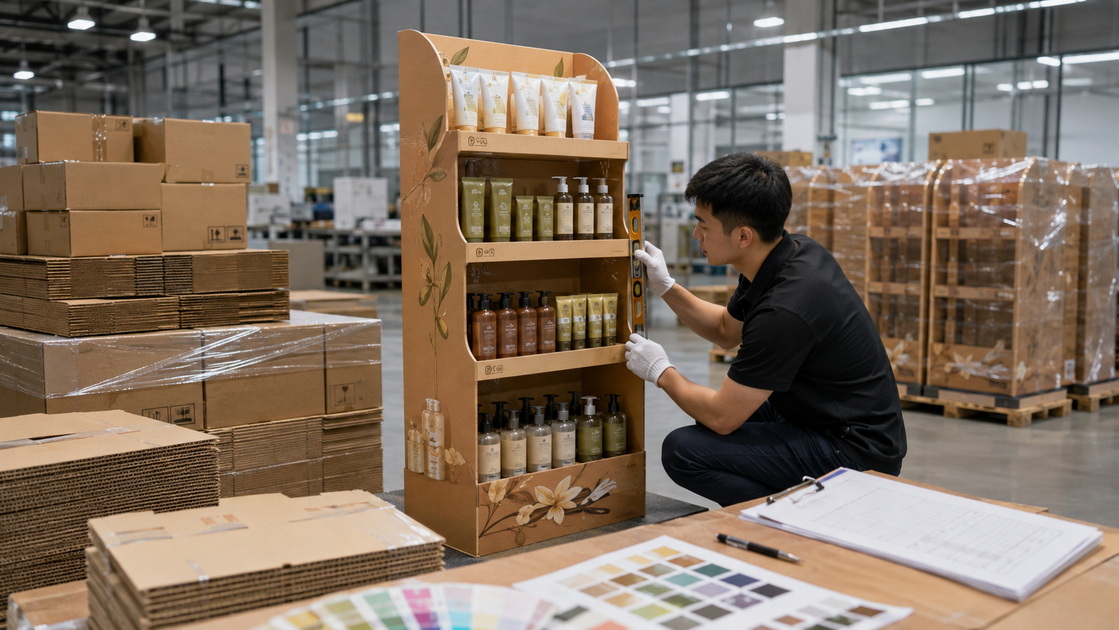
Provide the supplier with the following information:
- Product dimensions and individual product weight
- Quantity of products per shelf and per display
- Total loaded display weight
- Target store type and retail footprint
- Required display dimensions
- Flat-packed, pre-assembled or pre-loaded requirement
- Artwork files and brand color standards
- Desired board type and sustainability requirements
- Required delivery location and Incoterm
- Target order quantity
- Retail launch date
- Required certifications or buyer-code-of-conduct standards
- Whether the display will be used in humid, refrigerated or high-traffic environments
Without these details, suppliers can only provide a preliminary quote. The final price may change when structural requirements become clear.
For meaningful projects, use a two-stage process:
- White sample: A plain-board prototype used to check structure, dimensions, assembly and product fit.
- Printed sample: A final-material sample used to approve graphics, color, finishing, strength and packing.
The white sample often saves more money than it costs because structural corrections are much less expensive before printing plates, board orders and assembly begin.
A video call is useful, but it should not replace verification.
Ask for:
- Chinese business license and legal company name
- Factory address and production-site photos
- Current ISO, FSC, Sedex, BSCI or retailer-required documents
- Certificate number, issue date, expiry date and scope
- Equipment list
- QC checklist
- Recent project examples
- Export market references
- Audit report, where appropriate
- Confirmation of in-house versus outsourced processes
For higher-value programs, use an independent third-party inspection company for pre-production inspection, during-production inspection and final random inspection.
Your purchase order should not only state "good quality." It should include measurable criteria:
- Approved golden sample
- Board grade and grammage
- Color tolerance or approved color standard
- Display dimensions and tolerances
- Shelf-load requirement
- Carton drop-test or transit-test requirement
- Assembly instruction approval
- AQL inspection level
- Packaging method
- Barcode, label and carton-mark requirements
- Spare-part allowance, if applicable
- Delivery date and late-delivery consequences
A cardboard display project is a logistics project as much as a printing project.
Consider:
- Ocean freight versus rail, air or express freight
- Flat-packed versus pre-assembled freight volume
- Container utilization
- Humidity protection inside containers
- Desiccant use when appropriate
- Pallet requirements
- Import duties and HS classification
- Destination-warehouse handling
- Retailer appointment requirements
- Product pre-loading location
For retail campaigns with hard launch dates, build buffer time into the schedule. Sea freight disruptions, customs inspections, port congestion, artwork revisions and pre-shipment inspection failures can all affect delivery.
The right Chinese standee display manufacturer is not necessarily the one offering the lowest initial quote. The stronger long-term supplier is the one that can understand your retail objective, engineer the display around real product loads, communicate risks early, produce stable quality, protect the goods during shipment, and support your program from prototype through store delivery.
For brands that value flexible OEM customization, practical communication, cost-efficient structure design, pre-loading support and paper-based retail-display expertise, Long Win Display is a supplier worth including in a qualified sourcing shortlist. Its display-focused product range, Yiwu production presence, and stated experience serving international retail-oriented projects make it particularly relevant for small and medium-sized brands seeking a responsive China manufacturing partner.
Before placing a production order, request a project-specific quotation, structural proposal, physical prototype, documented material specification, fully loaded test sample, production timeline and compliance package. A carefully managed sampling phase is the most reliable way to turn a standee display concept into a successful retail execution.
Ask for the full certificate, including the certificate number, issuing certification body, legal entity name, factory address, scope and expiry date. Then verify it through the certification body's official directory or by contacting the issuer directly. Check that the certificate belongs to the same factory producing your order—not merely an affiliated trading company.
Not universally. FSC certification is typically required when a retailer, brand sustainability policy, tender document or customer claim requires FSC-certified material or chain-of-custody handling. If FSC is required, confirm that the factory's certificate is active and that the intended product category falls within the certificate scope. FSC certificate information can be checked in the FSC search system.
MOQ depends on display size, printing method, board grade, finishing complexity, number of components and whether the factory needs to create new die-cut tooling. Small trial quantities may be possible but will usually have higher unit prices. Rather than asking only for MOQ, request three quote scenarios—for example, 500, 1,000 and 3,000 units—with tooling, sampling, packing and freight volume shown separately.
Provide the exact product load, product dimensions, number of shelves and expected retail life. Require a structural design with adequate base support, shelf locks, sidewall reinforcement and appropriate corrugated-board grade. Then approve a fully loaded sample after a 24- to 72-hour load test. The factory should confirm maximum load per shelf and total safe display load in writing.
Choose flat-packed displays when minimizing freight volume is the priority and store staff or a co-packer can assemble them reliably. Choose pre-assembled units when speed of retail deployment is more important than freight efficiency. Choose pre-loaded units when the display must arrive retail-ready with products already packed, but carefully compare freight cost, carton strength, product protection and retailer warehouse requirements.
1. Long Win Display, "Our Company" — company profile, product scope, manufacturing workflow, stated production information and retail-market experience. [longwindisplay]
2. Future Market Insights, "Display Packaging Market" — market outlook and China growth projection. [futuremarketinsights]
3. National Bureau of Statistics of China, "Market Prices of Important Means of Production in Circulation" — corrugated-paper market data. [stats.gov]
4. FSC Certificate Search — official-style searchable resource for checking FSC chain-of-custody and forest-management certificates. [fscsearch.pages]
5. PDS Display, "POP Display Manufacturer" — company profile, establishment year, reported factory scale, export regions and management-system claims. [pdsdisplay]
6. WOW Display, "Custom Premium POP POS Display Manufacturer" — company background and cardboard POP/POS display focus. [wowpopdisplay]
7. Topwon Group — cardboard display and specialty-packaging capability overview. [topwongroup]
8. Solid Displays — company statement on POP/POS display specialization since 2008. [solid-displays]
9. Grandfly — paper-display, packaging and POS-solution profile. [grandfly]
10. Maituohong Packaging — corrugated packaging and ESG/one-stop packaging positioning. [mthpackagingbox]
11. Bonito Packaging — premium custom paper-packaging and display-box positioning. [bonitopack]


