
Views: 240 Author: Long Win Display Publish Time: 2026-09-06 Origin: Site


Content Menu
● Why Source Hook Display Stands from China?
● How We Selected These Manufacturers
>> 1. Display Design and Structural Engineering
>> 4. Production Capacity and Lead-Time Stability
>> 5. Export, Compliance, and Sustainability Readiness
● Top 10 Hook Display Stand Manufacturers in China
>> 8. Shenzhen Jingbang Display Products Co., Ltd.
>> 9. Guangzhou Dezheng Display Co., Ltd.
>> 10. Foshan Aojie Display Products Co., Ltd.
● Manufacturer Comparison Table
● Hook Display Stand Technical Specifications
● Material and Manufacturing Guide
>> Corrugated Cardboard Hook Displays
>> Acrylic Hook and Counter Displays
● The Overlooked Internal Trap: The Hook Is Often Not the Real Failure Point
● Common Sourcing Risks and How to Avoid Them
>> Risk 1: Paperboard Is Downgraded After Sample Approval
>> Risk 2: Hook Wire Is Thinner Than the Approved Sample
>> Risk 3: Color Is Inconsistent Across Production Batches
>> Risk 4: Display Design Is Not Optimized for Shipping
>> Risk 5: Preloaded Displays Arrive Damaged
>> Risk 6: Buyers Ask for Generic Certificates
● Buyer's Guide: How to Verify a Hook Display Stand Factory
>> Step 1: Verify the Manufacturing Scope
>> Step 2: Review a Similar Project Portfolio
>> Step 3: Request a Prototype Before Mass Production
>> Step 4: Inspect the Factory Remotely or On Site
>> Step 5: Define the Inspection Standard
>> Step 6: Plan Logistics Early
>> 1. How can I verify whether a hook display stand manufacturer's ISO certificate is still valid?
>> 2. What is the right MOQ for a custom hook display stand?
>> 3. How do I know whether a cardboard hook display is strong enough?
>> 4. Do hook display stands need CE or RoHS certification?
>> 5. Should I choose flat-packed or pre-assembled hook displays?
China is one of the most important global sourcing locations for hook display stands, countertop displays, corrugated POP displays, metal wire racks, acrylic displays, and retail-ready display packaging. For buyers, the advantage is not only unit cost: China offers a dense supply chain for structural design, printing, corrugated board conversion, metalwork, acrylic fabrication, packing, pre-assembly, and export logistics.
The wider point-of-purchase display market is expanding as brands compete for visibility in supermarkets, convenience stores, pharmacies, electronics retailers, specialty stores, and club-store environments. One market estimate places the global POP display market at USD 16.29 billion in 2025 and projects USD 27.45 billion by 2035, representing a 5.36% CAGR; Asia-Pacific is expected to be the fastest-growing region.
For professional buyers, the right hook display stand manufacturer is rarely the supplier with the lowest initial quotation. A suitable long-term partner should be able to convert a retail brief into a structurally reliable display, control material quality, meet retailer packaging rules, maintain production consistency, and communicate quickly when a campaign deadline changes.
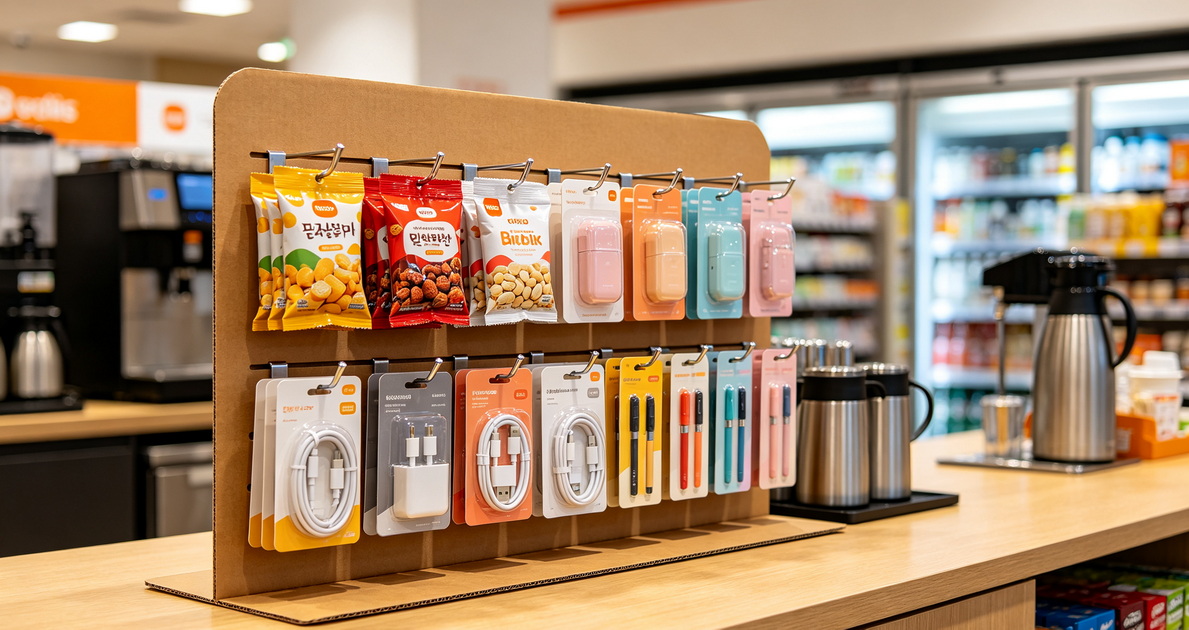
A hook display stand is a retail merchandising display designed to hold products on hooks, peg hooks, wire hooks, or hanging arms. It may be made from corrugated cardboard, metal wire, steel tube, acrylic, PVC foam board, wood, or a mixed-material combination.
Common applications include:
- Cosmetics and personal-care products
- Snacks and confectionery
- Small electronics and accessories
- Stationery and toys
- Pharmacy and health products
- Kitchenware and household goods
- Automotive accessories
- Batteries, cables, and mobile accessories
- Seasonal promotional merchandise
- Hardware and DIY products
China's strength in retail-display production comes from the ability to combine several manufacturing processes in one supply chain:
| Manufacturing Process | Relevance to Hook Display Stands |
|---|---|
| Structural design | Determines load-bearing capacity, assembly method, product visibility, and retail footprint |
| Offset and digital printing | Supports branding, graphics, product instructions, and campaign themes |
| Corrugated-board conversion | Used for lightweight, recyclable temporary POP displays |
| Metal wire forming | Produces hooks, baskets, grids, and durable permanent display structures |
| Powder coating and plating | Protects metal surfaces and supports brand color requirements |
| Acrylic cutting and bonding | Creates premium, transparent, semi-permanent product displays |
| Pre-assembly and kitting | Reduces retailer setup time and improves campaign rollout consistency |
| Export packaging | Helps protect displays during container loading, unloading, and retail distribution |
China's printed-signage market alone was valued at around USD 0.76 billion in 2025, according to one market estimate, reflecting the country's scale in print-related production and visual merchandising supply chains.
For international buyers, cities and regions such as Shenzhen, Dongguan, Guangzhou, Foshan, Yiwu, Ningbo, Wenzhou, Suzhou, Shanghai, and Qingdao offer different supply-chain advantages. Shenzhen and Dongguan are particularly relevant for export-oriented product development, electronics-related displays, packaging, printing coordination, and overseas customer communication. Yiwu provides cost and trading advantages for many consumer-product and packaging supply chains.
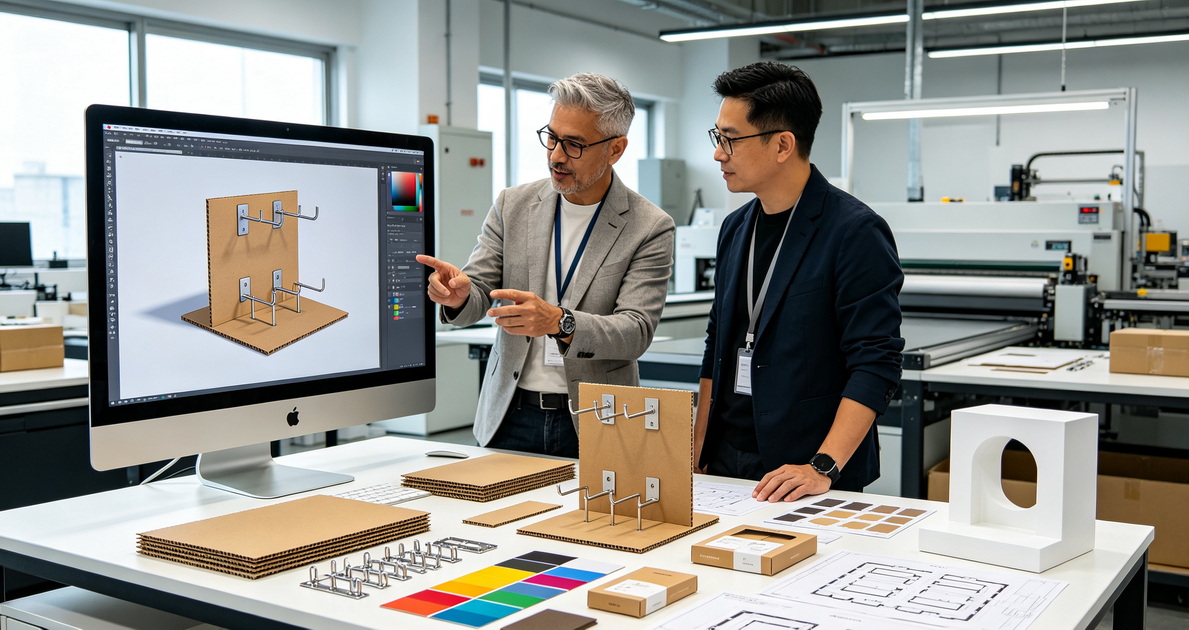
This list is designed as a buyer's research framework rather than a claim that every supplier is identical in scale, quality level, or technical capability. The following criteria are especially important when selecting a hook display stand manufacturer in China.
A hook display stand must do more than look visually appealing. It must safely carry the actual product load, survive transport, fit the designated shelf or counter space, and be easy for store personnel to assemble.
Buyers should evaluate whether the supplier can provide:
- Dielines and 3D renderings
- Structural drawings
- Load-bearing calculations or practical load-test results
- Prototype samples
- Assembly instructions
- Retail footprint drawings
- Hook-spacing recommendations
- Product-facing and stock-capacity calculations
- Material recommendations by product weight and shipping method
For cardboard hook displays, structural design is especially important because a display can look stable in a studio image but fail when fully loaded with hanging products.
A professional supplier should state exactly what materials are being quoted. Vague descriptions such as "high-quality cardboard," "strong metal," or "premium acrylic" are not sufficient for a long-term procurement program.
Key materials to define include:
- Corrugated board flute type: E-flute, B-flute, C-flute, BC double wall, or other construction.
- Paper weight and liner quality.
- Greyboard or chipboard thickness, where relevant.
- Metal wire diameter and steel grade.
- Tube-wall thickness for metal structures.
- Acrylic grade and thickness.
- PVC foam-board density and thickness.
- MDF, plywood, or wood species for wood-based displays.
- Surface finishing, including lamination, varnish, powder coating, plating, or paint.
A reliable factory should have clear quality checkpoints from artwork approval through final loading.
A typical POP-display quality-control process includes:
- Artwork proof approval.
- Color standard confirmation, often using Pantone references.
- Pre-production sample review.
- Material inspection.
- Die-cut accuracy inspection.
- Print-color inspection.
- Glue and structural assembly inspection.
- Hook alignment inspection.
- Load-bearing test.
- Drop or carton-strength check where appropriate.
- Final random inspection before shipment.
- Packaging and carton-mark inspection.
A hook display stand is often part of a campaign launch. Missing the delivery date can mean missing a retailer's promotional window entirely.
Buyers should ask for:
- Number of production lines.
- Monthly output by display type.
- Printing capacity.
- Manual assembly capacity.
- Pre-loading capability.
- Sample lead time.
- Mass-production lead time.
- Peak-season capacity.
- Standard delivery schedule.
- Contingency plan for urgent orders.
The compliance requirements for a display stand depend on its materials, destination market, product category, and retailer rules. Buyers may need to request:
- ISO 9001 quality-management certification.
- FSC chain-of-custody documentation for paper-based materials, if required.
- REACH-related material declarations for EU-bound products.
- RoHS-related declarations if electronic components, lighting, or relevant materials are included.
- CPSIA-related compliance for displays associated with children's products in the United States.
- Packaging-material declarations.
- Material Safety Data Sheets for coatings, inks, adhesives, or chemical treatments where needed.
- Social-compliance audit reports, depending on retailer requirements.
Important clarification: CE marking normally applies to products governed by specific EU legislation, such as certain electrical products, machinery, toys, or equipment. A standard non-electrical cardboard or metal hook display stand does not automatically require CE marking. Buyers should not request CE as a generic quality certificate; instead, they should identify the actual product, material, safety, and retailer requirements applicable to the destination market.
Company: Long Win Display Shenzhen Limited
Headquarters: Shenzhen, China
Production Base: Yiwu, Zhejiang, China
Established Overseas Business: 2018
Core Products: Cardboard display stands, counter displays, hook displays, pallet displays, display boxes, gift boxes, packaging boxes, acrylic displays, metal-wire displays, PVC foam-board displays, and other semi-permanent or permanent retail displays
Main Markets: Asia, North America, Oceania, and Europe
Best Fit: Brands, retailers, importers, distributors, and small-to-medium-sized businesses seeking customized POP display design, practical MOQ options, efficient communication, and end-to-end OEM support
Long Win Display is a China-based POP-display designer and manufacturer specializing in the design, customization, production, and preloading of retail displays. Its product range includes cardboard displays, counter displays, hook displays, pallet displays, display boxes, packaging boxes, and permanent display options made with materials such as PVC foam, metal wire, and acrylic.
The company's Shenzhen headquarters supports customer communication and project coordination, while its production facilities moved to Yiwu after 2020. According to the company, the Yiwu location supports cost control and communication advantages for global customers.
For international procurement teams, Long Win Display's main value proposition is not simply the ability to produce a standard hook display stand. Its stronger fit is for buyers who need a manufacturer to support the complete retail-display workflow:
- Initial product or merchandising brief
- Structural concept and display design
- Prototype development
- Graphic printing coordination
- Material selection
- Mass production
- Pre-assembly or preloading
- Export packaging
- Retail-ready delivery planning
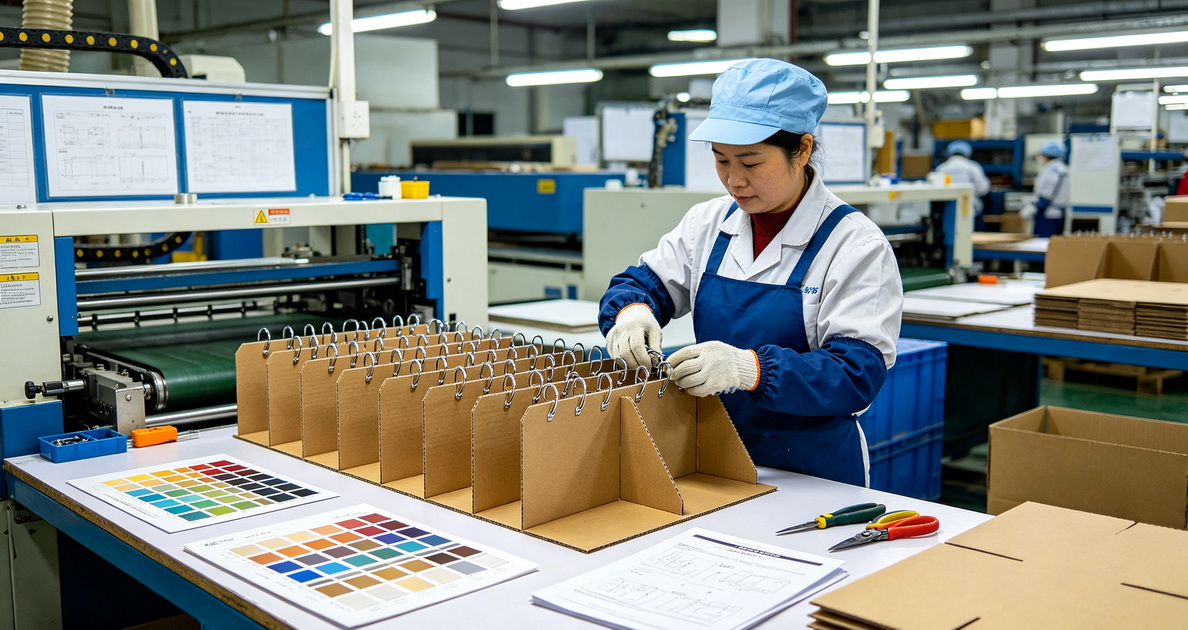
Long Win Display states that it has complete production equipment covering design, prototyping, printing, production, and delivery, together with an established quality-control procedure. It also reports more than 10 production lines, a daily output of 10,000 pieces, 60 employees, 20 main facilities, and annual sales of USD 200 million; buyers should confirm the scope, date, and applicable product categories of those figures during supplier qualification.
The company has stated experience helping brands enter retail environments associated with Walmart, Woolworths, Costco, Coles, Tesco, 7-Eleven, and Circle K. This makes it particularly relevant for buyers who need to consider retailer-facing display requirements such as carton dimensions, shelf footprint, setup speed, load capacity, barcodes, store distribution, and campaign schedules.
Core strengths
- More than 20 years of display-design experience referenced by the company.
- Broad POP display and retail packaging product range.
- Strong fit for countertop displays, cardboard hook displays, sidekick displays, pallet displays, display boxes, and retail-ready packaging.
- Flexible OEM/ODM support for buyers needing non-standard display structures, printed branding, customized hooks, packaging, and preloading.
- Production workflow covering design, prototype, printing, production, and delivery.
- Cost-control orientation through simplified structures, reduced material waste, and optimized packing methods.
- Suitable for small and medium-sized brands that may need faster communication and more adaptable project support than highly standardized, large-volume-only suppliers.
- Retail-display experience across grocery, convenience, cosmetics, electronics, daily necessities, stationery, toys, food and beverage, personal care, and seasonal promotion categories.
OEM/ODM applications
Long Win Display can be a suitable partner when the project requires:
- A branded cardboard counter hook display for cosmetics, snacks, accessories, or impulse-buy products.
- A floor-standing display with metal hooks for packaged consumer goods.
- A mixed-material display combining corrugated board, metal wire, acrylic trays, or PVC foam panels.
- Retail-ready preloaded display units for store distribution.
- Custom color printing, brand graphics, barcodes, QR codes, and campaign messaging.
- Packaging engineered to reduce freight volume and retailer assembly time.
- A display program that must be adapted for multiple markets, products, languages, or retail formats.
What buyers should verify
- Actual material specifications, including flute type, paper weight, board grade, hook-wire diameter, acrylic thickness, and coating method.
- Current certification and compliance documents relevant to the target market.
- Sample and mass-production lead times.
- Maximum load per hook, per shelf, and per full display.
- Retailer-specific packing and labeling experience.
- Preloading procedures and product-protection method.
- Quality-inspection standard and acceptable quality limit.
- Whether the stated daily capacity is applicable to the buyer's selected display type and assembly complexity.
Website:
Positioning: Custom display and retail merchandising supplier
Suitable For: Buyers seeking customized retail displays, commercial fixtures, and project-based POP solutions
OEM/ODM Focus: Display structure, branded visual merchandising, and store-oriented presentation
XK Display should be evaluated by buyers seeking a supplier with a custom-display orientation. When reviewing a hook display stand manufacturer, buyers should determine whether the supplier's strength lies in cardboard POP displays, metal fixtures, acrylic displays, retail furniture, or a combination of these formats.
A company with a broad display portfolio may be valuable when a brand wants consistent presentation across countertop displays, floor displays, wall-mounted hook panels, display boxes, and permanent fixtures.
Core strengths to assess
- Custom retail-display development.
- Potential relevance for branded merchandising programs.
- Suitable for buyers requiring project-level design input rather than only standard shelving.
- May support different display materials depending on the product category.
What buyers should verify
- Company establishment year and legal manufacturing entity.
- Material specialties and in-house versus outsourced processes.
- Retail-display case studies in the buyer's category.
- Hook loading capacity and fixture safety.
- Sample process, prototyping capability, and engineering response time.
- Current ISO, FSC, REACH, RoHS, or retailer-specific audit documents where relevant.
Website:
Positioning: Packaging and gift-box-oriented production with potential relevance for display packaging and countertop merchandising
Suitable For: Premium packaging, gift presentation, retail packaging, display boxes, and campaign kits
OEM/ODM Focus: Printed packaging, branded boxes, inserts, presentation units, and retail-ready kits
Xianda Gift Box is relevant for buyers whose hook-display or countertop-display project is linked to premium packaging, gift-box presentation, display boxes, or retail campaign packaging. Its suitability as a dedicated hook display stand source should be verified according to its current production scope, display-material capabilities, and structural engineering resources.
For many beauty, jewelry, personal-care, food gift, electronics accessory, and promotional-product brands, the display and packaging cannot be separated. The display must protect the product during shipping, support brand presentation, and enable easy retail setup.
Core strengths to assess
- Packaging-oriented customization.
- Potential fit for premium display boxes and countertop presentation.
- Useful for brands that need coordinated packaging and merchandising.
- Suitable for product launches, seasonal campaigns, gift sets, and promotional kits.
What buyers should verify
- Whether hook display stands are designed and manufactured in-house.
- Corrugated, paperboard, rigid-board, acrylic, or metal display capability.
- Color-management process and proofing standards.
- Compliance of inks, adhesives, coatings, and paper materials.
- Packaging drop-test or transit-protection process.
- Minimum order quantity for customized printed projects.
Website:
Positioning: Customized packaging and presentation packaging supplier
Suitable For: Printed packaging, product presentation, display boxes, inserts, and packaging-driven POP campaigns
OEM/ODM Focus: Brand packaging, retail-ready cartons, custom inserts, and promotional display packaging
MTH Packaging Box is relevant for buyers looking at the packaging side of a hook-display or countertop-display program. It may be considered where the project includes printed display boxes, packaging inserts, counter units, or retail distribution cartons.
Packaging suppliers can add value to a POP-display project when they understand both visual presentation and transport protection. However, buyers should verify whether the manufacturer has direct capability for load-bearing hook structures, metal components, permanent fixtures, or complex preloaded retail-display assembly.
Core strengths to assess
- Packaging-focused product customization.
- Suitable for visual merchandising programs where cartons, inserts, display boxes, and retail presentation are closely connected.
- Potentially useful for branded promotional packaging and product launch campaigns.
- Relevant for small and medium-sized brands needing manageable MOQs.
What buyers should verify
- Structural design capability beyond standard boxes.
- Experience with hook-bearing cardboard displays.
- Board strength, flute options, and compression resistance.
- Print quality, color consistency, and finishing options.
- Pre-assembly, kitting, and retailer-ready packaging capability.
- Production capacity during seasonal peaks.
Website:
Positioning: Custom packaging supplier with potential applications in retail-ready display packaging
Suitable For: Brands requiring custom printed packaging, mailer boxes, retail boxes, inserts, and presentation-oriented packaging
OEM/ODM Focus: Custom packaging structure, branded printing, unboxing experience, and campaign packaging
Bonito Pack is relevant to display procurement when the buyer's requirement includes retail-ready packaging, counter display boxes, product inserts, or packaging that transitions into a merchandising unit. Buyers should separately verify its capacity for heavy-duty hook display stands, metal wire racks, permanent displays, or large floor-standing retail fixtures.
For emerging brands and e-commerce-led companies entering physical retail, a packaging supplier can be especially useful when packaging must meet both transport and shelf-display requirements.
Core strengths to assess
- Custom packaging orientation.
- Appropriate for branded retail boxes and presentation packaging.
- Potential relevance for display boxes, countertop packaging displays, and promotional kits.
- May support smaller brands with customized printed-packaging requirements.
What buyers should verify
- Actual factory location and manufacturing scope.
- Whether the supplier is a manufacturer, sourcing company, or hybrid provider.
- FSC and recycled-material options, where required.
- Ink, coating, and adhesive compliance for the destination market.
- Display structural testing capability.
- MOQ, sampling cost, and artwork revision policy.
Location: China and international operations
Positioning: Retail display, store fixture, and merchandising solution provider
Suitable For: Larger retail programs, permanent displays, store fixtures, and multi-material merchandising systems
OEM/ODM Focus: Retail environments, custom fixtures, branded display systems, and store rollout projects
DGS Retail is relevant for buyers requiring more permanent retail-display structures rather than only temporary cardboard hook displays. This type of supplier may be useful for brands and retailers seeking metal, wood, acrylic, or mixed-material fixtures with longer service life.
For permanent hook-display projects, buyers should focus on structural safety, surface durability, fixture anchoring, load requirements, replacement parts, and store-installation logistics.
Core strengths to assess
- Potential fit for permanent retail-display and fixture programs.
- Suitable for multi-material structures.
- Relevant for broader retail rollout requirements.
- May support store-fixture standardization across locations.
What buyers should verify
- Applicable regional safety and fixture standards.
- Metal thickness, powder-coating thickness, weld quality, and rust-resistance testing.
- Installation method and site requirements.
- Replacement-part availability.
- Regional project-management and after-sales support.
Location: China
Positioning: POP-display and retail merchandising supplier
Suitable For: Cardboard, retail, promotional, and custom point-of-purchase display programs
OEM/ODM Focus: Printed POP displays, retail promotions, structural design, and branded campaigns
Sunway Display represents the category of China-based suppliers that support branded POP displays and retail campaigns. Buyers may consider similar manufacturers when they need high-impact printed displays for supermarkets, pharmacies, convenience stores, and specialty retail.
The key procurement question is whether the supplier can balance visual design with structural reliability. A colorful display is not successful if hooks bend, panels bow, cartons collapse, or assembly is too complicated for store staff.
Core strengths to assess
- Retail-promotion display orientation.
- Potential fit for printed cardboard POP programs.
- Suitable for campaign-driven, seasonal, or product-launch merchandising.
- May support custom graphic execution and structural display design.
What buyers should verify
- Structural engineering workflow.
- Load test for the actual product and hook quantity.
- Color-approval procedure.
- Display assembly time.
- Retail-ready packaging and store instruction quality.
- Quality consistency between prototype and mass production.
Location: Shenzhen, Guangdong, China
Positioning: Display products and custom retail display solutions
Suitable For: Buyers requiring acrylic, metal, wood, or mixed-material retail displays
OEM/ODM Focus: Branded fixtures, custom retail displays, countertop units, and permanent display solutions
Shenzhen-based display manufacturers can be attractive to export buyers because the region combines design resources, manufacturing coordination, proximity to consumer-electronics and brand ecosystems, and access to international logistics infrastructure.
A supplier in this category may be a useful choice when the display project needs a more permanent material format, such as acrylic countertop displays, metal hook racks, branded electronics-accessory stands, or cosmetic-display fixtures.
Core strengths to assess
- Potential multi-material display capabilities.
- Strong relevance to electronics, cosmetics, accessories, and branded retail environments.
- Suitable for custom display projects that require a more premium visual appearance.
- May offer easier communication for export-oriented programs.
What buyers should verify
- Material grade and thickness.
- Acrylic clarity, bonding quality, and scratch resistance.
- Metal fabrication, coating, and corrosion protection.
- Prototype approval process.
- Export packaging for fragile or high-gloss components.
- Factory ownership of key processes versus outsourcing.
Location: Guangzhou, Guangdong, China
Positioning: Custom retail display, shopfitting, and merchandising solutions
Suitable For: Retail fixtures, store displays, branded hook-display units, and medium-to-large commercial projects
OEM/ODM Focus: Store-oriented display concepts, permanent fixtures, and custom branded furniture
Guangzhou is an important commercial and manufacturing center in southern China, with extensive links to furniture, retail fixtures, printing, lighting, metalwork, and export trade. Suppliers in this category may be appropriate for buyers who need a hook display stand as part of a broader store-fixture or branded-shop project.
Core strengths to assess
- Retail-fixture and store-display orientation.
- Potential suitability for permanent metal, wood, acrylic, and mixed-material structures.
- Useful for brands requiring coordinated visual merchandising across multiple stores.
- May support custom branding, installation drawings, and fixture standardization.
What buyers should verify
- Factory experience with the buyer's retail segment.
- Engineering drawings and installation documentation.
- Material and finish samples.
- Weight capacity, stability, and anti-tip requirements.
- Retail rollout schedule and logistics plan.
- Project-management contact structure.
Location: Foshan, Guangdong, China
Positioning: Metal, furniture-related, and commercial display manufacturing
Suitable For: Metal hook displays, retail fixtures, shelving-related displays, and permanent merchandising systems
OEM/ODM Focus: Metal display fabrication, custom fixtures, powder-coated structures, and retail equipment
Foshan is internationally recognized for furniture, metalworking, stainless steel, lighting, and building-material supply chains. For buyers seeking durable hook display stands, gondola attachments, metal-wire hook panels, or semi-permanent retail fixtures, Foshan-based suppliers can be attractive because of access to metal fabrication and finishing resources.
Core strengths to assess
- Potential suitability for metal hook displays and long-life retail fixtures.
- Access to furniture and metalworking supply chains.
- Appropriate for permanent or semi-permanent retail programs.
- May support custom metal fabrication and finishing.
What buyers should verify
- Wire diameter, steel grade, tube-wall thickness, and welding method.
- Surface finish, powder-coating thickness, and corrosion resistance.
- Sharp-edge control and customer-safety requirements.
- Hook load capacity and panel-deflection limits.
- Flat-pack versus assembled shipping method.
- Retail-installation requirements and replacement-part support.
The following table is intended as a buyer-shortlisting tool. Production capacity, MOQ, certifications, and available materials vary by product type, seasonal workload, country requirements, and project complexity. Always obtain written, current confirmation directly from each supplier.
| Rank | Manufacturer | Main Focus | Typical Capacity Profile | Indicative MOQ | Certifications and Documents to Verify | OEM/ODM Fit |
|---|---|---|---|---|---|---|
| 1 | Long Win Display | Cardboard POP, hook displays, counter displays, pallet displays, packaging, acrylic, metal wire, PVC foam | Company states 10+ production lines and 10,000 pieces daily; confirm by display type | Project-based; confirm after design and material selection | ISO status, FSC where needed, material declarations, retailer audit records, QC reports | High—design, prototype, printing, production, preloading, branded customization |
| 2 | XK Display | Custom retail displays and merchandising | Confirm directly by material and product category | Project-based | ISO, FSC, REACH, RoHS, social-audit records where applicable | Medium to high |
| 3 | Xianda Gift Box | Gift boxes, packaging, display boxes, presentation packaging | Confirm directly | Usually project and print-run dependent | FSC, material safety, ink and adhesive declarations | Medium—especially for packaging and counter-display programs |
| 4 | MTH Packaging Box | Customized packaging and display packaging | Confirm directly | Project-based | FSC, print and material compliance documentation | Medium |
| 5 | Bonito Pack | Custom packaging and retail presentation | Confirm directly | Often varies by box style, size, printing, and finishing | FSC, recycled-content claims, packaging declarations | Medium |
| 6 | DGS Retail | Permanent displays and retail fixtures | Project-based and installation dependent | Project-based | ISO, material safety, project drawings, retailer audit documents | Medium to high |
| 7 | Sunway Display | POP and promotional displays | Confirm directly | Project-based | ISO, FSC, color-control and QC records | Medium to high |
| 8 | Shenzhen Jingbang Display Products | Acrylic, metal, wood, and mixed-material displays | Confirm directly | Project-based | Material reports, REACH/RoHS where relevant, QC documents | High for permanent custom displays |
| 9 | Guangzhou Dezheng Display | Retail fixtures and store displays | Project and rollout dependent | Project-based | Material, finish, structural, and installation documents | Medium to high |
| 10 | Foshan Aojie Display Products | Metal fixtures and hook display systems | Confirm directly by fabrication capacity | Project-based | Metal-material reports, powder-coating records, safety documentation | High for metal-based customization |
A professional RFQ should clearly define the display's commercial purpose, visual requirements, structural requirements, retail environment, and logistics method. The table below highlights common technical points.
| Technical Element | What Buyers Should Specify | Why It Matters |
|---|---|---|
| Display type | Countertop, floor-standing, sidekick, pegboard, wall-mounted, pallet display, or endcap unit | Determines footprint, stability, material choice, and packaging |
| Product weight | Weight per item, units per hook, total display load | Determines hook diameter, board reinforcement, and base stability |
| Hook dimensions | Hook length, wire diameter, spacing, end style, number of hooks | Prevents product overlap, hook bending, and difficult shopper access |
| Display material | Corrugated board, metal wire, acrylic, PVC foam, MDF, steel tube, or mixed material | Affects cost, durability, appearance, recyclability, and transit protection |
| Print requirement | CMYK, Pantone colors, gloss/matte finish, lamination, varnish | Controls brand consistency and visual quality |
| Retail footprint | Width, depth, height, shelf or counter dimensions | Prevents rejection by retailers because of space constraints |
| Assembly method | Flat-pack, pop-up, pre-assembled, preloaded, tool-free setup | Affects freight cost and retailer labor |
| Packaging | Master carton, inner carton, palletization, corner protection, moisture barrier | Reduces transit damage and improves store distribution |
| Compliance | FSC, REACH, RoHS, CPSIA, retailer audit, recycled content, fire-rating needs | Ensures destination-market and retailer requirements are met |
Cardboard hook displays are widely used for temporary promotions, launch campaigns, seasonal retail programs, and high-volume consumer products. They can be cost-effective, lightweight, printable, recyclable, and easy to ship flat-packed.
However, cardboard is not automatically suitable for every hook-display project. The supplier must account for:
- Total product weight.
- Hook leverage force.
- Number of hooks per panel.
- Board flute direction.
- Reinforcement method.
- Humidity exposure.
- Store environment.
- Display lifespan.
- Shipping method.
- Assembly method.
For heavier products, a cardboard display may require metal hook reinforcement, thicker board, double-wall corrugated construction, reinforced bases, or a mixed-material design.
Metal hook display stands are better suited for products with higher weight, long-term retail use, outdoor-adjacent conditions, hardware goods, automotive accessories, electronics accessories, and high-traffic retail environments.
Important metal specifications include:
- Steel wire diameter.
- Tube dimensions and wall thickness.
- Weld type and weld consistency.
- Powder-coating thickness.
- Corrosion-resistance requirement.
- Hook-end safety design.
- Base configuration.
- Anti-tip performance.
- Adjustable versus fixed hook placement.
- Flat-pack versus welded-frame construction.
Acrylic displays are often used for cosmetics, small electronics, luxury accessories, and premium countertop presentation. Acrylic can offer a clean and high-end appearance, but it is more vulnerable to scratching and cracking than metal.
Buyers should define:
- Acrylic thickness.
- Cast versus extruded acrylic.
- Transparency and color requirement.
- Edge finishing.
- Bonding method.
- Scratch-protection packaging.
- Load capacity.
- Replacement-part availability.
A common industry misconception is that hook-display failure is mainly caused by weak hooks. In many failed displays, the metal hook itself is strong enough—the actual problem is the hook mounting interface.
For example, a supplier may use a 4 mm or 5 mm metal hook that appears robust. However, if that hook is inserted into a thin corrugated panel without sufficient reinforcement, the panel can tear, deform, or gradually pull forward under repeated product loading. The display may look acceptable during a short factory inspection but fail after several days in a retail store.
This risk becomes greater when:
- Products are heavy.
- Hooks are long.
- Shoppers pull products forward repeatedly.
- The store environment has high humidity.
- The display is assembled incorrectly.
- Products are concentrated on upper hooks.
- The board grain or flute direction is not optimized.
- The display is transported while already loaded.
Ask the supplier to test the full hook-panel system, not only the hook.
Your test request should specify:
1. Product weight per unit.
2. Maximum units per hook.
3. Number of hooks loaded simultaneously.
4. Total expected display weight.
5. Hook length.
6. Required display duration in store.
7. Whether the display will be preloaded before shipping.
8. Intended retail environment.
9. Required safety margin.
10. Photos or video of the completed load test.
For cardboard displays, request a test using the actual product, actual hook configuration, and actual board specification. For metal displays, request testing that evaluates hook bending, weld performance, base stability, and overall unit tipping risk.
A prototype may use strong board, but mass production may use lighter paper, lower-strength liners, or a different flute construction to reduce cost.
How to avoid it: Define the board structure, flute type, paper weight, finish, and reinforcement method in the purchase order. Retain an approved "golden sample" and require the supplier to match it during mass production.
A supplier may quote a wire diameter that appears acceptable but substitute thinner wire or lower-grade material in production.
How to avoid it: State wire diameter, tolerance, coating, hook length, material, and load requirement in the approved specification. Request random measurement records during production.
Retail displays often use strong brand colors. If the factory lacks color control, different batches may show visible variance.
How to avoid it: Provide Pantone references, approve a printed color proof, state acceptable color tolerance, and require print checks during production.
A display may be visually effective but expensive to ship because it is bulky, poorly nested, or cannot be flat-packed.
How to avoid it: Ask for both a pre-assembled concept and a flat-pack cost comparison. Review carton dimensions, cubic volume, container loading quantity, and retailer assembly time before approval.
Preloading saves store labor but increases the risk of product movement, hook damage, crushed graphics, and unstable cartons.
How to avoid it: Require a preloading trial, internal protection plan, carton drop-test approach, palletization plan, and loading photos before mass shipment.
Many buyers request "CE, RoHS, ISO, FSC" without identifying the real compliance issue. This can result in irrelevant documents and false confidence.
How to avoid it: Create a compliance matrix based on your material, retail channel, destination country, product category, and retailer requirements. Ask for only the documents that apply to your program.
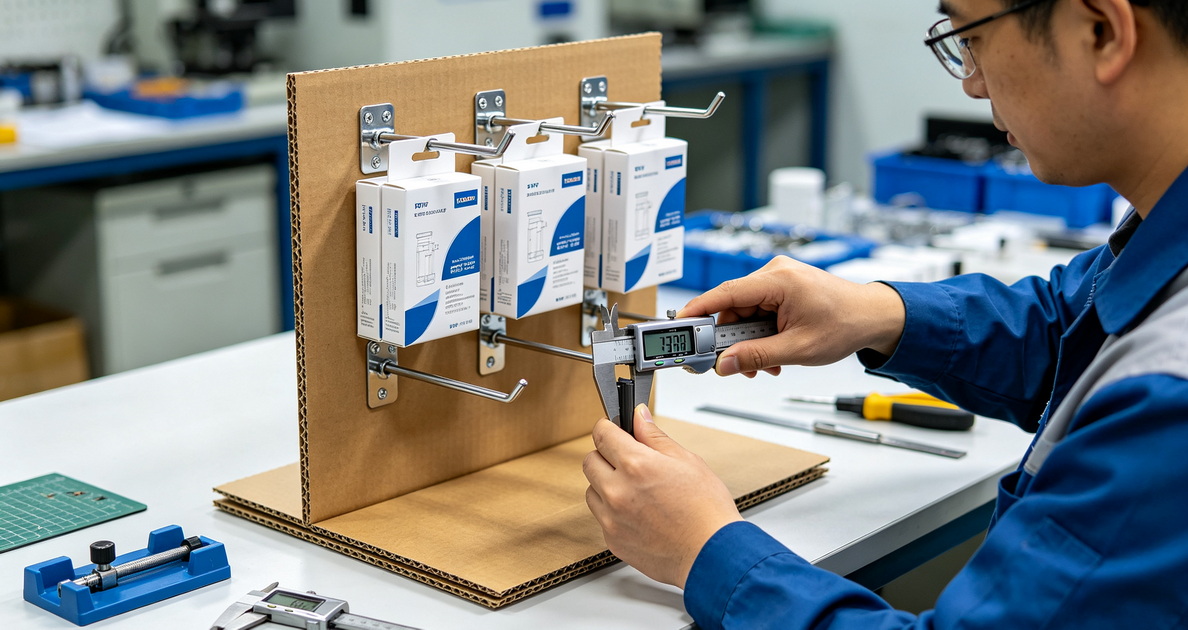
Ask whether the supplier manufactures the following processes in-house or outsources them:
- Structural design
- Sampling
- Offset printing
- Digital printing
- Die cutting
- Lamination
- Glue assembly
- Metal wire forming
- Welding
- Powder coating
- Acrylic fabrication
- Preloading
- Export packing
A supplier that outsources some processes may still be a suitable partner, but the buyer should understand who controls quality, timing, and accountability.
Ask for examples relevant to your project:
- Hook displays for similar product weights.
- Countertop displays for similar retail channels.
- Displays with comparable dimensions.
- Preloaded displays.
- Retail campaigns for comparable markets.
- Permanent metal display fixtures.
- FSC or sustainability-focused projects, if relevant.
Do not evaluate a supplier only by visually attractive photographs. Request details about materials, lead time, loading capacity, packaging, and production volume.
A complete sample process should include:
1. Artwork and structural brief.
2. Dieline or 3D drawing.
3. Digital rendering.
4. White structural sample.
5. Printed prototype.
6. Product loading test.
7. Packaging trial.
8. Buyer approval.
9. Golden-sample retention.
10. Mass-production release.
For high-value campaigns, buyers should test the display with actual retail products and simulate normal handling.
A video audit can provide meaningful initial evidence. Ask the supplier to show:
- Factory entrance and signage.
- Material warehouse.
- Printing equipment.
- Die-cutting area.
- Manual assembly lines.
- Quality-control station.
- Metalwork area, if applicable.
- Sample room.
- Finished goods area.
- Packaging and palletizing process.
- Container loading process.
For repeat orders, use a written inspection checklist. It may cover:
- Correct dimensions.
- Printed color.
- Material thickness.
- Hook diameter and spacing.
- Structural strength.
- Product fit.
- Assembly quality.
- Glue condition.
- Surface scratches.
- Carton markings.
- Quantity.
- Packaging integrity.
An acceptable quality limit, inspection level, and defect classification should be agreed before production.
Hook displays can be inexpensive to manufacture but expensive to ship if their packaging is not optimized.
Confirm:
- Incoterm: EXW, FOB, CIF, DDP, or another agreed term.
- Port of loading.
- Carton dimensions and gross weight.
- Total cubic volume.
- Flat-pack versus assembled shipping.
- Container quantity.
- Pallet dimensions.
- Moisture protection.
- Preloading requirements.
- Destination-country import requirements.
- Retailer delivery appointment requirements.
China offers a wide range of hook display stand manufacturers, from cardboard POP-display specialists and packaging suppliers to metal fixture producers and multi-material retail-display factories. The right manufacturer should be selected according to your display's material, product load, retail environment, branding requirements, compliance needs, target quantity, and logistics model.
For buyers seeking a flexible, design-oriented partner, Long Win Display is a relevant option to evaluate. The company provides customized cardboard displays, hook displays, counter displays, pallet displays, display packaging, and selected permanent display materials, with stated support for design, prototyping, printing, production, preloading, and delivery. Its Shenzhen and Yiwu operating structure, broad product range, and cost-control focus can be particularly suitable for small and medium-sized brands seeking responsive OEM/ODM cooperation.
The most effective first step is to send a complete display brief: product dimensions, product weight, desired display size, hook quantity, target retailer, artwork, intended market, required quantity, preferred material, and delivery deadline. This enables the manufacturer to recommend a technically suitable hook display stand rather than simply offering a generic quotation.
Request the complete certificate showing the legal company name, factory address, certification scope, certificate number, issue date, expiry date, and issuing body. Confirm that the certificate covers the manufacturing entity that will produce your order, rather than a related trading company. Where possible, verify the certificate through the issuing certification body's public database or directly by email.
There is no universal MOQ because it depends on material, printing method, display size, die-cut tooling, assembly complexity, hook type, and packaging. A cardboard display may have a lower practical MOQ than a metal display requiring custom tooling and powder coating. Ask suppliers to quote several quantity breaks, such as 500, 1,000, 3,000, and 5,000 units, so you can compare unit cost, tooling amortization, and freight efficiency.
Do not rely on a photo or a statement such as "heavy duty." Send the supplier your actual product weight, unit quantity per hook, total load, hook length, and expected retail duration. Require a physical sample loaded with real products. Ask for photographs or video of a static load test and, where appropriate, a repeated-use or pull-forward test.
Not automatically. A standard non-electrical cardboard, metal, or acrylic retail display normally does not require CE marking merely because it is sold in Europe. RoHS may become relevant if the display includes electrical or electronic components such as lighting. The correct requirements depend on the display's design, materials, destination market, product category, and retailer rules. Confirm obligations with an appropriately qualified compliance professional.
Flat-packed displays usually reduce freight volume and are often better for cardboard units. Pre-assembled displays reduce store labor and may improve visual consistency, but they take more shipping space and require stronger protective packaging. The best option depends on container utilization, retailer setup capability, product fragility, campaign timeline, and total landed cost.
1. Long Win Display, "Our Company" — company profile, product range, locations, production process, stated capacity, market coverage, and retail-brand experience. [longwindisplay]
2. Fortune Business Insights, "Printed Signage Market Size, Share & Growth Forecast" — China printed-signage market estimate for 2025. [fortunebusinessinsights]
3. Spherical Insights, "Top 30 Companies in POP Display Market (2026–2035)" — global POP-display market estimate and forecast. [sphericalinsights]
4. Data Bridge Market Research, "Point of Sale Display Market Size, Share, and Trends" — point-of-sale display market estimates and Asia-Pacific growth outlook. [databridgemarketresearch]
5. Market research report listing, "Point of Sale Display Market Outlook 2025–2034" — market segmentation including countertop and freestanding displays. [marketresearch]


