
Views: 277 Author: Long Win Display Publish Time: 2026-08-05 Origin: Site


Content Menu
● What Is a Corrugated POP Display, and Why Does It Still Dominate Retail?
● Nine Types of Corrugated Retail POP Displays (and Where Each One Wins)
>> Floor and Pallet Displays: Quarter, Half, and Full
>> Pallet Skirts, Graphic Wraps, and Floorstands
>> Dump Bins, Specialty Signage, and Sidekicks
● Corrugated vs. Semi-Permanent vs. Permanent Displays: Which Wins on Return?
● Market Growth and the 2026 Data Brands Need to Know
● How to Choose the Right Corrugated POP Display: A Five-Step Framework
● Common Display Mistakes That Cost Brands Retail Space
● Sustainability Is No Longer Optional
● Working With a Manufacturer That Understands Global Retail Compliance
Corrugated retail POP displays remain one of the highest-return tools in brick-and-mortar merchandising, but choosing the wrong type wastes budget and weakens shelf presence. This guide breaks down every major type of corrugated POP display, backs each recommendation with current market data, and gives brand managers a practical framework for selecting, costing, and launching a display that actually sells.
Whether you are a CPG brand entering big-box retail for the first time or a marketing manager refreshing a seasonal program, understanding the structural, financial, and sustainability trade-offs behind point-of-purchase display design is now a competitive necessity, not a nice-to-have.
A corrugated POP display is a temporary or semi-permanent fixture built from layered corrugated board that stands apart from standard shelving to spotlight a specific product. Retail buyers often call them "silent salesmen" because they influence purchase decisions without a staff member present.
The data supports this reputation. Regular-priced merchandise placed in a retail display has been shown to outsell clearance-priced merchandise on standard shelving by roughly 18%, and signage-backed displays typically outperform non-display placements by about 20% overall. More recent research on end-cap placement shows lift ranging from 150% to 400% in unit sales versus inline shelving, depending on category and promotional support.
The category isn't shrinking either. The global point-of-purchase display market is valued at approximately 17.14 billion USD in 2026 and is projected to reach 22.23 billion USD by 2031, growing at roughly a 5.35% compound annual rate. Corrugated remains the dominant substrate because it is lightweight, recyclable, and fast to produce at scale — a combination rigid plastic and metal displays cannot match on cost or sustainability.
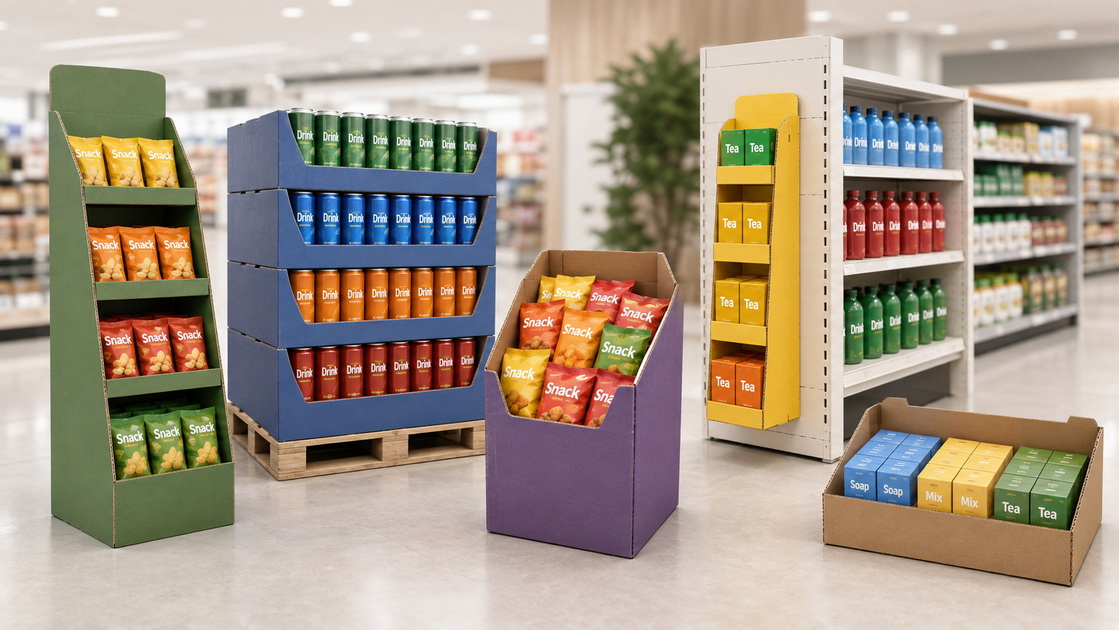
Not every display type suits every product. The table below offers a working reference, followed by deeper guidance on each category.
| Display Type | Shopping Access | Typical Load Capacity | Best Retail Placement |
|---|---|---|---|
| Quarter-Pallet Display | One-sided | Medium-heavy | Aisle ends, secondary placements |
| Half-Pallet Display | One-sided | Medium-heavy | Specialty and grocery retail |
| Full-Pallet Display | All-sided | 100kg+ | Wholesale clubs, main aisles |
| Pallet Skirt / Graphic Wrap | N/A (wraps existing fixture) | N/A | Existing pallet or shelf units |
| Floorstand | One or two-sided | 2kg–20kg | High-traffic zones, new launches |
| Dump Bin | Interactive, open-top | 15kg–30kg | Clearance, toys, bulk small items |
| Specialty Signage | N/A | Lightweight | Standees, hanging displays, aisle interrupters |
| Sidekick / Power Wing | One-sided | Light-medium | Existing endcaps and fixtures |
| Retail-Ready Packaging | Shelf-integrated | Product-dependent | Shelf-ready case-to-shelf transition |
Quarter-pallet displays are compact, one-sided floor units built to hold significant weight while remaining easy for shoppers to access — ideal for secondary placements where floor space is limited. Half-pallet displays step up in scale and are common in specialty and grocery retail, again with one-sided access. Full-pallet displays offer shopping access on all sides and dominate wholesale clubs, where printable surface area on every panel lets brands maximize visual merchandising real estate.

Pallet skirts and graphic wraps attach to existing store equipment rather than standing alone, making installation fast and low-cost while still projecting bold brand imagery from a distance. Floorstands are lightweight, highly customizable in shape and size, and best suited to displaying a moderate product quantity in a high-traffic zone — a top choice for product launches.
Dump bins invite shoppers to physically dig through merchandise and work especially well for toys, clearance stock, or bulk small items; one-piece construction holds its shape longer under repeated handling. Specialty signage spans standees, hanging displays, and aisle interrupters designed purely to build brand awareness. Sidekick and power wing displays clip onto an existing endcap or fixture, giving brands incremental shelf presence without requiring dedicated floor space.
Fully customized shelf-ready packaging is printed, glued, assembled, and pre-packed before it ever reaches the store, which shortens the case-to-shelf transition and gives brands more control over in-store presentation from the moment the box is opened.
Display lifespan is the single biggest driver of total cost of ownership, and it is the factor most brands underweight when comparing options.
| Factor | Corrugated (Temporary) | Semi-Permanent | Permanent |
|---|---|---|---|
| Typical lifespan | 2–12 weeks | 3–6 months | 1–10 years |
| Common materials | Corrugated fiberboard | PVC, coated board | Metal, wood, acrylic |
| Relative unit cost | Low per unit, higher at low volume | Moderate | High upfront, amortized over years |
| Restocking behavior | Usually discarded after sell-through | Occasionally refilled | Regularly refilled |
| Best fit | Promotions, seasonal SKUs, new launches | Category-seasonal products (e.g., sunscreen) | Anchor brands with locked-in shelf space |
Corrugated displays win on speed, sustainability, and print flexibility, but retailers almost always discard them after sell-through, meaning brands may need to reorder repeatedly to protect their shelf space. Permanent displays cost more upfront but typically generate the strongest long-term return because the investment is spread across years of restocked sales rather than a single promotional cycle.
The broader packaging context matters when planning next year's display budget. The global corrugated packaging market is valued at roughly 166.19 billion USD in 2026 and is forecast to grow at a 4.6% compound annual rate, reaching 227.68 billion USD by 2033. That expansion is being driven partly by retailers tightening sustainability requirements — major chains increasingly favor easily recyclable corrugated fixtures over mixed-material plastic units.
Digital integration is the other major shift shaping the category. QR codes, augmented-reality triggers, and digitally printed graphics are now routinely embedded into corrugated displays, a trend the industry describes as "retailtainment." Digital printing removes the need for costly printing plates, which also lowers minimum order quantities and speeds up seasonal turnaround for brands running short promotional windows.
Selecting a display type is not guesswork — it follows a repeatable evaluation process that experienced display manufacturers apply on every project.
1. Define the display's single goal. Decide whether the priority is brand awareness, impulse conversion, or bulk sell-through — one display rarely optimizes for all three at once.
2. Match the structure to the product. Heavy or dense items need double-wall (BC-flute) construction; small impulse items like cosmetics work well on lighter E-flute or B-flute countertop units.
3. Set the intended lifecycle up front. Confirm whether the program is a two-week promotion, a seasonal three-to-six-month run, or a program intended to hold permanent shelf space, since this determines material grade and budget.
4. Confirm retailer compliance requirements. Big-box retailers enforce strict size, weight, and disposability standards; a display that fails compliance review never reaches the floor.
5. Prototype and load-test before mass production. Physical or simulated load testing catches structural failures before they happen in-store, where a collapsed display damages both product and brand credibility.
After years of running production for export brands entering North American and European retail chains, a few recurring mistakes stand out:
- Overcrowding the display with too much text or too many SKUs, which slows shopper comprehension at the critical two-second decision window.
- Underestimating load requirements, leading to sagging shelves or collapsed floor units within days of setup.
- Ignoring flat-pack efficiency, which can inflate shipping costs by up to 40% compared to a well-engineered flat-pack structure.
- Skipping a compliance review, resulting in rejected shipments or last-minute redesigns that blow through launch timelines.

Retail buyers now treat recyclability as a baseline requirement rather than a bonus feature. The global sustainable packaging market is projected to reach approximately 325.94 billion USD in 2026, growing toward 463.41 billion USD by 2031, with corrugated board already commanding the dominant share of that category. For export manufacturers, specifying recycled test liner over virgin kraft paper, minimizing mixed-material components, and designing for single-stream recycling are now practical requirements for approval by major retail chains, not optional upgrades.
Choosing the right type of corrugated POP display is only half the challenge — engineering it to survive shipping, pass retailer compliance, and print beautifully at scale requires genuine manufacturing expertise. Long Win Display designs, customizes, and pre-assembles corrugated POP displays and package boxes for brands launching into major retail terminals worldwide, handling everything from structural load testing to retail-ready packaging integration.
In summary, the right display type depends on product weight, campaign length, retailer compliance rules, and sustainability requirements — and getting that match right is what separates a display that sells from one that simply sits on the floor. Brands preparing for their next retail launch are encouraged to reach out to Long Win Display's team for a structural consultation and prototype quote before finalizing their next program.
1. What is the difference between a POP display and a POS display?
A point-of-purchase display is placed anywhere in the store to highlight a product, while a point-of-sale display is specifically positioned at the checkout counter to drive last-second impulse purchases.
2. How long does a corrugated POP display typically last in stores?
Most corrugated displays are designed for temporary use, lasting roughly two to twelve weeks before retailers discard them, which makes them ideal for seasonal or promotional campaigns rather than long-term shelf fixtures.
3. How much does a custom corrugated display cost?
Unit costs generally range from 5 to 15 USD for simple countertop units to 25 to 65 USD for complex floor displays, with pricing driven mainly by order volume, print finish, and structural complexity.
4. Which type of corrugated display works best for a new product launch?
Floorstands and quarter- or half-pallet displays are typically the best fit for launches, since they offer high visibility in traffic-heavy zones without requiring the volume commitment of a full-pallet program.
5. Are corrugated POP displays environmentally friendly?
Yes. Corrugated fiberboard is widely recyclable and increasingly specified with recycled content, which is why it remains the material of choice as retailers tighten sustainability requirements across their supply chains.
1. Bpkc.com — [Different Types of Corrugated Retail POP Displays]
2. Color Reflections — [Are Point of Purchase Displays Effective? Boosting Sales]
3. Opener AI Blog — [End Cap Displays That Actually Drive Sales in Retail]
4. Mordor Intelligence — [POP Display Market Size, Share, Trends, 2031 Report]
5. Coherent Market Insights — [Corrugated Packaging Market Size, YoY Growth Rate, 2026-2033]
6. Agility Retail — [Successful Retail Merchandising Starts with Choosing the Right Kind of POP Display]
7. PopDisplay.me — [Types of POP Displays and Their Cost Ranges]
8. EcoPackables — [Sustainable Packaging Statistics 2026]
9. Bpkc.com — [Digitally Printed Packaging Solutions]
10. Atlantic Packaging — [Digital Printing and QR Codes: Enhancing Interactivity in Packaging]


