
Views: 230 Author: Long Win Display Publish Time: 2026-09-04 Origin: Site


Content Menu
>> Main Benefits of Standee Displays
>> Typical Limitations of Standee Displays
● What Is a Cardboard POP Display?
>> Main Benefits of Cardboard POP Displays
>> Typical Limitations of Cardboard POP Displays
● Standee Display vs Cardboard POP Display: Key Differences
● When Should You Use a Standee Display?
>> Use a Standee When Your Promotion Needs:
>> Standee Example: Mall Beauty Campaign
● When Should You Use a Cardboard POP Display?
>> Use a Cardboard POP Display When You Need:
>> Cardboard POP Display Example: Seasonal Snack Promotion
● Why Product Proximity Matters in Mall Promotions
● Visibility Is Not the Same as Conversion
>> The Hybrid Display Strategy
● Cardboard POP Display Engineering: Details Buyers Should Not Ignore
>> Board Grade and Flute Selection
>> Shelf Load and Display Stability
>> Pre-Loading and Retail Readiness
● How to Choose the Right Format
● Sustainability Considerations
● FAQ
>> 1. Is a standee display cheaper than a cardboard POP display?
>> 2. Can a cardboard POP display be used in a shopping mall corridor?
>> 3. What products work best in cardboard POP displays?
>> 4. How long can a cardboard POP display last in a retail environment?
>> 5. Should I use a counter display or a floor display?
For shopping mall promotions, a standee display is usually the faster and lower-cost tool for catching attention, while a cardboard POP display is better when the campaign must also hold, organize, and sell products. The right choice depends on whether your primary objective is awareness, shopper engagement, product sampling, or direct retail conversion.
At Long Win Display, we have seen that brands often compare these two formats too late in the planning process. They may approve a visually attractive standee, then discover they need product storage. Or they may order a large cardboard display when a lightweight promotional standee would have delivered the same awareness result at a lower cost.
This guide compares Standee Display vs Cardboard POP Display for Shopping Mall Promotions from the perspective of retail display planning, structural design, shopper behavior, logistics, installation, sustainability, and campaign measurement.
Important decision rule: Choose a standee when the message is the product. Choose a cardboard POP display when the product itself must become part of the message.
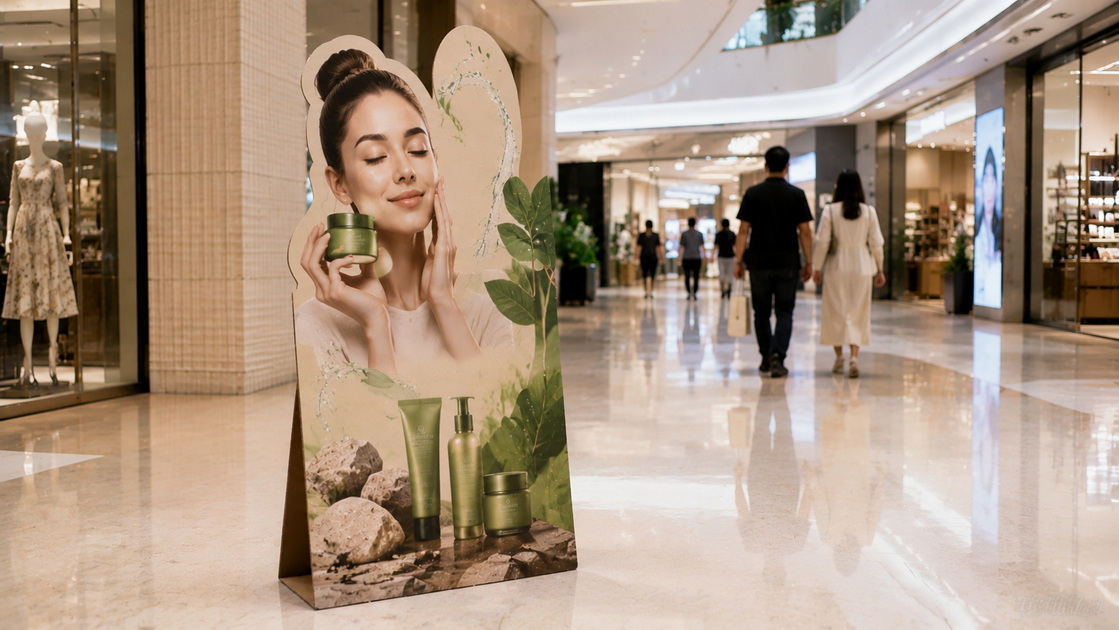
A standee display is a freestanding promotional visual, usually produced from cardboard, foam board, PVC foam board, KT board, corrugated board, acrylic, or other lightweight materials. It normally features a brand mascot, product image, promotional slogan, QR code, celebrity figure, campaign artwork, or event message.
Most standees are designed for visibility rather than merchandising.
They are common in:
- Shopping mall atriums
- Cinema entrances
- Retail store entrances
- Pop-up events
- Product-launch booths
- Seasonal campaigns
- Brand roadshows
- Supermarket promotional zones
- Cosmetics counters
- Sports and entertainment activations
A standee can be life-size, tabletop-sized, or built as a large freestanding branded visual. It may use a rear support easel, a folded cardboard base, or a custom floor stand.
Fast visual impact. A large character, product image, or campaign message can be recognized from several meters away.
Lower structural complexity. Because the unit does not usually carry product weight, it requires less board strength than a floor display.
Easy campaign replacement. Brands can change artwork for a new promotion without redesigning a full merchandising fixture.
Simple transportation. Most standees can be shipped flat and assembled quickly.
Strong event compatibility. They work well near photo zones, sampling stations, mall entrances, queues, ticket counters, and temporary kiosks.
A standee has one major limitation: it normally does not create a convenient purchase moment.
It can make shoppers look, but it may not help them find, touch, compare, or take the product. If the promoted item is located far away, the standee relies on shoppers remembering the message and moving to another retail area.
That disconnect matters in a busy mall environment, where attention is fragmented by store windows, competing posters, mobile phones, digital screens, people traffic, and time pressure.
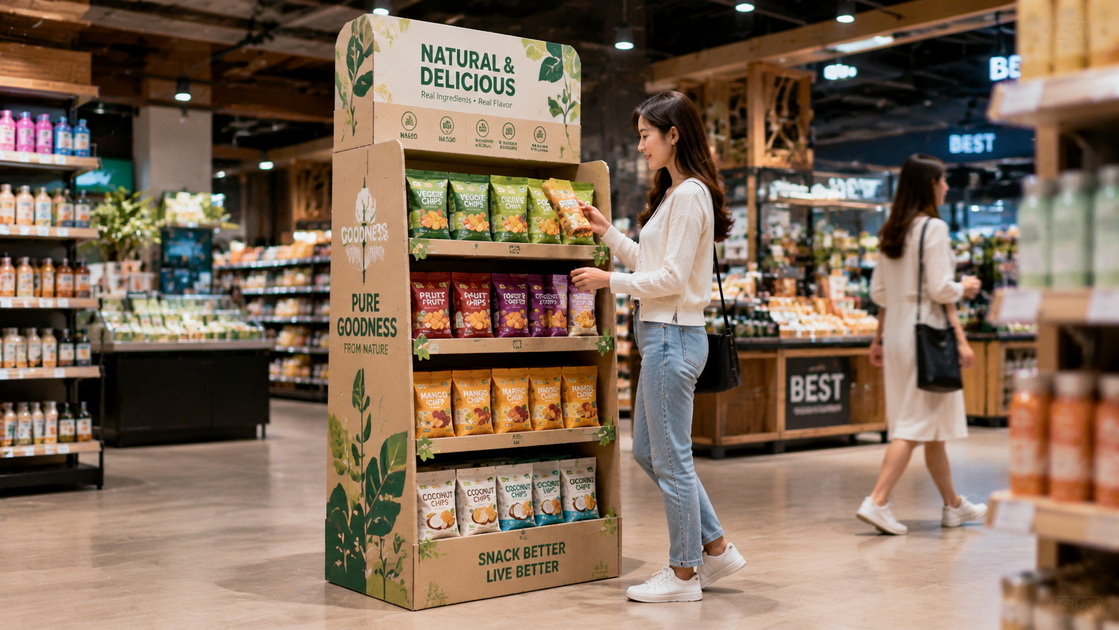
A Cardboard POP Display, also called a cardboard point-of-purchase display, is a product-holding retail fixture made from corrugated cardboard, paperboard, or a combination of paper-based materials.
Unlike a standee, it is designed to do two jobs at once:
1. Attract shopper attention
2. Present products where a buying decision can happen
Common formats include:
- Cardboard floor displays
- Countertop displays
- Pallet displays
- Dump bins
- Sidekick displays
- Endcap displays
- PDQ displays
- Shelf-ready trays
- Cardboard display stands
- Retail-ready packaging displays
A well-designed cardboard POP display uses printed headers, shelves, trays, dividers, hooks, product facings, and structural locks to transform a product assortment into a retail destination.
Long Win Display designs, customizes, produces, and pre-loads cardboard display stands for brand owners, retailers, importers, and marketing agencies. The objective is not only to make a display look attractive. It is to help products arrive safely, assemble efficiently, remain stable, and perform effectively in retail environments.
Product and promotion stay together. The shopper sees the message and can immediately take the product.
Higher merchandising capacity. A floor display can hold multiple SKUs, flavors, colors, or product sizes.
Stronger retail visibility. A branded header can be visible from a distance, while products are displayed at reachable heights.
Flexible campaign design. Brands can create seasonal themes, product launches, limited editions, bundle promotions, and cross-selling units.
More measurable retail performance. Product movement can be compared between stores with displays and stores without them.
A cardboard POP display requires more planning than a standee. It must be engineered around the product load, shelf span, display height, shipment method, assembly process, and retailer requirements.
A display that looks excellent in a computer rendering can fail in the real world if it has weak shelves, poor locking tabs, incorrect board grade, insufficient base support, or an overly complicated assembly sequence.
| Comparison Factor | Standee Display | Cardboard POP Display |
|---|---|---|
| Main purpose | Brand awareness and campaign visibility | Product merchandising and direct purchase support |
| Product capacity | Usually none or very limited | Designed to hold one or multiple SKUs |
| Best location | Mall entrance, event zone, photo area, corridor | Retail aisle, checkout zone, endcap, shop entrance |
| Structural complexity | Low to medium | Medium to high |
| Typical materials | Cardboard, foam board, PVC foam board, acrylic | Corrugated cardboard, paperboard, litho-laminated board |
| Installation | Usually quick and simple | May require assembly, product loading, and retailer placement |
| Graphic space | Very high relative to its function | High, but shared with product shelves and trays |
| Product access | Usually indirect | Immediate shopper access |
| Campaign use | Events, launches, directional signage, branding | Retail promotions, sampling, bundle offers, impulse purchases |
| Freight efficiency | Usually excellent when flat-packed | Good when flat-packed, but larger displays require more volume |
| Measurement method | Footfall, QR scans, social engagement, event leads | Unit sales, sell-through, basket size, display compliance |
| Best for | Awareness-first promotions | Conversion-focused promotions |
A standee is often the right choice when the campaign is focused on recognition, announcement, atmosphere, or shopper direction.
For example, a skincare brand introducing a celebrity collaboration may place a life-size standee at the entrance of a beauty store. The standee communicates the campaign identity, creates a photo opportunity, and directs shoppers toward the product counter.
The standee does not need shelves because its job is to create a visual reason for shoppers to approach the space.
- A large brand mascot or character
- A celebrity or influencer visual
- A movie, gaming, or entertainment partnership
- Directional signage for a pop-up event
- A campaign QR code
- A photo-friendly mall activation
- A short-duration seasonal promotion
- A low-cost visual message
- A visual companion to a staffed sampling booth
- A product launch before merchandise reaches stores
A cosmetics brand launches a new lipstick collection in a shopping mall.
The campaign includes:
- A life-size beauty ambassador standee
- A branded mirror wall
- A QR code linked to online product information
- A temporary sampling counter
- A nearby retail store carrying the collection
In this situation, the standee is effective because it supports visual storytelling and shopper traffic generation. It is not intended to store 100 lipstick units or manage product replenishment.
A cardboard POP display is usually a better investment when you want to turn attention into an immediate transaction.
It is especially useful when the product is affordable, giftable, seasonal, new to the market, easy to understand, or suitable for impulse purchase.
The format works particularly well for:
- Snacks and confectionery
- Beverages and energy drinks
- Cosmetics and personal care
- Toys and collectibles
- Phone accessories
- Small consumer electronics
- Pet products
- Health and wellness products
- Seasonal gift packs
- Convenience items
- Promotional bundles
- Product storage and product visibility in one unit
- Multiple SKUs presented by flavor, size, color, or function
- A branded floor display near a store entrance
- A counter display at checkout
- A campaign display for a limited-time offer
- Sampling products beside take-home products
- Retail-ready shipping and merchandising
- Pre-loaded product displays for faster store deployment
- Clear pricing and promotional communication
- Better control of shelf presentation
A snack brand launches a limited-edition holiday flavor in 60 shopping mall supermarkets.
Instead of using only a standee, the brand uses a cardboard floor display with:
- A large seasonal header
- Four product shelves
- A front-facing brand message
- Price signage
- Product dividers
- A small QR code for a coupon or loyalty program
- Pre-loaded products for rapid placement
This format allows the brand to create a promotional destination where shoppers can see, understand, and purchase the product in one location.
A practical retail principle is simple: the closer the promotion is to the product, the easier it is for attention to become a purchase.
Recent research on in-store digital signage found that featured-product purchase likelihood increased by 8.1%, with stronger effects when the advertising was located close to the advertised product. The research covered 237 advertising campaigns and approximately 30 million shoppers.
Although a standee and a digital sign are not the same format, the insight is relevant. Promotion works more effectively when the shopper can act immediately.
For cardboard POP displays, that means:
- Put the display close to the relevant category.
- Keep the product reachable without asking store staff.
- Use simple price or benefit communication.
- Avoid hiding the product behind excessive decoration.
- Ensure replenishment is planned before shelves look empty.
For standees, that means:
- Add clear directional messaging when the product is not nearby.
- Use QR codes only if the shopper receives a clear reason to scan.
- Place the standee where people naturally slow down.
- Use one primary message instead of several competing claims.
One of the most expensive mistakes in retail promotion is treating "people saw it" as proof that the campaign worked.
A standee can generate strong visual exposure. But exposure alone does not necessarily create product trial, cart addition, or repeat purchase.
A cardboard POP display can support conversion. But it may still underperform if it is placed in the wrong location, loaded with the wrong product mix, or designed with unclear shopper communication.
From a display manufacturer's point of view, the strongest mall promotion often uses both formats strategically.
A hybrid campaign uses a standee to create traffic and a cardboard POP display to support conversion.
For example:
1. Place a large standee at the mall entrance or outside the retail store.
2. Use a QR code or short message to direct shoppers to the promotional product.
3. Place a cardboard floor display at the store entrance or relevant category zone.
4. Use a strong header, clear product arrangement, and a simple promotional offer.
5. Track QR scans, display sell-through, and store-level sales changes.
This approach works particularly well for launches, entertainment partnerships, character-based products, and seasonal promotions.
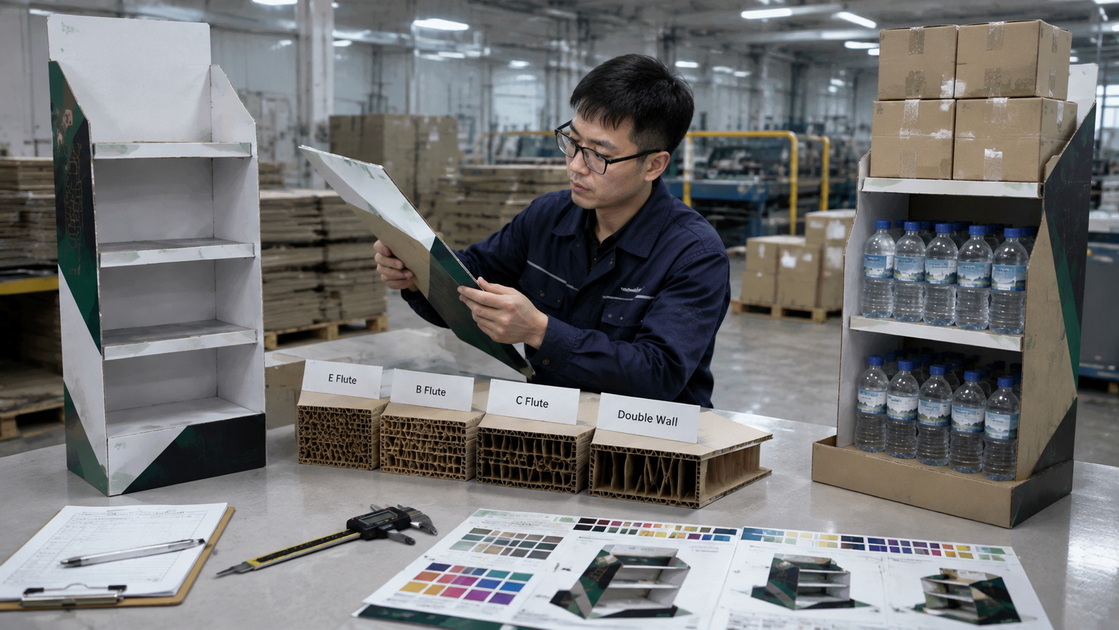
A cardboard display should not be chosen based only on a visual mock-up. Its structure must match the merchandise, logistics route, campaign duration, and retail environment.
Different products require different corrugated board structures.
- E flute is commonly used for compact counter displays and print-focused applications.
- B flute provides useful strength and is suitable for many retail display formats.
- C flute can offer more cushioning and structural support for larger units.
- BC double-wall board may be appropriate for heavier floor displays and high product loads.
- Litho-laminated corrugated board can improve visual quality when premium graphics are required.
The right board is determined by shelf weight, span, product shape, humidity exposure, shipping distance, and display height.
Ask your supplier to calculate:
- Weight per product
- Units per shelf
- Total display load
- Shelf span
- Base footprint
- Center of gravity
- Required safety margin
- Number of display layers in shipping cartons
- Assembly and locking method
A display with a narrow base and a tall header can become unstable, especially when shoppers remove products unevenly from one side.
Pre-loaded cardboard displays can save store labor and improve campaign consistency. However, they also increase shipping weight and carton volume.
Before choosing pre-loading, ask:
- Can the loaded display survive shipping?
- Are individual products protected from vibration?
- Can the retailer move the display safely?
- Does the store require flat-packed delivery?
- Will the display fit through warehouse and store doors?
- Does the display require a pallet?
- Who removes shipping protection and installs the header?
Long Win Display can support display development from structural design through production and pre-loading, allowing buyers to evaluate the complete display program rather than only the empty display unit.
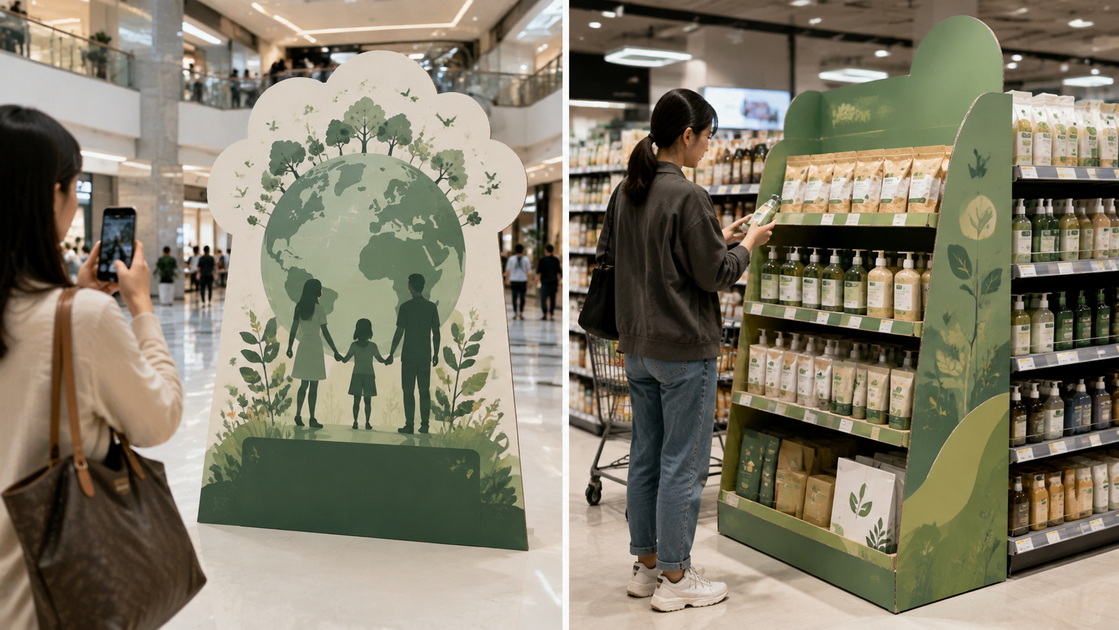
Use this decision process before requesting quotations.
1. Define the campaign goal.
Is the campaign intended to create awareness, generate leads, support sampling, increase product trial, or drive immediate sales?
2. Identify the product role.
Will the product be displayed beside the promotion, sold from the promotion, or located elsewhere?
3. Check the retail location.
Is the unit going in a mall corridor, store entrance, checkout area, aisle, endcap, or temporary event zone?
4. Calculate the campaign duration.
A two-day event may need a simple standee. A six-week retail promotion may justify a more durable cardboard POP display.
5. Confirm operational requirements.
Consider storage, delivery, installation, replenishment, and disposal.
6. Choose a measurable outcome.
Measure QR scans, product trial, sales uplift, sell-through rate, shopper engagement, or store compliance.
Cardboard can be a practical material for temporary retail promotions because it is lightweight, printable, flat-packable, and commonly recyclable where collection systems accept corrugated materials.
The American Forest & Paper Association reported that the U.S. cardboard recycling rate was between 70% and 75% in 2025.
However, recyclability is not automatic. A display can become harder to recycle if it includes excessive plastic lamination, metal hardware, mixed-material decorations, electronics, glued acrylic parts, or non-paper accessories.
For a more responsible cardboard POP display program:
- Specify recyclable corrugated board where feasible.
- Request FSC-certified material options when appropriate.
- Avoid unnecessary mixed-material components.
- Use water-based or low-impact finishing options when compatible with the project.
- Design the display to flat-pack efficiently.
- Include simple disposal guidance for retail teams.
- Match campaign duration to material durability instead of over-engineering a temporary unit.
A standee display and a cardboard POP display solve different promotion problems.
Choose a standee when your priority is visual awareness, traffic generation, campaign storytelling, event decoration, or directional communication. It is simple, lightweight, and highly visible.
Choose a cardboard POP display when you need the promotion to hold products, support product discovery, improve merchandising, and encourage an immediate purchase. It requires more structural planning, but it can create a stronger connection between brand visibility and retail conversion.
For many shopping mall promotions, the most effective approach is not choosing one format exclusively. Use a standee to attract shoppers and a cardboard POP display to convert attention into product interaction.
If you are planning a shopping mall launch, retail promotion, seasonal activation, or multi-store product rollout, Long Win Display can help evaluate your product dimensions, display load, retail location, branding requirements, and preferred delivery method. A properly engineered cardboard display stand can be designed, customized, produced, and pre-loaded to support a more consistent retail execution.
Usually, yes. A standee normally uses less material and has a simpler structure because it does not need to hold products. However, the final cost depends on size, material, printing, shape, base design, and order quantity.
Yes, but permission is usually required from mall management or the retailer. The display must meet size, safety, fire-safety, placement, and pedestrian-flow requirements. For public mall areas, a standee or branded event fixture may be easier to approve than a product-loaded floor display.
Cardboard POP displays work well for lightweight to medium-weight packaged products, including snacks, cosmetics, toys, personal care items, phone accessories, pet products, stationery, and promotional gift sets. Heavy products require stronger board grades, reinforced shelves, or a different display material.
A properly designed display can last for the duration of a short-term or medium-term campaign. Actual performance depends on product weight, shopper traffic, humidity, cleaning practices, replenishment frequency, board grade, and whether the display is moved frequently.
Use a counter display for small, lightweight, impulse-oriented products near checkout. Use a floor display when you need higher product capacity, stronger visibility, multiple SKUs, or a promotional destination at a store entrance, aisle, or endcap.
1. [In-Store Advertising With Digital Signage — Vrije Universiteit Amsterdam]
Field-experiment research covering 237 advertising campaigns and 30 million shoppers, including the reported 8.1% increase in likelihood of purchasing featured products.
2. [2026 In-Store Retail Display Influence Report — Frank Mayer and Associates]
Survey-based report covering shopper awareness, comparison behavior, and retail-display influence among more than 1,100 U.S. shoppers.
3. [Paper Industry Announces 2025 U.S. Paper Recycling Rates — American Forest and Paper Association]
Industry recycling data reporting a cardboard recycling rate of 70% to 75% in the United States for 2025.
4. [How Much Paper Was Recycled in 2025? — American Forest and Paper Association]
Additional AF&PA overview of U.S. paper and cardboard recovery data.
5. [Long Win Display — Custom Cardboard POP Display Manufacturer]
Company information on custom cardboard displays, permanent display solutions, design, customization, production, and pre-loading support.


