
Views: 219 Author: Long Win Display Publish Time: 2026-09-01 Origin: Site


Content Menu
● Sidekick Display vs Floor Display
● Why Narrow Retail Aisles Change the Decision
● Sidekick Display Advantages in Narrow Aisles
>> 1. They Preserve Valuable Floor Width
>> 2. They Support Cross-Selling at the Point of Decision
>> 3. They Are Cost-Efficient for Short Campaigns
>> 4. They Can Be Fast to Install
>> 5. They Can Improve Category Navigation
● Floor Display Advantages When Space Allows
>> 3. Better Visibility From a Distance
>> 4. More Flexible Structural Design
● Sidekick Display vs Floor Display: Selection Matrix
● A Practical Aisle Audit Before Designing
>> Step 1: Measure the Real Store Environment
>> Step 2: Define a Clear Space Budget
>> Step 3: Test With a Full Product Load
>> Step 4: Test Shopper Visibility at Real Distance
● Cardboard Display Engineering for Retail Reliability
>> Sidekick Structural Priorities
>> Floor Display Structural Priorities
● How to Improve Conversion in a Narrow Aisle
● Sustainability and End-of-Campaign Planning
● Final Recommendation: Sidekick or Floor Display?
● FAQ
>> 1. What is the difference between a sidekick display and a floor display?
>> 2. Are sidekick displays better for narrow retail aisles?
>> 3. How wide should a retail aisle be before adding a floor display?
>> 4. What products work best in a cardboard sidekick display?
>> 5. Can a cardboard floor display hold heavy products?
For narrow retail aisles, a sidekick display is usually the safer and more efficient choice because it uses unused vertical shelf-edge or endcap space instead of consuming valuable walking width. A floor display can deliver greater product capacity and stronger brand impact, but it should be used only where store layout, shopper flow, accessibility, replenishment, and retailer rules allow enough clear space.
From our experience as a Chinese POP display design and manufacturing partner, Long Win Display has seen that the best cardboard display stand is not simply the largest structure or the most colorful print. It is the display that helps shoppers find and pick up products while allowing the store to remain comfortable, accessible, safe, and easy to restock.
For retail brands, supermarkets, pharmacies, convenience stores, specialty shops, and distributors, the decision between a sidekick display and a floor display should begin with one question:
How much aisle space can this campaign use without disrupting the shopper journey?
This guide compares sidekick displays and floor displays for narrow retail aisles. It explains their structure, placement, product capacity, cost considerations, design requirements, and best B2B use cases. It also provides a practical selection framework for brands that need custom cardboard POP displays for retail rollouts.
| Feature | Sidekick Display | Floor Display |
|---|---|---|
| Alternative names | Power wing display, side wing display, shelf-side display | Floor-standing display, cardboard floor stand, freestanding POP display |
| Typical placement | Side of an endcap, retail shelf, gondola, aisle fixture, or wall display | Retail floor, promotional zone, aisle opening, endcap area, entrance, checkout zone |
| Floor-space use | Minimal or no additional footprint when mounted correctly | Uses dedicated floor space |
| Best for narrow retail aisles | Usually the preferred option | Suitable only when clear aisle width remains sufficient |
| Product capacity | Low to medium | Medium to high |
| Brand-graphic area | Moderate | Large |
| Ideal product types | Lightweight, small, impulse, complementary products | Larger packs, multi-SKU campaigns, bulk products, hero launches |
| Installation | Can be hung, clipped, or mounted to existing fixtures | Freestanding and usually preassembled or easy to assemble |
| Restocking | Fast for small SKU quantities | Can hold more stock but may require more frequent structural checks |
| Main risk | Overloading, poor attachment, low shelf visibility | Obstructing shopper flow, accessibility, cleaning, carts, or replenishment |
| Best campaign goal | Cross-selling, trial, impulse purchase, shelf adjacency | Product launch, high-volume promotion, category takeover |
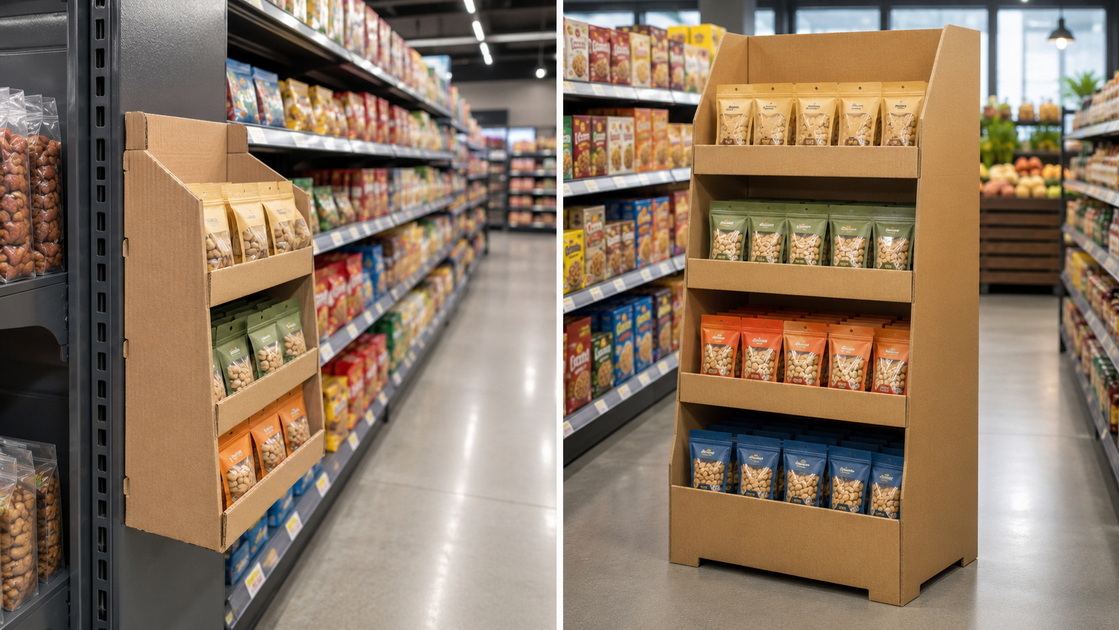
A sidekick display—also called a power wing—is commonly designed to hang from the side of an endcap, aisle shelf, or wall fixture. It helps brands use vertical retail space that might otherwise remain unused. Floor displays are freestanding POP structures designed to hold products and communicate a campaign message at shopper level.
A sidekick display is a compact point-of-purchase display attached to an existing retail fixture. It is normally placed beside a shelf, gondola, endcap, checkout unit, or category display.
Because it uses a fixture's side surface or vertical space, a sidekick display can support promotions without occupying the center of a retail aisle. This makes it especially useful in convenience stores, drugstores, supermarkets, hardware stores, beauty retailers, and other environments where aisle width is limited.
Sidekick displays may include:
- Corrugated cardboard back panels
- Die-cut product trays
- Peg hooks
- Shelf trays
- Header cards
- Printed side panels
- Reinforced hanging tabs
- Plastic or metal hooks, where retailer rules permit
- QR codes or simple promotional messaging
- Tear-away replenishment cartons
A sidekick display can be designed as either:
- Hanging: Attached to a shelf edge, endcap, wall, or gondola side.
- Freestanding side wing: Installed close to a fixture while using a narrow footprint.
- Pegboard compatible: Designed around hooks or retail pegboard systems.
- Shelf-adjacent cross-sell unit: Positioned next to related products.
For example, a snack brand can place a compact sidekick display of seasoning sachets beside instant noodles. A personal-care brand can place travel-size products beside a skincare aisle. A hardware brand can place batteries, tape, fasteners, or small accessories beside relevant tools.
Core advantage: A sidekick display can create an additional selling location without asking the retailer to give up a large portion of the aisle.
A floor display is a freestanding point-of-purchase unit placed directly on the retail floor. It can be built from corrugated cardboard, paperboard, wood, metal, acrylic, or mixed materials. For short-term promotions, seasonal launches, retailer activation campaigns, and high-volume product presentations, corrugated cardboard floor displays are a popular option because they can combine structural strength, large-format printing, easy assembly, and recyclable material choices.
Floor displays typically offer:
- More product capacity
- More shelf or tray levels
- Larger brand-message areas
- Greater visual height
- Better visibility from multiple approach angles
- More flexibility for multi-SKU merchandising
- A stronger "store-within-a-store" campaign effect
Typical floor-display formats include:
- Full pallet displays
- Quarter-pallet displays
- Dump bins
- Four-sided tower displays
- Multi-tier shelf displays
- Corrugated cardboard floor stands
- Promotional islands
- Endcap-ready display units
- Side panel displays
- Gravity-feed displays
Floor displays can be highly effective when they are placed at retail entrances, aisle ends, open promotional zones, wide main pathways, or category transitions. But they can become a liability when inserted into narrow aisles without adequate planning.
A floor-standing display is generally designed to hold products and communicate product benefits while customers browse or pass through the store. It is commonly used in stores and trade-show settings.
Narrow retail aisles create a different display-design problem. The goal is no longer only product visibility. It is also about maintaining clear movement, shopper comfort, safety, accessibility, and operational efficiency.
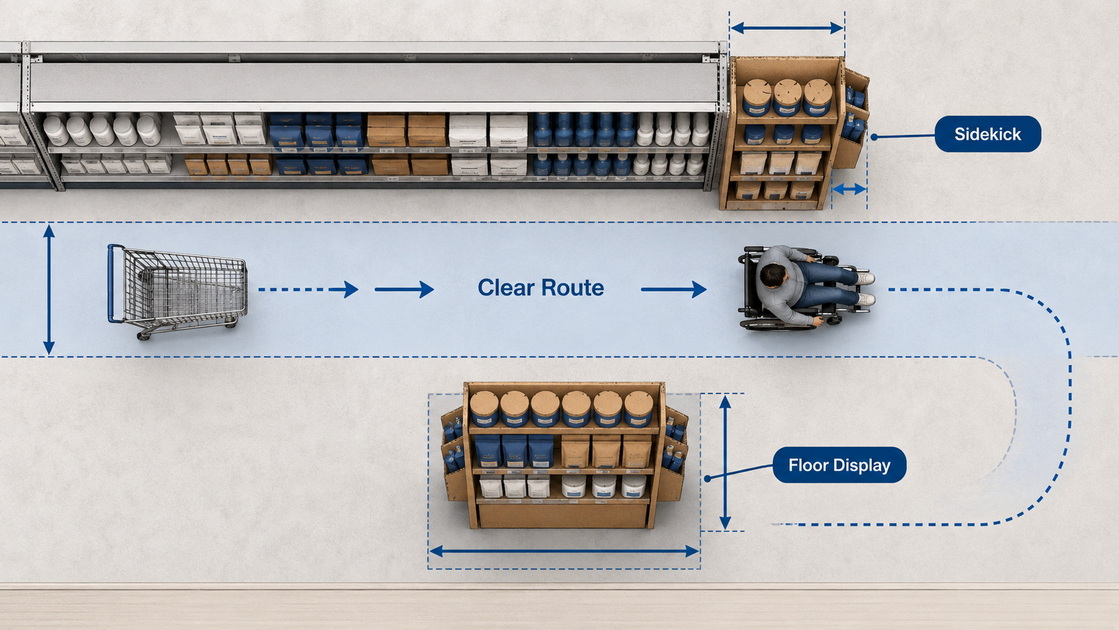
A floor display that is only 300 mm deep may appear compact in a design drawing. In a real store, that same display may create a bottleneck once shoppers, baskets, carts, restocking trolleys, children, wheelchairs, mobility aids, and queueing customers enter the aisle.
For U.S. retail environments, accessible routes generally require a minimum clear width of 36 inches, or 915 mm, with certain exceptions and additional requirements depending on the setting. The ADA's standards identify 36 inches as the minimum clear width for an accessible route.
This does not mean every retail aisle can safely accept a display simply because the space measures 36 inches at one point. Retailers should also consider:
- Doorway access
- Turning space near aisle intersections
- Wheelchair and mobility-device passage
- Product overhang
- Shopping-cart circulation
- Queue formation
- Emergency egress
- Store-cleaning routes
- Staff replenishment access
- Seasonal merchandising changes
- Local building and accessibility rules
A display that blocks a customer's path is not an effective POP display. It may reduce dwell time, frustrate shoppers, create retailer complaints, or be removed before the campaign reaches its full selling period.
Retail insight: In narrow aisles, display success depends on preserving the customer path before adding product capacity.
For narrow retail aisles, sidekick displays often offer the best balance between visibility and spatial efficiency.
A properly mounted sidekick display uses vertical retail-fixture space rather than projecting into the aisle. This protects the shopper pathway and can make it easier for retailers to approve the promotion.
Sidekick displays are particularly useful when the aisle already includes fixed shelves on both sides. Instead of positioning a standalone unit in the center or along the walkway, brands can place a compact display beside an existing fixture.
Sidekick displays work well when the promoted item is directly connected to the category beside it.
Examples include:
- Coffee filters beside coffee products
- Phone accessories beside consumer electronics
- Batteries beside toys or electronics
- Small sauces beside snacks
- Travel-size toiletries beside personal-care products
- Pet treats beside pet food
- Cable accessories beside computer products
- Small DIY accessories beside tools
A sidekick is commonly used as a secondary display that leverages traffic around a primary shelf or endcap. Its shelf adjacency can create practical cross-selling opportunities.
A cardboard sidekick display can often use less material than a large floor display. It may also require fewer products to look full and attractive.
For brands testing a new SKU, launching a limited-time promotion, or running a regional retail trial, a small sidekick display may reduce the risk of overproducing display materials and inventory.
Many sidekick displays are designed for quick installation with hooks, clips, reinforced hanging tabs, or retailer-approved mounting methods. This can reduce store labor compared with large floor displays that require unpacking, assembly, placement, and floor-plan verification.
A well-designed sidekick can act as a visual signal. It can help shoppers notice a related product, seasonal offer, new flavor, bundle promotion, or limited-edition pack without making the aisle look crowded.
However, design discipline matters. The display should use a concise message, clear product-facing layout, and a structure that does not interfere with neighboring shelf labels, price strips, or replenishment access.
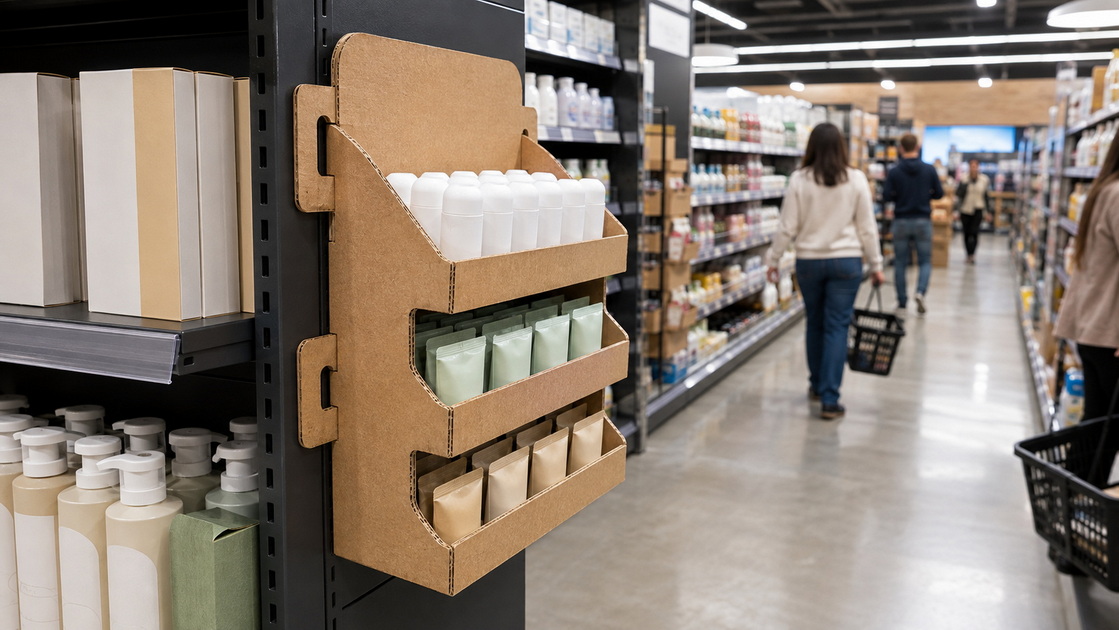
Floor displays are not the wrong choice for narrow-store environments. They simply require more careful placement. If the retailer has an aisle opening, promotional bay, store entrance, endcap zone, or wide secondary pathway, a floor display can outperform a sidekick display in visibility and stock capacity.
A floor display can hold more units, larger packs, and more SKU variations. This is important for high-volume consumer goods, beverage multipacks, seasonal gift sets, personal-care bundles, snack assortments, toys, household products, and larger packaged items.
A floor display is often the better choice when replenishment labor would be too high for a small sidekick unit.
Floor displays provide a larger billboard surface for graphics. A brand can use the header, side panels, shelves, base, and back panel to create a cohesive campaign.
This is especially valuable for:
- New-product launches
- Brand repositioning
- Movie or sports promotions
- Holiday campaigns
- Sampling events
- Retailer-exclusive packs
- Multi-product bundles
A taller, freestanding cardboard display can catch shopper attention before customers reach the product category. It may create an interruption in a wide retail pathway and direct traffic toward a promotional product.
A custom floor display can incorporate:
- Multiple shelves
- Gravity-feed lanes
- Divider systems
- Pegboard panels
- Display trays
- Product testers
- Pallet bases
- Refillable cartons
- QR-code panels
- Detachable promotional headers
The greater design freedom also creates greater engineering responsibility. The display must be tested for load capacity, compression strength, stability, transport conditions, and in-store handling.
Use the following matrix when deciding which cardboard POP display format fits your campaign.
| Decision Factor | Choose a Sidekick Display When | Choose a Floor Display When |
|---|---|---|
| Aisle width | The aisle is narrow or heavily used | The location is a wide pathway, entrance, endcap, or promotional zone |
| Product size | Products are small and lightweight | Products are larger, heavier, or sold in multipacks |
| SKU count | The campaign features one or a few SKUs | The campaign needs multiple SKUs or pack sizes |
| Sales objective | Cross-sell, impulse buy, product trial | Large launch, brand blocking, bulk promotion |
| Store labor | Fast hanging installation is needed | Store teams can receive and position a freestanding unit |
| Replenishment volume | Moderate sales volume is expected | High sales volume requires more stock on hand |
| Graphics requirement | A focused message is sufficient | The brand requires a larger visual campaign |
| Budget and materials | A compact solution is preferred | A larger structural and printing budget is available |
| Shopper flow | Maintaining aisle clearance is the priority | Display placement will not interrupt traffic or accessibility |
| Retailer compliance | Fixture-mounted programs are approved | Freestanding promotional fixtures are approved |
One of the biggest information gaps in many POP display projects is designing the display before measuring the store environment. Brands may approve a beautiful display rendering, but the unit can fail at installation because it blocks a shelf, hides price labels, conflicts with a cart path, or does not fit the retailer's fixture specification.
Before designing a sidekick display or floor display, conduct a retail aisle audit.
Measure and document:
- Full aisle width
- Clear walking width after fixtures are installed
- Shelf depth
- Endcap depth
- Gondola height
- Available mounting area
- Distance to checkout
- Distance to doors and emergency exits
- Distance to refrigeration units or promotional bins
- Turning points and aisle intersections
- Height of the shopper's primary sightline
- Cart and basket traffic patterns
Do not rely only on a retailer's general planogram. Store conditions can vary across locations.
Create a "space budget" for the display. This means calculating not just the display's physical depth, but its effective operating footprint.
For a floor display, include:
- Base dimensions
- Product overhang
- Shopper stopping distance
- Restocking access
- Cart turning area
- Cleaning and maintenance access
For a sidekick display, include:
- Attachment depth
- Product protrusion
- Hook or clip clearance
- Shelf-door movement
- Nearby price-label visibility
- Replenishment clearance
A cardboard display can behave very differently when empty versus fully stocked. Product weight changes the center of gravity, shelf deflection, stacking pressure, and attachment load.
For a floor display, test:
- Tipping resistance
- Base stability
- Shelf deformation
- Compression strength
- Product retention
- Transit vibration resistance
For a sidekick display, test:
- Hanging-tab strength
- Hook performance
- Tear resistance
- Load distribution
- Product drop risk
- Fixture compatibility
Stand at several positions:
- 3 meters away
- 1.5 meters away
- Directly beside the display
- At child height
- At wheelchair-user eye level
- At the shelf category approach point
Your brand message should be understandable in seconds. In a narrow aisle, shoppers may have limited time and limited viewing distance.
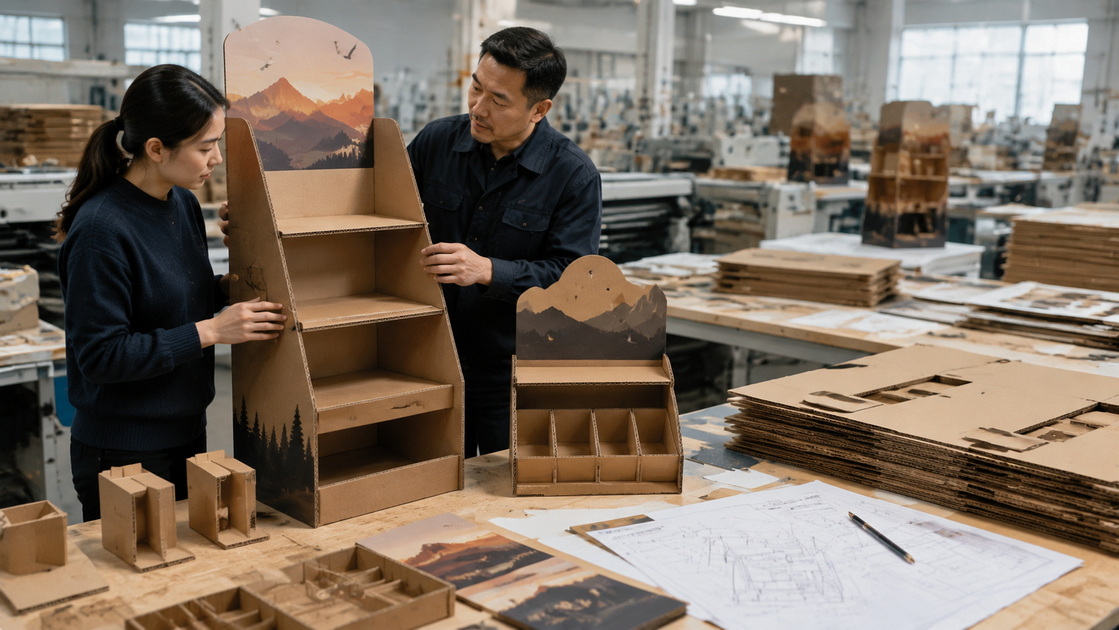
For cardboard display manufacturers, a narrow-aisle project is not only a visual-merchandising assignment. It is a structural design project.
A custom cardboard display stand should be engineered around:
- Product dimensions
- Unit weight
- Total display load
- Retail fixture requirements
- Display height
- Shipping method
- Assembly method
- Required campaign duration
- Store climate and humidity
- Printing finish
- Retail recycling requirements
Corrugated cardboard can provide a practical balance of printability, structural strength, transport efficiency, and end-of-campaign recyclability. It is widely recognized as recyclable, and many corrugated-display programs use recycled content and renewable fiber sources. However, coatings, laminations, adhesives, plastic accessories, and mixed materials can affect recyclability.
For a sidekick display, prioritize:
- Reinforced hanger zones
- Double-layer cardboard around hooks
- Load-distributing back panels
- Strong die-cut locking structures
- Appropriate product tray depth
- Limited total weight
- Retailer-compatible attachment methods
- Easy replenishment access
For a floor display, prioritize:
- Strong base design
- Anti-tip geometry
- Shelf-locking tabs
- Internal support partitions
- High compression resistance
- Safe edge treatment
- Transit-ready packaging
- Fast and intuitive assembly
- Clear instructions for retail staff
A display that collapses, leans, tears, or obstructs the aisle can damage both brand perception and retailer trust. Structural testing should be completed before mass production, especially for multi-store campaigns.
A narrow aisle does not leave much room for long messages. The display should communicate quickly.
Use the three-second rule:
1. The shopper sees the product category or brand color.
2. The shopper understands the product benefit or offer.
3. The shopper can physically reach and remove the product.
For both sidekick displays and floor displays, improve conversion by using:
- One dominant message instead of multiple competing claims
- High-contrast brand colors
- Large product imagery when packaging is small
- Clear price communication, where retailer rules permit
- Product-facing layouts that minimize gaps
- Easy-grab tray angles
- Cross-selling beside a relevant category
- Seasonal or occasion-based messaging
- QR codes only when they add genuine value
- A display height appropriate for the target shopper
Avoid placing important text too low, too high, or behind product stock. A customer should never need to search for the product or tilt a display item to understand the offer.
Retail brands increasingly consider what happens after a promotional campaign ends. Corrugated cardboard displays can offer a lower-complexity end-of-life option when designed for recycling and when local recycling systems accept the materials used.
To improve sustainability, consider:
- FSC-certified or responsibly sourced paper materials, where required
- Recycled-content corrugated board
- Water-based inks when appropriate
- Minimal plastic components
- Easy-to-separate mixed materials
- Reduced lamination
- Flat-pack shipping
- Right-sized display dimensions
- Modular designs that reduce material waste
- Clear recycling instructions for store teams
Corrugated cardboard displays are often described as recyclable, and cardboard can contain recycled materials. However, recyclability depends on the final design and local recycling acceptance, so brands should avoid unsupported environmental claims.
Expert recommendation: Design sustainability into the display structure from the first engineering drawing, not as a marketing label added after production.
For narrow retail aisles, choose a sidekick display when you need impulse sales, cross-selling, compact product capacity, and minimal impact on shopper movement. It is especially effective for lightweight products, small packs, accessories, trial items, and category-adjacent promotions.
Choose a floor display when your retailer provides a wider promotional zone, entrance area, endcap, aisle opening, or dedicated display location. It is better for heavier products, multi-SKU campaigns, larger product quantities, strong visual branding, and high-volume promotions.
The most successful retail program may use both:
- A floor display at the entrance or in a promotional zone to build brand awareness.
- A sidekick display beside related category shelves to drive cross-selling and last-meter conversion.
Long Win Display designs, customizes, manufactures, and pre-assembles cardboard display stands for brands entering supermarkets, retailers, specialty stores, and other retail channels. Whether you need a compact sidekick display, a structural floor display, a pallet display, a countertop unit, or a fully customized POP display program, our team can help evaluate your product, retail fixture, aisle conditions, campaign goals, and logistics requirements.
Contact Long Win Display to request a custom cardboard display solution engineered for your product size, retail aisle, product load, branding goals, assembly needs, and store rollout plan.
A sidekick display is typically attached to the side of an existing retail fixture, such as a gondola, shelf, or endcap. A floor display is freestanding and placed directly on the retail floor. Sidekicks save floor space, while floor displays usually offer more capacity and larger branding areas.
Usually, yes. A sidekick display can use vertical fixture space and minimize intrusion into the walking route. It is often a better fit for narrow aisles, provided it is securely attached and does not block shelf labels, accessibility routes, or restocking activity.
The answer depends on the retailer's layout rules, local regulations, cart traffic, accessibility requirements, and the display's effective footprint. In U.S. contexts, accessible routes generally require at least 36 inches of clear width, but retailers should plan for more room where carts, traffic, and turning movements occur.
Small, lightweight, high-margin, impulse-friendly, and complementary products work best. Examples include batteries, snacks, small beauty products, stationery, tools, electronics accessories, travel-size items, and seasonal add-on products.
Yes, but it must be engineered for the specific product weight, package size, number of units, shelf span, shipping condition, and intended campaign duration. Heavy products may require reinforced corrugated board, internal supports, stronger bases, and structural testing before production.
1. U.S. Department of Justice. "[ADA Standards for Accessible Design]." Provides the 36-inch minimum clear-width reference for accessible routes and related access-space requirements. [ada]
2. ADA National Network. "[Accessibility of Sidewalk Dining, Retail, and Community Spaces]." Explains the minimum 36-inch clear width for accessible routes and limited circumstances where 32-inch passage widths may apply over short distances. [adata]
3. BPKC. "[5 Design Tips for Sidekick Displays]." Discusses sidekick-display customization, product highlighting, and retail placement potential. [bpkc]
4. Topwon Group. "[Power Wing Display Sidekick Displays Manufacturer]." Defines cardboard power-wing and sidekick displays as fixture-based POP display formats suited to limited retail space. [topwongroup]
5. Packwins. "[15 In Store POP Displays That Influence Buying Decisions]." Describes freestanding floor displays and sidekick displays, including their product-presentation and cross-selling roles. [packwins]
6. Innvoke. "[Types of POP Displays]." Covers floor stands and sidekick/power-wing display formats in retail merchandising. [innvoke]
7. Creative Displays Now. "[Going Green With Cardboard Displays]." Discusses corrugated-cardboard recyclability, recycled material content, and renewable fiber resources. [creativedisplaysnow]
8. Packwins. "[Eco Friendly Cardboard Displays Sustainability in Retail]." Discusses recyclable materials, responsible sourcing, and design-for-disassembly considerations for cardboard retail displays. [packwins]


