
Views: 267 Author: Long Win Display Publish Time: 2026-07-19 Origin: Site


Content Menu
● What Is Shelf-Ready Packaging and Why It Matters
● The 7 Core Design Elements of High-Performing SRP
>> 1. Easy to Identify in Backroom and on Shelf
>> 3. Easy to Restock and Maintain Availability
>> 4. Easy to Shop and Encourage Interaction
>> 5. Easy to Recycle and Handle After Use
>> 6. Branded Canvas, Not Just a Brown Box
>> 7. Supply Chain Optimization and Cost Efficiency
● Regulatory and Sustainability Trends Shaping SRP
● The Role of Digital Printing in Modern SRP
● A Practical 5-Step Checklist for SRP Projects
>> Step 1 – Define Channels and Constraints
>> Step 2 – Validate the "Five Easies"
>> Step 3 – Check Materials and Compliance
>> Step 4 – Prototype and Test with Real Products
>> Step 5 – Optimize for Printing and Logistics
● How Long Win Display Supports Brand Teams
● Practical Shelf-Ready Packaging Design Table
Shelf-ready packaging (SRP) has evolved from a simple utility into one of the most strategic levers for retail visibility, replenishment efficiency, and sustainable brand growth. For a China-based POP display and package box manufacturer like Long Win Display, SRP is no longer just a compliance requirement—it is an opportunity to help global brands win at the shelf by turning transport packaging into a powerful, integrated display system.
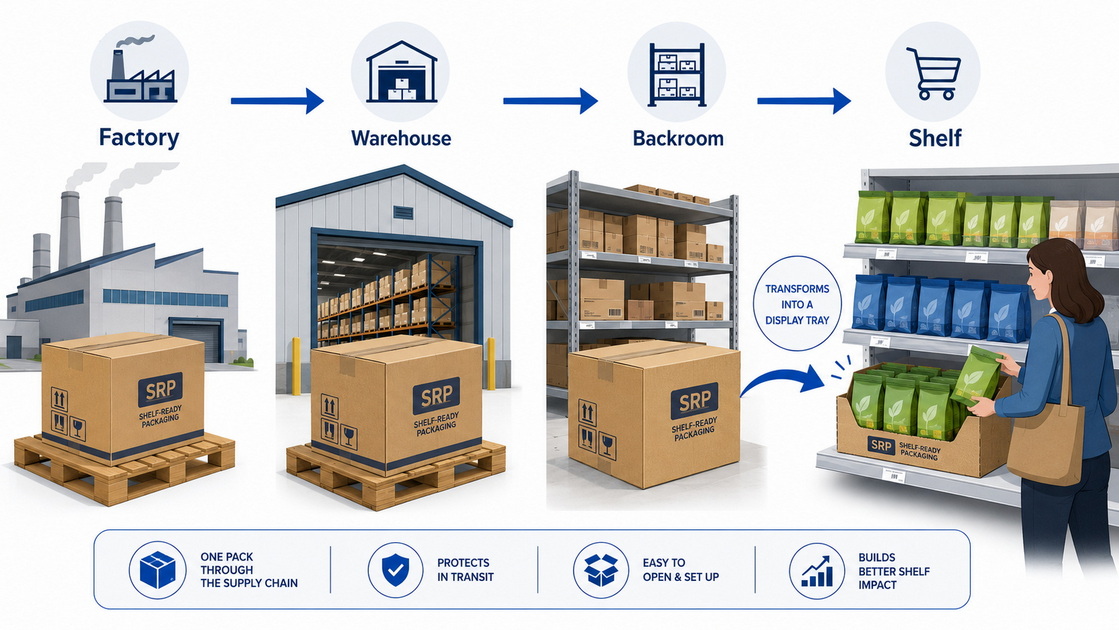
Shelf-ready packaging, sometimes referred to as retail-ready packaging, is secondary packaging designed to move directly from transport to the selling shelf with minimal handling. Instead of opening an unbranded carton, unpacking units, and arranging them one by one, staff remove a pre-designed panel, place the unit in the fixture, and immediately present a structured block of product.
For retailers, this delivers faster replenishment, fewer empty facings, safer operations, and more consistent on-shelf presentation across stores. For brands, SRP acts as a mini-billboard that aggregates multiple units into a single strong visual presence, extends core brand elements beyond primary packaging, and supports sustainability and compliance objectives through better material choices and design.
High-performing SRP is instantly recognizable from multiple angles. Warehouse teams, stockers, and shoppers should be able to identify the product quickly, even at a distance and under time pressure. If a new staff member cannot find the right box within a few seconds, the packaging is not doing its job.
Strong identification comes from multisided branding, high-contrast graphics, and clear information hierarchy. Large product names, variant descriptors, and counts should be visible on at least two key faces. Consistent use of brand colors, logos, and icons across primary and secondary packaging helps everyone see that the SRP "belongs" to the same family and reduces picking errors and mis-stocking.
Traditional shipping cartons often require box cutters or knives, which slow down replenishment and introduce the risk of injury or product damage. Modern SRP replaces cutting with intuitive, tool-free opening. If staff still reach for a blade, the structural design has failed its main purpose.
Well-designed SRP uses clean perforations, tear strips, and pre-scored panels to convert a shipping carton into a ready-to-use display in a single motion. Opening zones are clearly marked and positioned so that staff naturally open the box in the correct orientation. Structural details prevent accidental tearing across key branding or product windows, ensuring that the display remains attractive even after repeated handling.
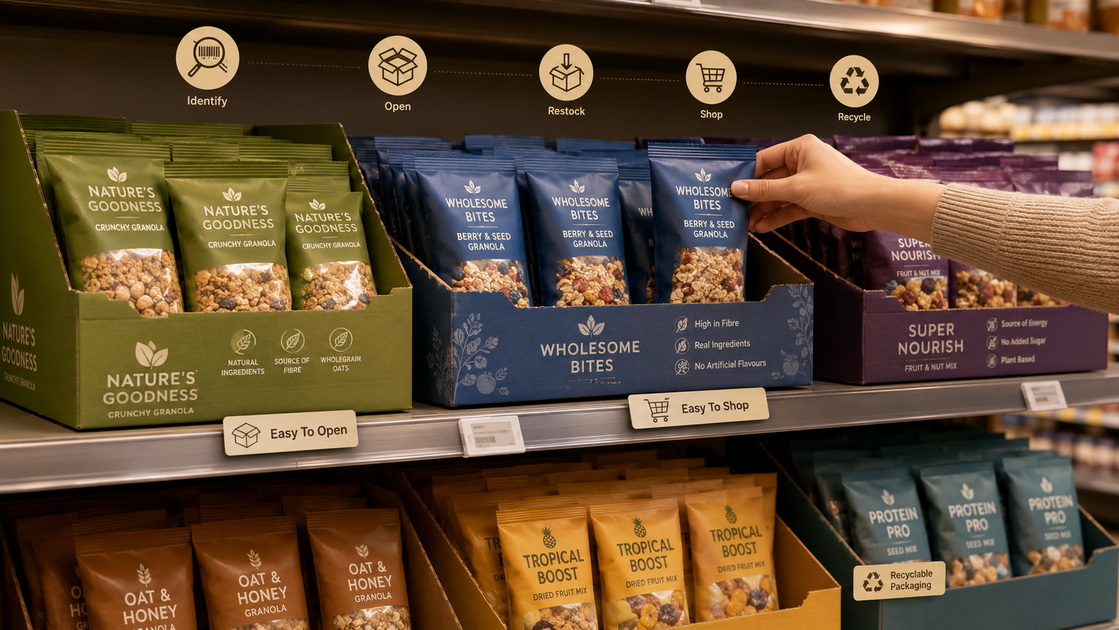
SRP exists to compress replenishment time and keep products available at the exact moment shoppers are ready to buy. When SRP is easy to restock, staff can move from pallet to selling shelf in seconds instead of minutes. This reduces labor pressure and decreases the chance that shelves sit empty between deliveries.
Restocking efficiency comes from dimensions and footprints tuned to typical shelf depths and widths in target channels. Trays should hold units in neat rows and prevent them from sliding or tipping while still allowing easy access for grabbing and placing new boxes. Orientation markers on the packaging help staff position each unit correctly without needing detailed instructions.
From the shopper's perspective, SRP should feel like an invitation, not a barrier. The front opening, cutouts, and product arrangement all affect how quickly people can see, reach, and compare items. When SRP supports easy shopping, it improves clarity on the shelf, encourages impulse buys, and helps new products gain attention in crowded categories.
Key features include low front tray lips or open faces for maximum product visibility, organized rows that keep shelves looking full and tidy, and printed claims and icons that help shoppers understand flavors, sizes, certifications, and usage scenarios at a glance. SRP that aligns with category norms—while still standing out visually—tends to build trust and reduce friction during decision-making.
Backroom operations must manage a constant flow of packaging waste, from cartons to plastic wrap to pallets. SRP that breaks down quickly and uses straightforward material streams simplifies this process, supports sustainability commitments, and reduces clutter around the store.
The best designs favor single-material construction, typically corrugated board, with minimal contamination from plastic windows or complex laminates. Tear-away panels and fold lines allow staff to flatten the box in a few quick motions. Clear recycling marks and simple instructions printed on the carton help teams handle waste correctly without extra training, supporting consistent practice across locations.
One of the biggest missed opportunities is treating SRP as a neutral shipper instead of a powerful branding surface. In reality, the outer and inner panels are a generous canvas that can carry storytelling, promotions, and category cues right at the shelf.
Transforming SRP into a branded canvas means extending logos, colors, and fonts across the structure, using bold typography for key messages, and reserving "billboard" zones for hero claims, QR codes, or cross-sell messages. Moving from plain board to fully branded SRP often results in stronger visual share of shelf and better resilience against price-focused competition, especially in categories where many products share similar sizes and shapes.
SRP is not only about visual appeal. It is also a structural lever across logistics and operations. A thoughtfully engineered SRP format can cut hidden costs in the supply chain while supporting high-volume manufacturing and modern distribution.
Optimized SRP focuses on material efficiency, stable stacking, and compatibility with automated equipment. By refining unit dimensions, brands can increase pallet density and reduce freight frequency. Aligning packaging formats with case packers, palletizers, and distribution center workflows reduces rework and damage. When SRP designs are stable, robust, and efficient, they create long-term savings that far outweigh the initial design investment.
The landscape of packaging rules and sustainability expectations is changing rapidly, especially for exporters into North America and Europe. These developments influence everything from material selection to panel layout, as packaging is increasingly expected to carry traceability information and support circular economy goals.
In practice, this means working with board grades that balance recycled content with safety requirements, choosing inks and coatings compatible with recycling or composting, and allocating space on packaging for batch-level tracking codes and essential product data. For a manufacturer serving global brands, integrating these considerations into early design stages prevents costly rework and ensures that SRP functions both as a display unit and a data carrier within complex supply chains.
Digital printing has changed what is possible for SRP, especially for brands that need agility and variation without long lead times. Traditional methods demand plates and setup changes for each design, but digital workflows enable full-color production in a single pass with rapid artwork updates.
With digital printing, brands can test seasonal or localized campaigns, create retailer-specific headers, and run multiple versions targeted to different regions or audiences—all on the same structural design. Complex gradients, illustrations, and fine typography can be produced at high quality without the cost and time impact of new plates. For manufacturers equipped with direct-to-corrugate digital lines, this opens the door to agile, data-driven packaging strategies based on real market feedback.

For brand and packaging teams, a simple, structured framework helps move from concept to shelf efficiently and reduces the risk of costly errors. The following five-step checklist summarizes a practical approach that works well in real projects.
Before sketching structures or artwork, define target channels, typical fixtures, and category norms. A unit designed for club-format stores may differ from one intended for convenience chains. Shelf height, depth, and facing expectations all influence tray dimensions and opening mechanics.
Review how well the SRP performs across five basic expectations: easy to identify, open, restock, shop, and recycle. This validation should happen in realistic store scenarios or test environments, using real products and actual shelf configurations.
Confirm that board grades, inks, adhesives, and coatings meet material, safety, and sustainability requirements for destination markets. This includes recyclability, migration limits, and compatibility with established waste streams. Aligning these elements early avoids delays when entering new regions or channels.
Build physical prototypes, load them with products, and place them in fixtures to check fit, stability, and shopper interaction. Observe how staff open, position, and restock the units. Small structural adjustments at this stage can remove friction that might later slow replenishment or cause damage.
Finally, align dielines with printing capabilities and logistics plans. Confirm that the design can run efficiently on selected equipment, fits palletization schemes, and supports the required number of units per shipment. Balancing these factors ensures that the final SRP solution is not only attractive on the shelf but also economical and reliable in the full supply chain.
As a specialist in POP displays and custom package boxes, Long Win Display focuses on integrated design-to-delivery solutions that align with real retail needs. The goal is to help brands move beyond generic shippers and create SRP systems that perform consistently from factory to shelf.
Typical support includes structural and graphic design tailored to target retailers, material selection and testing to balance cost, durability, and sustainability, and printing strategies that make it possible to run multi-version campaigns without excessive complexity. For international customers, the team also pays close attention to the differences between domestic channel expectations and overseas requirements, adjusting SRP specifications to bridge that gap smoothly.
To make core decisions easier to digest, the following table summarizes key SRP aspects, what they mean in practice, and typical design focuses and features.
| Aspect | Meaning in Practice | Design Focus | Typical Feature |
|---|---|---|---|
| Easy to identify | Fast recognition in backroom and shelf | Multisided branding, clear hierarchy | Large SKU name on two visible faces |
| Easy to open | Quick conversion without tools | Perforations, tear strips, open cues | “Open here” tear-away front panel |
| Easy to restock | Rapid, consistent replenishment | Shelf-fit footprint, stable trays | Stackable units with orientation marks |
| Easy to shop | Better visibility and product access | Cutouts, low lips, on-pack messaging | Open-front snack or beverage display |
| Easy to recycle | Simple breakdown and disposal | Single material, clear symbols | 100% corrugated box with recycle icon |
Shelf-ready packaging has become a strategic interface between brand, retail operations, and the end consumer. When designed well, it improves sell-through, reduces labor, supports sustainability goals, and strengthens brand presence precisely where decisions are made.
By focusing on the seven core design elements, keeping up with material and regulatory trends, and using tools such as digital printing and structured checklists, packaging and marketing teams can transform SRP from a simple container into an integrated part of their product and channel strategy. For manufacturers and brands working together, SRP is one of the most direct ways to connect design decisions with tangible performance on the shelf.
1. What is the main difference between SRP and a standard shipping box?
A standard shipping box is designed primarily for protection during transport, while SRP is engineered to serve both as shipping protection and an on-shelf display. SRP emphasizes easy opening, strong branding, and fast replenishment in addition to basic protection.
2. How does SRP help reduce labor costs in stores?
Because SRP can be placed directly on the shelf after a simple opening step, staff spend less time cutting cartons and arranging individual units. This shortens replenishment tasks and reduces the number of steps needed to keep shelves full, especially in categories with high turnover.
3. Can SRP support sustainability goals without raising overall costs?
Yes. By optimizing dimensions and materials, SRP can reduce total packaging volume, improve pallet efficiency, and make waste handling easier. Using recyclable board grades and carefully selected inks often leads to a better balance between environmental impact and cost per unit.
4. Are SRP requirements the same across all retailers?
No. Different retailers publish their own expectations and guidelines for packaging, including SRP. However, most major chains focus on similar principles: safe handling, recyclability, strong on-shelf availability, and clear presentation. Packaging that aligns with these expectations tends to be easier to adopt across multiple channels.
5. When is digital printing the right choice for SRP?
Digital printing is especially useful when brands need frequent artwork changes, multiple versions, or test-market campaigns. It simplifies updates and versioning without requiring new plates. For long, stable runs with limited variation, conventional printing may still be suitable, and many teams use a hybrid approach based on project needs.
1. Bennett Packaging – "7 Design Elements of Shelf-Ready Packaging". https://bpkc.com/blogs/blog/7-design-elements-of-shelf-ready-packaging
2. Pakoro – "Shelf‑Ready Packaging Design Guide". https://pakoro.com/blog/shelf%E2%80%91ready-packaging-design-guide/
3. Great Northern Packaging – "5 Requirements for Shelf-Ready Packaging". https://greatnorthernpackaging.com/2025/11/19/5-requirements-for-shelf-ready-packaging/
4. RetailerHub – "Shelf Ready Packaging (SRP) Guide". https://www.retailerhub.ai/guides/retail-ready-packaging
5. Goulding Media – "The Best Shelf-Ready Packaging Solutions for Retail". https://gouldingmedia.com/the-best-shelf-ready-packaging-solutions/
6. iPack – "Shelf-Ready Packaging Guide: SRP Design, Benefits & Costs". https://ipacku.com/blog/complete-guide-to-shelf-ready-packaging/
7. Shelf Ready Packaging Toolkit (PDF). http://static1.1.sqspcdn.com/static/f/690152/27418456/1484788565733/Shelf+Ready+Packaging+Toolkit+2024.pdf
8. ZS Iron – "2026 Food Packaging Policy Updates Reshape Shelf-Ready Packaging". http://www.zsiron.com/news/Article_Type/policy-regulations/Why_food_packaging_policy_updates_in_2026_are_quietly_reshaping_shelf
9. Bosson Research – "Global Shelf-Ready Packaging Market Research Report 2026". https://www.marketresearch.com/Bosson-Research-v4252/Global-Shelf-Ready-Packaging-Research-44581905/


