
Views: 248 Author: Long Win Display Publish Time: 2026-08-24 Origin: Site


Content Menu
● POP vs POS Displays at a Glance
>> POS Display Design Requirements
>> Why POS Display Stability Matters
>> POP Display Design Requirements
● POP vs POS: The Main Retail Difference
● Common POP Display Types for Retail Programs
>> Cardboard Floor Display Stand
>> Sidekick or Power Wing Display
● How to Choose Between POP and POS Displays
>> Step 1: Define the Shopper Moment
>> Step 2: Review Product Characteristics
>> Step 3: Consider Store Operations
>> Step 4: Plan for the Full Display Journey
● Cardboard POP Displays: Advantages and Considerations
>> Advantages of Cardboard POP Displays
>> Practical Considerations for Cardboard Displays
● POSM and Point of Activation
● How to Measure POP and POS Display Results
● Expert Display Design Principles
>> Design for Partial Stock Levels
>> Design for Retailer Requirements
>> 1. What is the difference between POP and POS displays?
>> 2. Can a POS display also be a POP display?
>> 3. What products work best in POS displays?
>> 4. What products work best in POP displays?
>> 5. Are cardboard POP displays strong enough for supermarkets?
POP vs POS displays are often confused because both help brands promote products inside retail stores. However, they influence shoppers at different moments. A POP display can appear throughout the store to attract attention during browsing, while a POS display is positioned at the checkout area where the payment decision takes place.
For brands selling through supermarkets, pharmacies, convenience stores, specialty retailers, and warehouse clubs, this distinction matters. Display location affects product capacity, structural design, shopper behavior, replenishment needs, branding space, and the way a product is presented.
At Long Win Display, we design, customize, manufacture, and pre-assemble cardboard display stands for retail programs. From a practical production perspective, the most effective display must do more than look attractive. It must perform through shipping, installation, product loading, daily shopper interaction, store replenishment, and campaign removal.
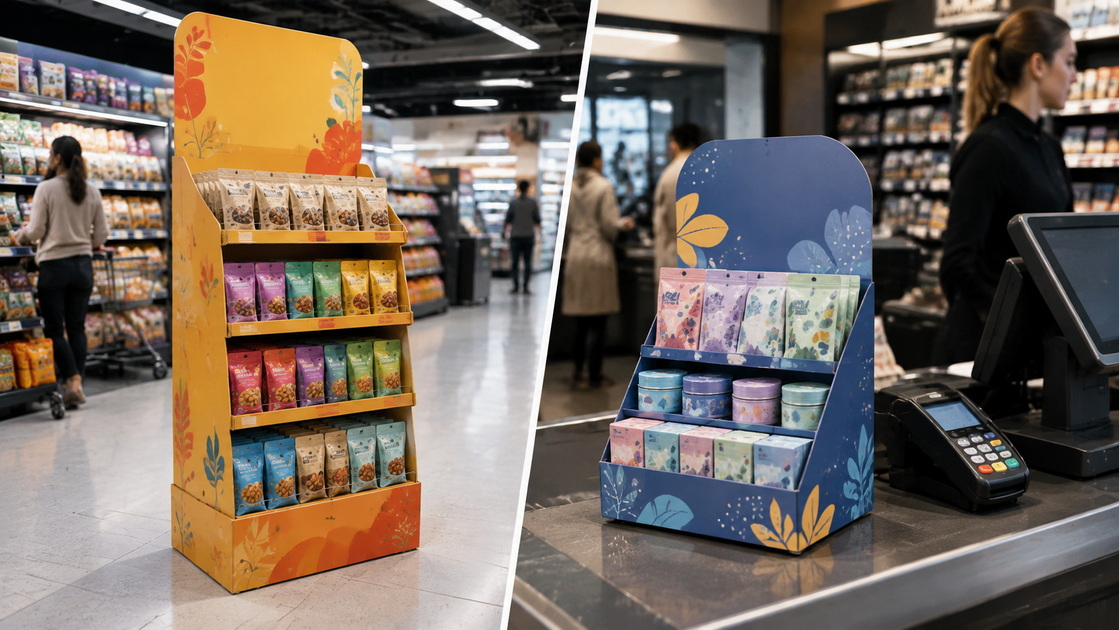
| Factor | POP Display | POS Display |
|---|---|---|
| Full Meaning | Point of Purchase Display | Point of Sale Display |
| Main Location | Throughout the retail store | Checkout counter or payment zone |
| Shopper Stage | Browsing and product discovery | Final payment and impulse purchase |
| Primary Goal | Attract attention and influence consideration | Encourage a last-minute product addition |
| Typical Product Type | New launches, bundles, seasonal products, larger packs | Small, low-cost, easy-to-carry products |
| Display Size | From shelf units to pallet display stands | Usually compact and counter-sized |
| Product Capacity | Medium to high | Low to medium |
| Common Formats | Floor stands, pallet displays, dump bins, sidekicks | Countertop trays, cash-wrap units, compact product holders |
| Key Design Priority | Visibility, capacity, product organization, and branding | Stability, compact size, and easy product access |
The simplest way to understand the difference is straightforward:
- POP displays influence buying decisions while shoppers browse.
- POS displays encourage small purchases immediately before payment.
Both formats can be valuable. However, they should not be designed, stocked, or placed in the same way.
A POS display, or Point of Sale display, is a compact merchandising unit placed near the cash register, payment counter, self-checkout area, or service desk.
This location is often called the cash wrap. It is the final stage of the shopper journey.
POS displays are designed for quick, low-effort product selection. They work best for products that shoppers can easily add to an existing basket without much comparison or explanation.
Common POS display products include:
- Gum and confectionery
- Batteries
- Lip balm
- Small beauty products
- Phone accessories
- Travel-size personal care products
- Gift cards
- Mini snacks
- Small toys
- Energy shots
- Seasonal novelty products
- Small household accessories
A checkout area has limited space. It also contains payment terminals, barcode scanners, receipt printers, bags, baskets, promotional materials, and cashier equipment.
For this reason, the most effective POS display is compact, stable, simple, and easy to shop.
A countertop display needs practical engineering, not only attractive graphics.
Important design requirements include:
- A compact counter footprint
- A stable and balanced base
- Easy product access
- Low front lips that keep product labels visible
- A clear area for price communication
- Simple replenishment access
- Appropriate product capacity
- Suitable protection for small products
- No interference with payment equipment
- Clear staff-side access where needed
A display that is too tall may block communication between customers and store staff. A display that is too deep may affect access to the payment terminal. A display that is too light may move when a shopper removes a product.
A well-designed POS unit should remain stable when fully stocked, half stocked, and nearly empty.
Checkout displays usually hold small products. Their weight distribution changes quickly as shoppers remove items.
A display that looks stable at the beginning of the day may become unstable later if the remaining products are concentrated on one side.
Useful stability features include:
- Wider base panels
- Double-layer corrugated board
- Reinforced back panels
- Anti-slip feet
- Hidden weighted base sections
- Lower product placement
- Strong tray locking systems
- Extended easel-back structures
- Internal support panels
Before final production, the display should be reviewed at several stock levels. This helps identify potential tipping, shifting, shelf sagging, or product-access issues before the display enters stores.

A POP display, or Point of Purchase display, is a retail merchandising structure placed anywhere shoppers make product decisions. It is a broader category than a POS display.
POP displays can be placed in many retail locations, including:
- Store entrances
- Main aisles
- Endcaps
- Seasonal areas
- Promotional zones
- Near related product categories
- Checkout queues
- Warehouse-club pallet areas
- Pharmacy aisles
- Specialty retail departments
A POP display may be a small countertop unit, but it can also be a large freestanding floor structure. Its purpose is to interrupt routine shopping behavior and bring visibility to a product, promotion, or brand.
Common POP display formats include:
- Cardboard floor display stands
- Pallet display stands
- Quarter-pallet displays
- Half-pallet displays
- Full-pallet displays
- Dump bins
- Sidekick displays
- Power wing displays
- Shelf-ready displays
- Endcap displays
- Countertop display trays
- Hanging retail signage
- Shelf talkers
POP displays are useful for new product launches, seasonal promotions, product bundles, limited-edition items, retailer events, product trials, and cross-merchandising programs.
A POP display must perform in a larger and more competitive retail environment. It should be visible from a distance, easy to shop, simple to replenish, and stable in active store traffic.
Important design requirements include:
- Strong brand visibility
- Large header panels
- Easy-to-read product messages
- Appropriate product capacity
- Clear shopper access
- Stable floor construction
- Retailer-approved dimensions
- Efficient replenishment
- Transport-ready packaging
- A structure that remains attractive at lower stock levels
A floor display can be moved by store staff, bumped by shopping trolleys, exposed to cleaning equipment, and replenished by different employees. The display structure must account for these real conditions.
Strong graphics attract attention. Strong engineering keeps the display working throughout the campaign.
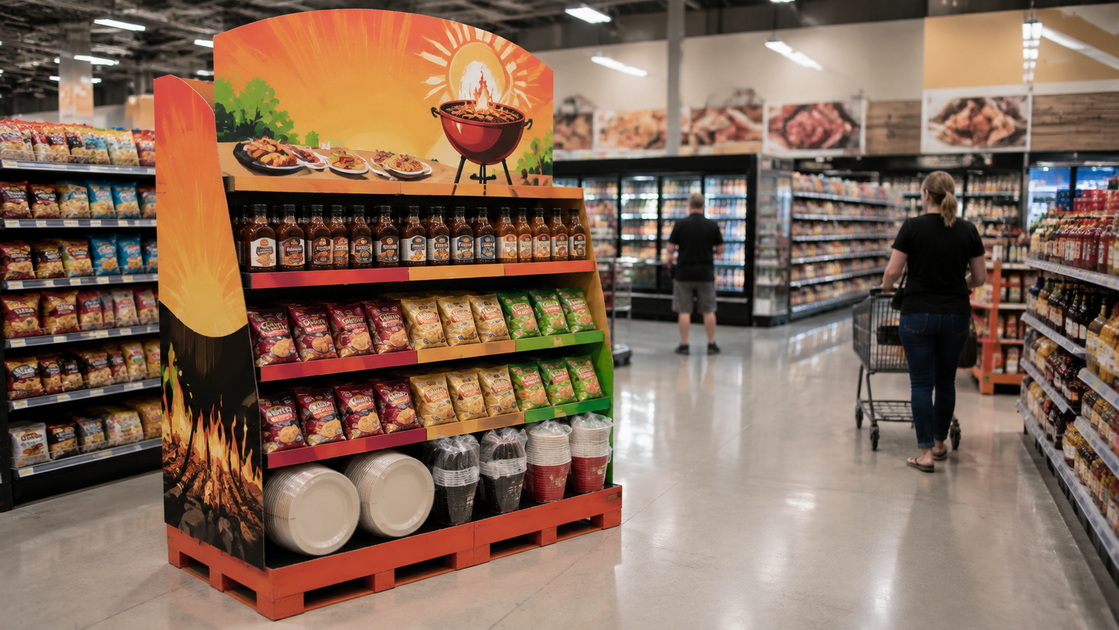
The biggest difference between a POP display and a POS display is the shopper's mindset.
A shopper viewing a POP display is usually browsing. They may be comparing products, looking for ideas, noticing a seasonal offer, or discovering something they did not plan to buy.
A shopper viewing a POS display is already close to payment. They have less time to consider the product and are more likely to make a quick add-on decision.
| Shopper Behavior | POP Display Strategy | POS Display Strategy |
|---|---|---|
| Attention span | More time to browse and compare | Very limited time |
| Product message | Product benefits, seasonal value, bundle appeal, brand story | Simple benefit, price cue, convenience, immediate need |
| Product capacity | Larger product load | Limited counter capacity |
| Product choice | Multiple SKUs or related products | One category or a small number of SKUs |
| Display interaction | Browsing, comparing, selecting | Quick pick-up and add-on purchase |
| Best graphic style | Bold visuals with clear product hierarchy | Minimal message with high visibility |
| Best structure | Floor stand, pallet display, shelf unit, dump bin | Compact tray, countertop unit, cash-wrap display |
A POP display can encourage discovery and exploration. A POS display should make the product decision feel immediate and effortless.
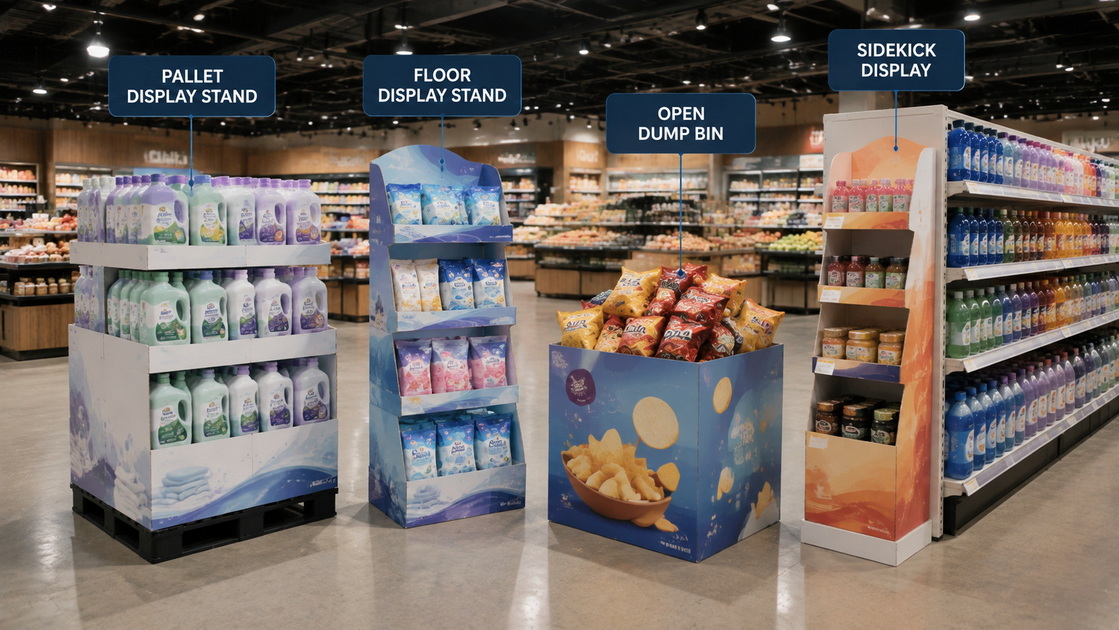
Different POP display formats serve different retail objectives. The best option depends on product weight, dimensions, campaign duration, store placement, shopper traffic, and sales volume.
A cardboard floor display stand is a freestanding retail structure that holds products on shelves, trays, hooks, or product channels.
It is often suitable for:
- New product launches
- Seasonal promotions
- Personal care products
- Packaged food products
- Consumer electronics accessories
- Household goods
- Multi-SKU campaigns
- Gift sets
- Retail bundles
A floor display gives brands significant space for visual communication. It can include headers, side panels, shelf strips, price areas, product descriptions, and product-facing shelves.
A pallet display stand is built around a quarter-pallet, half-pallet, or full-pallet footprint. It is particularly suitable for supermarkets, warehouse clubs, and high-volume retail environments.
It is often suitable for:
- Beverages
- Bulk snacks
- Seasonal bundles
- Large packaged products
- Household products
- Promotional multipacks
- Club-store programs
- Fast-moving consumer goods
A pallet display can support efficient store handling and create a strong retail presence. It should use a stable load-bearing structure, clear product access, and dimensions that match retailer requirements.
A dump bin is an open-top retail container that lets shoppers browse products freely. It creates a sense of abundance and is effective for loose, lightweight, colorful, or low-cost products.
It is often suitable for:
- Confectionery
- Small toys
- Pet treats
- Seasonal novelty products
- Discount items
- Snacks
- Small accessories
- Travel-size products
A dump bin should be designed with suitable depth. If products fall below the shopper's sightline, access becomes difficult. Shallow compartments, internal dividers, and strong front graphics can improve product visibility.
A sidekick display is attached to the side of an endcap or retail shelf. It supports cross-selling without taking up a large amount of floor space.
It is often suitable for:
- Small accessories
- Trial-size products
- Seasonal add-ons
- Complementary products
- Impulse products
- Convenience items
For example, a sidekick display of grilling accessories can be placed near barbecue sauces. A display of travel-size sunscreen can be positioned near summer accessories.
The strongest display decision begins with the retail objective. Do not start with a preferred material or display style. Start with the product, shopper moment, store environment, and campaign requirement.
Ask when the shopper should notice the product.
Choose a POP display when the goal is to:
- Build product awareness
- Launch a new product
- Present a seasonal campaign
- Encourage browsing
- Promote several products together
- Support a bundle
- Create cross-selling opportunities
- Increase brand visibility
Choose a POS display when the goal is to:
- Encourage a small add-on purchase
- Support a low-price impulse item
- Use checkout waiting time
- Present a compact product offer
- Support convenience buying
- Promote travel-size or trial-size products
Review the product before choosing the display structure.
Consider:
- Product dimensions
- Unit weight
- Package strength
- Number of SKUs
- Product price point
- Required product capacity
- Replenishment frequency
- Need for product visibility
- Risk of theft
- Need for premium presentation
- Retail packaging design
For example, a gift set may need a structured floor display with shelves. Small confectionery packs may work well in a dump bin. Travel-size personal care products may perform better in a compact checkout tray.
A retail display must be practical for store teams.
Ask these questions:
1. Can the display be installed quickly?
2. Can staff replenish products without removing the display?
3. Does it fit approved retailer dimensions?
4. Is it stable when stock levels decrease?
5. Does it fit through backroom and store access points?
6. Can it be moved safely if the layout changes?
7. Is the intended product arrangement clear?
8. Does the structure protect products during delivery?
The right display structure should reduce store effort, not create extra work.
A cardboard display stand should perform from factory production to campaign removal.
The complete display journey includes:
1. Structural design
2. Artwork development
3. Prototype production
4. Product loading
5. Packaging and shipment
6. Warehouse handling
7. Store delivery
8. Retail installation
9. Replenishment
10. Shopper interaction
11. Campaign removal
12. Reuse, recycling, or disposal planning
Each stage affects the final retail appearance and display performance.
Cardboard is one of the most versatile materials for promotional retail displays. It supports custom die-cut shapes, full-color printing, structural flexibility, and efficient flat-pack shipping.
- Flexible custom structures
- Large printable branding areas
- Efficient flat-pack shipping
- Fast sampling and production
- Suitable for seasonal retail programs
- Easy artwork updates for retailer-specific versions
- Lower investment than many permanent fixtures
- Potential for fiber-based recovery where suitable systems are available
Cardboard works particularly well for campaigns that require visual impact, structural flexibility, and defined in-store timelines.
Cardboard should be selected and engineered for the actual retail environment.
Important considerations include:
- Moisture exposure
- Floor-cleaning splash
- Product load
- Shelf sagging risk
- Edge wear
- Display handling
- Campaign duration
- Store traffic level
- Printing requirements
- Shipping conditions
These factors can be addressed with stronger board grades, reinforced shelves, internal supports, pallet bases, protective surface treatments, laminated graphic panels, and transport-tested outer cartons.
For example, a supermarket floor display may need added protection around the lower edges. A dump bin carrying dense products may require internal dividers and reinforced sidewalls to prevent outward bulging.
Retail teams may also use the terms POSM and Point of Activation.
POSM refers to the broader group of physical retail materials used to communicate product messages. These materials may include display stands, shelf talkers, wobblers, posters, header cards, banners, counter units, and product signage.
A Point of Activation is a place where a shopper actively engages with a brand or product message. A POP display can serve this role when it gives shoppers a clear reason to interact.
Useful engagement elements may include:
- A visible QR code
- A product demonstration space
- A seasonal recipe card
- A sampling tray
- A simple promotional message
- A product comparison guide
- A gift-with-purchase notice
- A product-use suggestion
The interaction should remain simple. If a shopper cannot understand the message quickly, the display may lose its impact.
Retail display performance should be assessed beyond shipment volume. In-store results provide a clearer picture of what worked and what should change in future campaigns.
Useful measurements include:
- Sales per store per week
- Product sell-through rate
- Incremental sales compared with regular shelf placement
- Replenishment frequency
- Out-of-stock time
- Display damage rate
- Store placement consistency
- Product visibility
- Shopper interaction
- Cross-selling results
- Customer and store-team feedback
A practical method is to compare similar stores. One group can use the display, while another group uses standard shelf placement. This can help separate the impact of the display from seasonal demand, pricing changes, or other retail activity.
A retail display should do more than hold products. It must support the real store environment.
Displays often look excellent when fully stocked. However, products may sell down quickly during a successful promotion.
The structure should still look organized when it is half stocked.
Useful design features include:
- Angled shelves
- Shallow product trays
- Product dividers
- Raised product platforms
- Strong front graphics
- Clear product-facing guides
- Smaller product compartments
- Easy-to-refill channels
POP displays need stable construction in busy stores. They may be bumped by baskets, trolleys, children, cleaning equipment, or stock carts.
Important safety features include:
- Wide bases
- Secure shelf locks
- Balanced weight distribution
- Reinforced pallet connections
- Protected display edges
- Suitable display height
- Anti-tip structural design
- Clear aisle space around the fixture
A display can encounter problems if it does not meet retailer requirements. Confirm key requirements before production begins.
These may include:
- Approved footprint
- Maximum display height
- Product capacity
- Material restrictions
- Fire-safety requirements
- Assembly rules
- Retailer graphics standards
- Pallet specifications
- Delivery labels
- Store delivery instructions
Early alignment helps reduce redesign work and supports smoother retail deployment.
A POP display is the stronger choice when a brand needs to attract attention throughout the shopper journey, introduce products, support a seasonal campaign, present several SKUs, or create a larger in-store presence.
A POS display is the stronger choice when the product is compact, affordable, easy to understand, and suitable for a final checkout purchase.
Many retail programs benefit from using both formats. A floor display can create visibility in a main aisle, while a compact checkout display can support final add-on purchases near payment.
Long Win Display provides custom cardboard floor display stands, pallet displays, dump bins, sidekick displays, countertop POS units, retail-ready packaging, pre-assembly, quality control, and export manufacturing support. Share product dimensions, target retail channel, campaign duration, and capacity requirements to develop a display solution that fits the retail program.
POP displays are placed throughout a retail store to influence product decisions during browsing. POS displays are positioned at checkout areas to encourage last-minute purchases before payment.
Yes. A POS display can be considered a type of POP display because it influences a purchase decision. However, POS specifically refers to the checkout or payment area, while POP includes product displays throughout the store.
POS displays work best for compact, low-cost, easy-to-carry products such as gum, confectionery, batteries, lip balm, travel-size products, small accessories, mini snacks, and seasonal novelty products.
POP displays work well for new launches, seasonal products, bundled offers, beverages, snacks, household products, personal care items, gift sets, electronics accessories, and multi-SKU retail campaigns.
Yes, when they are designed for the correct product load and store conditions. Reinforced corrugated board, pallet bases, internal supports, shelf locks, protective treatments, and suitable board grades can improve durability and stability.
1. POP Display. "POP vs. POS Displays: What's the Difference?"
[https://popdisplay.me/pop-vs-pos-displays-whats-the-difference/]
2. Shop! Association. "The Global Association for Retail Environments."
[https://www.shopassociation.org/]
3. Food Industry Association. "Seasonal Merchandising: A Grocer's Secret to Success."
4. Sustainable Packaging Coalition. "2020–21 Centralized Study on Availability of Recycling."
5. Corrugated Packaging Alliance. "Corrugated Industry Resources."


