
Views: 204 Author: Long Win Display Publish Time: 2026-08-21 Origin: Site


Content Menu
● POP vs PDQ Display at a Glance
>> When POP Displays Work Best
● POP Display vs PDQ Display: Main Differences
● When POP and PDQ Displays Work Together
● How to Choose Between POP and PDQ Displays
>> Choose a POP Display When You Need
>> Choose a PDQ Display When You Need
>> Choose a Combined POP and PDQ Solution When You Need
● Five Requirements of a Practical PDQ Display
● Structural Design Considerations for POP and PDQ Displays
● Retail Requirements and Store Execution
● A Step-by-Step Display Development Process
>> 1. Define the Retail Objective
>> 2. Confirm Product and Pack Details
>> 3. Select the Right Display Format
>> 4. Develop Structural and Graphic Design
>> 5. Build and Test a Prototype
>> 6. Prepare for Production and Distribution
● Display Boxes for Retail Brands
>> 1. What Is the Main Difference Between POP and PDQ Displays?
>> 2. Is a PDQ Display Also a POP Display?
>> 3. What Does PDQ Mean in Retail Packaging?
>> 4. What Products Are Suitable for PDQ Displays?
>> 5. Can a POP Display Be Pre-Assembled?
The POP vs PDQ display decision matters for brands that want stronger product visibility, faster store setup, and a more effective retail presence. Although both formats are widely used in supermarkets, pharmacies, convenience stores, specialty shops, and large retail chains, they are designed for different priorities.
A POP display is mainly created to attract shopper attention, communicate brand value, and support purchasing decisions. A PDQ display is mainly created to move products from shipping to shelf or sales floor quickly, with minimal handling by store staff.
For retail brands, the right format depends on the product category, retailer requirements, campaign purpose, pack quantity, display location, distribution method, and expected display life.

| Factor | POP Display | PDQ Display |
|---|---|---|
| Full meaning | Point of Purchase Display | Product Display Quickly |
| Main purpose | Product promotion and brand visibility | Fast stocking and retail-ready presentation |
| Typical location | Aisles, entrances, end caps, checkout zones, promotional areas | Shelves, pallets, end caps, promotional aisles |
| Main design priority | Graphics, structure, shopper attention, and brand storytelling | Speed, product protection, easy opening, and efficient placement |
| Common formats | Floor displays, countertop stands, dump bins, pallet displays, sidekicks | Display boxes, shelf trays, retail-ready shippers, pre-packed floor displays |
| Assembly requirement | May be flat-packed, partially assembled, or pre-assembled | Usually opened and placed directly in the intended retail position |
| Product handling | Store staff may stock products after delivery | Products are usually packed inside before shipment |
| Best use | Launches, promotions, retail events, impulse sales, brand activation | High-volume distribution, easy replenishment, and retail efficiency |
| Graphic flexibility | High | Moderate to high |
| Typical lifespan | Temporary, seasonal, or campaign-based | Usually temporary or short-to-medium term |
A POP display helps sell the story. A PDQ display helps speed up the retail process.
In many retail programs, the two formats overlap. A PDQ display can include strong branding and promotional graphics, while a POP display can be designed for rapid setup and pre-packed delivery.
POP means Point of Purchase. A POP display is a custom retail display designed to make products more visible when shoppers are deciding what to buy.
These displays are usually placed in high-traffic retail areas where they can attract attention and encourage product discovery. Common locations include entrance zones, end caps, checkout areas, promotional islands, side aisles, shelves, and seasonal spaces.
The main purpose is to help a product stand out from surrounding merchandise.
A POP display can include:
- High-impact printed graphics
- Brand colors
- Product images
- Header cards
- Promotional pricing areas
- Product benefits
- Seasonal messages
- Creative structural shapes
- Product bundles
- Sampling areas
- QR code placement
- Shelf-edge communication
Corrugated cardboard is a widely used material for POP displays because it combines printability, structural flexibility, manageable shipping cost, and efficient production.
Retail brands can select from many POP display formats.
- Countertop display stands
- Floor display stands
- Pallet displays
- Dump bins
- Sidekick displays
- End-cap displays
- Power wings
- Shelf displays
- Display boxes
- Promotional islands
- Product trays
- Clip strips
Each format serves a different retail purpose. A countertop display may be ideal for cosmetics or snacks. A pallet display may be better for high-volume products. A floor display can create a strong standalone product presence in a busy aisle.
POP displays are particularly useful when a brand wants to increase product awareness and encourage purchase.
They are often selected for:
- New product launches
- Seasonal promotions
- Limited-edition products
- Gift sets
- Retail events
- Sampling programs
- Product bundles
- Impulse-purchase categories
- Brand-awareness campaigns
- Retailer-specific promotions
A strong POP display gives shoppers a clear reason to notice the product, understand its value, and pick it up.
PDQ commonly means Product Display Quickly. It is often associated with retail-ready packaging, shelf-ready packaging, or display-ready packaging.
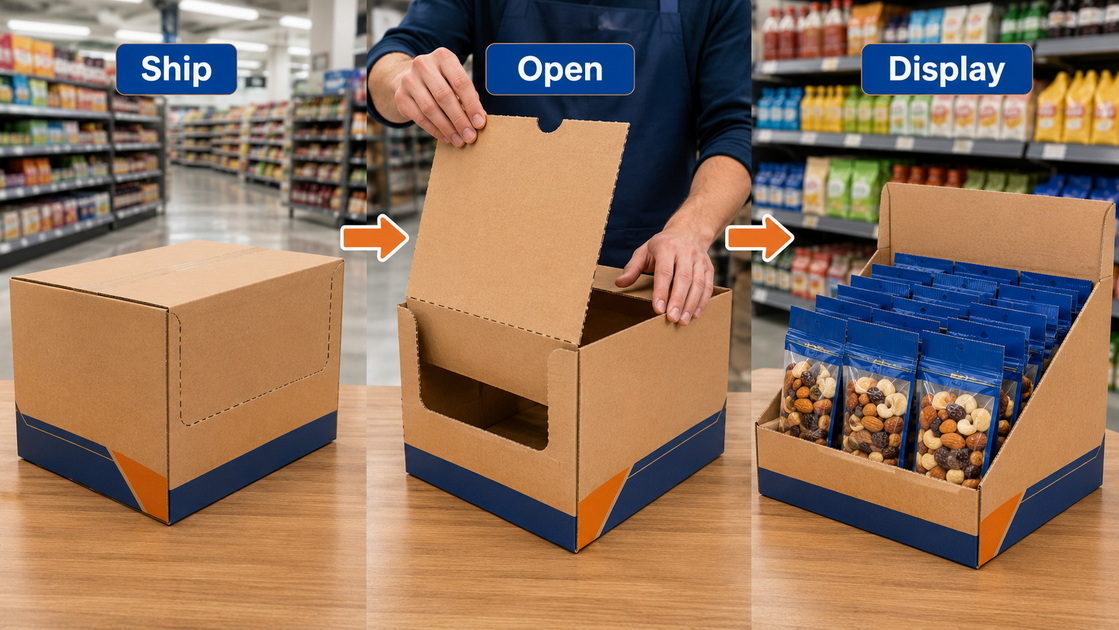
A PDQ display is usually shipped with products already packed inside. Store staff open the outer carton, remove a perforated cover or protective panel, and place the full display directly onto a shelf, end cap, pallet, or promotional area.
The main goal is speed and simplicity.
Instead of opening a master carton and stocking each product one by one, store staff can place the full tray, display box, or pre-packed display unit in one step.
A PDQ display can support:
- Faster shelf stocking
- Better product organization
- Product protection during transportation
- Consistent shelf presentation
- Reduced store handling
- Easier replenishment
- Faster retail setup
- Improved product visibility
- Cleaner display execution
- Simplified product placement
PDQ formats are common for fast-moving consumer goods, including snacks, candy, cosmetics, health products, batteries, small electronics, toys, accessories, personal-care products, household products, and packaged beverages.
PDQ displays can be developed in several formats.
- Countertop PDQ display boxes
- Shelf-ready trays
- Retail-ready display boxes
- Pre-packed floor displays
- Quarter-pallet displays
- Half-pallet displays
- Full-pallet displays
- PDQ shippers
- Tear-away display cartons
- Shelf-ready packaging trays
These displays often include perforated openings, tear-away panels, locking tabs, front display lips, and pre-arranged product rows.
The main difference is the primary purpose of the display.
A POP display is developed to capture shopper attention. It focuses on visual impact, promotional messaging, product storytelling, and retail activation.
A PDQ display is developed to reduce store labor and speed up placement. It focuses on shipping efficiency, product protection, easy opening, and ready-to-sell presentation.
| Feature | POP Display | PDQ Display |
|---|---|---|
| Primary function | Promote products and attract shopper attention | Convert shipping packaging into a retail display |
| Product packing | Products may be stocked after delivery | Products are usually pre-packed before shipment |
| Store setup | May require assembly or product stocking | Usually requires opening and placement only |
| Design focus | Visual impact and brand communication | Retail handling and operational efficiency |
| Graphics | Often extensive and campaign-focused | Usually focused on product identification and visibility |
| Structure | Can be highly customized and creative | Often based on product pack size and shelf requirements |
| Best retail goal | Product discovery and promotional presence | Faster replenishment and organized merchandising |
| Ideal campaign type | Seasonal, promotional, and high-visibility programs | High-volume, repeatable, and distribution-focused programs |
| Shipping role | May need a separate shipping carton | Often serves as both shipper and display |
| Store labor | May require more setup | Can reduce stocking steps |
A strong PDQ display can still create high visual impact. A well-designed POP display can still arrive pre-assembled or pre-packed for faster retail placement.
The most practical retail solution is often a display that combines both POP and PDQ features.
For example, a snack brand may use a pre-packed display box that fits directly onto a shelf. Store staff can quickly remove the protective cover and place the unit in the intended location. At the same time, the display can use bright graphics, product images, flavor callouts, and a strong header.
This format works as both a shelf-ready display and a promotional tool.
A floor-standing display can also combine both approaches. It can arrive pre-assembled and pre-filled with products, allowing store staff to remove the outer protective packaging and place the unit directly on the sales floor.
This combined approach can provide:
- Faster store setup
- Better retail consistency
- Reduced product handling
- Stronger brand presentation
- Easier retailer acceptance
- Lower risk of assembly errors
- Cleaner product organization
- More reliable campaign execution
The correct choice should start with the retail objective.
- Strong product visibility
- High-impact graphics
- Creative display structures
- Brand storytelling
- Seasonal product promotion
- Product bundles
- Retail event support
- Sampling opportunities
- High impulse-purchase potential
- A freestanding or countertop promotional display
- A distinctive retail presence
- Fast shelf stocking
- Pre-packed product delivery
- Minimal store setup
- Easy opening
- Better product protection during shipping
- Retail-ready distribution
- Faster replenishment
- Consistent product arrangement
- Reduced store labor
- Standardized retail execution
- Strong branding and fast retail placement
- Pre-packed product delivery
- Display-ready shipping
- Easy store handling
- Seasonal graphics with efficient stocking
- High-volume retail rollout
- Reduced store assembly
- Clean and organized product presentation
A PDQ display should work smoothly for both retail staff and shoppers.
Store staff should quickly understand the product category, display orientation, intended location, and product quantity.
Clear product branding and simple outer-carton identification can help prevent placement errors.
Perforations, tear strips, and removable panels should work cleanly. The display should not require complicated tools or excessive force.
Poorly designed opening features can damage graphics, tear the display structure, or slow down store staff.
The display should move from shipping carton to shelf, pallet, countertop, or promotional area with minimal handling.
A pre-packed display can reduce the need to handle every individual product unit.
Shoppers should be able to see the products clearly and remove individual units without damaging the display.
The front lip should be high enough to retain products during shipping, but low enough to keep labels and product packaging visible.
After the promotion ends, the display should be easy to collapse, separate, recycle, or remove according to the retailer's store procedures.
Simple material construction can help support more efficient end-of-life handling.
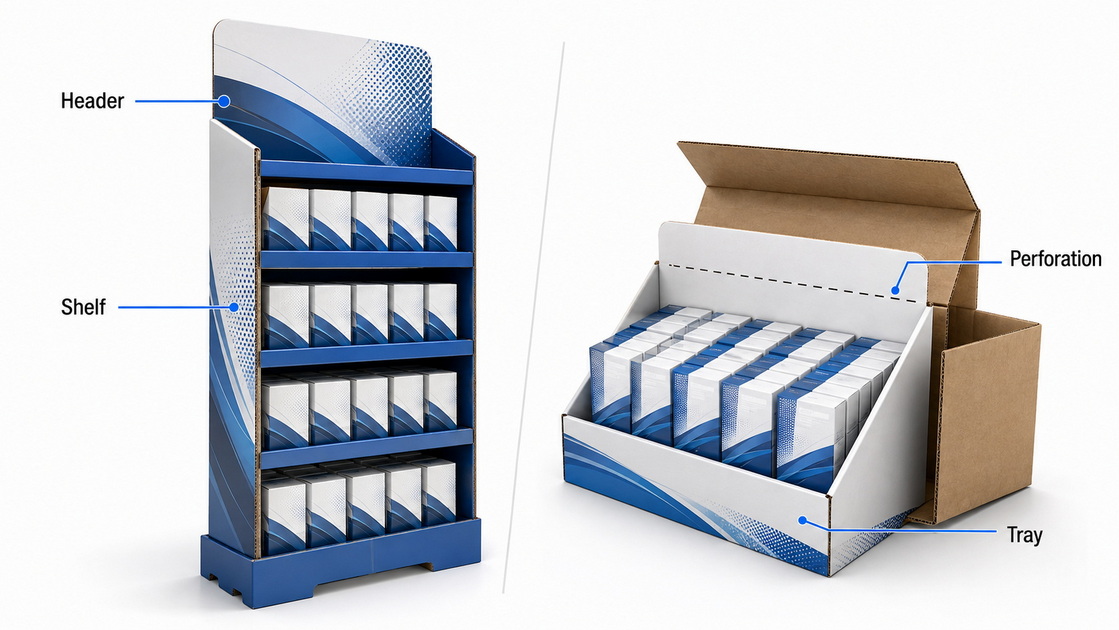
A display box must protect products during delivery and perform effectively in the retail environment.
For POP displays, the structure must balance visual creativity with stability. Large headers, tall back panels, multiple shelves, dividers, and unusual shapes should not reduce the display's strength.
For PDQ displays, the structure performs two important functions:
- Protect products during shipping
- Present products effectively in retail
Important design considerations include:
- Product dimensions
- Product weight
- Product quantity per display
- Total packed weight
- Shelf or pallet footprint
- Display height
- Tray depth
- Front-lip height
- Product accessibility
- Corrugated board grade
- Internal dividers
- Perforation placement
- Opening instructions
- Outer shipping protection
- Pallet configuration
- Retailer requirements
A display that is too weak may collapse during delivery. A display that is difficult to open may slow down store staff. A display with a high front lip may cover product labels. A display with a low front lip may allow products to fall during transportation.
A practical display balances all of these requirements.
Retail displays must fit the store environment.
A visually attractive display may still fail if it does not fit the assigned shelf, pallet, aisle, end-cap space, or checkout location. Retail teams also prefer displays that are easy to understand, easy to move, and quick to place.
Before developing a POP or PDQ display, confirm:
- Retailer footprint requirements
- Shelf width, depth, and height
- Pallet configuration
- Product quantity per display
- Maximum display weight
- Store assembly rules
- Price-sign location
- Product barcode visibility
- Recyclability expectations
- Delivery method
- Product replenishment plan
- Retailer branding requirements
For large retail programs, pre-assembly and pre-packing can reduce inconsistency between stores. It can also help ensure that the display looks correct across different retail locations.
A structured process can reduce redesigns, shipping problems, and store-execution issues.
Clarify the main purpose of the display.
Is the project intended to increase impulse purchases, launch a product, improve shelf efficiency, support a seasonal event, or simplify replenishment?
Provide accurate product information.
Include:
- Product size
- Product weight
- Retail pack format
- Number of units per display
- Product orientation
- Barcode location
- Fragility requirements
- Product shelf life
- Required product visibility
Choose a countertop display box, shelf-ready tray, floor display, pallet display, sidekick, end-cap unit, or pre-packed PDQ shipper based on the retail space and product category.
The structure must protect the product and support the intended retail experience. The visual design should make products easy to identify and attractive from the expected shopper distance.
Test the prototype using real products.
Review:
- Product fit
- Opening performance
- Display strength
- Product accessibility
- Shipping protection
- Shelf stability
- Assembly speed
- Retail appearance
- Disposal process
Confirm material specifications, printing details, pre-assembly requirements, product packing method, pallet layout, shipping marks, and store instructions before mass production.
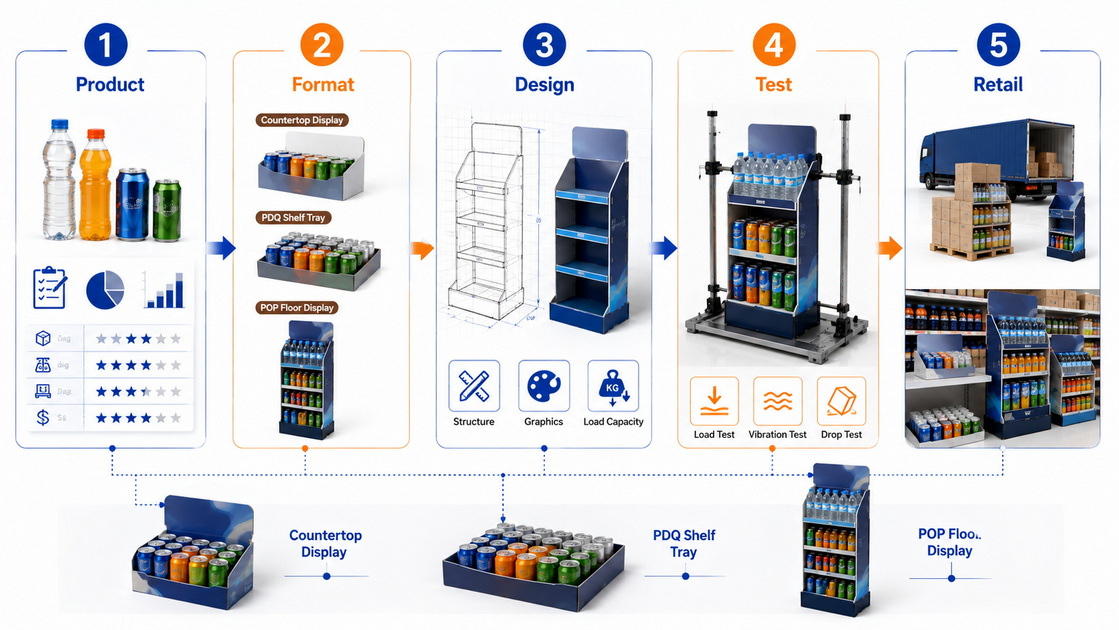
Display boxes are highly effective for compact products that need visibility without requiring a large floor display.
A custom display box can function as a PDQ tray, countertop display, shelf-ready shipper, or compact POP display. It can protect products during transportation and create a clean, organized retail presentation after opening.
Display boxes are often used for:
- Cosmetics
- Snacks
- Candy
- Supplements
- Health products
- Electronics accessories
- Batteries
- Personal-care products
- Small toys
- Stationery
- Pet products
- Gift items
- Seasonal products
For these categories, a carefully designed display box can reduce handling while making the products easier to see, access, and replenish.
Long Win Display designs, customizes, manufactures, and pre-assembles display boxes, countertop display stands, floor displays, pallet displays, and other corrugated POP display solutions. Each project can be developed around product dimensions, retail-pack quantity, retailer requirements, shipping method, store location, and campaign objectives.
POP and PDQ displays serve different but complementary retail purposes.
A POP display is a strong choice when the priority is visual impact, product discovery, brand presentation, and promotional visibility. A PDQ display is a strong choice when the priority is fast stocking, simple store handling, product protection, and retail-ready delivery.
The most effective approach is often a display that combines the visual strength of POP with the practical efficiency of PDQ. When the display is developed around real product dimensions, store requirements, shipping conditions, and retail workflows, it can improve product presentation while making day-to-day store execution easier.
Long Win Display provides custom display boxes, PDQ displays, countertop display stands, floor displays, pallet displays, and pre-assembled retail display solutions for brands entering supermarkets, pharmacies, convenience stores, specialty shops, and other retail channels. Share the product type, pack quantity, retail destination, display dimensions, and campaign requirements to develop a display solution that supports both product presentation and store efficiency.
A POP display focuses on promoting products and attracting shopper attention at the point of purchase. A PDQ display focuses on fast placement by combining shipping protection and product display in one pre-packed retail unit.
A PDQ display can also function as a POP display when it includes clear branding, strong product graphics, and promotional messaging. The main difference is that PDQ places greater emphasis on quick setup and retail efficiency.
PDQ commonly means Product Display Quickly. It describes a retail-ready display format that can be opened and placed on a shelf, pallet, countertop, or sales floor with minimal store handling.
PDQ displays are suitable for compact, fast-moving consumer products such as snacks, candy, cosmetics, health products, batteries, toys, accessories, personal-care items, small electronics, household products, and packaged beverages.
Yes. A POP display can be flat-packed, partially assembled, fully pre-assembled, or pre-packed with products. The best option depends on display size, shipping cost, store setup requirements, product weight, and retail rollout plans.
1. TopWon Group. [POP vs PDQ Displays What Is the Difference]
2. Smurfit Westrock. [Shelf Ready Packaging]
3. VistaPrint. [What Is Shelf Ready Packaging]
4. Assemblies Unlimited. [The Latest Trends in Shelf Ready Packaging for Retail Products]
5. Creative Displays Now. [Designing Displays Around Walmart Packaging Requirements]
6. Folene Packaging. [Shelf Ready Packaging Benefits]
7. ScienceDirect. [Impact of Different Types of In Store Displays on Consumer Purchase Behavior]


