
Views: 222 Author: Long Win Display Publish Time: 2026-08-27 Origin: Site


Content Menu
● Why Brands Use Cardboard POP Displays
● POP Display vs. PDQ Display: What Is the Difference?
● When Should You Choose a POP Display?
>> New Skincare Product Launch
● When Should You Choose a PDQ Display?
● How to Choose the Right Cardboard Display
● Design Features That Improve Retail Performance
● Common POP and PDQ Display Mistakes
● Working With Long Win Display
>> 1. What products are best for PDQ displays?
>> 2. Can cardboard POP displays be customized?
>> 3. Are cardboard display stands recyclable?
>> 4. Should a cardboard display be shipped flat-packed or pre-assembled?
>> 5. How do I choose between a countertop display and a floor display?
POP and PDQ displays both help products stand out in retail, but they serve different purposes. POP displays are built to attract attention and communicate a brand message, while PDQ displays are designed to get products onto the sales floor quickly with minimal store handling.
For retailers, brand owners, and sourcing teams, the right choice depends on product size, campaign goals, store location, product quantity, retail labor requirements, and shipment method. Long Win Display designs, customizes, manufactures, and pre-assembles cardboard display stands that help brands present products more effectively across retail environments.
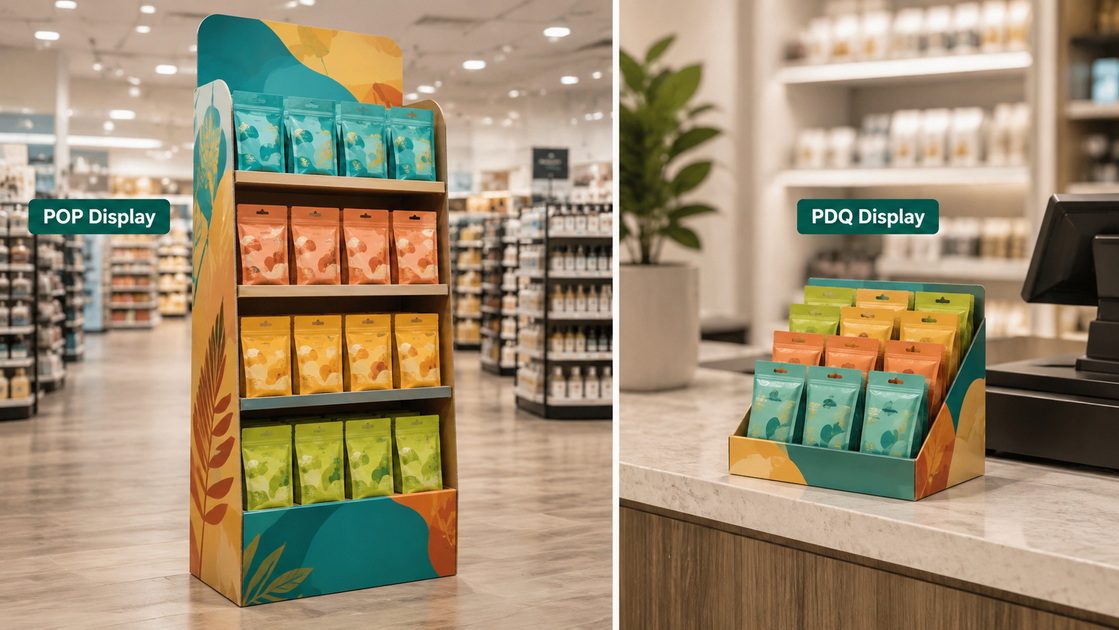
A POP display means a Point-of-Purchase display. It is a retail merchandising structure placed where shoppers can see, consider, and purchase products.
POP is a broad term covering many types of retail displays, including:
- Freestanding floor displays
- Countertop display stands
- Endcap displays
- Shelf-ready trays
- Sidekick displays
- Dump bins
- Pallet displays
- Hanging displays
- Promotional display boxes
- PDQ displays
The main purpose of a POP display is to increase product visibility at a critical buying moment. It combines structure, graphics, product organization, and retail placement to encourage shoppers to pause, interact with the product, and make a purchase.
A POP display can be a small countertop unit for cosmetics, candy, or accessories. It can also be a large corrugated cardboard floor display with shelves, hooks, trays, printed side panels, headers, and reinforced structures for heavier products.
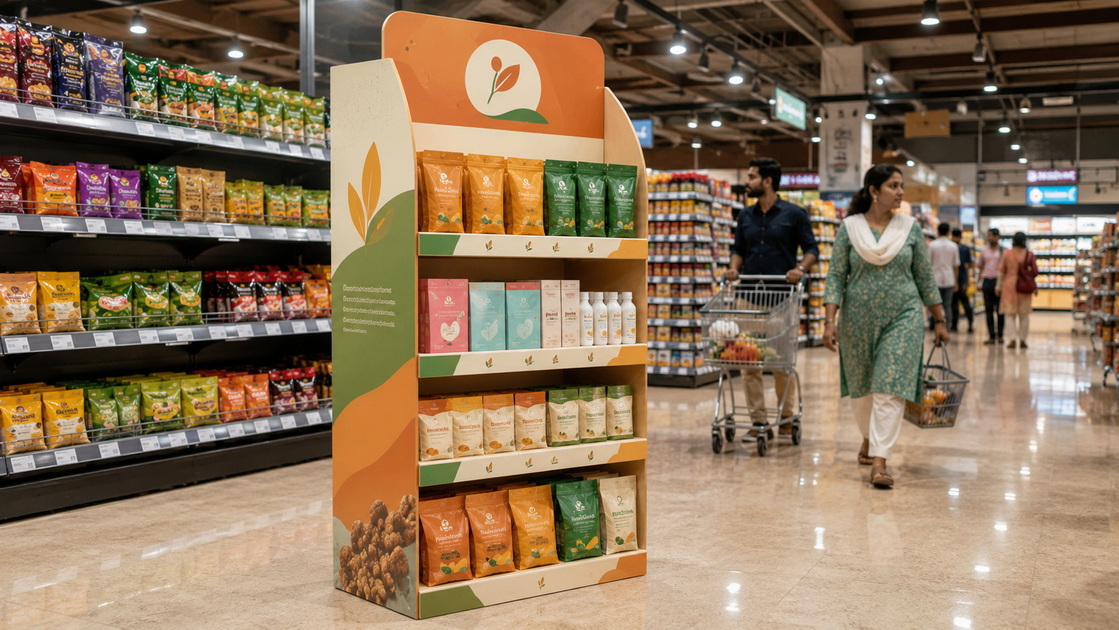
A well-designed cardboard POP display can transform a standard product presentation into a recognizable retail destination. It gives a brand more space to communicate benefits, promotions, product ranges, and visual identity than ordinary shelf placement.
Brands commonly use POP displays to:
- Improve visibility in crowded retail spaces
- Support new product launches
- Promote seasonal collections and holiday campaigns
- Encourage impulse purchases
- Create cross-selling opportunities
- Present multiple SKUs in one organized unit
- Strengthen brand recognition through custom printing
- Build themed retail campaigns around an event or promotion
- Support limited-time offers and special bundles
For example, a skincare brand launching a new product range may use a freestanding cardboard display with separate shelves for cleansers, serums, moisturizers, and travel-size products. The display can guide shoppers through a recommended routine while making the brand easier to notice from across the aisle.
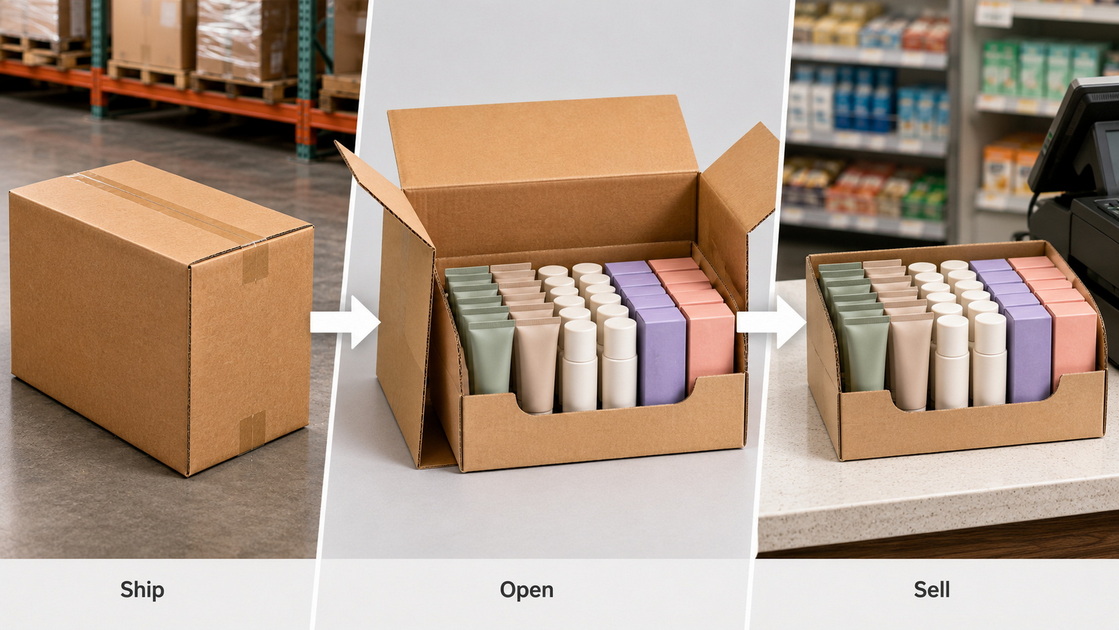
A PDQ display is a compact, retail-ready display unit designed for fast placement in stores. PDQ is commonly understood as "Pretty Darn Quick" or "Product Display Quickly."
Unlike a display that needs to be assembled and filled in-store, a PDQ unit is often delivered pre-packed with products. Retail staff can remove the outer shipping carton, place the display on a counter, shelf, endcap, or promotional table, and begin selling.
The defining advantage of a PDQ display is speed and simplicity.
Common applications include:
- Checkout counters
- Inline shelves
- Store entrances
- Promotional tables
- Endcap zones
- Seasonal campaign areas
- Convenience-store displays
- High-traffic impulse-purchase locations
PDQ displays are particularly suitable for lightweight, compact, fast-moving products such as:
- Snacks and confectionery
- Beauty accessories
- Cosmetics and personal-care items
- Batteries
- Phone accessories
- Stationery
- Toys and collectibles
- Travel-size products
- Small household items
- Health and wellness products
A PDQ display can be part of a POP display program, but not every POP display is a PDQ. The main difference is that POP refers to the larger category of promotional retail displays, while PDQ refers to a fast-to-deploy retail display format.
| Feature | POP Display | PDQ Display |
|---|---|---|
| Main purpose | Attract attention, build brand visibility, and promote products | Place products in retail quickly and reduce store setup work |
| Display category | Broad category with many display formats | A specific quick-setup display format |
| Typical size | Countertop, floor-standing, endcap, pallet, or hanging display | Usually compact countertop, shelf, tray, or small promotional unit |
| Product loading | May be shipped flat-packed, pre-assembled, or product-loaded | Often supplied with products pre-packed inside |
| Setup requirement | May require assembly, product loading, or simple placement | Usually needs minimal setup before selling |
| Graphic space | Can include extensive branding and campaign storytelling | Usually more compact but still customizable |
| Best retail use | Product launches, brand campaigns, seasonal promotions, multi-SKU displays | Impulse products, quick promotions, high-turnover products |
| Retail placement | Aisles, entrances, endcaps, counters, promotional zones, and pallet areas | Shelves, counters, checkout areas, tables, and endcaps |
| Campaign length | Suitable for short-term, seasonal, and longer promotional programs | Often used for short campaigns, quick launches, and rapid replenishment |
The easiest way to understand the difference is:
- POP display: A broader retail presentation designed to capture attention and promote a brand.
- PDQ display: A ready-to-place display designed to move products from shipment to selling space quickly.
A custom POP display is usually the best choice when your product needs stronger branding, larger visual impact, or a more structured in-store presentation.
Choose a POP display when you need to:
1. Launch a new product range.
2. Present multiple SKUs in a single display.
3. Create a high-visibility feature in an aisle, entrance, or promotional area.
4. Communicate product benefits, usage instructions, or campaign messages.
5. Support a holiday, seasonal, or limited-edition promotion.
6. Use large-format graphics, branded headers, or themed display elements.
7. Add shelves, hooks, trays, testers, or product dividers.
8. Build a display around a specific retailer footprint or planogram.
9. Support heavier or larger products with reinforced corrugated structures.
A floor-standing POP display is especially useful when the product needs to be visible from a distance. It can create a strong visual destination in-store and offer enough room for bold branding, product organization, and promotional messages.
A skincare brand may introduce a new hydration collection in pharmacies, supermarkets, and beauty stores. Rather than placing the products only on a crowded shelf, the brand can use a custom cardboard floor display.
The display may include:
- A large branded header
- Separate shelves for each product type
- A visual routine showing the recommended order of use
- Product benefit statements
- A QR code linking to product education
- Promotional space for bundle offers
- Trial-size samples or testers
This type of display can make the product range easier to understand while creating a more engaging in-store experience.
A PDQ display is often the right choice when your priority is quick rollout, fast placement, low store labor, and immediate product availability.
Choose a PDQ display when:
- Your products are lightweight and compact.
- Your retail campaign depends on impulse purchases.
- The retailer needs products ready for rapid placement.
- Your products can be safely packed inside the display before shipment.
- You want to reduce individual product handling at store level.
- You are launching a short-term promotion across many locations.
- The display will be used on a shelf, counter, checkout zone, or promotional table.
- Your products need frequent replenishment.
- You want a practical format for high-volume, fast-moving items.
A mobile-accessory brand launching charging cables, adapters, and earphones may use a countertop PDQ display. Each unit is packed with products before delivery and shipped inside a protective outer carton.
At the store, staff simply remove the outer packaging and place the PDQ display near checkout or in the accessories department. Products are already organized, visible, and ready for shoppers to select.
This approach is especially effective for small products that benefit from convenience, accessibility, and high shopper traffic.
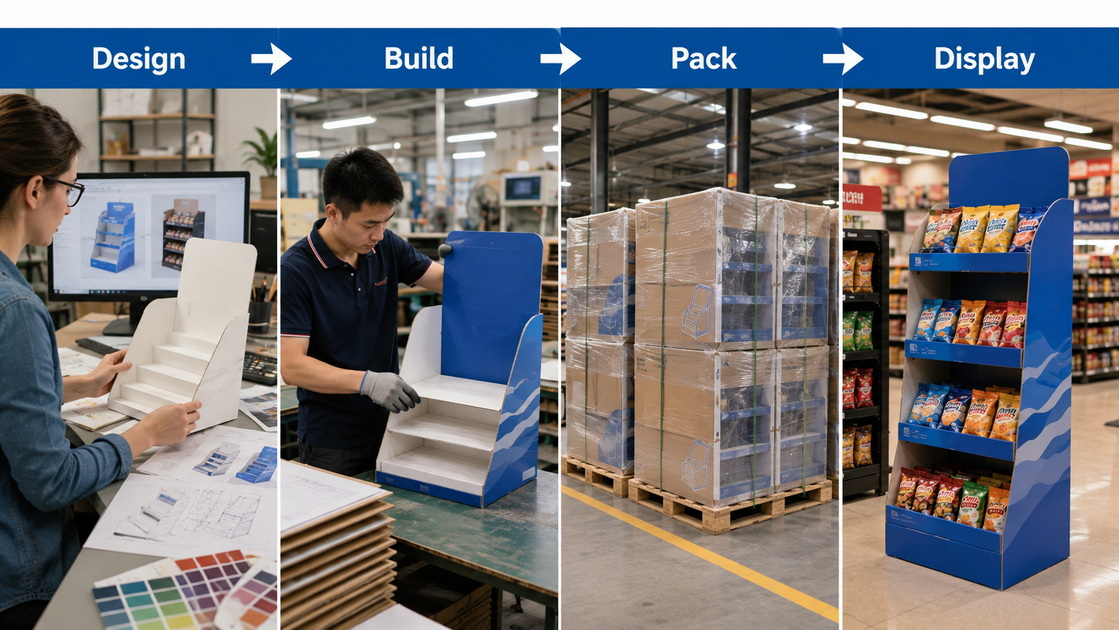
The best cardboard display is not always the largest or most visually complex option. It should fit your product, retail environment, logistics process, campaign duration, and store-execution requirements.
Before developing a POP or PDQ display, consider the following factors.
Start with accurate product specifications:
- Product length, width, and height
- Individual product weight
- Total display load
- Packaging type
- Number of products per display
- Whether products will hang, stand, stack, or sit in trays
The display structure must safely support the full product load throughout shipping, placement, replenishment, and shopper interaction.
The retail location affects display size, format, and shopper behavior.
| Retail Location | Suitable Display Type | Typical Product Use |
|---|---|---|
| Checkout counter | Countertop PDQ display | Snacks, accessories, cosmetics, batteries |
| Shelf | Shelf-ready tray or PDQ display | Small packaged goods and fast-moving items |
| Aisle | Freestanding POP display | Multi-SKU products, new launches, seasonal items |
| Endcap | POP floor display or pallet display | Promotions, bundles, high-volume campaigns |
| Store entrance | Large branded POP display | Product launches and campaign visibility |
| Promotional table | PDQ, dump bin, or compact floor display | Discounted, seasonal, or impulse products |
Short-term promotions may require lightweight, economical structures that are easy to ship and install. Longer campaigns may need stronger board materials, reinforced shelves, durable printing, and more stable construction.
A seasonal campaign might prioritize quick production and fast rollout. A longer retail program may prioritize structure, replenishment efficiency, and a more durable appearance.
Store teams often have limited time for assembly and merchandising. If retail staff need to unpack, assemble, load, and place products individually, the process can create delays and inconsistencies.
For faster retail execution, consider:
- Pre-assembled displays
- Product-loaded PDQ units
- Clear opening instructions
- Simple display placement markings
- Protective transit packaging
- Easy-access replenishment areas
- Compact master-carton dimensions
Cardboard display design should account for the full supply-chain process, not only final appearance.
A display must perform through:
Design→Production→Packing→Shipping→Store Setup→Shopper
A display can look excellent in a digital rendering but still create problems if it is oversized, difficult to pack, weak under product load, complicated to assemble, or vulnerable during transit.
Important logistics considerations include:
- Flat-packed or pre-assembled shipping
- Master-carton dimensions
- Pallet configuration
- Container loading efficiency
- Product protection
- Display edge protection
- Drop-test and compression-test requirements
- Shipping method by sea, air, courier, or domestic freight
A successful display should make the product easy to see, understand, pick up, and purchase.
Useful design features include:
- Large, readable headers
- High-contrast brand colors
- Clear product categories
- Shelf dividers and trays
- Product-facing labels
- Promotional pricing areas
- QR codes for product information
- Easy-access product openings
- Stable bases and reinforced shelves
- Clear replenishment areas
- Retailer-compatible dimensions
- Recyclable corrugated board materials where appropriate
The display message should be simple and visible from the shopper's approach angle. A shopper should understand what the product is, who it is for, and why it matters within a few seconds.
Use one primary message, one strong product image, and one clear purchasing reason.
Too much text can weaken the display. Simple, benefit-led messaging is more effective than trying to explain every product detail on the structure.
For example:
- "Hydration That Lasts All Day"
- "Travel-Ready Charging Essentials"
- "Limited Edition Summer Flavors"
- "Buy Two, Save More"
- "New Formula. Fast Results."
Even a well-printed cardboard display can fail if its design does not match the product and retail environment.
Avoid these common issues:
- Choosing a large floor display for a product with limited sales volume
- Using a small PDQ tray when the product needs explanation or strong branding
- Ignoring total product weight and shelf-loading requirements
- Using complicated assembly steps for time-sensitive retail campaigns
- Adding too much copy or too many graphic messages
- Making products difficult to reach or remove
- Designing graphics that shoppers cannot see from the aisle
- Forgetting retailer size restrictions
- Underestimating freight and carton-space requirements
- Shipping loaded displays without sufficient internal protection
- Using unsupported environmental claims
- Failing to test the display with the actual products before mass production
A successful cardboard display program should balance creative impact with manufacturing practicality. The best retail display is visually appealing, structurally reliable, easy to transport, simple for retail staff to place, and convenient for shoppers to use.
Long Win Display provides custom cardboard POP display and PDQ display solutions for brands, retailers, importers, and promotional agencies. From early concepts to structural design, graphic development, prototyping, sample approval, mass production, pre-assembly, product pre-packing, and export preparation, every stage should support a smoother retail rollout.
Whether you need a high-impact freestanding POP display, a compact countertop PDQ unit, a shelf-ready tray, a dump bin, or a pallet display, the right display solution begins with a clear understanding of your product, sales channel, campaign objectives, and logistics requirements.
Share your product dimensions, product quantity, retail location, target market, campaign schedule, and artwork requirements with Long Win Display to develop a cardboard display solution that is practical, retail-ready, and built for your brand.
POP and PDQ displays are both valuable tools for retail merchandising, but they are designed for different priorities.
A POP display is ideal when a brand needs strong in-store visibility, promotional storytelling, multi-product presentation, and a customized retail experience. A PDQ display is ideal when products need to reach the shelf, counter, or checkout area quickly with minimal setup work.
The most effective choice depends on the product, campaign duration, retail environment, shopper behavior, store-labor requirements, and supply-chain plan. By combining structural engineering, retail-focused design, custom printing, and practical pre-assembly solutions, cardboard displays can help brands create a more organized, visible, and effective presence in stores.
PDQ displays are suitable for lightweight, compact, fast-moving products. Common examples include snacks, confectionery, cosmetics, beauty accessories, batteries, stationery, charging cables, toys, travel-size products, and small household items.
Yes. Cardboard POP displays can be customized in size, shape, print design, structure, shelf configuration, hooks, trays, headers, product capacity, and packaging method. The display can also be designed to fit specific retail locations and product requirements.
Many cardboard display stands are recyclable because they are commonly made from corrugated board. However, recyclability depends on the board type, coatings, inks, adhesives, plastic components, and local recycling systems.
The answer depends on the campaign and retail requirements. Flat-packed displays can reduce shipping volume and freight costs. Pre-assembled or pre-loaded displays can reduce store setup time and support faster retail rollout.
Choose a countertop display for small products, impulse purchases, checkout zones, and limited space. Choose a floor display for larger product ranges, stronger brand visibility, heavier products, seasonal promotions, and aisle-level campaigns.
1. Heda Rack. "[The Complete Guide to PDQ Display: Definitions, Types, Designs and Applications]."
2. Grand Fly. "[What Is 'Pretty Darn Quick' (PDQ) in Retail?]."
3. Indeed. "[Point of Purchase (POP) Displays: Definition and Benefits]."
4. MDI. "[Your Guide to POP (Point-of-Purchase) Displays]."
5. DotActiv. "[10 Things You Need to Know About the Point of Purchase]."
6. TopWon. "[POP vs. PDQ Displays: What's the Difference?]."


