
Views: 235 Author: Long Win Display Publish Time: 2026-10-30 Origin: Site


Content Menu
● Plastic vs Cardboard Cosmetic Counter Displays at a Glance
● What Counts as a Plastic Counter Display?
>> Acrylic and Other Clear Materials
>> Fabricated vs Molded Displays
● What Counts as a Cardboard Counter Display?
>> Board Grade Is Only One Part of Performance
>> Printed Graphics Are a Major Design Advantage
● Which Display Makes Cosmetics Look More Premium?
>> Match the Display to the Packaging
● Compare Campaign Conditions, Not Material Reputation
>> Reuse Must Be Operationally Realistic
>> Plastic Is Not Universally Chemical Resistant
>> Cardboard Finishes Need Verification Too
● Tester Displays vs Sealed Product Displays
>> When Cardboard May Offer Better Value
>> When Plastic May Offer Better Value
● Neither Material Wins by Default
>> Avoid Vague Environmental Claims
● The Display Works Only When Full
● A Practical Comparison Test Before Production
>> Step 1: Define the Campaign
>> Step 2: Approve Actual Materials
>> Step 3: Test Representative Use
>> Step 4: Compare Complete Costs
>> Step 5: Document Acceptance
● How Long Win Display Can Support a Cardboard Counter Display Project
● FAQ
>> 1. Can cardboard counter displays hold glass cosmetic bottles?
>> 2. Is acrylic safe to clean with alcohol?
>> 3. Can cardboard displays support testers?
>> 4. Will a reusable plastic display always have a lower environmental impact?
>> 5. Can we switch materials after approving the design?
A plastic counter display is often worth considering for a long-running cosmetics presentation with frequent handling and cleaning. A cardboard counter display is often a practical choice for product launches, seasonal promotions, and campaigns requiring frequently updated graphics.
However, the plastic counter display vs cardboard counter display decision should not begin with a universal material preference. It should begin with the products, retail environment, campaign duration, and operating requirements.
My recommendation is to prioritize fitness: select the construction that performs adequately throughout the campaign without adding unnecessary cost, material, or store-level work.
This guide compares both options from a procurement perspective. It also addresses cosmetic-specific risks, including spills, cleaning chemicals, tester handling, changing assortments, and presentation as products sell through.
The comparisons are practical selection guidance—not results from independent testing of specific displays.

| Purchasing factor | Plastic counter display | Cardboard counter display |
|---|---|---|
| Typical applications | Reusable fixtures and longer-running presentations | Promotional campaigns and changing assortments |
| Appearance | Transparent, translucent, opaque, or formed finishes | Printed surfaces and shaped graphics |
| Customization | Fabrication, printing, forming, or molding | Printing, die-cutting, folding, and assembly |
| Cleaning | Depends on polymer, coatings, and cleaner | Depends on board, print finish, and exposure |
| Structural performance | Depends on material, thickness, joints, and design | Depends on board, spans, folds, and reinforcement |
| Graphic updates | May use replaceable inserts | Often economical to redesign between campaigns |
| Shipping | Rigid constructions may occupy more space | Fold-flat designs can reduce shipping volume |
| Initial cost | Can include fabrication or molding costs | Can include tooling, printing, and assembly costs |
| End-of-life | Depends on polymer, components, and collection route | Depends on coatings, components, and collection route |
These are tendencies, not guarantees. Compare finished designs with equivalent capacity and service requirements.
"Plastic" is a broad category, not a complete specification.
Acrylic, PET-based materials, polypropylene, polystyrene, and other polymers have different properties. Production may involve cutting and bonding sheet material, thermoforming, or injection molding.
Clear acrylic can provide an unobtrusive presentation that leaves product packaging visible.
However, transparency does not automatically make a fixture suitable for every cosmetics environment. Scratching, visible fingerprints, adhesive joints, and chemical exposure require consideration.
Ask the supplier to identify the material and grade rather than accepting "premium plastic" as a technical description.
A fabricated acrylic organizer and an injection-molded tray have different cost structures.
A simple fabricated fixture may not require expensive molds. Conversely, a molded design may involve tooling that only becomes economical at sufficient volume.
Compare processes before assuming that all plastic displays require either high or low minimum quantities.
A cardboard counter display may use corrugated board, solid paperboard, or a combination of materials.
Its construction can include folded trays, stepped shelves, dividers, product apertures, headers, and reinforcement.
Flute designation or thickness alone does not establish load capacity.
Shelf span, product weight, folds, glue joints, load distribution, and exposure conditions all influence performance.
A well-designed structure can use material efficiently. An oversized or poorly supported structure can fail despite apparently substantial board.
Cardboard offers a useful surface for shade identification, launch messaging, usage information, and coordinated branding.
Nevertheless, more printing does not necessarily improve communication. Product visibility and straightforward selection should remain priorities.
Neither material guarantees a premium presentation.
A clean, accurately made cardboard display can look more convincing than a scratched plastic fixture. A well-finished plastic organizer can outperform a poorly printed cardboard unit.
Assess:
- Print consistency.
- Edge quality.
- Joint appearance.
- Product alignment.
- Surface condition.
- Lighting and reflections.
- Graphic clarity.
Cosmetics already contain visual signals through bottles, tubes, cartons, and finishes.
A restrained display may suit elaborate packaging. A stronger graphic treatment may help distinguish products with similar containers.
Judge the complete presentation under representative store lighting—not only a digital rendering.
A long service period may favor a reusable plastic fixture, but only if it survives the actual environment and remains relevant to the assortment.
A cardboard display can be suitable for a defined promotion if its structure and finish meet the required conditions.
Paper-based materials absorb and release moisture. Increased moisture content can reduce corrugated material strength.
That does not mean every cardboard display is unsuitable for cosmetics. It means humidity, spills, counter cleaning, and storage conditions belong in the specification.
Avoid extrapolating shipping-box compression results directly into a countertop shelf rating.
A reusable fixture delivers value only if it is retained, cleaned, stored, and used again.
Ask who performs those activities and whether the display will accommodate the next product range.
A physically durable fixture can become commercially obsolete when packaging dimensions or branding change.
A product display may encounter more than water.
Potential exposures include fragrance, oils, makeup remover, cleaning solutions, and products transferred from testers.

Acrylic manufacturer guidance shows that resistance varies with chemical type and concentration.
The published tests also have defined conditions, including stress-free panels at room temperature. A bonded, bent, or loaded display may not behave identically.
Do not assume that alcohol-based cleaning is suitable simply because a fixture is plastic.
A coating may improve wipeability without making the entire display waterproof.
Edges, folds, openings, and joints can remain vulnerable. Cleaning may also alter printed appearance or surface finish.
Request a representative test using the intended products and cleaning procedure. Define acceptable changes in appearance, adhesion, and function before testing.
This distinction can matter more than the material comparison.
A display holding sealed retail cartons faces different demands from one supporting open testers.
| Requirement | Sealed product presentation | Tester presentation |
|---|---|---|
| Handling | Primarily product removal and replenishment | Repeated touching and repositioning |
| Exposure | Usually limited unless packs leak | Greater likelihood of residue or spills |
| Cleaning | Based on retail procedure | Often more frequent |
| Product location | Can change during shopping | May need a defined return position |
| Replacement | Campaign-dependent | May need replaceable wear components |
For tester programs, discuss removable inserts, replaceable graphics, and accessible cleaning areas.
A hybrid construction may be appropriate—for example, a replaceable printed surround with a separately specified tester holder. Confirm how components are attached and separated at end-of-life.
A useful purchasing model is:
Total project cost = development + tooling + production + packing + freight + installation + maintenance + replacements + end-of-campaign handling.
Cardboard deserves consideration when:
- Graphics change frequently.
- The campaign has a defined duration.
- Fold-flat transport is practical.
- The product range is still evolving.
- Stores need a straightforward promotional unit.
These conditions do not establish automatic savings. Obtain quotations covering the complete scope.
Plastic deserves consideration when:
- The fixture will remain useful across several campaigns.
- Product positions remain consistent.
- Cleaning procedures are compatible.
- Reuse and storage are organized.
- Replaceable graphics prevent early obsolescence.
Do not divide the purchase price by an assumed number of uses unless those uses are realistic.
Environmental comparisons require a life-cycle perspective.
Relevant factors include material weight, production, transport, actual reuse, replacement rates, and available recovery systems.
A heavier reusable display may be worthwhile if it genuinely replaces repeated purchases. A lightweight cardboard display may be appropriate for a short campaign with a suitable recycling route.
Neither conclusion follows from material names alone.
Ask suppliers to substantiate:
- Recycled content.
- Fibre-sourcing claims.
- Material composition.
- Component separation.
- Relevant disposal instructions.
Do not equate "paper-based" with universally recyclable or "reusable" with proven lower impact.
Comparative claims require a defined basis. Results from food packaging or other products should not be presented as measured results for cosmetic displays.
Closely packed products can hide weak dividers, awkward openings, or poor support.
After several items sell, the remaining products may lean, fall behind a lip, or become difficult to identify.
Before approval, evaluate:
1. Full stock.
2. Half stock.
3. A few remaining units.
4. Replenishment.
5. Tester replacement, where applicable.
Check both appearance and access.
This proposed validation process applies to plastic and cardboard. A rigid fixture can still have poor merchandising geometry.
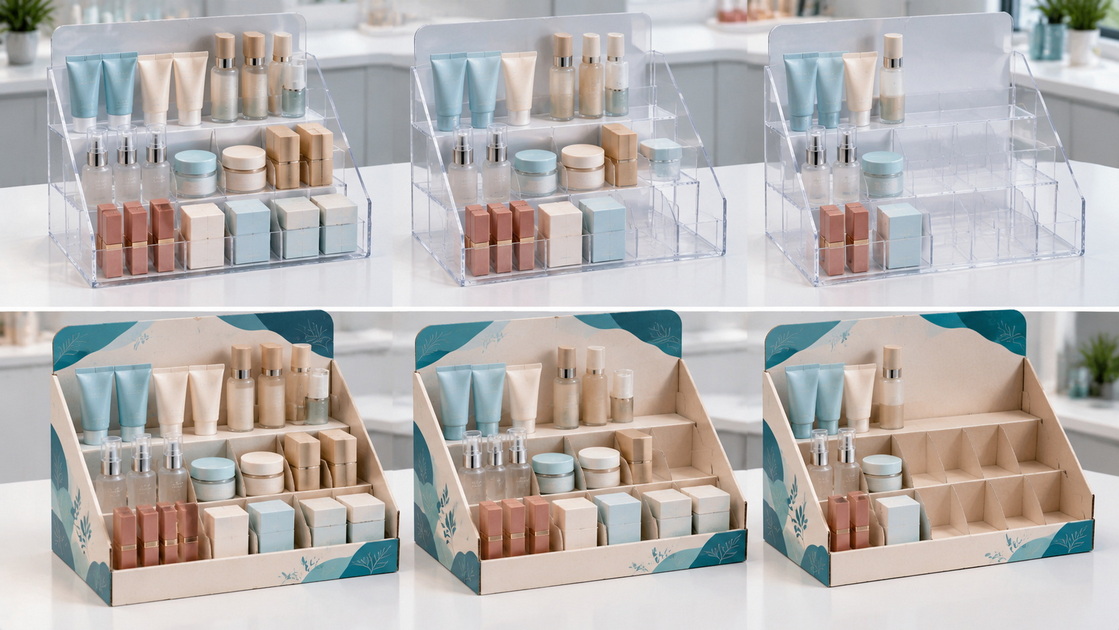
Use the same product assortment and functional requirements for both prototypes.
Specify store type, counter dimensions, duration, product quantities, cleaning, delivery format, and intended reuse.
Record polymer or board specifications, finishes, joints, inserts, and graphics. Require approval before substitutions.
Check loading, removal, replenishment, stability, relevant cleaning exposure, and packed transport.
Use equivalent quantities and service expectations. Separate confirmed costs from estimates.
Retain an approved sample and written criteria covering appearance, dimensions, assembly, and functional performance.
Do not approve an entire production order solely from a rendering.
Based on company-provided information, Long Win Display is a Chinese POP display designer and manufacturer offering customized cardboard displays and preassembly services.
Its relevant role is helping buyers develop and evaluate cardboard countertop formats for their actual products and retail conditions.
A useful project discussion should cover:
- Structural concepts.
- Product organization.
- Printed branding.
- Packing volume.
- Assembly requirements.
- Prototype validation.
- Production inspection.
No independently verified plastic manufacturing capability, comparative test result, or guaranteed sales uplift was supplied for this article.
If plastic or hybrid components are required, confirm whether they are available, who manufactures them, and how quality responsibilities are managed.
Choose a plastic counter display when its service life, cleaning compatibility, and realistic reuse justify the investment.
Choose a cardboard counter display when customization, campaign changes, efficient distribution, and a defined promotional life are priorities.
Potentially. Validate the completed structure with actual filled weights, realistic loading, and the intended service period. Avoid relying on a generic board thickness.
Not universally. Compatibility depends on the acrylic, concentration, exposure, stress, and other conditions. Follow material-specific guidance and validate the intended procedure.
Sometimes, with an appropriate design and maintenance plan. Assess spills, cleaning, replacement, and product retention separately from sealed-product display requirements.
No. Actual reuse, material quantity, transport, cleaning, and end-of-life affect the comparison. A reuse claim is not a life-cycle result.
Treat the change as a new validation step. Material substitutions can affect dimensions, graphics, assembly, cleaning, transport, and stability.
1. ACRYLITE. "What Chemicals Is ACRYLITE Acrylic Sheet Resistant To?" Manufacturer data explaining chemical-specific resistance and test conditions. It does not establish compatibility for every assembled fixture. [acrylite]
2. Billerud. "What Is Relative Humidity and How Does It Affect Your Boxes?" Explains moisture absorption and its influence on paper-based material strength. Box guidance is used for material context, not as a countertop load rating. [billerud]
3. FEFCO. "Testing Methods & Recommendations." Industry methods covering corrugated board properties, including water absorption and glue-bond water resistance. [fefco]
4. United Nations Environment Programme. "Single-Use Supermarket Food Packaging and Its Alternatives." Provides life-cycle assessment context. Its product-specific findings are not presented as cosmetic-display comparisons. [wedocs.unep]
5. Life Cycle Initiative. "Addressing Single-Use Plastic Products Pollution." Explains the significance of material weight, production, number of uses, and waste management in environmental comparisons. [lifecycleinitiative]
6. Long Win Display. Company background supplied for this article. Its cardboard display design, customization, production, and preassembly activities are company-provided information. No comparative material test results or verified customer case studies were supplied.
7. Editorial methodology. The campaign framework, depleted-stock checks, total-cost model, and prototype process are proposed procurement practices—not measured supplier performance or audited production procedures.


