
Views: 263 Author: Long Win Display Publish Time: 2026-11-07 Origin: Site


Content Menu
● Which Products Are Best Suited for Pharmacy Countertop Displays?
>> Lip Care and Small Personal Care Products
>> Skincare and Beauty Products
>> First-Aid and Selected OTC Products
● How to Select Products Before Designing the Stand
● Design Pharmacy Countertop Display Stands Around Real Shopping Tasks
>> Keep Packaging Visible Without Applying Arbitrary Percentages
>> Make the Last Products Easy to Retrieve
>> Use Simple, Accurate Header Messaging
● Protect Label Access and Pharmacy Service Areas
>> Preserve Access to Product Information
>> Keep Accessible Counters and Routes Clear
● Choose Materials and Printing for the Actual Campaign
● Plan Pre-Assembly, Packing, and Replenishment Together
>> Compare Flat-Pack and Pre-Assembled Delivery
>> Test the Complete Packed Configuration
● Validate Performance With a Small Store Pilot
● Turn Your Product Range Into a Retail-Ready Display
>> 1. What products work best in pharmacy countertop display stands?
>> 2. What size should a pharmacy countertop display be?
>> 3. Can cardboard displays hold bottles?
>> 4. Should pharmacy displays arrive pre-assembled?
>> 5. Can promotional graphics cover part of the product label?
The best products for pharmacy countertop display stands are compact, easy to identify, and relevant to everyday shopping needs. Lip care, travel-size personal care, selected skincare products, small first-aid packs, and appropriately approved over-the-counter products can all be suitable candidates. However, product size alone does not determine whether a display belongs on the counter.
A successful pharmacy display must help shoppers make informed choices without interrupting service. It should keep packaging readable, preserve access to payment equipment, and make replenishment straightforward.
At Long Win Display, our focus is designing, customizing, manufacturing, and pre-assembling countertop display stands around these practical requirements. The starting point is not simply how much merchandise a stand can hold. It is how well the complete unit works for shoppers, pharmacy staff, and the brand.

Start with products shoppers can recognize quickly and handle comfortably. Then check retailer approval, security requirements, packaging information, and expected replenishment.
The following categories provide a useful starting framework, not a universal sales ranking.
| Product Category | Suitable Examples | Recommended Display Features | Main Planning Concern |
|---|---|---|---|
| Lip care | Lip balms and packaged lip treatments | Shallow trays with individual channels | Small products disappearing behind tray walls |
| Personal care | Travel-size hand creams and hygiene products | Divided trays with stable bases | Leakage and mixed pack sizes |
| Skincare | Small moisturizers and packaged treatments | Stepped platforms or fitted inserts | Access to product information |
| First aid | Adhesive bandages and compact dressing packs | Open-front trays | Clear identification of pack contents |
| Oral care | Floss and travel-size toothpaste | Narrow compartments | Similar-looking product variants |
| Seasonal products | Small sunscreen packs and seasonal care items | Replaceable headers and modular inserts | Campaign timing and claim accuracy |
| Selected OTC products | Retailer-approved, compact medicine packs | Clearly separated compartments | Label reading and responsible placement |
Lip balms, hand creams, and travel-size essentials fit compact displays because their packaging allows multiple facings within a limited footprint.
Their main design challenge is visibility. A deep front wall may secure the products but hide the brand or variant.
Use a low front edge, shaped openings, or raised inserts where appropriate. Validate the design with actual samples rather than assuming one tray height suits every package.
Small skincare products can benefit from organized presentation, especially when several variants share similar packaging.
Separate compartments help shoppers distinguish products and give staff an obvious replenishment layout. For taller bottles, check stability as inventory falls. A stand that works when full may become unbalanced when only one side remains stocked.
Do not assume a premium appearance requires a complicated structure. Clean graphics, accurate color, and neatly fitted products often create a more convincing presentation.
Compact first-aid packs and selected OTC products may suit countertop merchandising when the retailer approves their placement.
However, medicine purchases require more care than ordinary impulse categories. Shoppers may need to compare active ingredients, warnings, directions, or age restrictions.
The stand should allow easy product removal and inspection. It should never imply that a product is suitable for everyone or replace guidance from a pharmacist.
My recommended approach is to evaluate the product and the retail location together. An attractive package can still be a poor countertop candidate if it needs excessive explanation or consumes space required for service.
Use these five screening questions:
1. Can shoppers identify the product and variant without moving several other packs?
2. Can they remove one unit without destabilizing the remaining stock?
3. Is the expected selling rate compatible with the available capacity?
4. Can staff replenish the stand without disrupting transactions?
5. Has the retailer approved the category, location, and promotional message?
Products that need refrigeration, special security, controlled access, or extensive consultation require a different placement assessment.
For supplements, avoid treating a countertop header as permission to simplify complex health claims. Keep promotional wording within the brand's approved claim set and obtain a market-specific review before printing.
The most useful design principle is clarity. Shoppers should understand what the product is, distinguish the available options, and see how to pick it up.
There is no single product-exposure percentage that guarantees an effective display.
Instead, identify the information shoppers need to recognize the product: brand, product name, size, variant, and any relevant front-panel statements. Position tray edges and inserts around those elements.
For a short tube, a raised platform may help. For a tall carton, a deeper compartment may provide better support.
Test visibility from several directions, including a seated position. A front-facing rendering alone cannot reveal every obstruction.
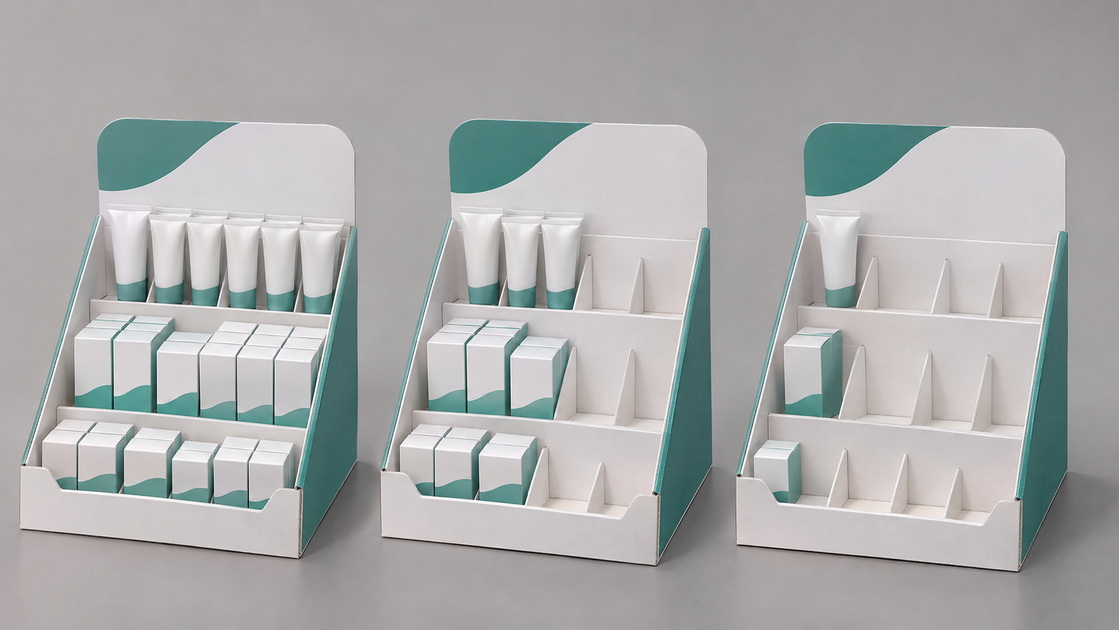
A display should work throughout its selling cycle, not only during the launch photograph.
Check three inventory conditions:
- Fully stocked.
- Approximately half stocked.
- Nearly empty.
Look for bottles tipping, packs slipping sideways, and rear products becoming difficult to reach. Dividers, stepped bases, or revised compartment depths may solve these problems without increasing the overall footprint.
Also check whether an almost-empty stand still looks intentional. A compact, well-organized presentation can be preferable to excessive opening stock.
A pharmacy countertop display does not need to tell the entire brand story.
Give the header one clear job: identify the category, introduce the range, or communicate an approved offer.
Keep prices and variant names easy to associate with the correct products. Avoid decorative text that competes with essential information.
A useful practical test is to show the loaded prototype to someone unfamiliar with the range. Ask them to identify the products and find a specific variant. Their hesitation reveals problems that internal teams may overlook.
Pharmacy merchandising operates in a health-related environment. Appearance matters, but it should not compromise informed selection or access to services.
In the United States, OTC medicines generally use standardized Drug Facts labeling. Dietary supplements use a different information format, including a Supplement Facts panel.
Display design should respect that distinction.
Shoppers should be able to remove and rotate packages to inspect relevant information. Avoid tight openings that damage cartons or require excessive force.
Sunscreen deserves particular attention because it is regulated as an OTC drug in the United States. Use approved product wording rather than inventing stronger protection claims for the display.
Requirements vary by destination market. Obtain the appropriate brand, retailer, and regulatory approvals before production.
Countertop displays must not occupy space needed for accessible service, payment, or customer movement.
Before approving placement, check:
- The designated accessible counter area.
- Access to card readers and signature devices.
- Staff visibility across the counter.
- Space for product handover.
- Nearby customer routes and queue movement.
- Privacy during pharmacy conversations.
Do not apply a universal "eye-level" height to every location. Counter heights, shopper needs, and service functions differ.
A display that attracts attention but obstructs a transaction is not a successful retail solution.
Material selection should reflect campaign duration, product weight, cleaning expectations, and distribution conditions.
| Material | Potential Application | Important Limitation |
|---|---|---|
| Corrugated board | Temporary promotions and lightweight product ranges | Needs validation against loading, moisture, and handling |
| Folding paperboard | Small, lightweight countertop units | May need reinforcement |
| Acrylic | Longer-term presentation where cleanability matters | Surface marking and transport protection need consideration |
| Metal | Durable fixtures and heavier merchandise | Weight and logistics can increase |
| Mixed materials | Projects needing a balance of presentation and support | Assembly and end-of-life separation become more complex |
For paper-based displays, board specification alone does not establish the finished stand's load capacity. Geometry, joints, inserts, and product distribution also matter.
Likewise, neither process printing nor spot colors are automatically right for every design. Photographic artwork, solid brand colors, substrate choice, and printing method influence the decision.
Approve a physical sample using the intended material and finish. Review it under lighting representative of the destination store, not only on a screen.
A countertop stand has two jobs: survive distribution and perform in the store.
Those jobs should be engineered together.
Flat-packed displays can reduce shipping volume, but staff must assemble them correctly.
Pre-assembled units can simplify store setup, although their larger shipping volume and protection requirements may increase logistics costs.
Product-loaded delivery introduces additional considerations, including stock accountability, expiry dates, pack movement, and responsibility for damaged merchandise.
Compare total program cost rather than display price alone:
- Manufacturing.
- Assembly labor.
- Packing materials.
- Freight and storage.
- Store setup.
- Replenishment.
- Damage and replacement.
The best option depends on the distribution route and retailer workflow.
A display prototype should be assessed with representative products and the proposed shipping protection.
Check movement inside the carton, pressure on headers, contact with product labels, and damage around load-bearing joints.
Choose transport testing appropriate to the shipping route with a qualified packaging specialist. A successful static load check does not establish performance during handling and distribution.
For replenishment, define which products belong in each compartment. Simple compartment markings or a clear loading diagram can help maintain the intended presentation.

Before a larger rollout, test a limited number of locations where practical.
This pilot is not just a sales exercise. It should reveal whether the display fits, remains stocked, and works during normal pharmacy operations.
Record:
1. Setup time and assembly errors.
2. Actual placement versus the approved location.
3. Product availability during the selling period.
4. Units sold per store per week.
5. Damage, stability, and cleaning issues.
6. Staff observations about replenishment and service interference.
Interpret results carefully. Higher sales may reflect pricing, seasonality, store traffic, or better stock availability rather than display design alone.
Where possible, compare similar stores over the same period and document promotional differences.
Collect feedback systematically instead of relying on a single enthusiastic comment. Ask staff what slowed them down and ask shoppers which variants were difficult to distinguish.
Only publish customer quotations with permission and accurate context.
An effective pharmacy countertop display stand combines suitable products, readable packaging, stable construction, and a practical store workflow.
Long Win Display supports brands with custom design, manufacturing, and pre-assembly tailored to their product range and retail requirements.
Compact lip care, personal care, skincare, oral care, and first-aid products are useful candidates. Selected OTC products may also fit when the retailer approves placement and shoppers can inspect the packaging easily.
There is no universal size. Base the footprint on the approved location, product dimensions, required capacity, and service clearance. Validate the loaded prototype at a representative counter.
Yes, when the structure is engineered for the actual load. Bottle weight, compartment layout, reinforcement, and distribution conditions all affect performance. Test the complete loaded stand.
Pre-assembly can reduce store setup work, but it may increase shipping volume. Compare freight, protection, assembly labor, and retailer handling before choosing.
Avoid designs that prevent identification or make important information difficult to inspect. Confirm that shoppers can remove and examine each package, and obtain the required market-specific approvals.
1. PopDisplay. "Products Best Suited for Pharmacy Displays?" Original article reviewed for topic coverage, design recommendations, and evidence gaps. Its specific visibility percentages, height rules, and guaranteed outcomes are not adopted as universal standards here. [popdisplay]
2. U.S. Food and Drug Administration. "The Over-the-Counter Drug Facts Label." Explains standardized OTC medicine information and distinguishes Drug Facts labeling from dietary supplement labeling. [fda]
3. U.S. Food and Drug Administration. "Sunscreen: How to Help Protect Your Skin from the Sun." Supports the discussion of sunscreen regulation, label information, and protection terminology. [fda]
4. U.S. Food and Drug Administration. "Labeling and Effectiveness Testing: Sunscreen Drug Products for Over-the-Counter Human Use—Small Entity Compliance Guide." Provides context for sunscreen labeling and substantiated product claims. [fda]
5. U.S. Department of Justice. "ADA Update: A Primer for Small Business." Addresses accessible routes, merchandise placement, service counters, and maintaining unobstructed access. [ada]
6. U.S. Department of Justice. "2010 ADA Standards for Accessible Design," Sections 227 and 904. Provides the underlying requirements for checkout aisles and sales and service counters. [ada]
7. U.S. Department of Justice. "Guidance on the 2010 ADA Standards for Accessible Design." Explains accessible counter use and the need to keep required areas clear of merchandise and equipment. [ada]


