
Views: 216 Author: Long Win Display Publish Time: 2026-11-21 Origin: Site


Content Menu
● PDQ Display vs Dump Bin: The Essential Differences
● What Is a PDQ Display for Snack Promotions?
>> Where PDQ Snack Displays Work Best
>> What Makes a PDQ Truly Retail-Ready?
● What Is a Dump Bin for Snack Promotions?
>> Where Snack Dump Bins Work Best
>> When a Dump Bin Becomes a Poor Fit
● Product Protection and Shopping Experience
>> Compare Package Behavior, Not Just Product Category
>> Design for Partial Depletion
● Branding, Pricing, and Assortment Control
>> PDQ Displays Support Structured Communication
>> Dump Bins Need a Simple Promotional Message
● Comparing Total Cost, Not Just Display Price
>> A Hypothetical Break-Even Example
● A Practical Method for Sizing Snack Displays
● How to Test PDQ Displays and Dump Bins Before Production
>> Validate the Loaded Structure
>> Match Transport Testing to the Distribution Route
● Run a Fair Retail Pilot Before Scaling
● Custom Snack Display Planning with Long Win Display
>> 1. Is a PDQ display always better for checkout snacks?
>> 2. Can fragile snack bags go in a dump bin?
>> 3. Can one display hold several snack flavors?
>> 4. Is a prefilled PDQ cheaper to ship?
>> 5. Which format is easier to replenish?
Choosing a PDQ display vs dump bin for snack promotions comes down to how your products should be presented, protected, and replenished. A PDQ display generally suits organized, branded merchandising on shelves or counters. A dump bin suits loose-placement promotions where accessible stock and a strong volume message matter more than precise product alignment.
Neither format automatically generates better sales. The right choice depends on snack packaging, approved retail space, campaign economics, and store execution.
At Long Win Display, our approach to custom cardboard display stands starts with these practical questions—not simply the shape of the fixture. This guide explains how to compare both options and build a more effective snack promotion.
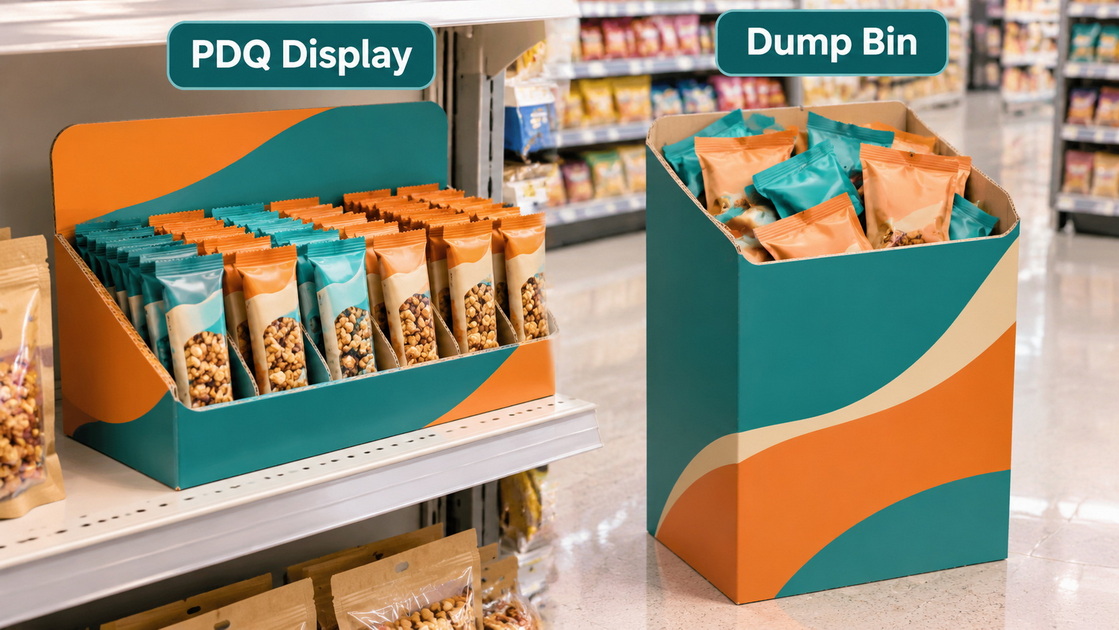
For this comparison, "PDQ display" means a compact, display-ready corrugated tray or box used on a shelf, counter, or supporting fixture. A dump bin means an open-top merchandising container, usually floor-standing, holding individually packaged products in a relatively loose arrangement.
| Comparison factor | PDQ display | Dump bin |
|---|---|---|
| Presentation | Organized rows, compartments, or facings | Loose, accessible product assortment |
| Typical location | Shelf, counter, checkout, or display base | Approved promotional floor space |
| Suitable snacks | Bars, small cartons, portion packs | Durable candy packs, snack pouches, value packs |
| Main strength | Brand and assortment clarity | Capacity and browsing accessibility |
| Main limitation | Restricted capacity within a compact footprint | Less control over product orientation |
| Replenishment | Replace trays or refill defined positions | Refill the container and manage stock rotation |
| Critical design issue | Pack fit and front-panel visibility | Reach depth, loading, and stability |
These are starting points rather than fixed rules. A reinforced PDQ can hold substantial weight, while a compartmented dump bin can provide more organization than an undivided container.
PDQ is commonly associated with "pretty darn quick," reflecting rapid retail setup. The term describes a merchandising approach rather than one universal construction.
Some PDQ displays arrive prefilled inside protective shipping packaging. Others arrive empty and require loading. Do not assume every PDQ is also a shipping case.
A snack PDQ display is worth considering when shoppers need to recognize differences quickly.
Examples include:
- Protein bars organized by flavor.
- Premium confectionery with distinctive packaging.
- Small snack cartons requiring upright presentation.
- New products whose front panels explain their benefits.
- Checkout promotions with tightly controlled dimensions.
Dividers can maintain separation, but they should solve a real problem. Unnecessary partitions add material, assembly steps, and packing complexity.
Retail-ready packaging should simplify identification, opening, merchandising, shopping, and disposal.
For a snack promotion, that translates into practical details: clear case identification, intuitive opening, clean display edges, visible products, and straightforward breakdown after use.
A display that looks attractive but requires repeated rearrangement has not fully solved the retail task.
A cardboard dump bin is an open container designed for accessible, relatively high-volume merchandising. It can include a printed header, internal supports, partitions, or a raised platform.
"Dump" describes the presentation style. It should not mean careless handling or uncontrolled filling.
Dump bins can suit:
- Individually wrapped confectionery.
- Durable snack pouches.
- Seasonal promotional assortments.
- Value packs with clear pricing.
- Products shoppers can identify without seeing a perfectly aligned front panel.
The strongest applications tolerate loose placement without losing their appeal or suffering unacceptable damage.
Think carefully before choosing a deep bin for fragile chips, delicate biscuits, or crush-sensitive cartons.
The issue is not simply whether the packaging fits. Products near the bottom may carry accumulated weight, while shoppers may squeeze or move packs to reach another item.
A raised internal platform can reduce effective depth. However, its supports must carry the specified load reliably.
Two snack pouches with identical dimensions may behave differently. One stands upright; another collapses. One tolerates stacking; another protects a fragile product poorly.
Before selecting a format, check:
1. Filled dimensions, including seals and bulges.
2. Actual unit weight.
3. Resistance to compression and abrasion.
4. Whether the pack stands without support.
5. Which panel shoppers must see.
6. How easily one pack can be removed.
A PDQ often offers better presentation control. A dump bin offers more freedom of placement, but that freedom requires stronger attention to package durability.
The full display is only the beginning of the shopper experience.
Evaluate prototypes when full, half-full, and nearly empty. These are proposed review conditions, not universal industry thresholds.
In a PDQ, check whether remaining packs fall forward or disappear behind the front lip. In a dump bin, check whether the final products remain visible and comfortably reachable.
A display that performs well only when freshly stocked is an incomplete design.
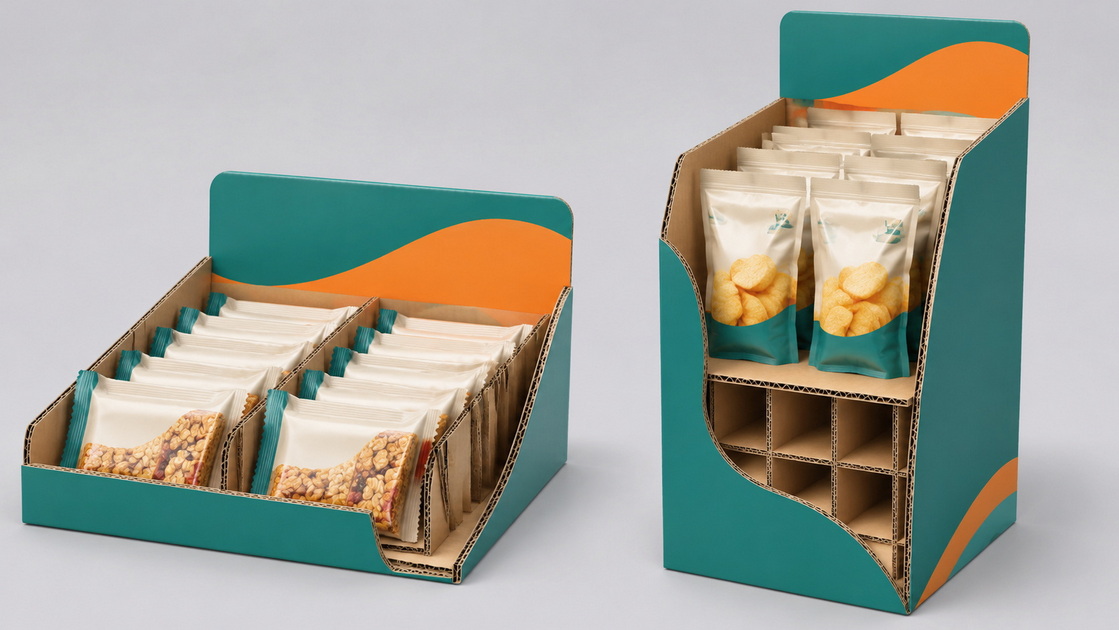
A PDQ can create a clear sequence: brand, product type, flavor, and price.
Keep the front panel low enough to reveal important packaging information. If the display hides the product's main selling message, adding more graphics rarely fixes the underlying problem.
For unfamiliar snacks, a short product explanation may be more useful than several competing promotional claims.
Dump bins generally benefit from communication shoppers can understand at a glance.
Use a clear campaign theme, recognizable branding, and an unambiguous price message. If products have different prices, provide distinct compartments and corresponding labels—or reconsider the mixed assortment.
One large price sign above several differently priced products creates avoidable confusion.
Neither format guarantees impulse purchases. Placement, product appeal, availability, and promotional pricing still influence results.
A cheaper cardboard display can become more expensive once packing, shipping, replenishment, and damage enter the calculation.
Compare both formats using the same campaign scope.
| Cost component | Questions to ask |
|---|---|
| Display production | What structure, printing, and quantity are included? |
| Packing labor | Who assembles and loads the display? |
| Freight | Does it ship flat, assembled, or prefilled? |
| Store execution | How long do opening, placement, and refilling take? |
| Product loss | What damage or markdown allowance is realistic? |
| Disposal | How easily can staff separate and flatten components? |
Suppose a PDQ program costs $24 per store and a dump bin program costs $34, including the campaign-specific costs being compared.
The difference is $10. If each additional snack sold contributes $0.50 after variable costs, the dump bin needs 20 additional sales per store to recover that difference.
These figures are illustrative—not quotations, benchmarks, or Long Win Display customer results.
The useful principle is to compare additional contribution with additional campaign cost, rather than choosing whichever fixture holds more products.
Capacity should follow the replenishment plan, not the assumption that more stock is always better.
Start with:
Target capacity = expected daily sales × days between replenishment + agreed buffer.
Then check whether the resulting quantity creates acceptable product pressure, reach depth, display weight, and shipping dimensions.
For a PDQ, arrange real packs to establish usable rows and facings. For a dump bin, conduct a physical fill trial; irregular flexible packaging makes simple volume calculations unreliable.
Also distinguish storage capacity from shoppable capacity. Products that technically fit but cannot be reached or identified do not improve the promotion.
Review the display with actual snack packs whenever possible.
Check:
- Base and platform deflection.
- Stability during product removal.
- Divider movement.
- Pack snagging and sharp contact points.
- Header security.
- Assembly accuracy.
- Performance under expected storage conditions.
Specify board grade and reinforcement through structural requirements and testing—not through a blanket assumption that one flute type suits every snack campaign.
A prefilled display must protect both its structure and its contents during distribution.
ISTA provides different test procedures for different transport environments. Procedure 3A addresses individual parcel shipments, while Procedure 3E addresses qualifying unitized full-truckload shipments.
Neither should be selected simply because it is familiar. Ask the packaging team or laboratory to match the procedure to the actual route and retailer requirements.
Transit testing also does not replace in-store stability and usability checks.
A controlled pilot is more useful than an unsupported claim that either format "increases sales."
Where feasible, compare stores with similar sales patterns and keep product, price, promotional period, and placement conditions consistent.
Track:
- Units sold per store per day.
- Contribution after display-related costs.
- Setup and replenishment time.
- Out-of-stock periods.
- Damaged or unsellable packs.
- Compliance with the intended placement.
- Appearance as stock depletes.
Location is an important limitation. A checkout PDQ and an entrance dump bin differ in both format and shopper exposure.
If placement cannot be matched, report the result as a comparison of complete merchandising programs—not proof that one structure alone caused the difference.
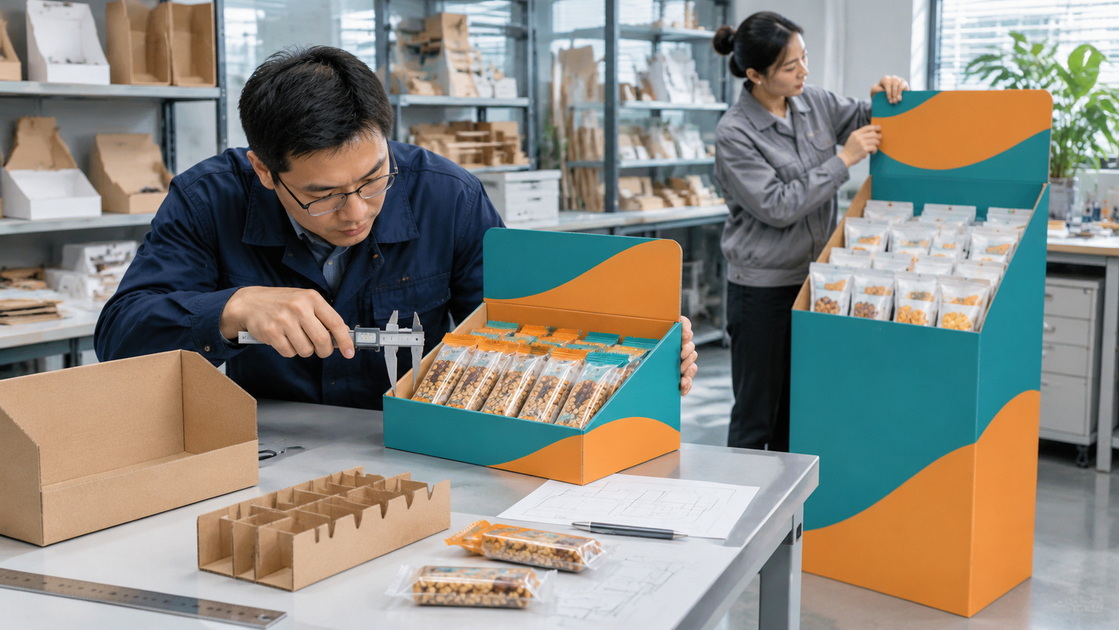
As a China-based POP display designer and manufacturer, Long Win Display supports custom cardboard display development and preassembly.
For a useful project brief, provide:
1. Snack samples or accurate filled-pack specifications.
2. Target retailer and approved placement.
3. Maximum footprint and height.
4. Intended capacity and campaign duration.
5. Shipping and loading arrangements.
6. Artwork, price communication, and assortment details.
Our design perspective is straightforward: choose the structure around the product and retail workflow, then develop the graphics around that structure.
Discuss preassembly and prefilling separately. An assembled display is not necessarily product-filled, and food loading arrangements require their own scope and handling requirements.
No. It is often suitable for compact, organized presentation, but the retailer's approved dimensions and checkout arrangement come first. Some locations do not permit additional fixtures.
Possibly, but validate them through loading and handling trials. Shallower filling, partitions, or a raised platform may help. A structured tray may remain the safer option.
Yes. PDQ dividers can maintain clear flavor positions. Dump bins can use compartments, but loose mixed assortments become harder to navigate when packaging and prices differ.
Not necessarily. Prefilling may reduce store handling while increasing shipped volume or protective-packaging needs. Compare the complete packed configuration rather than the empty display.
A PDQ can simplify replacement when stocked trays are ready. A dump bin can accept loose replenishment quickly, but staff still need to manage presentation and stock rotation.
1. [Smurfit Westrock — Shelf Ready Packaging / Retail Ready Packaging]. Manufacturer guidance on shelf-ready formats, easy opening, product protection, and stocking efficiency. [us.smurfitwestrock]
2. [Smurfit Kappa — Retail Ready Packaging]. Explains the five practical requirements: identification, opening, merchandising, shopping, and disposal. [smurfitkappa]
3. [Topwell Display — Cardboard Snack Displays: How to Choose the Right Format for Retail Promotions]. Industry supplier perspective on PDQ applications, dump bins, presentation control, and snack crush risk. [topwelldisplay]
4. [International Safe Transit Association — Test Procedures]. Primary guidance explaining transport simulation procedures and their different applications. [ista]
5. [International Safe Transit Association — Procedure 3A Overview]. Defines parcel-delivery testing scope and the evaluation of the package and product together. [ista]
6. [International Safe Transit Association — Procedure 3E Overview]. Defines testing for qualifying unitized full-truckload shipments and discusses load stability and distribution hazards. [ista]


