
Views: 288 Author: Long Win Display Publish Time: 2026-09-13 Origin: Site


Content Menu
● PDQ Display Tray vs Counter Display
>> How PDQ Display Trays Support Impulse Buying
>> Why Counter Displays Can Convert at Checkout
● PDQ Tray vs Counter Display: Which One Fits Your Product?
>> Choose a PDQ Display Tray When You Need Speed and Capacity
>> Choose a Counter Display When Checkout Conversion Matters Most
● The Real Cost Comparison: Unit Price Is Not the Whole Story
● Engineering Differences That Buyers Often Miss
>> PDQ Tray Engineering Priorities
>> Counter Display Engineering Priorities
● The Hidden Risk: Designing for a Full Display Only
● How to Select the Right Format: A Buyer Decision Process
>> 1. Define the Shopper Moment
>> 2. Define Product Economics
>> 3. Define Retail Labor Requirements
>> 4. Request a Structural Sample
>> 5. Measure Results After Launch
● Long Win Display: From Retail Concept to Ready-to-Sell Display
>> 1. Is a PDQ display tray the same as a counter display?
>> 2. Which display is better for impulse purchases?
>> 3. What products work best in a PDQ tray?
>> 4. How do I prevent a cardboard counter display from tipping?
>> 5. Can PDQ trays be shipped pre-loaded with products?
PDQ display trays and counter displays can both support impulse purchases, but they solve different retail problems. A PDQ display tray is usually the stronger choice for fast shelf replenishment and pre-packed product presentation, while a counter display is better when checkout visibility, compact space, and last-second add-on purchases are the priority.
For brands selling snacks, cosmetics, batteries, personal-care items, travel-size products, stationery, small electronics, or seasonal accessories, the decision affects more than appearance. It changes retail labor, product capacity, shipping efficiency, merchandising consistency, display cost, and conversion opportunity.
At Long Win Display, we design, customize, manufacture, and pre-load cardboard display stands for retail programs. In practical projects, we find that the best format is rarely determined by one question such as "Which display looks better?" The more useful question is: Where will the shopper see the product, how quickly must store staff deploy it, and how much product must the display carry?
This guide compares PDQ display trays and counter displays from the viewpoint of retail buyers, brand managers, packaging engineers, and global procurement teams.
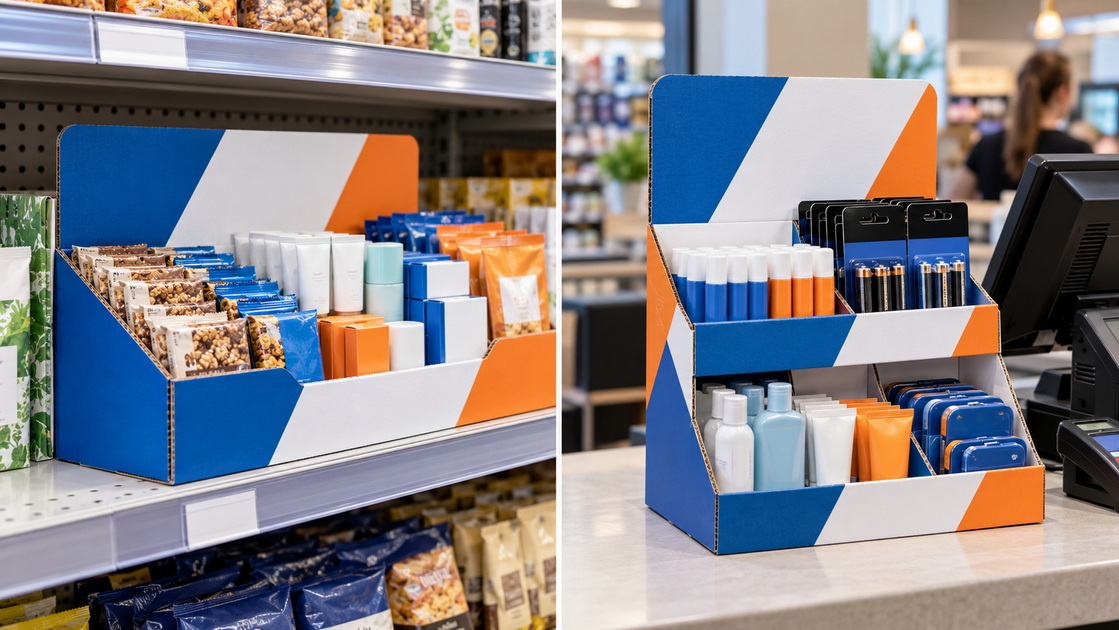
| Feature | PDQ Display Tray | Counter Display |
|---|---|---|
| Main Retail Location | Shelf, endcap, promotional aisle, club-store fixture, or checkout area | Checkout counter, service desk, cash wrap, pharmacy counter, or small retail counter |
| Primary Purpose | Fast replenishment and retail-ready product presentation | Last-second impulse purchase and high-visibility product exposure |
| Typical Product Type | Snacks, beverages, cosmetics, household goods, electronics accessories, packaged consumer goods | Lip balm, candy, batteries, travel-size products, gift cards, small accessories, samples |
| Product Capacity | Medium to high | Low to medium |
| Setup Method | Usually pre-filled and shelf-ready | Usually pre-assembled or quickly placed on a counter |
| Retail Labor Requirement | Low when supplied as a ready-to-place tray | Low, but may require periodic replenishment |
| Shipping Efficiency | Often efficient when trays are stacked, nested, or flat-packed | Can be less efficient if the display is bulky or fully assembled |
| Shopper Interaction | Browsing, selection, product comparison, stock replenishment | Quick visual cue and immediate add-on decision |
| Best For | High-volume promotional products and organized shelf placement | Small, high-margin, low-consideration impulse products |
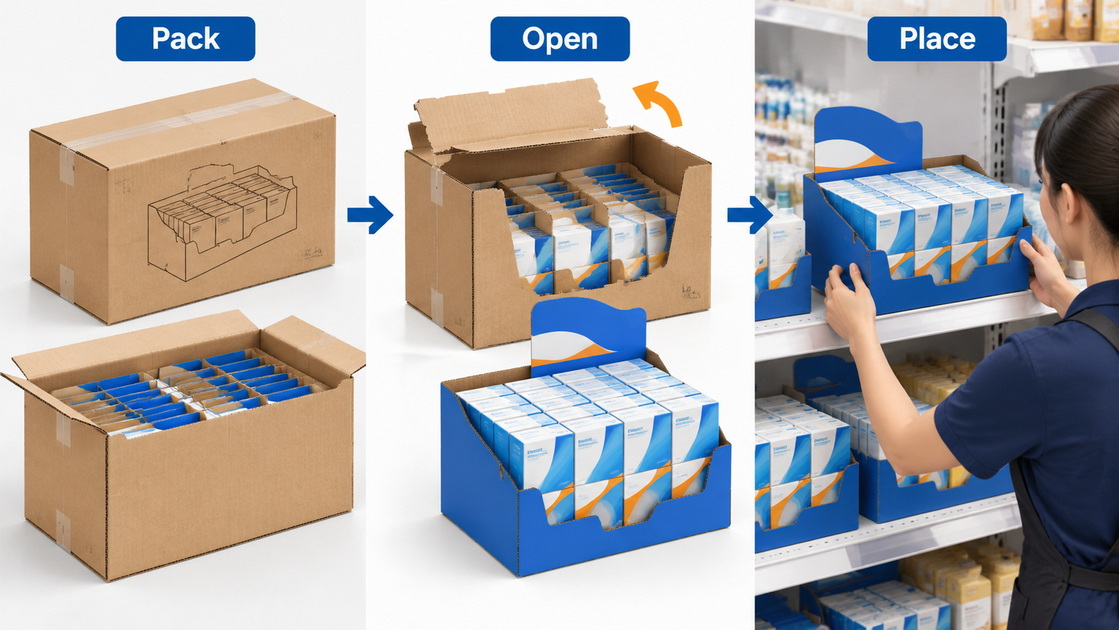
A PDQ display tray is a compact, pre-filled, retail-ready unit that combines transport packaging and merchandising. The term PDQ is commonly interpreted as "Pretty Darn Quick," reflecting the goal of moving products from a delivery carton to the retail shelf with minimal handling.
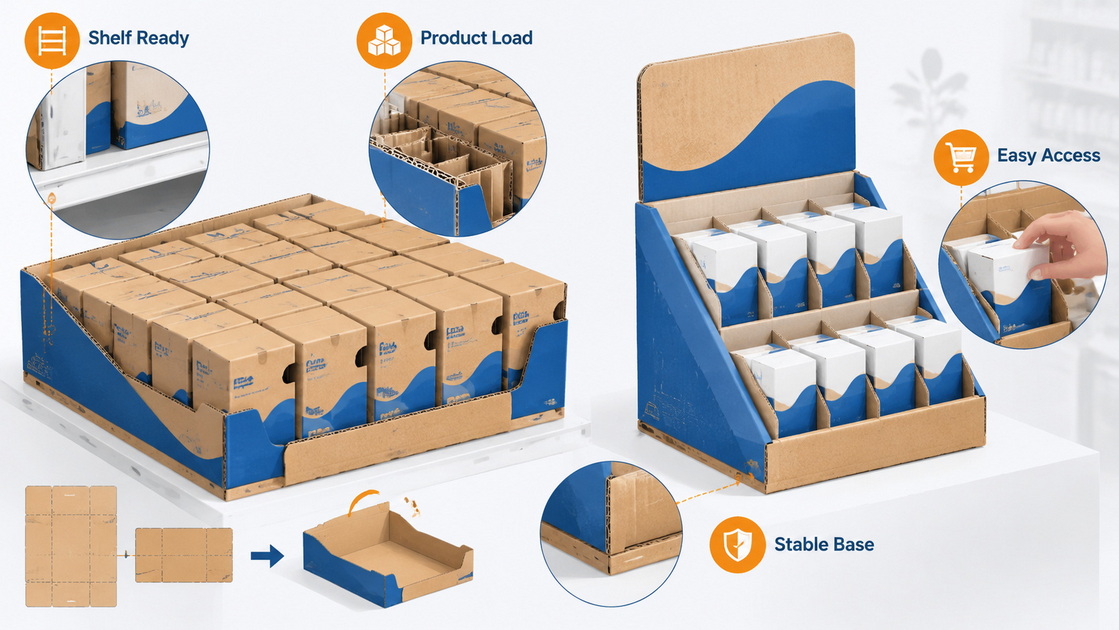
Unlike a standard shipping carton, a PDQ tray is designed to remain visible after opening. It may include a low front wall, side panels, a printed header card, internal dividers, tear-away outer packaging, or stackable components.
Long Win Display's product range includes PDQ units, cardboard counter displays, pallet displays, floor displays, and related retail-display formats. The company describes PDQ as a compact display category designed for rapid deployment in standardized shelving and checkout environments.
A PDQ display tray makes it easier for retailers to place branded products into a high-traffic area without unpacking each individual item.
This format can support impulse purchase behavior because it:
- Keeps products organized and easy to pick up
- Creates a dedicated branded block on a shelf
- Reduces the visual clutter of loose products
- Lets a retailer replenish stock quickly
- Combines shipping and merchandising functions
- Allows the brand to use headers, color blocks, and simple price messages
- Works well for temporary promotions and seasonal launches
Industry sources describe PDQ displays as shelf-ready units that can support fast stocking, checkout merchandising, impulse-purchase promotion, and on-shelf organization.
However, a PDQ tray does not automatically increase sales simply because it exists. Research on point-of-purchase displays shows that display results depend on placement, shopper attention, product category, and how the display changes the shopper's ability to compare alternatives. In one real-market wine promotion study, a special POP display reduced sales of the featured wines because the regional grouping made comparison with competing products easier.
That is an important lesson for buyers: a display should simplify the purchase decision, not create additional decision friction.
A counter display is a small retail display placed on or near a checkout counter, service desk, cash wrap, pharmacy counter, café counter, or customer-service area. It is designed to attract attention during a short waiting period—often when the shopper has already decided to buy other items.
Counter displays are typically used for products that are:
- Small and lightweight
- Easy to understand quickly
- Affordable enough for an unplanned purchase
- Easy to carry after checkout
- Frequently replenished
- Suitable for visual browsing at close range
Common examples include confectionery, gum, lip balm, hand sanitizer, travel-size beauty products, batteries, charging cables, keychains, small toys, gift items, sunglasses, and seasonal accessories.
The strongest advantage of a counter display is proximity to the payment moment.
At checkout, shoppers may be waiting, scanning nearby products, and considering small additions to their basket. A compact display that clearly shows the product, price, benefit, or promotion can create a low-friction purchase opportunity.
Retail-display guidance commonly recommends high-traffic and checkout placement for inexpensive, easy-to-understand products. It also advises keeping messages clear, limiting clutter, and using visual contrast to help products stand out.
A counter display works best when it follows three principles:
1. The product is visible immediately. Shoppers should not need to search through deep trays or dense graphics.
2. The decision is simple. The display should communicate one core benefit, one offer, or one use case.
3. The product is easy to take. If the shopper must lift a heavy package, untangle products, or ask for help, impulse conversion can decline.

The most important difference is not the material. Both can be made from corrugated cardboard, folding carton board, litho-laminated board, or a hybrid construction. The real difference is the retail job the display must perform.
A PDQ display tray is usually the right choice when your product must move efficiently from a carton to a shelf, endcap, or promotional location.
Choose a PDQ tray if you need:
- A pre-packed retail-ready packaging solution
- Medium or high product capacity
- Fast store replenishment
- Simple placement on standard shelves
- Product organization by SKU, color, flavor, or size
- A display that can be stacked or placed in multiple retail zones
- Reduced store labor
- A shipping-and-display hybrid for temporary campaigns
PDQ trays are especially useful for products sold in quantity, including snack bars, confectionery, packaged food, cosmetics, household items, batteries, tools, cables, stationery, and health-and-beauty items.
Stackable PDQ trays can also operate as individual units, countertop trays, components within a pallet display, or modular display systems with a pallet skirt.
A counter display is usually the better choice when product visibility at the point of payment matters more than carrying a large number of units.
Choose a counter display if you need:
- Checkout-area exposure
- A compact footprint
- A focused display for one hero product or a small SKU range
- A high-margin add-on product
- A display near a cashier, service desk, or pharmacy counter
- Frequent manual replenishment
- A premium visual presentation at close range
- A seasonal, promotional, or sampling-focused unit
Counter displays are effective for products that need little explanation. If a shopper can understand the item, price, benefit, and use in a few seconds, a counter display has a stronger chance of triggering an unplanned purchase.
Many buyers compare PDQ trays and counter displays only by factory price. That is incomplete.
The correct comparison should include total retail deployment cost.
| Cost Factor | PDQ Display Tray | Counter Display |
|---|---|---|
| Structural material cost | Often lower per unit for standard tray formats | Can be higher if the design needs premium finishing or complex geometry |
| Product capacity | Usually higher | Usually lower |
| Store setup labor | Very low when pre-filled | Low, but replenishment can be more frequent |
| Shipping efficiency | Strong for stackable and flat-packed designs | Depends heavily on display shape and assembly method |
| Retail footprint cost | Uses shelf or promotional space | Uses limited counter space, often highly controlled |
| Replenishment labor | Efficient if replacement trays are ready | Can require loose-product replenishment |
| Brand visibility | Moderate to high, depending on location | High at close range but limited by counter space |
| Campaign flexibility | Strong for shelf, aisle, and promotional deployment | Strong for checkout and localized activation |
A PDQ tray may cost more than a plain shipping carton, but it can reduce store handling and improve merchandising consistency. A counter display may have lower product capacity, but it can earn its space when the product has a strong margin and a simple purchase trigger.
The right calculation is:
Display Value=Incremental Sales Margin−Display Cost−Retail Labor Cost−Damage and Waste Cost
Do not evaluate the display solely on how many products it holds. Evaluate whether it helps the retailer sell the right products with less labor and fewer replenishment problems.
From a structural-design perspective, PDQ trays and counter displays require different assumptions.
For PDQ trays, the main concerns are often:
- Product weight per tray
- Tray-wall height
- Tear-away carton design
- Shelf depth and width
- Stackability
- Product-facing count
- Front-panel visibility
- Shelf-edge compatibility
- Compression strength during shipping
- Easy opening by store staff
- Consistent product arrangement after transport
A tray may appear stable when empty but bow after products are loaded. This is why manufacturers should know the unit weight, total tray weight, number of facings, product dimensions, and shipping method before selecting board grade.
For counter displays, the key risks are different:
- Counter footprint
- Center of gravity
- Tipping resistance
- Display height
- Shopper reach
- Product removal sequence
- Visual clutter
- Cashier sight lines
- Theft or accidental displacement
- Refill method
- Compatibility with retailer counter policies
A counter display must be stable even when partly empty. This issue is frequently ignored. A full display can be balanced, but once shoppers remove products from one side, its center of gravity may shift.
Expert recommendation: Ask the manufacturer to test the display in three states: fully loaded, half loaded, and nearly empty. A display that only works when full is not retail-ready.
One of the most overlooked issues in impulse-display design is partial depletion.
Most 3D renderings show a fully stocked display. That is not how the display will look for most of its store life.
When half the products are sold:
- A PDQ tray may look empty, reducing perceived demand.
- Loose products may slide forward or fall sideways.
- A counter display may become unbalanced.
- Dividers may become more visible than the products.
- The shopper may assume the remaining items are unwanted or damaged.
- The display may stop communicating the intended product message.
To avoid this, ask your display manufacturer to design for the "last 30% of stock," not only the first day of the campaign.
Practical solutions include:
- Angled tray bases that move products forward
- Adjustable dividers
- Low front walls that keep products visible
- Strong side walls that maintain shape
- Modular refill packs
- False-bottom systems where retailer rules allow them
- Counter-display bases with wider support geometry
- Product-facing limits that avoid over-deep trays
This is a small engineering detail with major commercial value. A display should remain visually credible until replenishment—not only when it leaves the factory.
Use this five-step process before sending an RFQ.
Ask where the shopper will see the product:
- On a regular shelf?
- At checkout?
- On an endcap?
- Near a complementary product?
- In a pharmacy or service area?
- In a convenience store?
- At a seasonal promotional table?
A PDQ tray is normally stronger for shelf-based convenience. A counter display is normally stronger for payment-stage visibility.
Review:
- Retail price
- Gross margin
- Unit weight
- Pack size
- Purchase frequency
- Product fragility
- Target number of facings
- Expected promotional duration
Low-priced and lightweight items often suit counter displays. Higher-volume products or multi-unit packs often suit PDQ trays.
Ask the retailer:
- Will staff place a pre-loaded tray directly on the shelf?
- Is counter space available?
- Who replenishes the display?
- Can staff assemble a display?
- Are there limits on display height or footprint?
- Does the retailer require recyclable or easily separable materials?
A PDQ display tray often wins where retailers want low-touch replenishment. Industry sources emphasize that PDQ units are intended to reduce handling by allowing product-filled trays to move directly into a retail setting.
For a new display, request:
- White sample for size, fit, and stability
- Printed sample for graphics, color, and product visibility
- Loaded sample for real product weight
- Partial-load test
- Shipping-carton test
- Final golden sample for mass-production inspection
Track more than sales. Monitor:
- Units sold per store per week
- Sell-through rate
- Replenishment frequency
- Display damage rate
- Store compliance rate
- Out-of-stock events
- Product shrinkage
- Staff feedback
- Retailer acceptance
- Display removal date
This creates evidence for the next campaign. Instead of relying on subjective opinions, the brand can compare display formats using actual store performance.
Long Win Display is a China-based POP display designer and manufacturer with more than 20 years of experience in display design. The company offers cardboard display stands, counter displays, pallet displays, PDQ displays, display boxes, gift boxes, and pre-loading services, while also coordinating semi-permanent and permanent materials through partner factories.
For brands deciding between a PDQ display tray and a counter display, Long Win Display can support the full development sequence:
- Product and retail-placement review
- Display structure recommendation
- CAD dieline development
- White sample and prototype
- Print and finish selection
- Corrugated-board and load-bearing recommendation
- Production and quality control
- Flat-packed, pre-assembled, or pre-loaded configuration
- Export packing and logistics optimization
The company states that it operates more than 10 production lines, has a thorough QC procedure, and focuses on reducing material waste and packing volume to help customers control raw-material and logistics costs. Its public profile also lists experience supporting brands entering retailers including Walmart, Costco, Woolworths, Coles, Tesco, 7-Eleven, and Circle K.
No. A PDQ display tray is usually a pre-packed, shelf-ready unit that can be placed on a shelf, endcap, or promotional fixture with minimal handling. A counter display is specifically designed for compact placement near checkout counters, service desks, or cash-wrap areas. Some PDQ trays can be used on counters, but the formats are not automatically interchangeable.
Neither format is universally better. A PDQ display tray is better for organized shelf placement, fast restocking, and medium-to-high product volume. A counter display is better for small, low-consideration, high-margin products that benefit from checkout visibility.
PDQ trays are commonly used for snacks, confectionery, packaged food, cosmetics, household goods, small electronics, batteries, stationery, toys, health-and-beauty products, and promotional consumer goods. The product should be light enough for the tray structure and easy for shoppers to remove.
Use a wide enough base, place heavier products low in the display, avoid excessive display height, calculate the center of gravity at full and partial stock levels, and test the unit when nearly empty. Add internal supports or weighted base elements only if they are compatible with the retailer's recycling and material requirements.
Yes. PDQ trays are often designed as pre-filled retail-ready packaging. The tray can be packed inside an outer shipping carton, then placed directly on the shelf after the outer carton is opened or removed. The manufacturer should verify product protection, carton compression strength, moisture exposure, and retail opening instructions.
1. Long Win Display. "Our Company." [https://www.longwindisplay.com/our-company.html]. Company profile describing Long Win Display's experience in POP display design, cardboard display stands, counter displays, pallet displays, PDQ displays, pre-loading, production capability, quality-control process, cost-control approach, and stated retail-market experience. [longwindisplay]
2. PopDisplay. "What Is a PDQ Display?" [https://popdisplay.me/what-is-a-pdq-display/]. Discussion of PDQ display terminology, shelf-ready deployment, structural engineering, and the difference between PDQ units and larger POP displays. [popdisplay]
3. Land AAL. "PDQ Displays for Retail: Custom Shelf and Endcap Solutions." [https://www.landaal.com/promotional-pop-displays/shelf-pdq-displays/]. Industry overview of PDQ displays as shelf-ready units used for rapid stocking, retail visibility, checkout merchandising, and impulse-purchase promotion. [landaal]
4. Abbott-Action. "Complete Guide to PDQ Tray Displays." [https://www.abbottaction.com/blog/pdq-tray/]. Guide describing PDQ trays as pre-filled, shelf-ready packaging designed to combine transport, display, and merchandising functions. [abbottaction]
5. Packwins. "Custom Cardboard Stackable PDQ Trays." [https://packwins.com/stackable-pdq-trays/]. Overview of stackable PDQ trays and their use as individual trays, counter displays, pallet-display components, and shelf-ready retail packaging. [packwins]
6. Journal of Marketing. "Point-of-Purchase Displays, Product Organization, and Brand Purchase Likelihoods." [https://link.springer.com/article/10.1177/0092070399274003]. Academic research indicating that POP-display performance depends on the display's effect on product organization and consumer comparison behavior. [link.springer]
7. ShopPOPDisplays. "How to Encourage Impulse Buying With Point-of-Purchase Displays." [https://www.shoppopdisplays.com/blog/2019/08/15/how-to-encourage-impulse-buying-with-point-of-purchase-displays/]. Practical retail-display guidance on checkout placement, high-traffic locations, clear messaging, product value, and impulse-purchase presentation. [shoppopdisplays]
8. Rush Custom Boxes. "Custom PDQ Trays and Retail-Ready Display Boxes." [https://www.rushcustomboxes.com/display-boxes/pdq-trays/]. Overview of PDQ trays as pre-loaded retail-ready packaging designed to reduce individual shelf-stocking effort. [rushcustomboxes]


