
Views: 261 Author: Long Win Display Publish Time: 2026-10-19 Origin: Site


Content Menu
● Paper Gift Box vs Rigid Gift Box: Understanding the Structures
>> What Is a Folding Paper Gift Box?
● Folding Paper Gift Box vs Rigid Gift Box Comparison
● Which Box Creates a More Convincing Luxury Experience?
>> Where Folding Paper Gift Boxes Perform Well
>> Where Rigid Gift Boxes Add Value
● Does a Rigid Gift Box Always Protect Better?
>> Separate Compression Resistance From Cushioning
>> Test the System That Will Actually Ship
● What Buyers Should Put in Writing
>> For Folding Paper Gift Boxes
>> Why Flat Packing Can Matter
>> Match MOQ to the Actual Production Process
● The Approved Sample May Not Represent Production
● Compare the Finished Package, Not the Material Name
>> Recycling Depends on the Complete Construction
>> Current Market and Regulatory Context
● A Practical Selection Method for Luxury Brands
>> Choose a Folding Paper Gift Box When
>> Consider a Rigid Gift Box When
● Working With Long Win Display on Custom Gift Packaging
>> 1. Is a Rigid Gift Box Also a Paper Box?
>> 2. Can a Folding Carton Look Luxurious?
>> 3. Are Collapsible Rigid Boxes Always Better for Shipping?
>> 4. Which Format Is Better for Fragile Products?
>> 5. Can I Claim That a Paper-Based Gift Box Is Fully Recyclable?
A folding paper gift box is often the better choice when a luxury brand needs strong print presentation, efficient storage, and scalable fulfillment. A rigid gift box is often more suitable when structural firmness, a distinctive opening experience, and long-term presentation justify higher material and logistics costs.
However, the paper gift box vs rigid gift box comparison needs one clarification: both formats can be paper-based. In this article, "paper gift box" means a folding paperboard carton, while "rigid gift box" means a box built around a thicker structural board core, commonly covered with decorative paper.
The purchasing priority is fit—matching the packaging to the product, sales channel, customer experience, and supply chain.
For Long Win Display, a Chinese manufacturer developing customized gift packaging and POP displays, the useful question is not simply which box looks more expensive. It is which structure delivers the required presentation without creating unnecessary cost or operational difficulty.
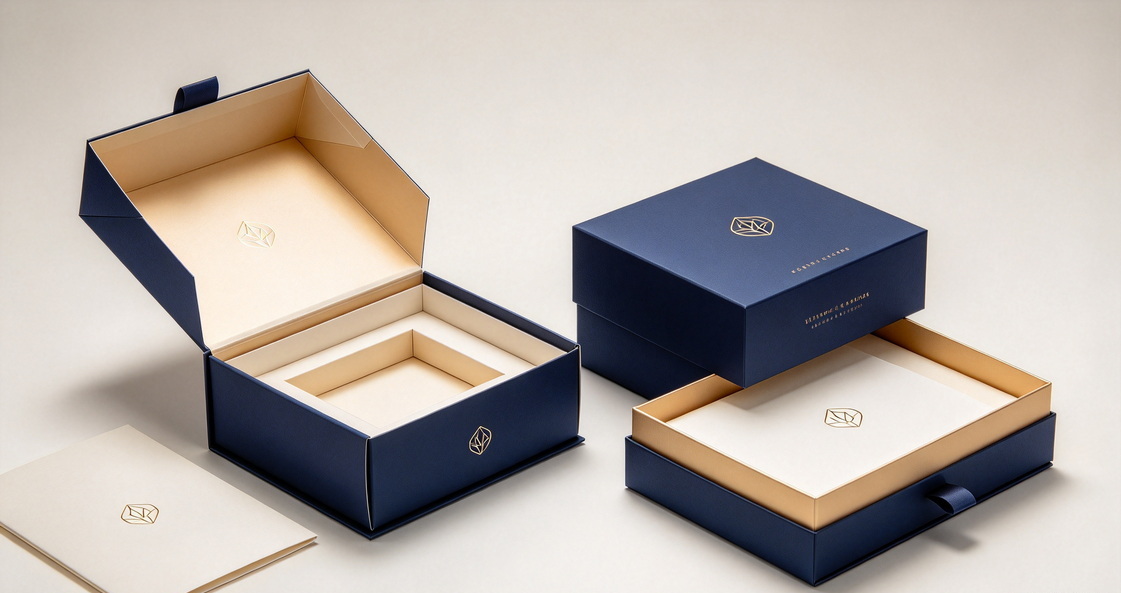
A folding paper gift box is typically made from cartonboard that is printed, die-cut, creased, and assembled into its final shape.
Common structures include:
- Tuck-end cartons.
- Lock-bottom boxes.
- Sleeve-and-tray formats.
- Folding gift carriers.
- Window cartons.
- Custom cartons with integrated inserts.
Many folding cartons can travel flat before filling. Their performance depends on board selection, grain direction, structural design, and manufacturing quality—not just thickness.
A rigid gift box commonly uses a thicker board core covered with a separate wrapping material.
Popular structures include lift-off lids, shoulder boxes, drawers, and book-style magnetic closures.
Conventional setup boxes retain their shape during shipping and storage. Collapsible rigid designs are an important exception: they can reduce empty-box shipping volume but introduce additional hinges, assembly steps, or fastening features.
Rigid packaging therefore describes a family of structures, not one fixed production method.
| Decision factor | Folding paper gift box | Rigid gift box |
|---|---|---|
| Core construction | Creased and folded cartonboard | Thicker structural board with a covering |
| Empty-box logistics | Commonly supplied flat | Conventional setup styles occupy assembled volume |
| Structural feel | Depends on board and design | Generally firmer walls |
| Decoration | Direct printing and specialty finishes | Printed wraps and specialty coverings |
| Assembly | May require erection before filling | Setup styles arrive formed; collapsible styles need assembly |
| Cost tendency | Often lower material and freight costs | Often higher material, conversion, and freight costs |
| Typical suitability | Scalable retail gifts and lighter products | Presentation-led sets and keepsake packaging |
| Main caution | Weak closures or unsuitable board selection | Excess volume, poor wrap quality, or overly complex construction |
| Main caution | Weak closures or unsuitable board selection | Excess volume, poor wrap quality, or overly complex construction |
These are tendencies, not quotation rules. A complicated folding carton can cost more than a simple rigid box.
Luxury presentation does not require maximum thickness, weight, or decoration.
A carefully proportioned folding carton with accurate color, restrained embossing, and a well-designed insert can feel more considered than an oversized rigid box with poor alignment.
Folding cartons suit products where the item itself should remain the focus.
Examples include a single skincare product, a premium accessory, a compact fragrance gift, or a seasonal confectionery presentation.
They also support coordinated retail programs. A brand can align the carton artwork with a countertop display, shelf-ready tray, or promotional fixture.
This creates a consistent presentation without requiring every packaging layer to use rigid construction.
Rigid boxes are useful when opening and retaining the package contribute to the product experience.
A multi-item gift set may benefit from a stable tray, a controlled reveal, and clearly separated components.
However, that experience requires appropriate tolerances. A lid that binds, a drawer that catches, or an insert that releases the product unexpectedly undermines the intended impression.
My recommendation is to evaluate the complete opening sequence with the actual product, rather than approving an attractive empty sample.
No. A firmer outer structure does not automatically provide suitable protection against impact, vibration, abrasion, or internal movement.
Rigid board may help a box retain its shape. Fragile contents can still break if the insert does not manage movement or impact.
Conversely, a folding carton combined with an appropriate insert and transport carton may provide effective protection.
Assess:
- Product weight and fragility.
- Contact points and abrasion risks.
- Internal clearances.
- Drop and vibration exposure.
- Stacking conditions.
- Temperature and humidity.
- The complete shipping configuration.
A gift box is often presentation packaging, not a replacement for transport packaging.

A sample tested empty does not validate a filled package.
Likewise, testing one product arrangement does not necessarily validate a heavier assortment or a different insert.
Select a distribution test appropriate to the shipping route. Parcel delivery, pallet distribution, and retail replenishment expose packages to different conditions.
Specify the board grade, grammage, thickness, surface characteristics, and required structural performance.
Grammage describes mass per area. It does not independently establish stiffness or resistance to damage.
Also confirm:
- Grain direction where relevant.
- Crease quality.
- Print and finish requirements.
- Glue areas.
- Closure engagement.
- Insert geometry.
A thicker board can still perform poorly if the crease cracks or the closure does not hold.
Define the structural board, wrapping paper, adhesive, lining, insert, and hardware.
Important acceptance points include:
- Wall alignment and squareness.
- Wrap positioning.
- Corner finish.
- Visible glue or lifting edges.
- Lid and drawer fit.
- Magnet retention, if used.
- Surface scuff resistance.
Avoid vague specifications such as "premium grayboard" or "luxury finish." Use measurable requirements and approved physical samples.
A meaningful quotation comparison includes more than the cost of an empty box.
Consider:
1. Structural development and tooling.
2. Printing and finishing.
3. Inserts and accessories.
4. Assembly and filling.
5. Freight volume.
6. Warehousing.
7. Damage and rework.
8. Disposal or recovery requirements.
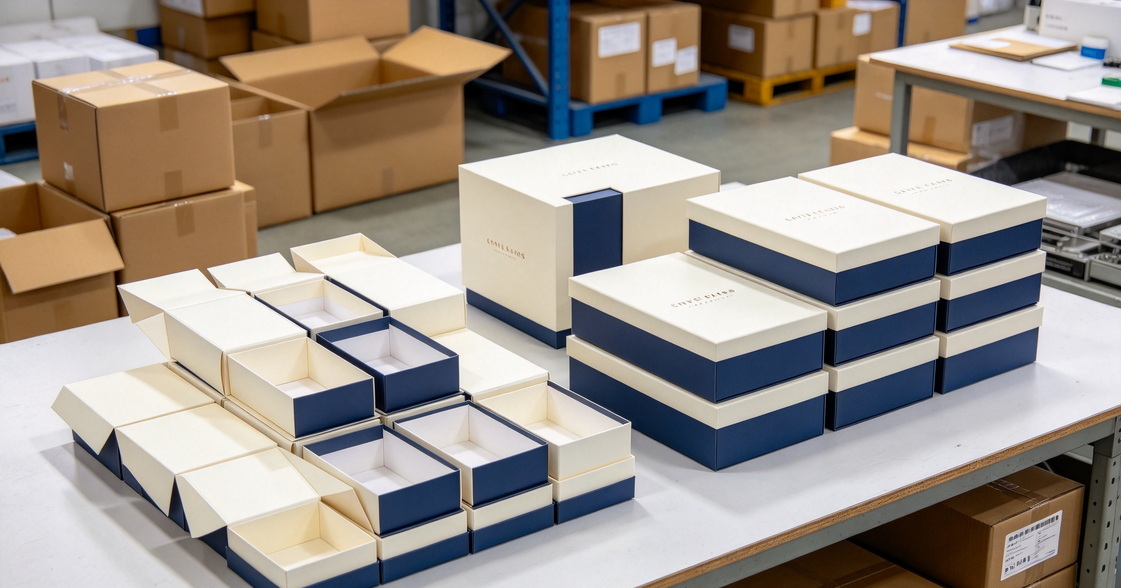
Folding cartons usually offer a volume advantage before filling.
Conventional rigid setup boxes carry their internal space through transportation and storage. This can matter when boxes are manufactured overseas and filled near the sales market.
However, flat packing is not automatically cheaper overall. Assembly labor, equipment, and handling errors may offset some savings.
Request packed carton dimensions and quantities per shipping carton before comparing landed costs.
Neither format has a universal minimum order quantity.
MOQ depends on materials, printing, finishing, tooling, manual operations, and production scheduling.
Ask whether the minimum applies per size, artwork version, color, or construction. Several related designs may still require separate production setups.
A handmade presentation sample can use different materials or assembly methods from the eventual production run.
That is not necessarily unacceptable—but it must be disclosed.
Distinguish three approval stages:
- Structural prototype: Confirms dimensions, fit, and basic construction.
- Decorated sample: Demonstrates artwork, color, finish, and appearance.
- Production-representative sample: Confirms the materials and processes intended for the order.
Keep a signed reference sample and document permitted tolerances.
For both folding and rigid boxes, require written approval before changing board, adhesives, coatings, inserts, or subcontracted processes.
Neither "paper" nor "rigid" automatically establishes environmental superiority.
A meaningful comparison considers material quantity, sourcing, manufacturing, transport, reuse, and actual end-of-life infrastructure.
Coatings, windows, magnets, foam, fabric, adhesives, and mixed-material inserts can influence sorting and recycling.
These components do not make every package unrecyclable. However, they require assessment rather than a blanket "100% recyclable" statement.
FSC chain-of-custody documentation concerns responsible material sourcing and traceability. It does not certify that every finished box is recyclable.
Pro Carton's 2026 European consumer study reports that ease of recycling is a leading packaging-material priority, identified by 64% of respondents.
Because Pro Carton represents the cartonboard industry, its findings should be understood as industry-sponsored consumer research—not proof that every paper-based format has a lower environmental impact.
The EU's Packaging and Packaging Waste Regulation also increases the importance of packaging minimization and recyclability. Requirements have different implementation dates, so brands should review their specific packaging and destination obligations.
Do not assume that a decorative gift box is exempt simply because presentation is commercially important.
Use the product and channel to narrow the choice.
- Empty-box storage is constrained.
- The product is relatively compact.
- Retail replenishment efficiency matters.
- Multiple artwork versions are needed.
- Luxury presentation can be achieved through structure and finishing.
- The opening sequence contributes meaningfully to the purchase.
- A coordinated set needs a firm presentation structure.
- The box is intended for continued storage.
- The price positioning supports additional costs.
- Warehousing and shipping volume are acceptable.
If neither option clearly wins, prototype both using the same product and evaluation criteria.
Compare product fit, opening quality, protection, packed dimensions, assembly time, and total cost.
Long Win Display's stated services include the design, customization, production, and preassembly of gift boxes and retail-display solutions.
For a useful proposal, provide product samples or drawings, quantity, target markets, sales channels, artwork, budget, and delivery requirements.
Ask the team to compare a folding carton, conventional rigid box, or collapsible structure where appropriate.
Confirm production responsibilities, materials, sample stages, quality criteria, and packing arrangements before ordering.
The paper gift box vs rigid gift box decision is not a contest between ordinary and luxurious packaging.
Folding cartons can deliver a refined presentation with efficient logistics. Rigid boxes can support a substantial opening experience and stable gift-set arrangement.
The stronger choice is the one that meets the product's needs with a justified structure and documented quality.
Often, yes. Many rigid gift boxes use paper-based structural board and a paper wrap. The useful distinction is folding-carton construction versus rigid-board construction.
Yes. Accurate printing, thoughtful proportions, embossing, foil accents, and a well-designed insert can create a refined result. Execution matters more than adding every available finish.
Not always. They can reduce empty-box volume, but assembly, fastening features, and handling requirements may add costs. Compare actual packed dimensions and operational needs.
Neither format alone answers that question. Evaluate the insert, clearances, cushioning, outer shipping carton, and distribution conditions with the actual contents.
Only with appropriate substantiation for the complete construction and relevant collection systems. Review coatings, accessories, inserts, and separation instructions rather than relying on the main material.
1. [Pro Carton — Cartons and Cartonboard]. Industry-association explanation of folding-carton construction, board properties, printing, and finishing options. [procarton]
2. [Paper Mart — Types of Gift Boxes: Your Complete Guide to Styles, March 2026]. Commercial packaging overview distinguishing folding paperboard formats and rigid chipboard construction. [blog.papermart]
3. [How to Buy Packaging — The Differences Between Folding Cartons and Rigid Boxes]. Construction, wrapping, storage, and cost tendencies; conventional setup boxes should be distinguished from collapsible rigid designs. [howtobuypackaging]
4. [Pro Carton — European Consumer Packaging Perceptions Survey 2026]. Industry-sponsored consumer research supporting the stated 64% recycling-priority figure. [procarton]
5. [Pro Carton and FFI — Recyclability of Folding Cartons, Short Report]. Testing of selected carton constructions, including the effects of non-paper components and finishes; not a universal certification for every gift box. [procarton]
6. [European Commission — Packaging and Packaging Waste Regulation]. Official overview of packaging minimization, recyclability, and phased requirements. [environment.ec.europa]
7. [Council of the European Union — Packaging]. Official explanation of packaging-reduction objectives and recycling targets. [consilium.europa]
8. [Forest Stewardship Council — Chain of Custody Certification]. Official explanation of sourcing traceability and chain-of-custody claims. [fsc]
9. [International Safe Transit Association — Test Procedures]. Distribution-specific packaged-product testing guidance. [ista]


