
Views: 202 Author: Long Win Display Publish Time: 2026-08-15 Origin: Site


Content Menu
● What Is a Pallet Display Stand?
● Why Pallet Displays Matter in Retail
● Main Types of Pallet Display Stands
>> Pallet Displays With Shelves
>> Pallet Displays With Header Cards
● Pallet Display Stand Comparison
● Five Retail Requirements for Pallet Displays
>> Easy to Open
>> Easy to Shop
● How to Design a Strong Pallet Display Structure
>> Select the Correct Corrugated Board
>> Design for Load Distribution
● Printing Options for Pallet Displays
● Pallet Display Shipping and Distribution
● Common Pallet Display Problems and How to Avoid Them
>> The Display Looks Strong but Collapses in Distribution
>> The Display Does Not Fit Retailer Requirements
>> Store Staff Cannot Set It Up Quickly
>> The Display Becomes Untidy After Product Sell Through
● How Long Win Display Supports Custom Pallet Display Projects
>> 1. What Is the Difference Between a Pallet Display and a Floor Display?
>> 2. What Pallet Size Should I Use for a Retail Display?
>> 3. How Much Weight Can a Corrugated Pallet Display Hold?
>> 4. Should Pallet Displays Be Shipped Flat Packed or Pre Loaded?
>> 5. Do Pallet Displays Need Transport Testing?
A pallet display stand is one of the most effective ways to place a large quantity of products directly into high-traffic retail environments. It combines transport packaging, product presentation, promotional communication, and store-ready merchandising in one retail unit.
For brands entering supermarkets, warehouse clubs, convenience stores, pharmacies, discount chains, and specialty retailers, a pallet display can improve product visibility while reducing the number of times store staff must handle individual products. However, a successful display must do more than look attractive. It needs to survive transport, remain stable under load, meet retailer requirements, support replenishment, and stay easy for customers to shop.
This guide explains how pallet display stands work, how to select the right format, how to avoid common structural failures, and how to develop a custom pallet display that performs from factory loading to retail sell-through.
The right pallet display stand balances product weight, pallet footprint, retail location, display height, brand visibility, loading method, distribution risk, and replenishment needs. A visually strong display is valuable only when its structure and logistics plan are equally reliable.

A pallet display stand is a point-of-purchase retail display built on a pallet or pallet-sized base. It is designed to hold and present products directly on the sales floor.
Unlike a standard shipping pallet, a retail pallet display is designed for customer interaction. It may include printed side panels, stacked product trays, shelf units, header cards, product dividers, branded skirts, display boxes, and retail-ready packaging.
Pallet displays are widely used for:
- Food and beverages
- Snacks and confectionery
- Household products
- Personal care items
- Pet supplies
- Health and pharmacy products
- Toys and seasonal products
- Consumer electronics
- Kitchenware
- Cleaning products
- Promotional multipacks
- Club-store product launches
The core purpose is simple: move products from warehouse storage to a customer-facing retail location with minimal repacking and reduced store labor.
A pallet display stand can create a high-impact product presence without requiring permanent retail fixtures.
It can help a brand:
- Increase product visibility in high-traffic areas
- Support new-product launches
- Promote seasonal campaigns
- Create bulk-buy opportunities
- Improve impulse-purchase potential
- Present multiple SKUs in one location
- Reduce shelf-restocking effort
- Keep products organized during retail deployment
- Strengthen brand recognition
- Support temporary retail promotions
The strongest pallet displays combine visual communication and practical retail operation.
A display that looks impressive but is difficult to open, refill, move, or recycle can create problems for both store staff and customers. A simpler display with clear product access and strong structural design often performs better in real retail conditions.
The best pallet display format depends on product dimensions, weight, order quantity, retail channel, store layout, and campaign goals.
A full pallet display uses the complete pallet footprint. It is suitable for high-volume retail programs, warehouse clubs, bulk products, beverage cases, large household items, and promotional multipacks.
Common advantages include:
- High product capacity
- Strong store-floor presence
- Good visibility from multiple directions
- Suitable for large retail campaigns
- Efficient for heavy or bulky products
- Can support multi-layer product loading
Full pallet displays are often used in warehouse clubs, hypermarkets, supermarkets, and large-format retail stores.
A half pallet display uses approximately half of a standard pallet footprint. It can provide a useful balance between product capacity and retail-space efficiency.
Half pallet displays are suitable for:
- Mid-volume promotions
- Grocery-store aisles
- Seasonal campaigns
- Health and beauty products
- Snacks and beverages
- Household goods
- Compact retail-floor locations
This format can provide strong brand visibility while requiring less floor space than a full pallet display.
A quarter pallet display uses a smaller pallet footprint and is designed for tighter retail environments.
It is commonly used for:
- Smaller product packs
- Convenience-store promotions
- Pharmacy products
- Personal care items
- Small consumer goods
- Seasonal impulse products
- Retail checkout-adjacent programs
Quarter pallet displays can be highly effective when space is limited. However, buyers should confirm the retailer's current footprint, height, placement, and delivery requirements before approving the structure.
A tray-style pallet display uses stacked product trays to create organized product layers.
This format is useful for:
- Canned products
- Bottled products
- Snack packs
- Cosmetics
- Household items
- Multipacks
- Small boxed products
Trays can make replenishment easier because staff can place a complete product layer into the display. The tray structure must remain stable as products are removed.
A shelf-style pallet display uses horizontal shelves to present products at different heights.
It is suitable for:
- Small packaged items
- Electronics accessories
- Cosmetics
- Toys
- Household accessories
- Gift products
- Premium consumer goods
Shelves improve product visibility but require careful load calculations. The display must remain stable even when customers remove products unevenly from one shelf.
A pallet display header is a vertical graphic panel placed above the product area. It improves visibility from a distance and supports campaign messaging.
A practical header should be:
- Easy to read
- High contrast
- Structurally stable
- Appropriate for retailer height limits
- Resistant to damage during distribution
- Positioned so it does not block product access
The strongest headers communicate one core message quickly. Too much small text reduces their impact.
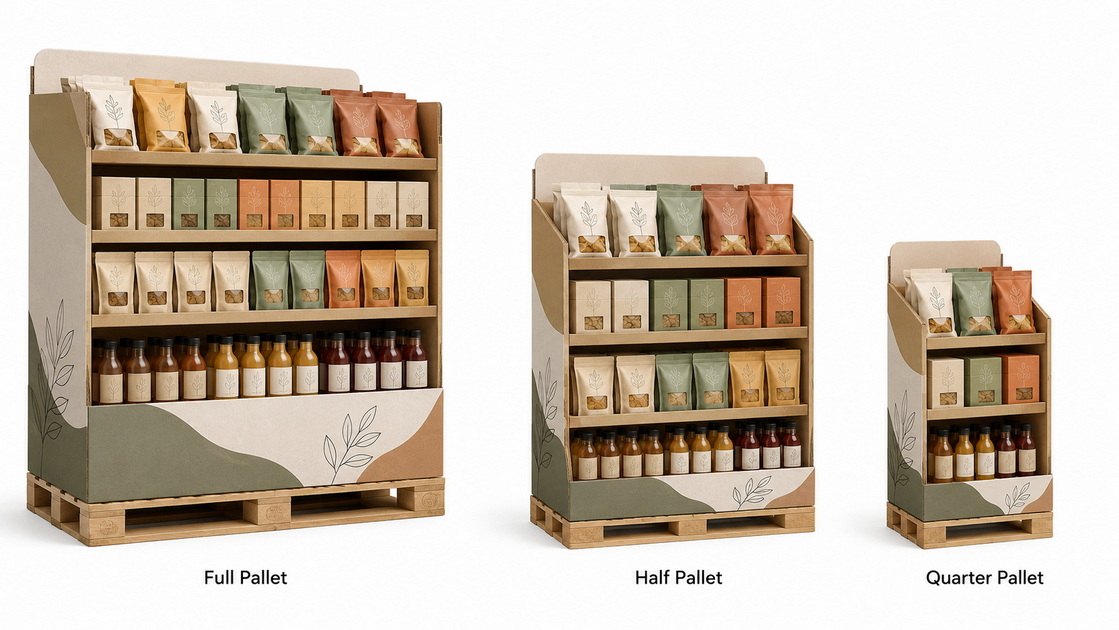
| Display Type | Product Capacity | Retail Footprint | Best Use | Key Consideration |
|---|---|---|---|---|
| Full Pallet Display | High | Large | Warehouse clubs, bulk promotions, beverages | Requires strong structure and transport testing |
| Half Pallet Display | Medium to high | Medium | Supermarkets, seasonal campaigns, household products | Balance capacity with aisle space |
| Quarter Pallet Display | Low to medium | Small | Convenience stores, pharmacy, impulse products | Confirm retailer acceptance and placement rules |
| Tray Pallet Display | Medium to high | Varies | Bottles, cans, snack packs, boxed goods | Tray strength and replenishment design |
| Shelf Pallet Display | Medium | Varies | Cosmetics, accessories, gift products | Shelf loading and stability |
| Mixed Material Pallet Display | Varies | Varies | Premium or semi-permanent campaigns | Higher cost and longer development time |
A pallet display should work for warehouse staff, retail employees, customers, and recycling teams.
A useful design review focuses on five practical requirements.
Store teams should quickly recognize the display, product category, SKU count, destination, and handling instructions.
Clear outer-carton marks, pallet labels, and display identification reduce warehouse confusion.
Customers should also understand the product offering immediately. The display should make it clear:
- What the product is
- Who it is for
- How many units are included
- Which promotion applies
- Where to take the product from
Retail employees should be able to remove transport protection and convert the shipment into a display without unnecessary tools, unsafe cutting, or complicated instructions.
Useful features may include:
- Tear strips
- Perforated panels
- Pull tabs
- Clear opening indicators
- Numbered assembly steps
- Pre-glued structural parts
- Simple header installation
A poor opening process can damage graphics, create rough edges, and delay retail placement.
A pallet display should arrive with products organized in the final retail configuration whenever possible.
The objective is to reduce unnecessary handling.
A display that requires store staff to individually unpack and arrange hundreds of products may lose its practical advantage. Pre-loaded trays, shelf-ready cases, and display-ready cartons can reduce store setup time.
Customers should be able to see the product, reach it safely, remove it easily, and understand the promotional message.
Consider:
- Product visibility from several directions
- Access height
- Product orientation
- Shelf or tray depth
- Divider position
- Product weight
- Remaining stock level
- Stability as products are removed
- Clear price-label space
- Product barcode visibility where needed
A display may look full and attractive at launch but become difficult to shop after half the products have sold. This condition should be tested during development.
A retail display should use materials that store teams can separate and recycle efficiently after the campaign ends.
Corrugated cardboard is often preferred for temporary pallet displays because it is lightweight, printable, recyclable, and structurally adaptable.
For improved recycling performance, consider:
- FSC-certified paper options
- Reduced plastic content
- Paper-based trays and dividers
- Water-based inks where appropriate
- Easily removable mixed-material components
- Clear material-separation instructions
- Compact post-campaign disposal design
A pallet display stand should be designed from the inside out.
The first question is not, "What graphics should be printed?" The first question is, "What load must the display carry through transport and retail use?"
Before structural design begins, collect:
- Product dimensions
- Unit weight
- Case-pack quantity
- Total loaded display weight
- Product packaging type
- Fragility level
- Stacking limits
- Product orientation
- Replenishment frequency
- Intended retail lifespan
- Temperature and humidity exposure
- Destination country
- Retailer guidelines
These details influence board grade, pallet base, tray construction, divider design, wrap method, corner protection, and final display configuration.
Corrugated board strength is not defined only by thickness.
The right material depends on:
- Flute type
- Paper weight
- Edge-crush strength
- Burst strength
- Compression requirements
- Humidity exposure
- Print method
- Product weight
- Stack height
- Transport distance
Common board options include:
- E Flute: Suitable for high-quality printing and lightweight product trays
- B Flute: Suitable for general retail displays and moderate product weight
- C Flute: Suitable for stronger corrugated structures and transport protection
- EB Flute: Suitable for stronger displays that also need detailed graphics
- BC Flute: Suitable for heavy products, reinforced bases, and high stacking loads
The board grade should be confirmed in the approved sample specification. Do not rely only on the word "cardboard."
A common failure occurs when the total product weight is acceptable, but the load is not distributed correctly.
For example, a display may collapse because:
- Heavy products are concentrated on one shelf
- Dividers do not transfer load to the base
- The pallet deck is weak
- The display has insufficient corner reinforcement
- Tray walls buckle as products are removed
- The top layer becomes unstable after partial sell-through
A strong structure uses vertical load paths. Product weight should transfer through reinforced walls, posts, tray supports, or base panels instead of relying on printed side panels alone.
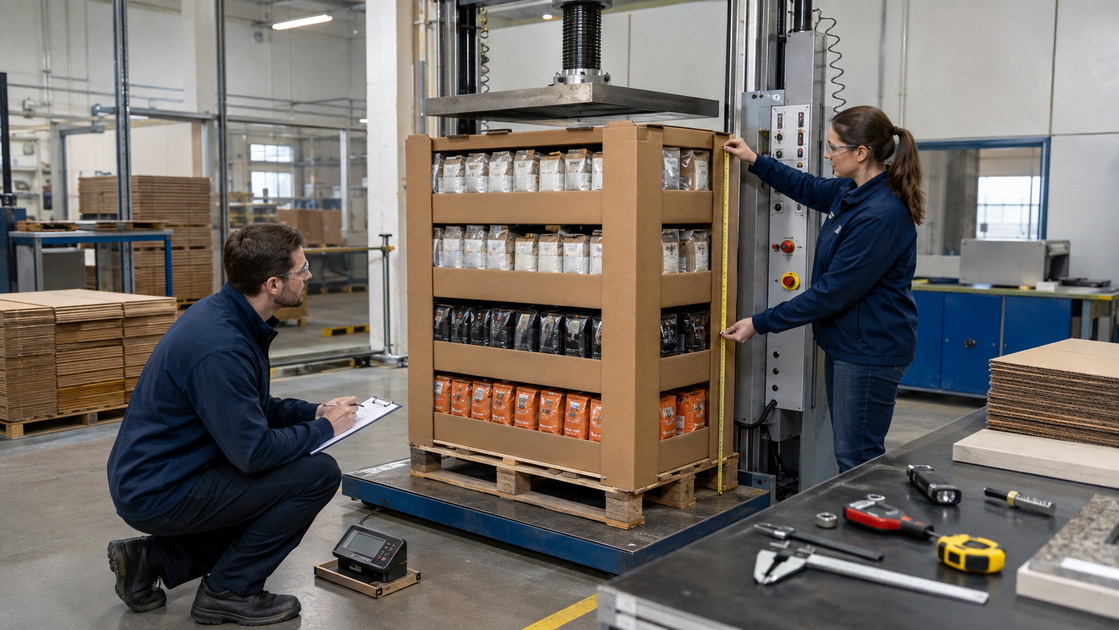
Many pallet displays are tested when fully loaded. This is necessary, but it is not enough.
The display can behave differently after 50% or 75% of the product has been removed. Weight distribution changes. A side panel may lose support. Shelves can become unbalanced. Products may fall forward. The display can look empty before the retailer is ready to replace it.
Before approving mass production, test the display in three conditions:
1. Fully Loaded: Confirm transport strength and initial retail appearance.
2. Half Empty: Confirm stability, product access, and visual balance during normal sales.
3. Nearly Empty: Confirm that remaining products stay upright and the structure remains safe.
This review is especially important for shelf-style and tray-style pallet displays.
The printing method affects graphic quality, lead time, cost, customization level, and order flexibility.
Lithographic printing is often selected for high-volume display programs requiring detailed graphics and consistent image quality.
It can be suitable for:
- Large production runs
- Premium retail campaigns
- Detailed product photography
- Strong color control
- Repeated graphic designs
The main consideration is that printing plates and setup can increase early project cost and lead time.
Flexographic printing is commonly used for simpler graphics and high-speed corrugated production.
It can be appropriate for:
- Transport-focused displays
- Simple brand graphics
- High-volume campaigns
- Cost-sensitive projects
- Limited-color designs
Flexographic printing may not offer the same photographic detail or smooth color gradients as other print methods.
Digital printing is useful for projects that need multiple artwork versions, regional campaigns, seasonal graphics, short runs, product testing, or rapid artwork changes.
It can support:
- Multiple graphic versions
- Seasonal promotion updates
- Regional language changes
- Retailer-specific designs
- Lower-volume campaigns
- Prototype graphics
- Faster artwork revision
The most suitable printing method depends on order quantity, image requirements, target cost, campaign duration, and the need for design variation.
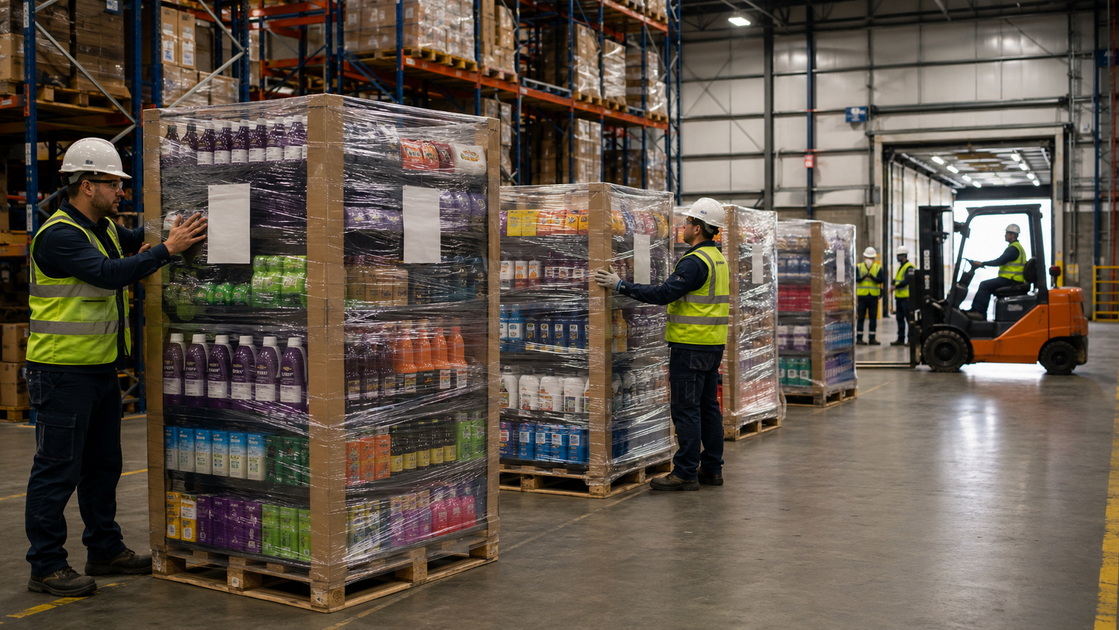
A pallet display can fail before it reaches the store if its transport design is not properly planned.
Distribution risks include:
- Vibration
- Shock
- Compression
- Moisture
- Forklift impact
- Stretch-wrap pressure
- Warehouse stacking
- Temperature changes
- Long-distance container shipment
- Retail receiving and handling
A complete logistics plan should confirm:
- Pallet size and material
- Total loaded weight
- Carton or tray configuration
- Stretch-wrap method
- Corner protection
- Top-cap design
- Edge-board requirements
- Forklift-entry position
- Container loading plan
- Stack-height limits
- Warehouse-storage conditions
- Retail delivery requirements
For major retail programs, transport testing can help confirm that the loaded display withstands normal distribution hazards.
This often happens when the display is designed mainly for visual impact rather than distribution load.
How to avoid it:
- Confirm total loaded display weight
- Use the correct board grade
- Reinforce base corners and vertical load paths
- Test the complete loaded display
- Review stretch-wrap pressure
- Confirm compression performance during stacking
Retailers may have strict rules for pallet footprint, height, signage, safety, barcodes, product access, and delivery format.
How to avoid it:
- Request current retailer guidelines before structural approval
- Confirm maximum display height
- Confirm allowable footprint
- Reserve price-label space
- Verify aisle-clearance requirements
- Confirm pallet type and delivery rules
A display that requires complex assembly may remain in the back room.
How to avoid it:
- Reduce the number of assembly steps
- Use clear visual instructions
- Pre-glue components where practical
- Use tear-away transport panels
- Test setup with non-technical users
- Consider pre-assembly or pre-loading
A pallet display may look excellent on the first day but become difficult to shop after customers remove products.
How to avoid it:
- Test full, half-empty, and nearly empty conditions
- Use dividers or product stops
- Reduce excessive shelf depth
- Design a clear visual hierarchy
- Plan replenishment procedures
- Ensure remaining products stay accessible
Long Win Display designs, customizes, manufactures, and pre-loads pallet display stands, cardboard displays, countertop displays, floor displays, PDQ displays, dump bins, display boxes, gift boxes, and packaging solutions.
The company supports brands that need practical POP display solutions for food and beverage, cosmetics, health and pharmacy, toys, household goods, electronics, kitchenware, seasonal campaigns, and other consumer categories.
Long Win Display can support the full development process, including:
- Display concept refinement
- Structural design
- Product-fit review
- Corrugated material selection
- Prototype development
- Printing and surface finishing
- Quality-control review
- Flat-pack, pre-assembled, or pre-loaded formats
- Export packaging
- International project coordination
For the most reliable result, provide product information, unit weight, case-pack quantity, target pallet format, retailer requirements, destination market, campaign duration, artwork files, target quantity, and delivery date at the beginning of development.
A properly designed pallet display can reduce store setup effort, improve product visibility, protect merchandise during distribution, and support a stronger retail launch.
A pallet display stand is not simply a large printed box. It is a retail and logistics system that must perform across manufacturing, packing, transport, warehouse handling, store setup, customer interaction, replenishment, and end-of-campaign recycling.
The strongest pallet display programs begin with product weight, retail conditions, and distribution risk. Graphics should enhance a structure that has already been designed to remain stable and easy to shop.
Before approving a new pallet display, define the full commercial and technical brief. Include product dimensions, loaded weight, pallet footprint, retailer requirements, expected display life, artwork, transport route, store setup method, and desired replenishment process.
Long Win Display can help brands develop custom pallet display solutions that balance visual presentation, structural reliability, flexible production, and retail-ready delivery. A well-planned prototype and load test can provide the confidence needed before moving into a full retail rollout.
A pallet display is built on a pallet or pallet-sized base and is typically designed for bulk product loading, transport, and direct placement on the retail floor. A floor display may be smaller, lighter, and not designed for palletized distribution.
The correct pallet size depends on the retailer, country, store format, product weight, and display location. Common formats include full, half, and quarter pallets. Always confirm current retailer requirements before finalizing the display design.
Capacity depends on board grade, flute structure, base reinforcement, product distribution, display height, humidity, transport method, and pallet support. The correct approach is to calculate the total product load and test a fully loaded sample.
Flat-packed displays can reduce shipping volume and allow assembly closer to the retail destination. Pre-loaded displays can reduce store labor and improve retail consistency. The best option depends on product type, campaign volume, distribution process, and retailer requirements.
Transport testing is strongly recommended for heavy products, warehouse-club programs, long-distance shipping, and high-value retail launches. Testing can help identify risks from shock, vibration, compression, moisture, and handling before a full shipment is released.
1. [Bennett Packaging — Floor Display: The Complete Guide]
2. [Long Win Display — Company Profile]
3. [Packaging Corporation of America — Retail Ready Packaging]
4. [International Safe Transit Association — Transit Packaging Testing Information]
5. [Bennett Packaging — The Anatomy of a Great Retail Pallet Display]
6. [How to Buy Packaging — Pallet Displays for Club Stores and Testing]
7. [Jamestown Container — The Complete Guide to Retail Ready Packaging]


