
Views: 253 Author: Long Win Display Publish Time: 2026-10-13 Origin: Site


Content Menu
● Notebook Display Stand vs Floor Display
● Why Back-to-School Display Planning Should Start Early
● Product Presentation: Focused Selection vs Assortment Breadth
>> Countertop Notebook Displays Simplify a Small Offer
>> Floor Displays Support Broader Seasonal Ranges
● Shopper Experience: Visibility, Reach, and Price Clarity
● Capacity and Replenishment: Design for the Selling Cycle
>> Calculate Capacity Using Actual Samples
>> Check the Half-Empty Display
● Materials and Structure: Notebook Weight Changes the Brief
● Total Campaign Cost: Look Beyond the Fixture Price
● A Practical Break-Even Comparison
● Accessibility and Retailer Approval
● How to Test Notebook Displays Before a Large Rollout
● Should You Combine Countertop and Floor Displays?
● Choose the Display Around the Store's Actual Needs
>> 1. Which Display Is Better for A4 Notebooks?
>> 2. Can a Corrugated Floor Display Hold Heavy Notebook Multipacks?
>> 3. Should Displays Arrive Preassembled or Flat Packed?
>> 4. How Can We Prevent Notebooks from Looking Untidy After Sales?
>> 5. How Far Ahead Should We Start Development?
A notebook display stand vs floor display comparison comes down to three questions: where will shoppers notice the products, how much inventory must the fixture hold, and how easily can store teams keep it organized? For back-to-school promotions, a countertop notebook display stand suits compact assortments and secondary placements. A floor display suits larger ranges and dedicated seasonal merchandising.
Neither format guarantees higher sales. The better choice depends on store layout, notebook dimensions, replenishment capacity, and the retailer's placement rules.
Here, "notebook" means paper notebooks, exercise books, and journals—not laptop computers. "Notebook display stand" refers to a compact countertop or shelf-top fixture, while "floor display" means a freestanding retail unit.
From a display-development perspective, I would evaluate placement before appearance. An attractive fixture has limited value if it arrives without an approved location or cannot accommodate the actual products.
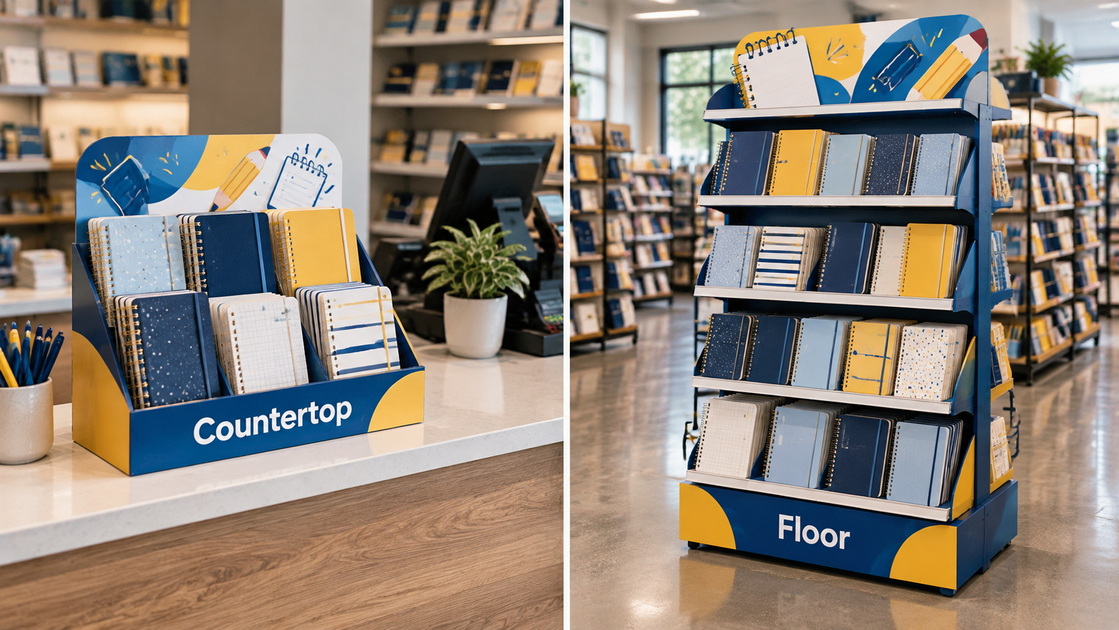
| Decision factor | Countertop notebook display stand | Freestanding floor display |
|---|---|---|
| Typical location | Checkout, service counter, shelf top | Approved seasonal zone or aisle location |
| Assortment fit | Selected notebook styles or compact ranges | Broader ranges, bundles, or multiple categories |
| Inventory capacity | Generally limited by available counter space | Potentially greater, depending on design |
| Visibility | Depends on counter position and surrounding clutter | Can support larger graphics and broader visibility |
| Store-space requirement | Uses existing surface space | Requires an approved floor footprint |
| Replenishment | May need frequent attention | Can accommodate more reserve stock if designed accordingly |
| Setup | Often compact and straightforward | May require more assembly or positioning |
| Commercial priority | Focused product presentation | Seasonal destination and assortment coverage |
These are design tendencies, not fixed specifications. A heavy-duty countertop stand may cost more than a simple corrugated floor display.
Recent U.S. consumer research found that 62% of back-to-school shoppers had started purchasing by early July 2026. Families with children in elementary through high school planned to spend an average of $146.45 on school supplies, within a broader back-to-school budget of $863.86.
These figures describe planned spending, not completed sales. They also cover school supplies generally, not notebooks alone.
For display buyers, the practical implication is timing. Development, sampling, retailer approval, production, and delivery should be scheduled backward from the required installation date.
An early placement can serve initial shopping trips. A later replenishment program can serve customers returning for additional supplies. The display should remain functional through both phases rather than look impressive only when fully stocked.
A compact notebook display stand works well when the promotion has a clear proposition:
- A selected notebook collection.
- A premium journal range.
- A small exercise-book multipack.
- A notebook-and-pen bundle.
- A limited seasonal design assortment.
The advantage is focus. Shoppers can compare a manageable selection without navigating a large fixture.
However, notebook size matters. A countertop stand designed around slim A5 products may not comfortably accommodate thick A4 notebooks. Confirm actual dimensions, thickness, packaging, and unit weight before designing pockets or shelves.
A back-to-school floor display can organize multiple notebook formats, ruling types, cover designs, and related stationery.
Its additional space is useful only when shoppers can understand the assortment. Separate products using a consistent hierarchy, such as:
1. Notebook size.
2. Ruling type.
3. Pack quantity.
4. Price or promotional offer.
Avoid organizing solely by decorative cover color if customers primarily need a specific size or page format.
A larger display should reduce search effort, not create a larger sorting problem.

A countertop fixture operates within an existing service or shopping area. Its effectiveness depends on whether customers can see it without obstructing transactions, payment equipment, or staff work.
A floor display can create a recognizable seasonal destination, but only if the retailer approves an appropriate location.
For either format:
- Keep prices adjacent to the correct products.
- Make notebook size and ruling easy to identify.
- Avoid graphics that cover important product information.
- Provide sufficient space to remove and replace items.
- Check visibility with neighboring fixtures present.
Test the display from several viewing positions. A header that looks clear in a design rendering may disappear behind products or surrounding merchandise.
Do not assume that increased graphic area automatically produces increased attention or sales.
Notebook capacity cannot be estimated reliably from shelf width alone.
Account for product thickness, dividers, shelf lips, finger clearance, and packaging variation. Test the proposed quantity with physical samples.
For floor displays, evaluate each shelf's loading separately. Uneven loading can affect usability and stability.
For countertop stands, confirm the usable surface area with the store. Nominal counter dimensions may include space reserved for equipment or transactions.
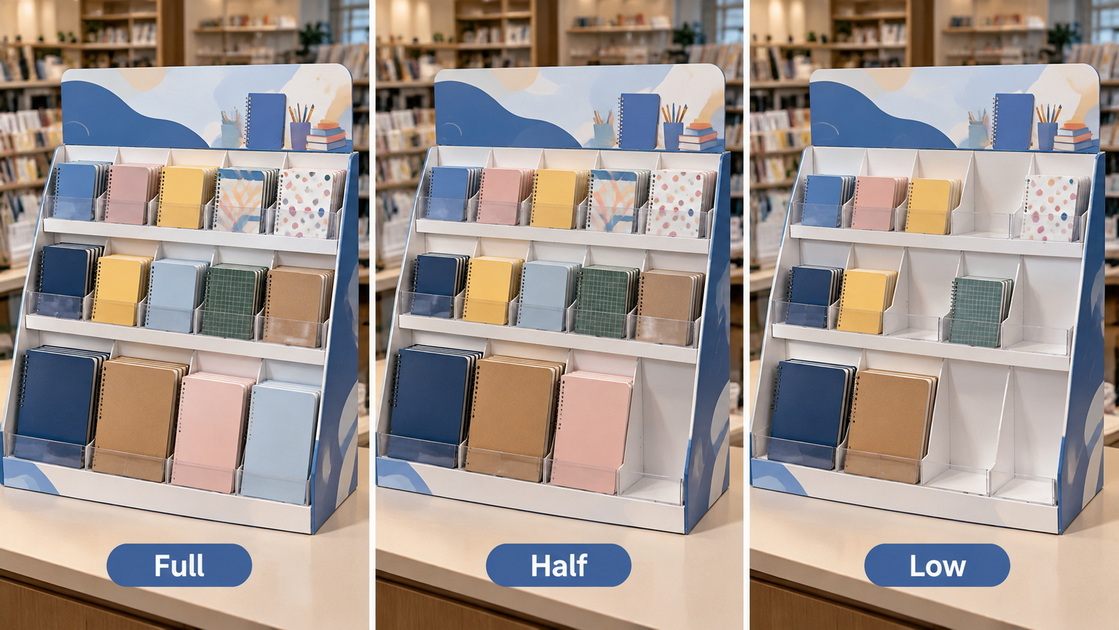
A full fixture is only one operating condition.
As notebooks sell, products may lean, slide, or obscure labels. Shoppers may return items to the wrong compartment.
Evaluate the display when:
- Fully stocked.
- Approximately half stocked.
- Nearly empty.
- Unevenly stocked.
- Refilled with a slightly different product mix.
This is an often-overlooked development step. Dividers, suitable shelf depth, and clear product grouping can help maintain order after the opening stock has changed.
Notebooks can create substantial cumulative loads, especially in multipacks. Material selection should follow the required load, service period, and retail environment.
| Material approach | Potential fit | Main validation question |
|---|---|---|
| Corrugated board | Short-duration seasonal promotions | Will shelves and joints withstand the intended load and conditions? |
| Metal | Repeated use or demanding loading | Are stability, finish, edges, and assembly suitable? |
| Acrylic | Visually clean countertop presentation | Are thickness, joints, and handling resistance adequate? |
| Wood or engineered board | Durable, furniture-style presentation | Are weight, finish, packaging, and material requirements acceptable? |
| Mixed materials | Application-specific combinations | Are interfaces durable and assembly instructions clear? |
These are starting points, not material guarantees.
Request testing of the finished structure under agreed conditions. A material sample alone cannot demonstrate the capacity of a complete shelf, joint, or base.
For corrugated displays, evaluate sustained loading and relevant humidity conditions. A short photographic demonstration is not equivalent to a seasonal-use validation.
A useful comparison includes the cost of getting an approved display installed and maintained.
Consider:
- Design and tooling.
- Sample development.
- Unit manufacturing.
- Packing and shipping volume.
- Store assembly.
- Installation labor.
- Replenishment labor.
- Damage and replacement.
- End-of-campaign removal or reuse.
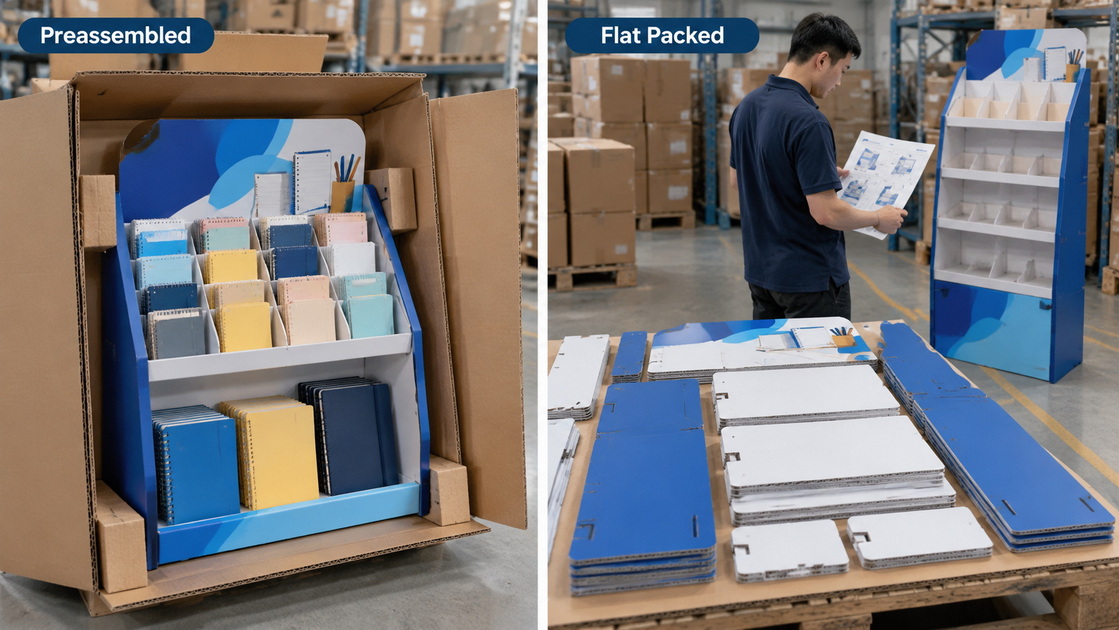
A flat-packed floor display may reduce shipping volume but increase setup work. A preassembled countertop stand may simplify installation but occupy more carton space.
At Long Win Display, our stated service scope includes design, customization, production, and preassembly. For procurement, the important question is which delivery configuration best suits the retailer's operating process—not whether preassembly is always preferable.
Ask suppliers to quote comparable configurations and clearly identify excluded costs.
Use incremental contribution rather than sales revenue alone when comparing campaign economics.
For an illustrative example, suppose the total campaign cost per store is:
| Hypothetical assumption | Countertop display | Floor display |
|---|---|---|
| Display, delivery, and setup cost | $30 | $90 |
| Contribution per additional notebook sold | $1.50 | $1.50 |
| Additional notebooks needed to cover cost | 20 | 60 |
The floor display would need 40 more incremental notebook sales than the countertop alternative to offset the $60 cost difference.
These figures are hypothetical, not Long Win Display prices or measured campaign results.
Define contribution consistently and include relevant variable costs. Also distinguish genuinely incremental sales from purchases shifted away from an existing shelf location.
A display can increase its own recorded sales without increasing total store-category sales.
Floor displays must not compromise required circulation space. In the United States, accessible routes generally require a continuous clear width of at least 36 inches, with additional requirements in certain situations.
That figure is not a universal instruction to design every retail aisle at exactly 36 inches. Local rules, turning requirements, operational needs, and retailer standards may require more space.
Countertop displays also need review. They should not obstruct accessible service areas or interfere with payment and customer assistance.
Before production, obtain approval for:
- Exact footprint and installed position.
- Overall height and projecting graphics.
- Customer reach and product access.
- Stability and foreseeable handling.
- Service-counter functionality.
- Retailer-specific installation requirements.
Evaluate the complete display, including headers, side panels, and protruding shelves.
A controlled store trial provides more useful evidence than a rendering alone.
1. Select comparable stores using traffic, format, and historical notebook sales.
2. Keep product selection, pricing, and promotional timing consistent where feasible.
3. Record the exact placement and installation date.
4. Track notebook sales, stockouts, replenishment, and damage.
5. Compare results with relevant baseline or control-store performance.
6. Document operational feedback before revising the design.
Monitor more than units sold. Useful measures include contribution after display cost, replenishment time, installation completion, and availability during peak periods.
Interpret results cautiously. Different traffic, neighboring promotions, or inconsistent stock availability can distort comparisons.
Do not advertise a percentage sales improvement unless the evidence supports both the number and the conditions attached to it.
A combined approach can serve different shopping tasks.
Use a floor display for the main school-supply assortment. Use a countertop notebook stand for a focused bundle, premium item, or complementary offer.
However, duplication creates additional inventory and replenishment responsibilities. It can also complicate price consistency.
Use both formats only when each has a defined role:
- Different assortment or bundle.
- Different shopper interaction.
- Clear replenishment ownership.
- Consistent pricing.
- Separate performance measurement.
For small stores with limited space, one well-managed fixture may be more practical than two competing placements.
A countertop notebook display stand suits a focused offer in an approved compact location. A floor display suits broader seasonal merchandising when space, stock, and store operations support it.
The strongest design brief connects the product assortment to installation, loading, replenishment, and campaign economics.
Either format can work if designed around actual dimensions and weight. A floor display may accommodate a broader A4 assortment, while a countertop stand can present a smaller selection where sufficient surface space exists.
Possibly, but capacity must be validated for the complete design. Specify shelf loads, loading duration, environmental conditions, and acceptance criteria. Do not rely on the material description alone.
Choose according to freight volume, store labor, installation complexity, and damage risk. Request a realistic setup trial and compare the total delivered-and-installed cost of both options.
Test partially stocked conditions. Appropriate dividers, shelf depth, label placement, and compartment sizing can help. Clear refill instructions also reduce incorrect product placement.
Work backward from the retailer's installation deadline. Include requirements approval, sampling, revisions, production, transit, and contingency. Obtain a project-specific schedule rather than relying on a universal lead-time claim.
1. [National Retail Federation — "Majority of Back-to-School Shoppers Get a Head Start on the Season," July 14, 2026]. Source for the 62% early-shopping figure, planned K–12 household expenditure of $863.86, and planned school-supply expenditure of $146.45. These are survey-based spending intentions, not actual notebook sales. [nrf]
2. [National Retail Federation — Back-to-School Research]. Supporting context for seasonal shopping research and the 2026 consumer-trends material. [nrf]
3. [U.S. Access Board — Guide to the ADA Accessibility Standards, Chapter 4: Accessible Routes]. Source for accessible-route clear-width requirements and related clearance limitations. [access-board]
4. [U.S. Access Board — Guide to the ADA Accessibility Standards, Chapter 3: Protruding Objects]. Supporting guidance for evaluating projections into circulation paths. [access-board]


