
Views: 224 Author: Long Win Display Publish Time: 2026-07-30 Origin: Site


Content Menu
● Mailer Boxes vs Shipping Boxes: Core Difference
● When Shipping Boxes Are Better
● Sustainability and Material Use
● Operational Decision Framework
● A Practical Industry Example
>> 1. What is the main difference between a mailer box and a shipping box?
>> 2. Which is more sustainable: mailer boxes or shipping boxes?
>> 3. Are mailer boxes strong enough for shipping?
>> 4. Do shipping boxes cost more than mailer boxes?
>> 5. Which box is better for branded unboxing?
Choosing between mailer boxes and shipping boxes is more than a packaging decision. It affects product protection, freight cost, sustainability, unboxing experience, and how customers perceive your brand from the moment the parcel arrives.
For brands that sell online, wholesale, or through retail-ready channels, the right box format can reduce damage, improve efficiency, and support a stronger premium image. In this guide, we compare mailer boxes vs shipping boxes in practical terms, explain when each option works best, and show how packaging teams can make a smarter decision based on product type, carrier rules, and customer experience.
A package is often the first physical brand touchpoint a customer sees. That makes it a logistics asset, a marketing tool, and a sustainability signal all at once.
If the box is too large, you waste material and pay more in dimensional weight. If it is too weak, product damage rises. If it is too generic, you miss a chance to reinforce brand value during unboxing.
For manufacturers, importers, and eCommerce brands, this is not an abstract debate. It affects margin, fulfillment speed, customer satisfaction, and repeat purchase behavior.
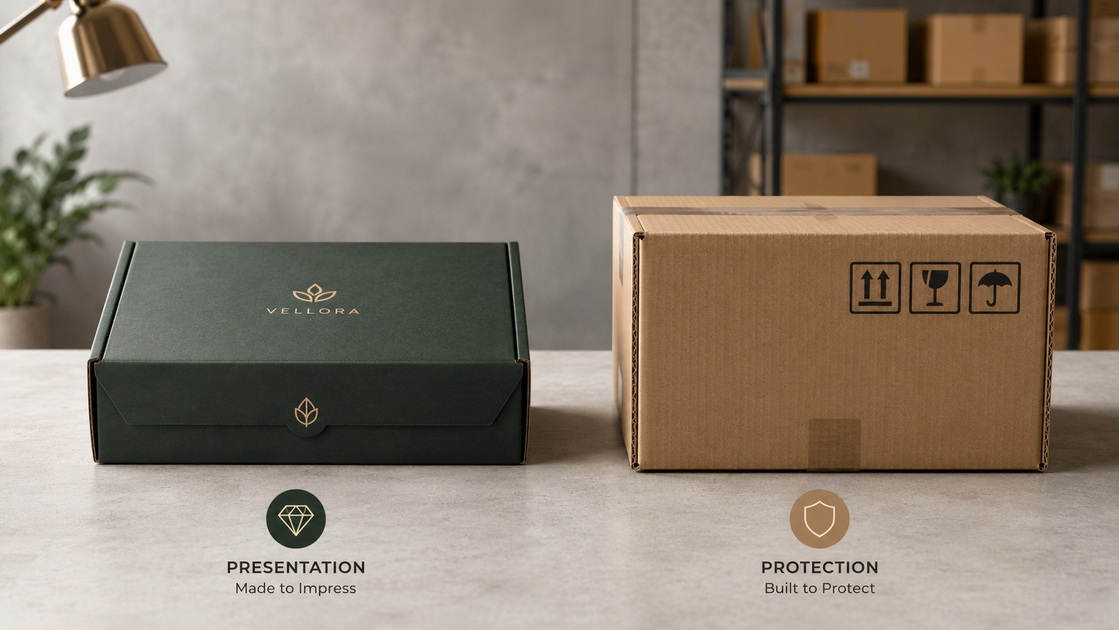
A mailer box is typically a self-locking corrugated box that folds together without much tape and is often used for direct-to-consumer presentation and light-to-medium products.
A shipping box usually refers to a regular slotted container or similar carton used for broader shipping needs, especially when durability, stacking strength, or multi-item protection matters more than presentation.
The simplest way to think about it is this: mailer boxes prioritize branding and efficiency, while shipping boxes prioritize versatility and protection.
| Factor | Mailer Boxes | Shipping Boxes |
|---|---|---|
| Best use case | Light, flat, or moderately fragile products, subscription kits, branded DTC shipments | Heavier products, bulk orders, multi-item packs, fragile goods needing stronger protection |
| Branding | Strong unboxing and presentation value | Can be branded, but usually less presentation-focused |
| Material use | Typically less material | Typically more material |
| Packing speed | Faster assembly, often less tape | More flexible but can take longer to pack |
| Protection | Good for many products, but not ideal for heavy or high-impact shipments | Stronger for stacking, rough handling, and fragile contents |
| Shipping efficiency | Often better for right-sized parcels | Better when product size or weight requires a sturdier structure |
| Sustainability | Often better when the product fits well in a smaller format | Can be less efficient because of higher material use and larger volume |
This comparison is useful because the right carton is rarely chosen on aesthetics alone. Most businesses need a packaging format that balances cost, protection, and customer experience.
Mailer boxes are a strong choice when the shipment is relatively light, compact, and presentation matters. They are commonly used for apparel, cosmetics, accessories, sample kits, small gifts, and subscription packages.
They also perform well when your team wants faster packing and a cleaner unboxing moment. Because they are often self-locking, they can reduce tape use and speed up fulfillment.
From a practical standpoint, mailer boxes are best when the product does not need heavy cushioning and the box can be closely matched to the item size. That right-sizing reduces wasted space and can improve shipping efficiency.

Shipping boxes are the better choice when the product is heavier, more fragile, irregularly shaped, or shipped in multiple units. They are also more appropriate when stacking strength and warehouse handling matter.
If you ship bottles, glass jars, tools, electronics, or mixed product sets, a shipping box usually gives you more room for inserts, dividers, and void fill. That added structure lowers breakage risk and improves transport reliability.
Shipping boxes are also useful for businesses that need one flexible carton format for many SKUs. In that case, standardization may be more efficient than maintaining several mailer sizes.

Sustainability is one of the biggest reasons brands compare mailers and shipping boxes. In general, shipping boxes require more material than mailers, which can increase environmental footprint and transport inefficiency.
That said, sustainability is not only about the carton format. It also depends on right-sizing, recycled content, and whether the package reduces damage and returns. A smaller package that fits the product well can be more efficient than a larger carton filled with unnecessary void fill.
In practice, the most sustainable option is usually the one that protects the product with the least amount of material and the fewest total shipping impacts. That is why packaging decisions should be based on product fit, not habit.
Cost is not just the price of the box. It includes material cost, packing labor, freight, dimensional weight, damage rate, and return handling.
Mailer boxes often reduce cost when the shipment is light and the box is properly sized. Shipping boxes may cost more per unit, but they can save money if they prevent product damage or eliminate the need for extra protective packaging.
A smart packaging team evaluates total landed packaging cost, not just carton price. That means looking at how the package performs in the warehouse, in transit, and after the customer opens it.
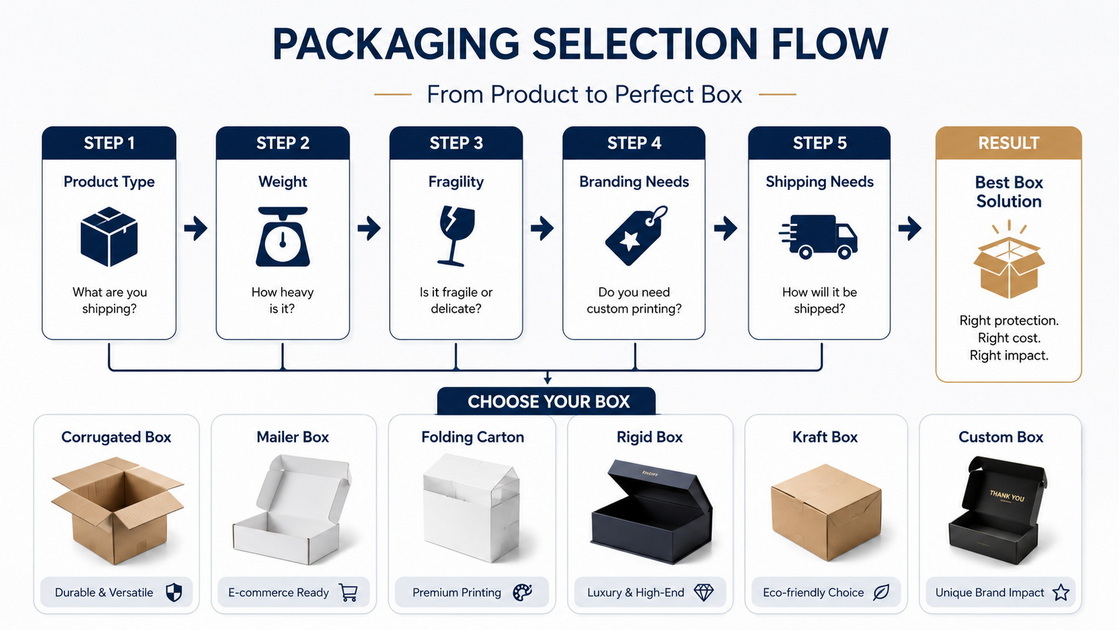
Use this simple decision process to choose the right format:
1. Check product weight and fragility. Heavy or fragile items usually need a shipping box.
2. Review shipment quantity. Single light items often fit mailer boxes; multi-item orders often do better in shipping boxes.
3. Assess branding needs. Premium DTC shipments usually benefit from mailer-style presentation.
4. Estimate packing time. If speed is critical, a self-locking mailer may improve workflow.
5. Measure damage history. If breakage or returns are rising, move toward stronger carton structures.
6. Calculate freight impact. Oversized packaging can raise shipping cost through dimensional weight.
This framework turns packaging choice into a repeatable business rule instead of a subjective preference.
A skincare brand shipping single-item orders may choose custom mailer boxes because the product is light, the unboxing experience matters, and the carton can be sized closely to the jar or bottle.
A hardware supplier shipping mixed kits, metal parts, or boxed accessories may choose shipping boxes because the contents are heavier, more varied, and need stronger stack resistance.
In both cases, the "best" option is the one that matches how the product is handled, shipped, and received. That is the core of efficient packaging design.
Customers rarely ask for packaging terminology. They care about whether the package feels premium, arrives safely, and avoids waste. That means your article should answer the following buyer questions clearly: what ships safely, what looks better, what costs less, and what is more sustainable.
For that reason, the strongest content on this topic should avoid generic definitions alone. It should help readers make a decision quickly and confidently.
The choice between mailer boxes and shipping boxes depends on what matters most for your product and your business. If your priority is presentation, efficiency, and lighter shipments, a mailer box is often the better fit. If your priority is protection, stacking strength, and mixed-product handling, a shipping box is usually the smarter option.
The most effective packaging strategy is not choosing one format forever. It is matching the right box to the right product, the right channel, and the right customer expectation.
A mailer box is usually a self-locking corrugated box designed for branded, efficient direct-to-consumer shipping, while a shipping box is typically used for stronger protection, heavier products, or more versatile carton needs.
Mailer boxes often use less material and can be more efficient, but the most sustainable choice depends on right-sizing, recycled content, and whether the package reduces damage and returns.
Yes, for many light to moderate products. However, fragile, heavy, or irregular items usually require a shipping box with stronger structural support.
Usually, yes, because they often use more material and can add freight cost if they create more package volume. But they may reduce damage-related losses.
Mailer boxes are usually better for branded unboxing because they are often used in DTC packaging and can be designed for a cleaner presentation experience.
1. EcoEnclose, "How to Choose Between a Mailer and a Shipping Box," available at [EcoEnclose blog].
2. Northwest Paper Box, "Mailer vs Shipping Box: A Practical Guide for DTC Brands," available at [NWPB blog].
3. Gushwork, "How SEO Helps Packaging Manufacturers Generate More ...," available at [Gushwork blog].
4. BigCommerce Help Center, "Best Practices for Blogging," available at [BigCommerce support].


