
Views: 248 Author: Long Win Display Publish Time: 2026-07-11 Origin: Site


Content Menu
● What Is Kraft Paper In Modern Packaging?
>> From Pulp To Board And Corrugated Structures
● Kraft Paper vs Regular Paper: Why It Matters
● Main Types Of Kraft Paper Used In Packaging
>> Coated Unbleached Kraft (CUK) / Solid Unbleached Sulfate (SUS)
>> Solid Bleached Kraft Paper (SBS)
>> Coated Recycled Board (CRB)
● Benefits Of Kraft Paper For Package Boxes
>> Strength, Protection, And Versatility
>> Eco-Friendly And Consumer-Friendly
● Customization Options: How Kraft Paper Supports Brand Storytelling
>> Printing, Finishing, And Color
>> Structural And Functional Customization
● Environmental Impact Of Kraft Paper: Nuances And Trade-Offs
>> Positives: Renewable, Recyclable, Biodegradable
>> Considerations: Chemicals And Process Management
● Case Insight: Sonhab Chocolate's Kraft Packaging
● Where Kraft Packaging Is Heading
● Practical Steps To Specify Kraft Paper For Package Boxes
>> Step 1 – Define Functional Requirements
>> Step 2 – Align Brand And Sustainability Goals
>> Step 3 – Choose Structure And Integrations
>> Step 4 – Prototype, Test, And Iterate
● How Long Win Display Uses Kraft Paper In POP And Package Box Projects
● Call To Action: Plan Your Next Kraft-Based Package Box Project
● FAQ
Kraft paper has moved from being "just brown paper" to a strategic packaging material for brands that care about sustainability, cost control, and on-shelf storytelling. From my perspective working with global retail brands and POP display projects at Long Win Display, understanding kraft paper—its types, strengths, and limits—is now a basic requirement for anyone specifying custom package boxes or display-ready packaging. [mbpak]
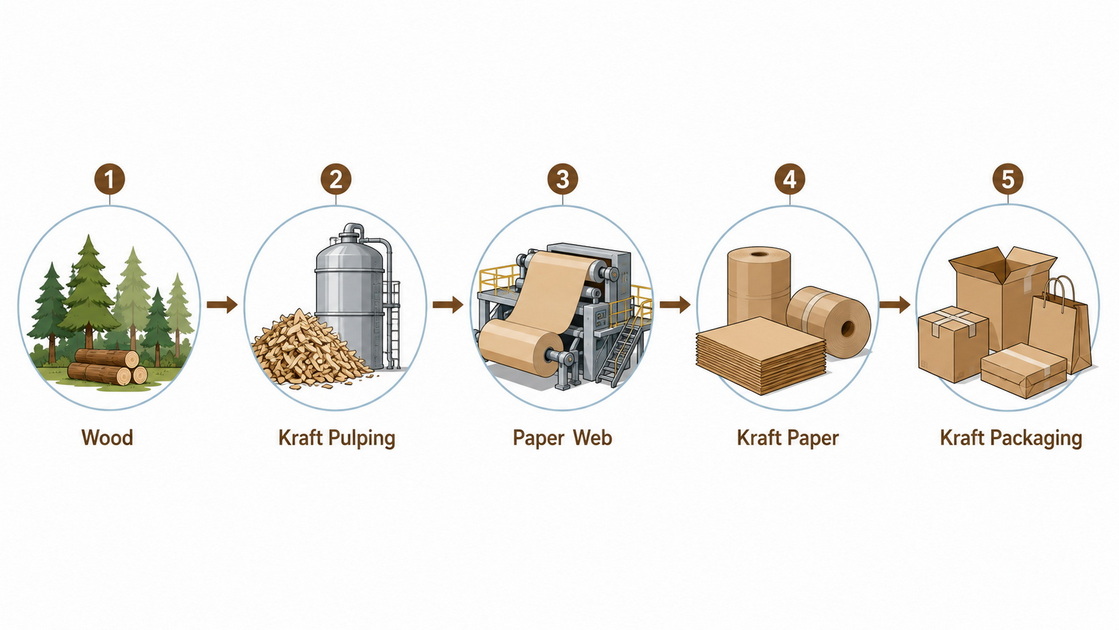
Kraft paper is a strong packaging paper made using the kraft pulping process, where wood chips are cooked with sulfate chemicals to remove lignin and leave more cellulose, the component that gives paper its strength. The term "kraft" comes from the German word for "strong," and that strength is what makes kraft paper so valued in packaging. [transparencymarketresearch]
Raw kraft paper is typically brown, durable, and tear-resistant, with a slightly textured and porous surface that supports high-quality printing and finishing. It is widely used for wrapping, corrugated boxes, carton boxes, and rigid box structures, and today it can be produced in multiple shades and colors for branded packaging programs. [ecopackables]
Understanding the kraft paper production process helps buyers assess performance, cost, and sustainability.
In the kraft process, wood is first converted into pulp, but instead of purely mechanical grinding, the pulp is treated with sulfate chemicals that dissolve much of the lignin. Removing lignin and preserving cellulose creates a paper with higher strength, better tear resistance, and improved durability compared with many conventional papers. [researchandmarkets]
Initially, kraft paper was used mainly as wrapping material, but its mechanical properties quickly made it a go-to choice for strong carton boxes and corrugated packaging. [overfuel]
After pulping and forming, kraft paper is calendered, dried, and optionally coated. For packaging:
- Folding cartons and rigid boxes use kraft-based boards like Coated Unbleached Kraft (CUK) or Coated Recycled Board (CRB). [overfuel]
- Corrugated boxes gain strength by adding fluted layers of kraft paper between linerboards, a construction that is now standard in e-commerce and retail logistics. [researchandmarkets]
This layered architecture is why kraft-based corrugated packaging can withstand stacking, shocks, and harsh shipping environments.
Many buyers ask, "Isn't kraft just another paper?" The answer is no. Kraft paper is inherently stronger and more durable than many regular paper grades because the kraft process strips more lignin and leaves more cellulose. [transparencymarketresearch]
Key differences include:
- Strength and tear resistance: Kraft paper has higher tear strength and is more resilient under tension, making it ideal for heavy or long-distance shipments. [researchandmarkets]
- Porosity and texture: Raw kraft is more porous than many fine papers, which can make it less suitable for extremely detailed printing but excellent for special finishes like embossing, debossing, and foil stamping. [overfuel]
- Visual identity: The natural brown tone immediately signals eco-friendliness and authenticity, a strong cue in modern retail. [yourpapersource]
For brands, these differences combine into a clear positioning choice: premium yet sustainable, rustic yet engineered.
Modern packaging programs rely on several distinct kraft-based substrates, each with different performance and cost profiles.
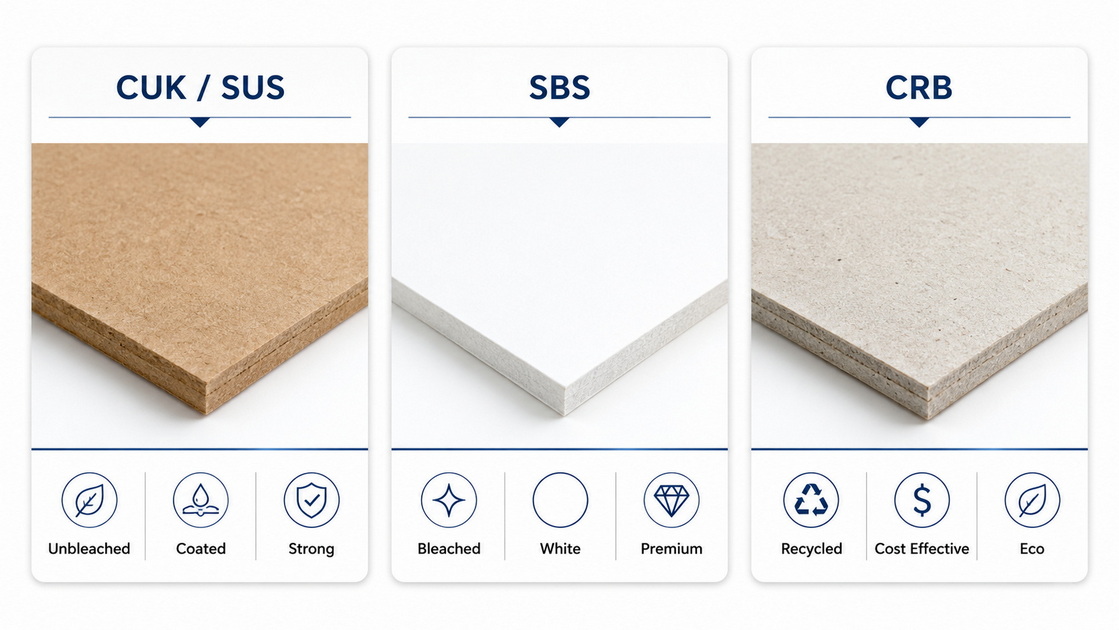
Coated Unbleached Kraft (CUK), also known as Solid Unbleached Sulfate (SUS), is an unbleached kraft board coated with kaolin clay and titanium dioxide for a smoother, printable surface. It typically consists of around 80% virgin fiber kraft pulp, offering: [transparencymarketresearch]
- Great tear resistance and stiffness without being overly thick.
- A strong, natural brown or kraft tone with a printable coated side.
- Suitability for durable folding cartons and sleeves, especially where a natural look is desired.
CUK/SUS is widely used in food, beverage, personal care, and eco-forward consumer products. [researchandmarkets]
Solid Bleached Sulfate (SBS) is produced by bleaching kraft pulp to create a bright white, smooth board. [transparencymarketresearch]
- It offers excellent printability and premium appearance, ideal for luxury and high-end packaging.
- It is often chosen for cosmetics, premium confectionery, and high-value retail boxes. [ecopackables]
However, bleaching introduces additional processing and environmental considerations, so brands must balance aesthetic goals with sustainability commitments. [british-business-bank.co]
Coated Recycled Board (CRB) is made from 100% recycled kraft paper, making it a cost-effective and eco-friendly substrate. [overfuel]
- CRB generally has lower stiffness and tighter tolerances compared to SBS or virgin CUK, but it is highly suitable for applications where extreme strength isn't critical, such as cereal boxes and lightweight folding cartons. [overfuel]
- Its lower material cost allows brands to pass savings to consumers or reallocate budget to printing and finishes. [researchandmarkets]
When combined with corrugated fluting layers, even recycled kraft can achieve strong structural performance.
Kraft paper has become a default choice for sustainable package boxes and retail packaging in many sectors. [mbpak]
- High strength-to-weight ratio: Kraft-based boxes can be lightweight yet durable enough for shipping and shelf display. [transparencymarketresearch]
- Versatile structures: Kraft supports everything from simple mailer boxes to complex display-ready cartons and gift boxes. [longwindisplay]
This makes kraft especially attractive for e-commerce, where boxes must survive sorting centers and courier networks while still delivering an acceptable unboxing experience. [shipbob]
Kraft paper is made from wood pulp, a renewable resource, and is biodegradable and recyclable. [british-business-bank.co]
- It can degrade naturally within weeks and can be processed into new paper products.
- Many kraft-based packaging solutions can carry FSC or similar certifications, aligning with corporate sustainability goals. [creativeretailpackaging]
Market reports show that kraft paper markets are growing steadily, driven by demand for sustainable packaging and regulatory pressure on plastics, with forecasts suggesting market values reaching around 20–23 billion USD by 2026–2030. [strategicpackaginginsights]
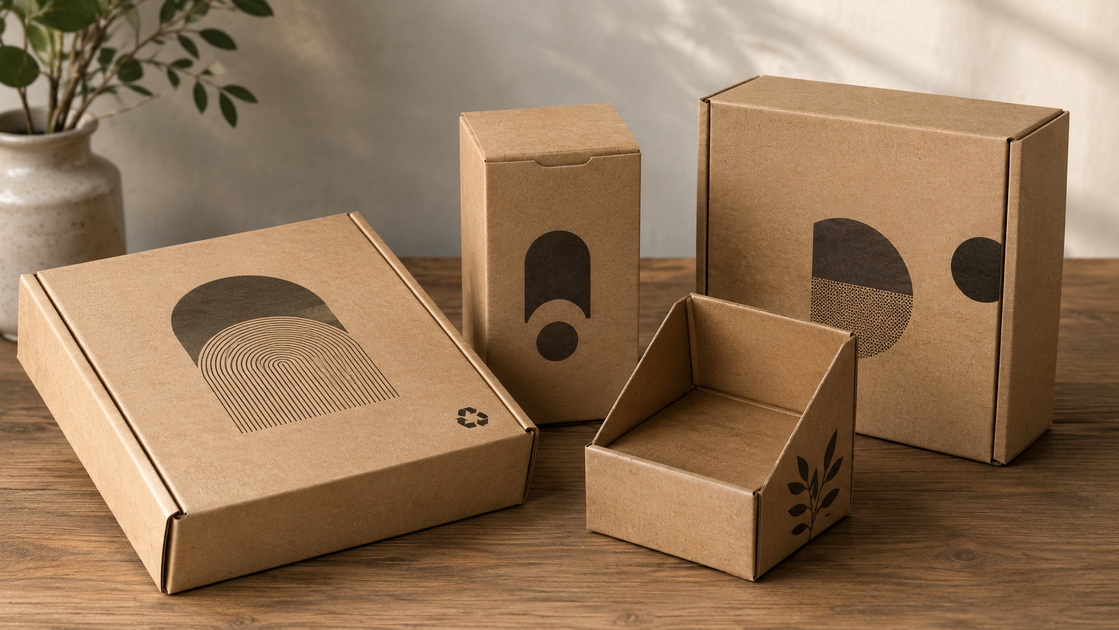
One reason brands love kraft is its customization flexibility. [ecopackables]
- High-quality printing is possible on coated kraft surfaces, including offset and digital methods.
- Kraft supports a wide range of finishes, such as:
- Embossing and debossing
- Foil stamping
- Spot UV and varnishes
- While traditional kraft is brown, boards can be produced in different colors and tints, or combined with printed designs that still maintain the kraft "feel". [ecopackables]
This makes kraft an ideal canvas for rustic, minimalist, or heritage-inspired brand identities.
Brands can also customize:
- Box structures: mailers, sleeves, tuck-end cartons, rigid boxes, display boxes.
- Interior fitments: kraft inserts, dividers, and trays that replace plastic thermoforms. [longwindisplay]
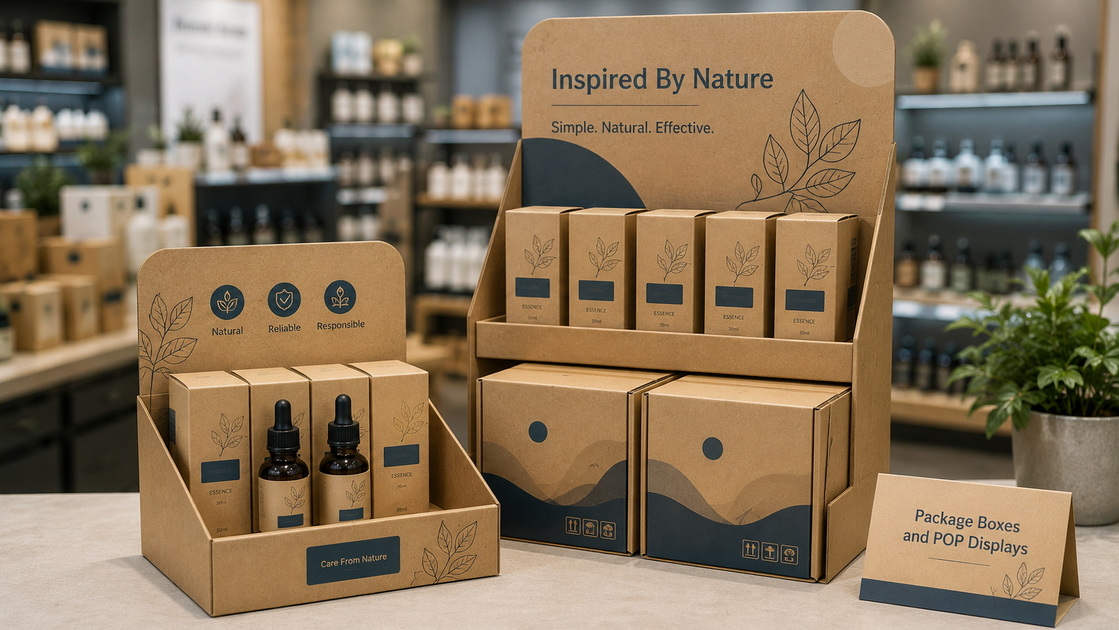
- Integration with POP displays: package boxes that double as counter displays or fit seamlessly into cardboard display stands, a common practice at Long Win Display. [longwindisplay]
For many of our clients, kraft packaging becomes a bridge between shipping, shelf presence, and display execution.
From a sustainability standpoint, kraft is often a strong improvement over plastics and non-recyclable composites, but it is not impact-free.
- Kraft is made from wood pulp, which can be sourced from responsible forestry.
- It is recyclable in most paper recycling systems and biodegradable under normal conditions. [british-business-bank.co]
- Many brands use kraft to support "paperization" strategies, replacing plastic packaging with paper-based formats. [creativeretailpackaging]
The kraft process uses chemical pulping, which can produce environmental impacts if not well managed. [researchandmarkets]
- Responsible mills implement closed-loop systems, energy recovery, and waste minimization.
- Brands should seek suppliers that can show environmental certifications or sustainability reports for their paper sources. [british-business-bank.co]
Compared with many plastic-based options, kraft remains one of the more environmentally friendly mainstream packaging materials, especially when combined with recycling and responsible sourcing. [strategicpackaginginsights]
The Sonhab Chocolate case provides a useful example of kraft's role in branding and sustainability. [overfuel]
- As a small-batch chocolatier, Sonhab needed packaging that aligned with sustainability values while supporting a cohesive brand experience.
- Kraft paper boxes allowed them to create durable, reliable packaging for handcrafted chocolates, with a surface suitable for handwritten notes and foil-stamped details. [overfuel]
- The result was a rustic, eco-aligned aesthetic that enhanced customer experience and reinforced their brand story, while also reducing their carbon footprint compared with heavier, multi-material packaging. [overfuel]
This kind of case is increasingly common in sectors like food, cosmetics, and lifestyle products, where kraft packaging underlines both authenticity and environmental awareness. [yourpapersource]
Recent industry analyses highlight that kraft packaging is entering a new growth phase, driven by sustainability, regulation, and e-commerce. [mbpak]
Key trends include:
- Steady market growth: Reports project the global kraft paper market to surpass 20.8 billion USD by 2026, with continued expansion thereafter. [transparencymarketresearch]
- Rising adoption in e-commerce: Kraft-based mailers, boxes, and void-fill materials are becoming standard in online retail logistics. [shipbob]
- Improved performance: Technological advances are enhancing moisture resistance and barrier properties, allowing kraft to compete in more demanding applications like food and certain liquids. [linkedin]
For packaging buyers, this means kraft will continue to evolve, offering more functional options while maintaining its sustainability profile.
Many marketing and procurement teams struggle with translating "we want kraft" into a precise specification. Here is a practical, step-by-step approach we use with Long Win Display clients. [longwindisplay]
- Product weight and fragility
- Shipping and handling conditions (e-commerce vs. in-store)
- Moisture and grease exposure (e.g., food vs. dry goods) [british-business-bank.co]
This informs board selection (CUK, SBS, CRB, corrugated) and structural design.
- Decide whether the visual should be natural kraft, tinted, or fully printed.
- Clarify ESG and certification needs (e.g., FSC, recycled content targets). [creativeretailpackaging]
This narrows down acceptable material sources and finishes.
- Select box style (mailer, tuck-end, rigid, display box).
- Determine whether the package must integrate with POP displays or act as a countertop unit when opened. [longwindisplay]
This joint thinking is critical for brands using Long Win Display for both package boxes and display stands.
- Run structural and print prototypes to check strength, color, and finishing quality.
- Test real lifecycle conditions (drop, stacking, humidity where relevant). [shipbob]
Short feedback loops here avoid costly surprises during major launches.
As a POP display and package box manufacturer, Long Win Display frequently combines kraft with other substrates to deliver display-ready packaging. [longwindisplay]
Typical project patterns include:
- Kraft package boxes that ship products and then act as counter displays once opened and folded, reducing extra materials and handling.
- Kraft cartons and gift boxes integrated into cardboard display stands, creating cohesive brand blocks at retail. [longwindisplay]
- Collaboration with brands to design multi-use structures that support both logistics and merchandising goals.
Because our team manages both structural design and production, we can optimize board grades, panel sizes, and print layouts to balance cost, sustainability, and visual impact for each campaign. [longwindisplay]
If you are planning a new product launch, e-commerce upgrade, or POP campaign, now is the time to evaluate where kraft paper can replace less sustainable materials and improve both cost and brand perception. [yourpapersource]
By partnering with a specialist like Long Win Display, you can:
- Integrate package boxes and POP displays using kraft-based solutions.
- Balance structural performance, printing quality, and sustainability for each SKU.
- Leverage OEM/ODM services that adapt designs, materials, and preloading options to your specific retail channels. [longwindisplay]
Prepare a concise brief with your product dimensions, weight, target markets, sustainability requirements, and retail environments, then work with our design and engineering teams to turn kraft paper into a strategic packaging asset rather than just a material choice.
1. Is kraft paper always the most sustainable packaging choice?
Not always. Kraft paper is generally more sustainable than many plastics and laminates because it is renewable, recyclable, and biodegradable, but overall impact depends on fiber sourcing, recycling infrastructure, and coatings used in the final structure. [british-business-bank.co]
2. Can kraft paper be used for premium or luxury packaging?
Yes. Using bleached kraft (SBS) or high-quality unbleached boards with foil stamping, embossing, and thoughtful structural design can create premium kraft-based packaging suitable for high-end cosmetics, confectionery, and gifts. [creativeretailpackaging]
3. Is recycled kraft paper as strong as virgin kraft?
Recycled kraft (CRB) generally has lower stiffness and strength than virgin CUK/SUS, but for many applications—like cereal boxes and lightweight cartons—it is sufficiently strong and offers cost and sustainability advantages. [towardspackaging]
4. How do coatings affect the recyclability of kraft packaging?
Light, water-based coatings usually maintain recyclability, while heavy plastic laminates or metallization can complicate or prevent recycling. It's important to discuss coating options with both your packaging supplier and downstream recyclers. [ecopackables]
5. What data should I request from a kraft packaging supplier before choosing them?
Ask for board specifications (grade, thickness, recycled content), sustainability certifications (e.g., FSC), print and finishing samples, and evidence of relevant case studies in your category or retail channel. [creativeretailpackaging]
1. PakFactory – "What is Kraft Paper and Why is it a Popular Packaging Choice?"
https://pakfactory.com/blog/what-is-kraft-paper/ [overfuel]
2. MBPAK – "Where Kraft Packaging Is Heading in the Next 5 Years."
https://mbpak.eu/where-kraft-packaging-is-heading-in-the-next-5-years/ [mbpak]
3. Your Paper Source – "Why Sustainable Packaging Is Driving Demand for Kraft Paper in 2026."
https://yourpapersource.com/blogs/news/why-sustainable-packaging-is-driving-demand-for-kraft-paper-in-2026 [yourpapersource]
4. USA Kraft Paper Market – "Expansion, Drivers, and Challenges."
https://www.linkedin.com/pulse/usa-kraft-paper-market-expansion-drivers-challenges-vvlqf [linkedin]
5. Towards Packaging – "Unbleached Kraft Paperboard Market Trends & Size 2026–2035."
https://www.towardspackaging.com/insights/unbleached-kraft-paperboard-market-sizing [towardspackaging]
6. Research and Markets – "Kraft Paper Market Report 2026."
https://www.researchandmarkets.com/reports/5939044/kraft-paper-market-report [researchandmarkets]
7. Transparency Market Research – "Kraft Paper Market Size, Trends, Analysis & Forecast – 2026."
https://www.transparencymarketresearch.com/kraft-paper-market.html [transparencymarketresearch]
8. British Business Bank – "Eco-friendly Packaging Alternatives for Your Business."
https://www.british-business-bank.co.uk/business-guidance/guidance-articles/sustainability/eco-friendly-packaging-alternatives [british-business-bank.co]
9. Long Win Display – "Customized Package Box Manufacturer & Factory."
https://www.longwindisplay.com/package-box.html [longwindisplay]
10. Creative Retail Packaging – "Top Packaging Trends for 2026."
https://creativeretailpackaging.com/packaging-insights/packaging-trends/ [creativeretailpackaging]
11. ShipBob – "Eco-Friendly Packaging Options for Ecommerce Orders."
https://www.shipbob.com/blog/eco-friendly-packaging/ [shipbob]
12. EcoPackables – "Sustainable Retail Packaging."
https://www.ecopackables.com/collections/sustainable-retail-packaging [ecopackables]


