
Views: 222 Author: Long Win Display Publish Time: 2026-05-11 Origin: Site


Shipping fragile products is not just about getting items from A to B; it is about protecting your brand promise every time a customer opens a box. As someone who has worked closely with brands shipping everything from glassware to high-end cosmetics in custom package boxes and POP displays, I have seen how a single broken shipment can undo months of marketing and customer acquisition. This guide combines hands-on packaging experience, current best practices and carrier recommendations to help you ship fragile products more safely, consistently and profitably. [fedex]
Fragile shipping today is less about a "handle with care" sticker and more about engineering a protective system around your product. Carriers process thousands of parcels per hour, and real-world handling includes stacking, conveyor impacts, vehicle vibration and accidental drops. That means your packaging must perform even if the box is dropped, tilted, compressed or briefly crushed. [speedwaypackaging]
From a brand perspective, every damaged shipment increases costs, but it also silently erodes customer trust and repeat purchase rates. In categories like cosmetics, electronics, home decor or premium beverages, customers often associate the unboxing experience with overall product quality, so a broken or poorly packed item can be perceived as a low-quality brand. [magetop]
Before choosing a box or filler, you need a clear view of the risk environment your fragile item will face. [easypost]
Key stress factors during shipping include: [fedex]
- Vertical drops from waist height
- Side impacts on conveyor edges
- Compression from stacked cartons
- Vibration inside trucks and containers
- Temperature and humidity changes
For each SKU, map these factors against the product's weak points: thin stems, protruding parts, sharp corners, seams, heavy components that can "punch through" the packaging, or liquids that could leak. This simple risk assessment will guide your choice of box strength, insert design and cushioning thickness. [ecoenclose]

This section lays out a practical, repeatable packing process your team can follow to reduce breakage rates. [pakfactory]
The outer box is your first structural shield against impact and compression. [imperialdade]
Best practices: [speedwaypackaging]
- Use corrugated boxes (preferably double-wall for heavier or highly fragile items).
- Match box size closely to the product plus cushioning; oversize boxes increase movement and filler cost.
- Avoid reusing old, weakened cartons for commercial shipments.
Industrial packaging research consistently recommends corrugated boxes as the default outer packaging for fragile items because they combine strength, stackability and cost-effectiveness. [ecoenclose]
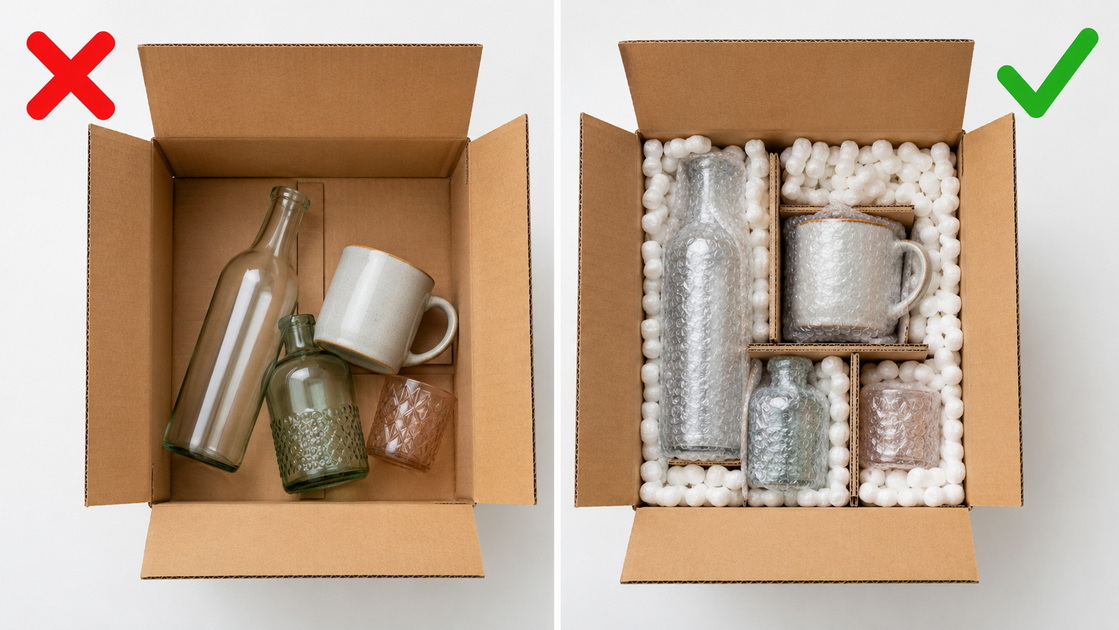
Never allow fragile items to touch each other directly inside the box. [easypost]
For each unit: [fedex]
1. Fill internal cavities (e.g., cups, glasses, vases) with crumpled paper or bubble wrap to prevent collapse.
2. Wrap the entire product in paper to avoid scratching, then secure lightly with tape.
3. Add at least one to three layers of bubble wrap or equivalent cushioning, securing with minimal tape.
Carriers such as FedEx recommend a minimum of about 3 inches of air-cellular cushioning around breakables, especially for particularly delicate items like glass or ceramics. [fedex]
Internal void fill prevents your product from "traveling" inside the box. [pakfactory]
Good practices: [speedwaypackaging]
- Place a cushioning layer at the bottom before inserting the product.
- Position the wrapped item in the center, not touching any wall of the box.
- Fill all four sides and the top with cushioning material (paper, bubble wrap, foam, air pillows or custom inserts).
For premium brands, custom-cut foam or cardboard inserts can both protect the item and support a more refined unboxing experience. [imperialdade]
Once packed, gently shake the box. If you feel or hear items moving, you still have risk. [pakfactory]
To reduce this: [easypost]
- Add more void fill around any loose areas.
- Pay particular attention to corners, edges and heavy parts that can shift.
- Re-test until there is no internal movement.
Some sustainability-focused packaging providers recommend a quick "drop test" or at least a realistic shake test before scaling a packaging design, to verify that the system actually protects the product in real-world conditions. [ecoenclose]
Even an expertly packed box can fail if the closure is weak. [speedwaypackaging]
Follow these steps: [easypost]
- Use high-quality packing tape; avoid thin, low-adhesion tapes.
- Apply the "H-taping" method: one strip along the central seam, and one along each edge of the top and bottom flaps.
- Reinforce the bottom of the box for heavy fragile items to prevent the contents from breaking through.
Packaging specialists consistently highlight sealing quality as a critical factor in keeping boxes intact throughout the shipping chain. [speedwaypackaging]
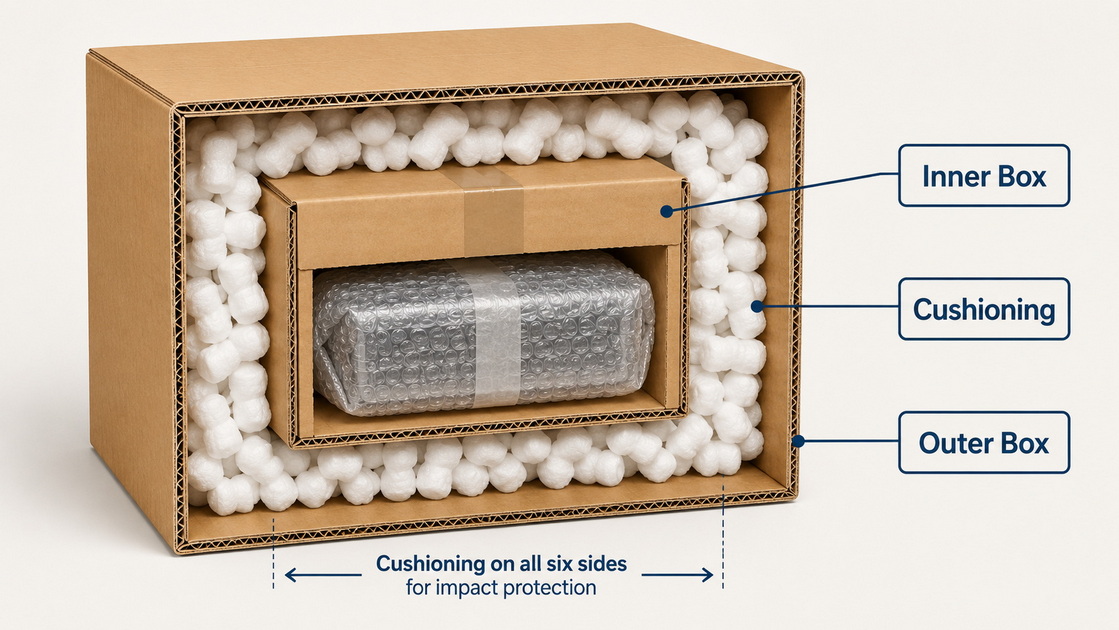
For particularly delicate or high-value items, a double-box strategy dramatically improves protection. [fedex]
How it works: [pakfactory]
- Pack the product in a smaller inner box, fully cushioned.
- Place that inner box inside a larger outer carton.
- Surround the inner box on all sides with at least several centimeters of cushioning material.
Major carriers explicitly recommend double-boxing for fragile items like fine glassware, antiques and sensitive electronics because it creates a second barrier against sharp impacts and compression. [easypost]
Selecting the right combination of materials is the backbone of safely shipping fragile products. [imperialdade]
Material type | Primary role for fragile items | Best use cases | Notes |
Corrugated boxes | Structural protection | Outer boxes for most fragile products | Double-wall recommended for heavy or very delicate items. (imperialdade) |
Bubble wrap / cushioning | Shock absorption | Wrapping glass, ceramics, electronics | Excellent for individual wrapping; adjust thickness to fragility. (fedex) |
Foam inserts (PE/EVA) | Precision protection | Premium, high-value and shaped products | Custom-cut to product shape; supports brand presentation. (imperialdade) |
Paper void fill | Movement control | General e‑commerce packaging | Good eco perception; must be packed tightly to prevent shifting. (ecoenclose) |
Air pillows | Lightweight cushioning | Filling gaps in outer boxes | Ideal for light, moderately fragile goods; not ideal for very sharp or heavy items. (imperialdade) |
Industrial packaging guidance emphasizes that there is no single "best" material; the right combination depends on weight, fragility, product geometry and brand positioning. [ecoenclose]
From a practical standpoint, most brands juggle three constraints: damage reduction, packaging cost and environmental impact. [altitudemarketing]
Industry trends show a steady move toward more sustainable options such as paper-based cushioning, molded pulp inserts and right-sized custom boxes that reduce excess material. However, experts still warn that eco-friendly choices must not compromise protective performance; the priority is to maintain a low breakage rate, then optimize material efficiency. [imperialdade]
In my experience working with global brands on custom POP displays and packaging, the most successful strategies use engineered solutions such as custom cardboard inserts or foam structures that both protect and present the product, instead of overfilling a generic box with loose filler. [longwindisplay]
User feedback and community discussions around shipping fragile items reinforce a few recurring themes. [reddit]
Common pain points include: [reddit]
- Insufficient cushioning or empty space inside the box
- Items allowed to touch each other without dividers
- Overreliance on "fragile" labels instead of robust packaging
- Excessive plastic use rather than recyclable materials
On the positive side, customers often praise shipments that use recycled paper, cardboard offcuts or compostable materials as void fill, highlighting the "second gift" feeling when packaging is easy to recycle or reuse. This aligns with broader consumer expectations for both protective and environmentally responsible packaging. [reddit]
Clear labeling plays a supporting role in shipping fragile products safely. [freightamigo]
Best practices: [freightamigo]
- Use visible "FRAGILE" and "HANDLE WITH CARE" labels on multiple sides of the box.
- Add orientation indicators such as "THIS SIDE UP" with arrows.
- For international shipments, consider multilingual labels to improve handling understanding across regions.
However, logistics experts consistently stress that labels alone cannot guarantee careful handling; your packaging design must protect the product even if it is treated like any other parcel. [freightamigo]
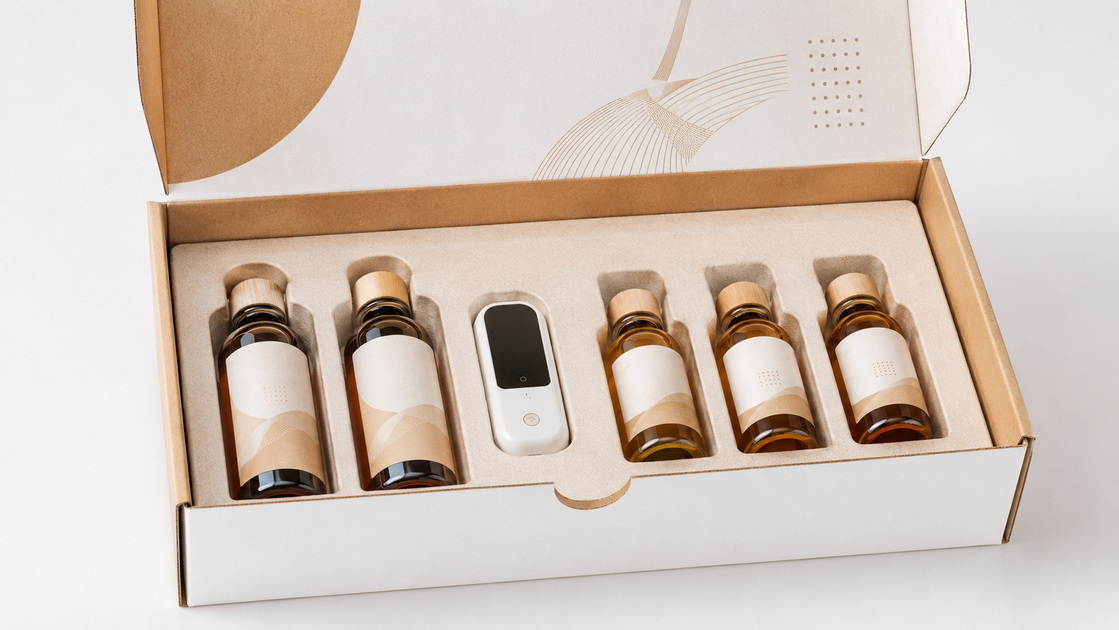
As a manufacturer of custom package boxes and POP displays, Long-Win Display sees firsthand how tailored packaging solutions can reduce damage rates and elevate brand perception. [longwindisplay]
Custom solutions can include: [longwindisplay]
- Structural cardboard inserts that lock fragile products in place
- Die-cut cavities for bottles, jars or electronics
- Display-ready packaging that ships, protects and then presents the product on-shelf
- Branded exterior and interior printing to reinforce the unboxing experience
By designing packaging around your specific product dimensions and fragility profile, you can often reduce filler, improve stacking strength and deliver a more consistent customer experience compared to generic off-the-shelf cartons. [longwindisplay]
An often-missing step in many guides on how to safely ship fragile products is systematic testing. [ecoenclose]
Practical QA steps include: [fedex]
- Performing internal drop and vibration tests on new packaging designs
- Monitoring damage rates by SKU, channel and carrier
- Collecting customer feedback and photos when issues occur
- Iterating box size, inserts and materials based on real-world data
E‑commerce logistics resources emphasize that brands that regularly review packaging performance can reduce damage-related returns significantly over time, sometimes by double-digit percentages. [freightamigo]

If your team is seeing recurring breakage, rising return costs or inconsistent unboxing experiences, it may be time to collaborate with a specialist. [longwindisplay]
Indicators you should consider a partner like Long-Win Display include: [longwindisplay]
- Multiple fragile SKUs with different shapes and fragility levels
- International shipping where transit conditions vary widely
- The need for packaging that both ships safely and functions as on-shelf POP display
- Ambitious sustainability or branding goals that exceed what generic boxes can provide
An experienced POP display and packaging manufacturer can help you design and test custom package boxes, inserts and display-ready solutions that align with your brand, budget and logistics constraints. [longwindisplay]
If you are serious about reducing breakage, improving customer satisfaction and turning your shipping boxes into a brand asset, consider working with a custom packaging partner who understands both structural protection and retail presentation. Long-Win Display can help you design and manufacture tailored package boxes and POP displays that protect your fragile products throughout the supply chain and enhance your in-store presence. [altitudemarketing]
1. What is the safest way to ship fragile items like glass and ceramics?
The safest method is to individually wrap each item, use sufficient cushioning, restrict movement inside a properly sized corrugated box and double-box highly fragile or valuable products. [ecoenclose]
2. Are "fragile" labels enough to prevent damage during shipping?
Labels help, but they cannot replace robust packaging; logistics experts emphasize that packing must withstand normal conveyor, stacking and drop conditions regardless of labeling. [freightamigo]
3. How can I reduce packaging waste while still protecting fragile products?
Use right-sized custom boxes, paper-based void fill and engineered inserts that minimize excess material, but always validate designs with testing to ensure damage rates remain low. [reddit]
4. When should I use double-boxing for fragile shipments?
Double-boxing is recommended for highly fragile, heavy or high-value items, or whenever damage would be especially costly to your brand or operations. [fedex]
5. How do I know if my current fragile packaging is good enough?
Track damage-related returns by product and carrier, gather customer feedback, and conduct periodic internal tests; if you see recurring issues, redesign the packaging or seek expert support. [freightamigo]
1. FedEx – "Packing breakables 101" – guidance on cushioning, double-boxing and sealing fragile shipments. [fedex]
2. PakFactory – "How to Safely Ship Fragile Products and Avoid Breakage" – foundational steps for wrapping and padding fragile items. [pakfactory]
3. EcoEnclose – "Shipping Fragile Items: How to Package Your Breakables" – best practices and sustainable packaging options. [ecoenclose]
4. Imperial Dade – "The Best Industrial Packaging Solutions for Fragile Items" – overview of cushioning, corrugated boxes and inserts. [imperialdade]
5. Speedway Packaging – "How to Package Fragile Items for Safe Shipping" – recommendations on box strength and sealing methods. [speedwaypackaging]
6. EasyPost – "Shipping Fragile Items: Packing Tips To Avoid Damage" – high-level guidance on box sizing, cushioning and labeling. [easypost]
7. FreightAmigo – "2025 Fragile Shipping Guide" – discussion of fragile labeling, handling and customs considerations. [freightamigo]
8. Long-Win Display – "Custom Cardboard Display & Package Box Manufacturer" – information on custom POP displays and packaging solutions. [longwindisplay]
9. Reddit – "Tips on shipping fragile items" – user discussions of risks and practical experiences. [reddit]
10. Reddit – "Good job, this is how you package fragile goods" – user feedback on effective, low-waste fragile packaging. [reddit]
11. Altitude Marketing – "SEO Strategies for Packaging Brands" – insight into SEO and authority building for packaging companies. [altitudemarketing]
12. Magetop – "How SEO Can Transform the Packaging Industry" – on-page and content strategies for packaging manufacturers. [magetop]


