
Views: 231 Author: Long Win Display Publish Time: 2026-10-23 Origin: Site


Content Menu
● Custom Cardboard Display Lead Time
● What Starts the Sampling and Production Clock?
>> Before Sampling: Confirm the Design Inputs
>> Before Production: Approve One Final Specification
● How Long Does a Custom Cardboard Display Sample Take?
>> White Samples: Validate Structure and Product Fit
>> Printed Samples: Review Graphics and Presentation
>> Revisions: Allow Time for Another Review Cycle
● How Long Does Cardboard Display Mass Production Take?
>> Printing, Lamination, and Finishing
>> Cutting, Gluing, and Assembly
● Flat-Packed, Pre-Assembled, or Product-Loaded: Which Timeline Applies?
● Three Checks That Prevent Expensive Timeline Surprises
>> 1. Test the Intended Load, Not Just the Appearance
>> 2. Match Transport Testing to the Distribution Route
>> 3. Run an Assembly Trial Before Shipment
● How to Work Backward from a Retail Launch Date
>> Illustrative Schedule: Why Factory Time Is Only One Part
● How to Reduce Lead Time Without Skipping Essential Checks
>> 1. Can a custom cardboard display sample really be made in 24 hours?
>> 2. Does production lead time include international shipping?
>> 3. Do I need both a white sample and a printed sample?
>> 4. Can mass production begin before the printed sample is approved?
>> 5. Will ordering more displays always extend production time?
Sampling a custom cardboard display can take as little as 24 hours for a straightforward white prototype, while mass production may take approximately 12–15 working days after final approval. However, custom cardboard display lead time is not the same as delivery time. Structural revisions, printed samples, buyer approvals, pre-assembly, and international shipping all affect when your display reaches the retail floor.
At Long Win Display, we design, customize, manufacture, and pre-assemble cardboard display stands for brands entering retail environments. Our recommendation is simple: plan around your required arrival date, not just the number of days needed to manufacture the display.
This guide explains what each stage involves, where delays develop, and how to build a practical schedule.
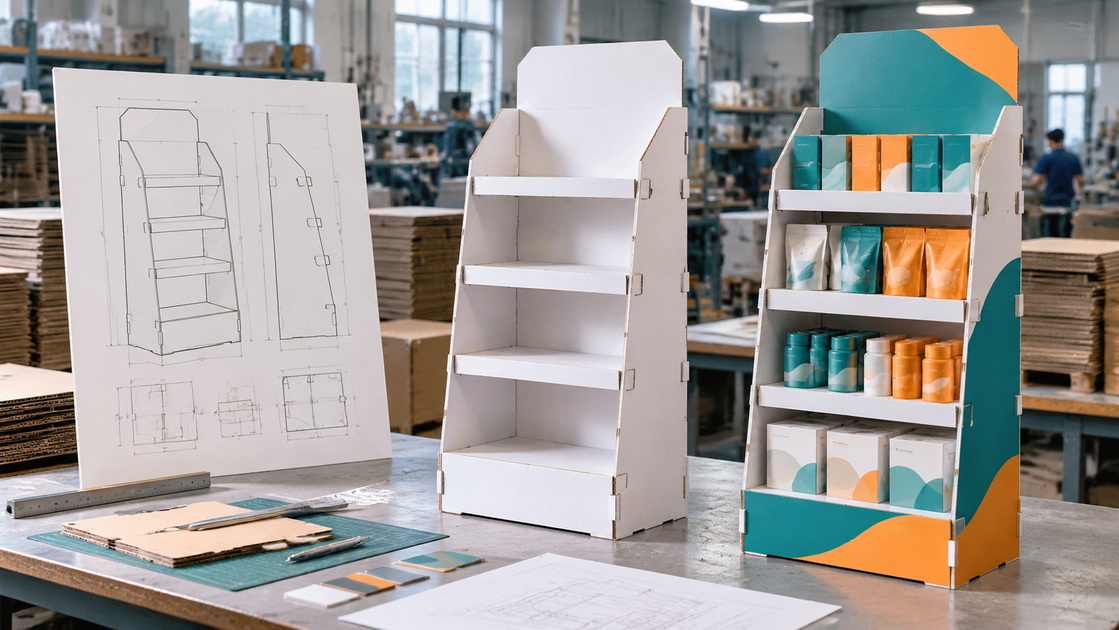
The following ranges provide planning context rather than a guaranteed schedule. Published supplier timelines vary because display complexity, approval requirements, and production scope differ.
| Project stage | Indicative timing | What the estimate depends on |
|---|---|---|
| Rapid white sample | As little as 24 hours | Straightforward structure, complete specifications, available materials |
| Standard white sample | Approximately 2–5 working days | Engineering complexity and sample workload |
| Printed color sample | Approximately 3–7 working days | Approved artwork, printing method, finishing |
| Mass production | Approximately 12–20 working days | Quantity, materials, finishing, assembly, factory capacity |
| Sample delivery and buyer approval | Confirm separately | Courier route, review process, revision rounds |
| Freight and destination delivery | Quote separately | Transport mode, customs, receiving appointments |
Some simple orders may move faster. More complicated retail programs can take substantially longer.
The most important question is: What exactly does the quoted lead time include?
Ask whether it covers structural development, printed sampling, packing, pre-assembly, and dispatch—or only manufacturing after approval.
A request for quotation does not necessarily start the sample countdown.
A factory may still need product dimensions, shelf loads, a display footprint, or clarification about the intended packing method. Likewise, approving a quotation does not automatically authorize production.
Provide the information needed to create a workable structure:
- Product dimensions, unit weights, and packaging format.
- Number of products per shelf, hook, or compartment.
- Maximum display width, depth, and height.
- Intended retail location and display duration.
- Retailer requirements, where available.
- Required delivery date and destination.
- Flat-packed, assembled, or product-loaded shipping preference.
Physical product samples are particularly useful when packaging has irregular shapes, flexible pouches, or protruding closures.
The production clock should start from an agreed milestone, such as written approval of the final structure, artwork, materials, packing specification, and commercial requirements.
Record that milestone in the order confirmation.
Otherwise, one team may count from purchase-order placement while another counts from sample approval. Both may believe the schedule is correct, yet work toward different dispatch dates.
Sampling time depends on what the sample must prove. A white structural prototype and a printed color sample answer different questions.
A white sample is an unprinted prototype used to evaluate construction.
For a straightforward display with complete inputs, rapid sampling may be possible within 24 hours. Other supplier guidance places standard white sampling at approximately 2–5 working days.
Do not treat the fastest published turnaround as a universal promise.
Use the white sample to check:
- Whether products fit without squeezing or excessive movement.
- Whether shelves remain level under the intended load.
- Whether the display stands securely when stocked.
- Whether locking tabs and supports assemble correctly.
- Whether shoppers can remove products easily.
- Whether the footprint matches the allocated retail space.
Approve the structure before committing to finished graphics. A shelf-height adjustment can change artwork positioning and require an updated cutting layout.
A printed sample adds another approval layer. Published industry guidance commonly allows approximately 3–7 working days, depending on artwork readiness and production requirements.
Review logo placement, text size, panel alignment, image quality, and finishing.
Also ask how the sample was produced. A digitally printed prototype may not reproduce every characteristic of the final production printing process.
When color accuracy matters, agree on the appropriate physical color reference or production proof. A screen preview alone should not define acceptance.
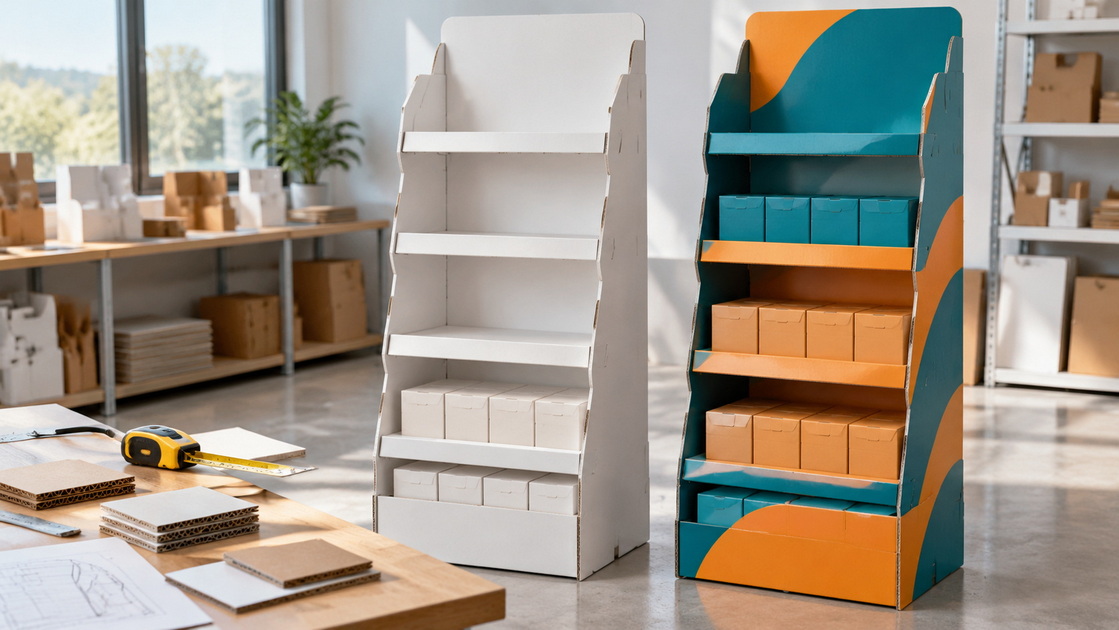
Changing a header is different from redesigning a load-bearing shelf.
Classify feedback as structural, graphic, or packing-related. Then submit one consolidated revision list with a clearly identified approver.
This prevents contradictory instructions and repeated sample rounds.
The original article's indexed summary gives approximately 12–15 days for mass production. Broader supplier guidance commonly quotes approximately 12–20 working days.
These figures describe manufacturing under specified conditions—not a universal order-to-door commitment. Confirm whether your quotation uses working days or calendar days.
Depending on the design, production may involve printing, mounting printed sheets onto corrugated board, surface finishing, and die-cutting.
Special finishes, unusual materials, or additional components can introduce extra scheduling dependencies.
A late artwork correction can also affect more than printing. If panel dimensions change, the cutting layout and assembly process may need review.
After printed components are prepared, the display must be converted into its final structure.
Simple countertop units and reinforced floor displays do not require identical operations. Hooks, dividers, internal supports, and multiple shelf components add handling and inspection steps.
Order quantity matters, but complexity matters too. A smaller order with many manually fitted components may require more coordination than a larger, simpler design.
Production is not finished merely because printing has ended.
The agreed schedule should include inspection, packing, labeling, and dispatch preparation. Confirm whether these activities sit inside the quoted production window.
For pre-assembled programs, also confirm how finished units will be protected during storage and transport.
"Pre-assembled" and "product-loaded" are not interchangeable.
A pre-assembled display arrives with its structure already built. A product-loaded display also contains the merchandise intended for sale.
| Delivery format | Main scheduling consideration | Buyer responsibility to clarify |
|---|---|---|
| Flat-packed | Assembly instructions and component packing | Who assembles the display at destination? |
| Pre-assembled | Assembly labor, protective packaging, shipping volume | Can the receiving location handle assembled units? |
| Product-loaded | Merchandise availability, loading, protection, labeling | Who supplies and approves the product-loading arrangement? |
The fastest factory option is not necessarily the fastest route to store readiness.
Flat packing can reduce shipping volume, but destination teams still need time to assemble and stock the displays. Pre-assembly shifts work upstream, where it must be included in the production plan.
Choose the format before finalizing the schedule—not after the display has been manufactured.
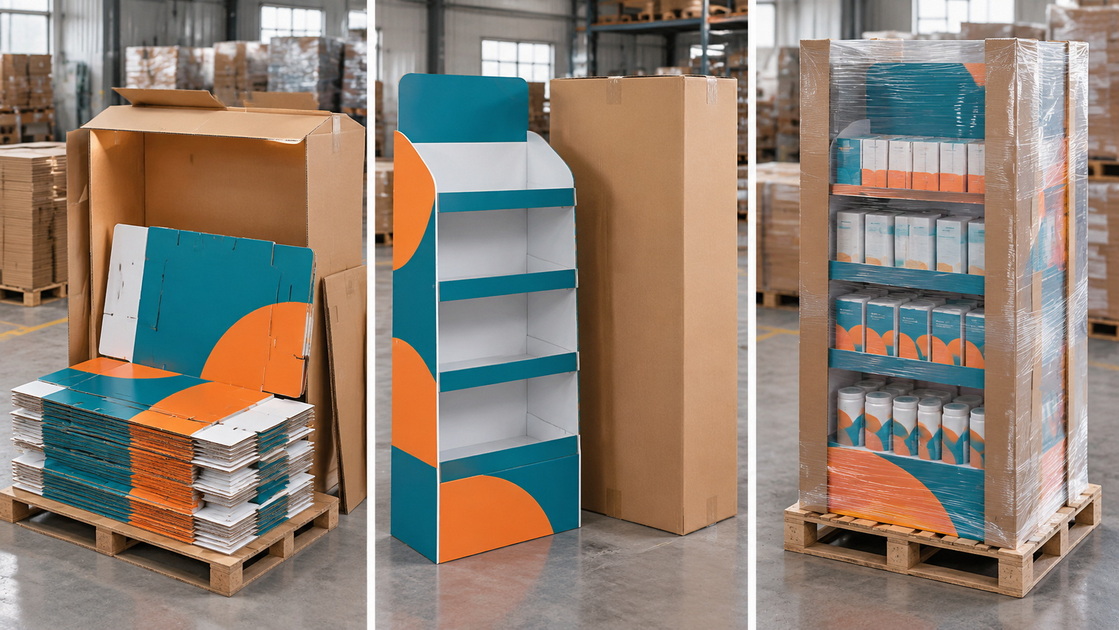
A prototype that looks correct when empty may behave differently when stocked.
Specify product weight per shelf, total display load, and expected use conditions. Review the structure with the intended merchandise wherever practical.
Ask the supplier to document the test arrangement, loading pattern, and acceptance criteria. Avoid approving a vague statement such as "strong enough" without defining the required load.
Structural review and transport testing serve different purposes. Neither should be assumed to replace the other.
A product-loaded display traveling on a pallet faces different handling conditions from individual flat-packed displays shipped as parcels.
The International Safe Transit Association publishes procedures for different distribution environments. For example, Procedure 3E addresses similar packaged products in unitized loads moving through full-truckload distribution.
That does not make 3E appropriate for every display shipment.
Agree on the relevant procedure with the retailer, packaging specialist, or testing laboratory. Include sample preparation, laboratory scheduling, conditioning where required, and potential corrective work in the project plan.
Have someone unfamiliar with the design assemble a sample using only the proposed instructions.
Record unclear steps, incorrectly fitted components, and tools required. For product-loaded units, check how the receiving team removes protective packaging and prepares the display for use.
This practical review can reveal problems that engineering drawings and polished product photographs do not show.
Start with the date the display must be ready for shoppers—not simply the date it should leave the factory.
Build the schedule backward through these milestones:
1. Store installation and merchandising.
2. Distribution-center processing and onward delivery.
3. Import clearance and destination handling.
4. International transport.
5. Factory inspection, packing, and dispatch.
6. Mass production.
7. Final sample and artwork approval.
8. Structural development and initial sampling.
Add a contingency allowance based on the risks in your actual program. Avoid applying an arbitrary buffer while leaving freight or buyer approval unplanned.
Suppose a project allows four working days for a white sample, three for buyer review, five for a printed sample, two for final approval, and fifteen for production.
If these stages run sequentially, they total 29 working days before freight.
This is a planning example, not a Long Win Display delivery promise. Some activities can overlap; others depend on completing the previous approval.
The lesson is that a fifteen-day production quotation does not mean a fifteen-day retail rollout.
The safest time savings usually come from removing uncertainty, not removing validation.
- Submit product dimensions and weights together.
- Confirm retailer restrictions before structural design.
- Appoint one person to consolidate approvals.
- Prepare artwork while structural development progresses.
- Freeze the approved cutting layout before final graphics.
- Supply actual merchandise early when product loading is required.
- Confirm packing, labeling, and delivery responsibilities upfront.
- Request separate sample, production, and freight milestones.
For urgent programs, ask whether an established structure can be adapted to your product. Reducing structural novelty may simplify development, provided the revised design still meets the required load and merchandising needs.
Do not authorize full production solely to recover time lost during approvals.
Sometimes. A straightforward white prototype may qualify when specifications are complete and materials and capacity are available. Printed samples, complex structures, and revisions require separate scheduling.
Not necessarily. Confirm the scope in writing. Manufacturing, freight, customs clearance, destination handling, and final delivery should have separate milestones unless the quotation explicitly combines them.
They validate different things. A white sample checks structure and fit; a printed sample checks presentation. Whether both are necessary depends on design novelty, print requirements, and approval risk.
It may be technically possible, but it creates additional risk. Any decision to proceed should identify which details remain unapproved, who accepts the risk, and what changes would require rework.
No. Quantity is only one factor. Material availability, printing capacity, component complexity, manual assembly, and packing requirements also influence the schedule. Request an estimate for the actual specification.
Original article. Its indexed summary states 24-hour rapid white sampling and 12–15-day mass production; the full page could not be retrieved during this review. [popdisplay]
2. [Leader Display — How Long Does It Take to Sample and Produce a Cardboard Display?]
Supplier-published planning ranges: approximately 2–5 working days for white samples, 3–7 for color samples, and 12–20 for production. These are indicative supplier estimates, not independently verified industry averages. [leader-display]
3. [PakFactory — Custom Cardboard Display Stands for Retail]
Additional supplier context on estimated turnaround and variation by order size, packaging type, and season. [pakfactory]
4. [Topwell Display — Cardboard Display Project Timeline: From Brief to Store Launch]
Practical context for approval stages, structural review, printed samples, packing, shipping, and store setup. [topwelldisplay]
5. [International Safe Transit Association — Test Procedures]
Primary-source guidance on distribution testing and the importance of selecting procedures appropriate to the shipping environment. [ista]
6. [International Safe Transit Association — Procedure 3E, 2026 Overview]
Primary-source description of unitized loads of similar packaged products in full-truckload distribution and relevant transport hazards. [ista]


