
Views: 249 Author: Long Win Display Publish Time: 2026-10-02 Origin: Site


Content Menu
● What Does Production Lead Time Include?
● A Practical Stage-by-Stage Timeline
● What Makes a Floor Display Take Longer?
>> Structural complexity and product weight
>> Board availability and substitutions
● The Hidden Schedule Risk: Approvals
>> An illustrative project scenario
● Plan From the Store Date Backward
● Test the Display for Its Delivery Route
● How to Shorten Lead Time Responsibly
● A Better RFQ for Custom Cardboard Floor Displays
>> 1. Does the four-to-eight-week estimate include international shipping?
>> 2. When should the production clock start?
>> 3. Can a supplier start printing before the structural sample is approved?
>> 4. Should we request ISTA 3A testing for every floor display?
>> 5. What change is most likely to invalidate an approved schedule?
Producing a custom cardboard floor display often takes about four to eight weeks, but that estimate is only useful when its starting and ending points are clear. Does the clock start when you send a brief, approve the structural sample, or release final artwork? Does it stop when the factory finishes production, when cartons leave its dock, or when displays reach stores? The existing article cites a four-to-eight-week range; buyers should treat it as a planning benchmark, not a guaranteed lead time for every design, quantity, or destination.
A custom cardboard floor display is a coordinated retail project. It brings together structural engineering, artwork, sampling, board procurement, printing, converting, assembly, quality checks, and packing. Pre-loading merchandise and international freight can add further stages. A reliable supplier should show you which steps are included in its quoted lead time and identify the approvals that could move the delivery date.

The phrase "production lead time" can describe different periods in different quotations. One supplier may count from purchase-order confirmation to factory dispatch. Another may start only after the buyer has approved a physical sample and print proof.
Before comparing quotes, ask each supplier to state four dates:
- Brief acceptance: The supplier has the product dimensions, load, retail requirements, quantities, and delivery destination.
- Design freeze: The structure, board specification, packing format, and artwork are approved for production.
- Factory-ready date: Finished displays have passed the agreed checks and are packed for collection.
- Required store date: The displays must be available for installation or sale at the retailer.
These dates prevent a common misunderstanding. A factory may meet its manufacturing promise while the retail campaign still launches late because freight, customs, distribution-centre processing, or store allocation were left outside the schedule.
The same distinction applies to flat-packed and pre-loaded displays. Flat-packed units require store or fulfilment staff to assemble and load them. Pre-loaded units require coordination between display production and merchandise supply before they can be packed. Long Win Display describes concept, sampling, production, pre-packing, and shipment as separate stages of its service process; its project quotation should specify which of those stages it will perform.
The table below is an illustrative planning model, not a published Long Win Display service commitment. Activities may overlap. A supplier should replace these ranges with a schedule based on your approved design, available materials, quantity, and factory capacity.
| Stage | Illustrative allowance | Buyer approval or output |
|---|---|---|
| Brief review and structural design | 3–5 working days | Confirm display dimensions, product load, retailer rules, and concept |
| White sample and fit checks | 4–7 working days | Test physical product fit, shelf load, assembly, and footprint |
| Color sample and artwork approval | 4–7 working days | Sign off print appearance and final production files |
| Board sourcing, printing, and converting | 10–20 working days | Check the agreed board, print, die-cutting, and production sequence |
| Assembly, inspection, and packing | 3–7 working days | Approve carton configuration and final quality records |
These allowances must not simply be added together: some work can proceed in parallel, while changes may send a project back to sampling. Printing preparation, for example, can begin while a sample is being reviewed, but a supplier should not release irreversible tooling or a full print run against an unapproved structure.
The most important date is often the design freeze. Before it, changes are part of development. After it, changing the footprint, shelf arrangement, board, or graphics may affect tooling, material orders, and the production slot. Ask the supplier to issue a revised schedule whenever an approved element changes.
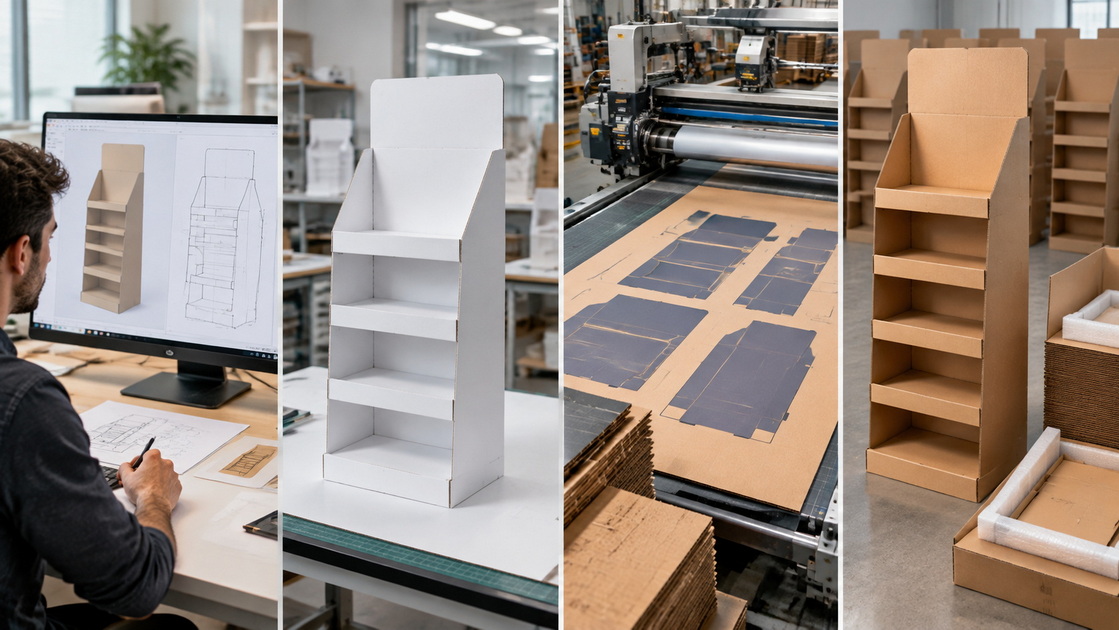
A lightweight promotional stand with a familiar shelf arrangement may need fewer design revisions than a display carrying heavy or unevenly distributed products. The supplier must verify not only that the display stands upright, but that it holds the specified merchandise during the intended campaign.
Provide actual product samples where possible. If samples are unavailable, send dimensions, packed weight, units per shelf, replenishment plan, and photos. A prototype approved with empty shelves does not prove that a fully loaded display is suitable.
Pay close attention to tab and slot fit. Corrugated board has physical thickness, and folds change how parts meet. A dieline that looks accurate on screen may be awkward to assemble in the chosen board. Test the proposed material and production-like cut parts rather than relying solely on a rendering. This is a more useful purchasing lesson from the existing article than repeating its unverified claims about particular time or labour savings.
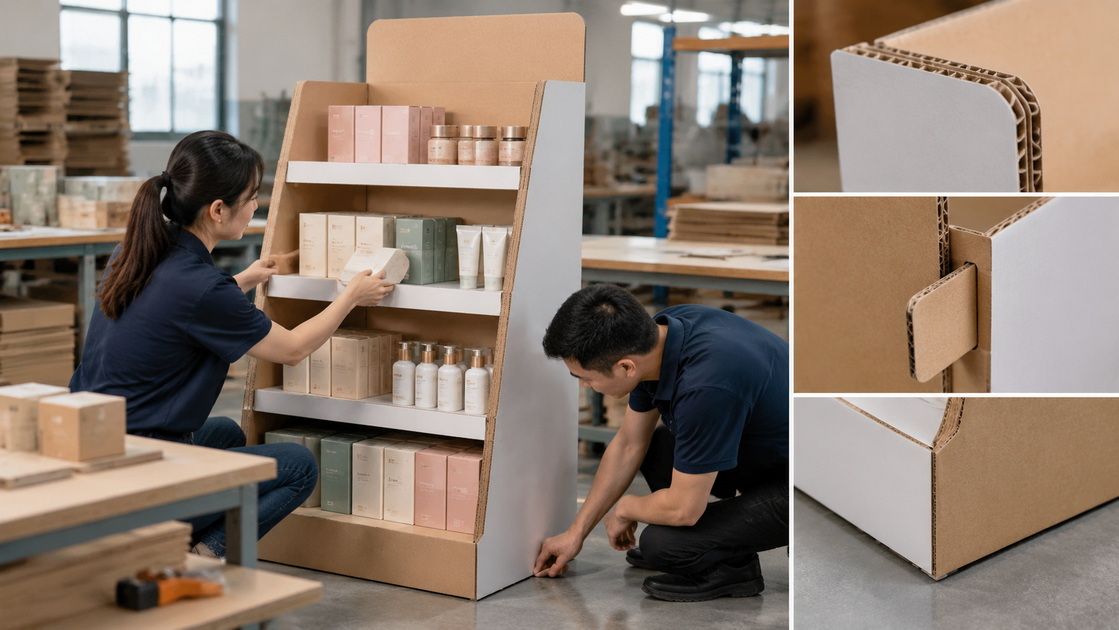
Artwork can become a schedule bottleneck when the brand approves a concept before supplying final files. The production team still needs the correct dieline, approved colors, readable product information, and any retailer-required graphics.
A buyer should also identify what is being approved. A PDF proof can reveal missing text or layout errors, but it may not show how color and finish will appear on the chosen substrate. If a physical color sample is important to the brand, build time for its review and potential revision into the project calendar.
Two samples that appear similar may use different board constructions. Do not approve "corrugated board" as the entire material specification. Record the intended grade, flute configuration, visible liner, and any protective treatment needed for the application.
Humidity deserves attention when a display will spend time in storage, transit, or a damp environment. Published research shows that temperature and moisture affect the mechanical properties of corrugated board. That research does not predict the life of your particular floor display. It does support testing the specified construction under conditions relevant to its actual distribution and use.
The factory is not the only party controlling lead time. A project can wait for a brand team to approve graphics, a retailer to confirm its footprint, or a co-packer to confirm how merchandise will arrive.
Set up a short approval register before sampling:
1. Name one decision-maker for structural approval and one for artwork approval.
2. List the evidence required at each gate: drawings, product-fit photos, physical samples, or packing instructions.
3. Set response dates that leave room for one revision rather than assuming first-pass approval.
4. Record version numbers on drawings, dielines, proofs, and the final sample.
5. Require a schedule update when a late change affects an approved version.
This is the practical difference between asking, "Can you make it in four weeks?" and asking, "What can be completed in four weeks after these named approvals?" The second question is far more likely to produce a schedule your team can manage.
Suppose a cosmetics brand needs a floor display for a multi-store launch. It provides complete product data, but its retailer has not yet approved the floor footprint. The supplier could proceed with a concept and perhaps a white sample. It should not assume that the same structure can enter final production unchanged.
If the retailer later reduces the permitted footprint, shelf spacing, stability, product capacity, and artwork placement may all need review. The delay is not simply "slow printing." It is an unresolved project dependency. This scenario is illustrative, not a documented Long Win Display customer case.
For a time-sensitive campaign, begin with the date stores must have usable displays. Work backward through distribution, freight, factory dispatch, inspection, production, and sample approval. This makes missing information visible early.
A working backward plan should include:
- The retailer's delivery window and any booking or labelling requirements.
- Time for the buyer's receiving warehouse or distribution centre.
- Transport from factory to destination, including customs where relevant.
- Final inspection, packing, and readiness for collection.
- Manufacturing and material procurement.
- White-sample and print approvals, including a revision allowance.
Keep factory production and transport as separate lines in the schedule. Freight depends on destination, shipping method, space availability, and import arrangements. A statement that production takes four to eight weeks should never be presented as a promise that displays will reach overseas stores in that period.
Also ask whether merchandise and displays are shipping together. If a supplier will pre-pack or pre-load the units, the products must be available in the right quantity and packaging format at the agreed time. Long Win Display says it offers pre-packing and store-ready shipment options; availability and timing should be confirmed for the specific order.
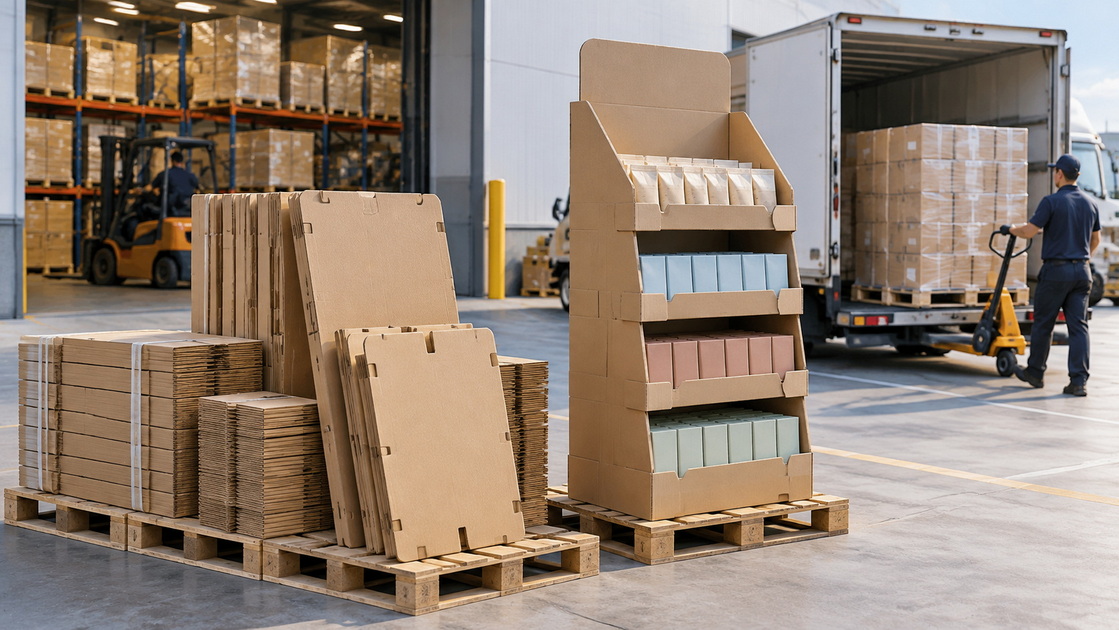
The appropriate test depends on how the packaged display will travel. A flat-packed unit sent as an individual parcel faces different handling from a pre-loaded unit moving on a pallet to a distribution centre.
The International Safe Transit Association (ISTA) distinguishes among several routes. Its published descriptions include Procedure 3A for certain individual parcel shipments, 3E for unitized loads of similar packaged products in full-truckload distribution, and 3F for certain individual packaged products travelling from a distribution centre to a retail outlet as part of a mixed pallet. That does not mean every cardboard display requires all three tests. Select a protocol—or a project-specific test plan—based on the actual shipment and retailer requirement.
Confirm the packaged configuration before testing. If production units will ship with products already loaded, a test on an empty flat-packed stand answers a different question. Likewise, testing a single carton does not automatically validate the stability of an entire palletized load.
For the in-store fixture itself, check the fully assembled unit with the intended merchandise. Record whether shelves deflect, the base remains stable, and staff can assemble or replenish it as instructed. A successful shipping test and a successful retail-use test address related but different risks.
A faster schedule does not have to mean omitting every check. The better approach is to remove avoidable waiting and make decisions earlier.
- Submit a complete brief. Include display dimensions, product data, shelf quantities, retailer specifications, quantity, delivery location, and required store date.
- Choose a proven structural starting point where appropriate. A suitable existing configuration may reduce design work, but still needs testing with your products.
- Develop artwork alongside the white sample. Avoid holding all graphics work until the structure is approved, while keeping the final dieline under version control.
- Set approval deadlines. Give the supplier a named contact who can consolidate comments instead of forwarding conflicting revisions.
- Agree on substitutions in advance. If an agreed board or finish is unavailable, require written approval of an alternative and a revised sample or test where needed.
- Confirm the packing method early. Flat-packed, assembled, and merchandise-loaded displays need different carton designs and labour plans.
Long Win Display's website says some urgent production orders can be completed in 7–10 days. That is a company-stated possibility for qualifying circumstances, not a verified promise for an entirely new, sampled, printed, pre-loaded, internationally shipped floor-display programme. Ask for a written milestone schedule before using an expedited figure in a retail launch plan.
A quotation is easier to compare when every supplier receives the same inputs. Send a one-page project brief plus supporting files:
- Retail format: floor-standing display, store footprint, height limits, and placement rules.
- Merchandise: dimensions, weight, units per shelf, total loaded weight, and any samples.
- Campaign: intended in-store duration, destination markets, and environmental concerns.
- Graphics: print files, brand-color requirements, finishes, and approval contact.
- Packing: flat-packed, pre-assembled, or pre-loaded; units per carton and required labels.
- Validation: assembly trial, load check, and transport-test requirements where appropriate.
- Commercial plan: pilot quantity, total quantity, phased releases, and required store date.
Then ask each supplier to return two dates: the expected factory-ready date and the estimated destination-ready date, with exclusions and assumptions listed. Request a separate price and schedule impact for pre-packing or a color-sample revision.
This turns lead time from a vague sales claim into a set of responsibilities. It also helps the buyer compare quotations that otherwise appear faster simply because they exclude sampling, packing, or delivery.
Not necessarily. The source article presents four to eight weeks as a typical custom-display production timeframe, but it does not establish a universal door-to-store transit commitment. Ask for factory-ready and destination-ready dates separately.
Use a defined contractual milestone, usually after the purchase order and all required structural, material, artwork, and sample approvals. A supplier may use a different starting point, so put the agreed definition in the quotation.
Some preparatory work may overlap, but releasing final print or tooling against an unapproved structure creates rework risk. Ask which tasks are reversible and which require the approved production dieline.
No. ISTA describes 3A for certain individual parcel shipments. Other methods address other routes, including unitized loads and distribution-centre-to-store movement. Match testing to the packaged product's actual journey and the retailer's requirements.
A late change to the approved structure or footprint can affect material, tooling, artwork, packing, and testing at once. Keep a controlled version of the approved sample and request a new schedule whenever a critical specification changes.
1. [PopDisplay, "How Long Does It Take to Produce a Custom Cardboard Floor Display?"] — Source article for the four-to-eight-week planning range and the structural-design issues re-examined here. Its first-person cases and specific performance claims have not been adopted as Long Win Display results. [popdisplay]
2. [Long Win Display, Company and Service Process] — Company-described concept, sampling, production, pre-packing, and shipment services; its expedited-production statement is a company claim requiring project-specific confirmation. [longwindisplay]
3. [International Safe Transit Association, Test Procedures] — Official descriptions of shipment-specific procedures, including 3A, 3E, and 3F. [ista]
4. [Cornaggia et al., "Influence of Humidity and Temperature on Mechanical Properties of Corrugated Board"] — Peer-reviewed research explaining why temperature and moisture matter to corrugated-board performance; not a test of this article's illustrative display. [bioresources.cnr.ncsu]
5. [Creative Displays Now, Corrugated Displays] — An industry example of structural prototyping before print production and coordination of display manufacturing and distribution. [creativedisplaysnow]


