
Views: 266 Author: Long Win Display Publish Time: 2026-11-01 Origin: Site


Content Menu
● What Is Kraft Paper in Packaging?
● How Is Kraft Paper Used in Packaging?
● How to Choose the Right Kraft Packaging Material
>> Virgin Fiber, Recycled Fiber, or a Combination?
>> Match the Construction to the Product
● Kraft Box Strength: What Buyers Should Actually Check
>> Fiber Direction and Flute Direction Are Different
>> ECT Does Not Guarantee Finished Box Capacity
>> Pallet Fit Matters, but It Is Not a Guarantee
● How Humidity Affects Kraft Paper Packaging
>> Validate Assembly Tolerances Under Relevant Conditions
● Printing on Kraft Paper Without Losing Brand Clarity
>> Why Brown Kraft Changes Color Appearance
>> Spot Colors vs CMYK Printing
>> Approve a Physical Production Reference
● Are Kraft Packaging Boxes Recyclable and Food Safe?
>> Recyclability Depends on the Complete Package
>> Food Contact Requires Intended Use Documentation
● A Practical Kraft Packaging Development Workflow
>> Step 1: Define the Packaging Job
>> Step 2: Compare Structural Options
>> Step 3: Build Representative Samples
>> Step 4: Select a Relevant Distribution Test
>> Step 5: Lock the Production Specification
>> 1. Is Kraft Paper the Same as Cardboard?
>> 2. Is Kraft Packaging Waterproof?
>> 3. Can Kraft Boxes Hold Heavy Products?
>> 4. Can Full Color Images Be Printed on Kraft Boxes?
>> 5. What Information Should I Include in a Kraft Box Quotation Request?
Kraft paper is used in packaging to make wrapping sheets, paper bags, protective fillers, folding cartons, and the liners of many corrugated boxes. For brands sourcing custom kraft packaging boxes, its value extends beyond a natural appearance. The right construction can support product protection, efficient packing, clear branding, and practical retail presentation.
At Long Win Display, our focus includes designing, customizing, manufacturing, and preassembling packaging boxes and POP display solutions. Our recommended starting point is simple: performance comes before appearance. Choose a packaging structure for the product and distribution route, then refine its material, printing, and finish.
This guide explains where kraft paper works, what buyers often misunderstand, and how to turn a packaging concept into a reliable production specification.

Kraft paper traditionally refers to paper made using the kraft chemical pulping process. The process separates cellulose fibers from wood while preserving useful fiber strength.
Unbleached kraft paper usually has a brown appearance. Bleached grades offer a lighter surface for applications requiring different visual characteristics.
However, brown color alone does not establish fiber composition, strength, recycled content, or suitability for a particular use.
When discussing kraft paper packaging with a manufacturer, distinguish between:
- Kraft paper: flexible sheets used for wrapping, bags, and other applications.
- Kraft paperboard: thicker material suitable for certain folding cartons.
- Corrugated board: a structure containing fluted paper between liners.
- Kraft-faced packaging: packaging with a kraft-looking exterior, which may contain other materials underneath.
These distinctions matter because a paper wrap and a corrugated shipping box protect products in very different ways.
"Kraft paper" is the established packaging term. "Craft paper" commonly describes paper used for creative activities.
The terms sometimes overlap in everyday searches, but purchasing documents should specify the actual paper grade, construction, and intended application rather than relying on either phrase alone.
Kraft paper can serve several roles within the same packaging system.
A product might sit inside a printed folding carton, receive paper-based cushioning, and travel inside a corrugated master carton. Each layer has a different job.
| Application | Typical construction | Main purpose | Important buying consideration |
|---|---|---|---|
| Product wrapping | Flexible kraft paper | Surface protection and presentation | Abrasion, cleanliness, and product compatibility |
| Void filling | Crumpled or converted paper | Limit movement inside a shipping box | Product weight and cushioning performance |
| Retail cartons | Suitable kraft paperboard | Containment and branding | Stiffness, closures, and print quality |
| Shipping boxes | Corrugated board with specified liners | Distribution protection | Compression, impact, and moisture exposure |
| Retail-ready trays | Die-cut corrugated construction | Shipping and shelf presentation | Opening method and remaining tray strength |
| Gift packaging | Paperboard or wrapped rigid construction | Presentation and organization | Inserts, finishing, and material separation |
Kraft retail boxes suit products whose branding benefits from a restrained, paper-based appearance.
Possible applications include personal-care products, accessories, stationery, and gift sets. However, the product's weight and fragility must determine the structure.
A lightweight carton may contain a small accessory effectively but provide little cushioning for a glass container. In that case, a fitted insert or additional protective system may be necessary.
In a corrugated box, strength comes from the combined behavior of liners, fluting, adhesives, dimensions, and converting quality.
The exterior may look like ordinary brown paper, but the finished structure performs differently from a single sheet.
For export shipments, evaluate the complete packed box rather than treating the kraft surface as evidence of shipping strength.
A well-designed carton can transport products and then convert into a shelf-ready tray.
This may reduce handling steps, but easy opening must not undermine distribution protection. Perforations, tear strips, and removable panels should be assessed in both shipping and display configurations.
The remaining tray must still hold products securely after the transport section is removed.
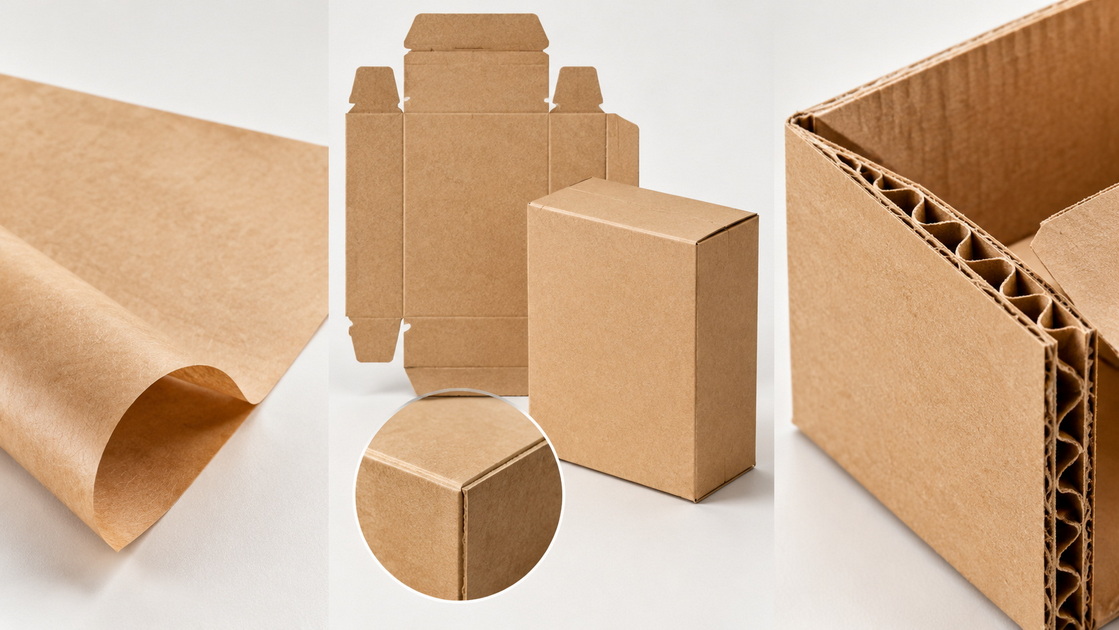
Virgin and recycled fibers can both play useful roles in packaging.
Do not assume that virgin material is always necessary or that recycled material is automatically unsuitable. Performance depends on the supplied grade, fiber blend, manufacturing process, and finished construction.
Ask for a material specification that identifies:
- Paper or board grade.
- Fiber-content claims and supporting documentation.
- Grammage, commonly expressed in grams per square meter.
- Board thickness or caliper.
- Relevant strength properties.
- Intended printing and converting process.
Grammage alone is not a reliable measure of finished-box performance. Two boards with similar weight can behave differently because their compositions and structures differ.
Start with the packaged product's dimensions, weight, fragility, and orientation.
Then consider whether the package needs to resist stacking, vibration, puncture, abrasion, or movement inside a larger carton.
For a fragile product, reducing internal movement may matter more than simply increasing outer-board thickness.
For a stacked master carton, panel geometry and sustained compression become more important.
Paper fibers tend to show directional properties associated with the papermaking process. Corrugated board also has a visible flute direction.
These are related design considerations, but they are not interchangeable terms.
For many conventional stacked corrugated boxes, vertical flutes support top-to-bottom compression. A retail display, however, may contain shelves, cantilevered sections, tabs, and panels carrying loads in different directions.
Consequently, rotating every component by 90 degrees is not a universal solution. Review each load-bearing element and test the assembled design.
The Edge Crush Test evaluates a corrugated-board property. A Box Compression Test evaluates the compression resistance of a formed box under specified conditions.
Neither should become an unsupported promise about the maximum product weight a package can carry.
Finished performance also depends on:
- Box dimensions and panel proportions.
- Creases, joints, and closures.
- Openings, handles, and perforations.
- Storage duration and environmental exposure.
- Pallet support and stacking arrangement.
Request a test method and acceptance criteria rather than accepting "heavy-duty kraft" as a specification.
Unsupported carton overhang can compromise load support. Nevertheless, keeping cartons inside the pallet boundary does not eliminate every damage risk.
Confirm the actual pallet dimensions, deck configuration, stacking pattern, and retailer requirements.
Avoid imposing a universal clearance allowance. The right arrangement must accommodate manufacturing variation while maintaining effective support and freight efficiency.
Paper-based packaging responds to moisture. Research on corrugated board shows that humidity and temperature influence its mechanical behavior.
This matters when packaging moves between dry production environments, ocean transport, humid warehouses, and conditioned retail spaces.
Potential problems include reduced stiffness, dimensional changes, distorted panels, and difficult assembly.
Tabs and slots should not be designed solely around a nominal board thickness.
Their fit also depends on material variation, die-cutting accuracy, scoring, coatings, and environmental conditioning.
A fixed additional clearance—such as 1 mm—is not appropriate for every construction. Too little clearance can cause tearing; too much can create loose joints.
A better process is to:
1. Measure representative production material.
2. Produce samples using the intended construction.
3. Condition samples for relevant environments.
4. Check assembly force, fit, and retention.
5. Adjust tolerances and repeat the evaluation.
The substrate contributes to the final printed result.
On brown kraft, light colors may appear less vivid, while photographs and subtle gradients may lose contrast compared with printing on a white surface.
That does not mean four-color printing always fails. It means artwork, ink, substrate, and printing method must be selected together.
Spot colors use premixed inks. CMYK printing combines cyan, magenta, yellow, and black to reproduce a wider range of imagery.
Spot colors can suit limited-color branding. CMYK can suit photographs and complex illustrations.
However, a spot-color reference does not guarantee an identical appearance on every substrate. The paper and ink system still affect the result.
Possible approaches include:
- Simplifying graphics for direct printing on brown kraft.
- Using suitable opaque inks where available.
- Applying a white underprint when compatible with the process.
- Selecting a white-top liner.
- Laminating a printed paper sheet onto corrugated board.
Each option changes cost, appearance, and potentially material recovery.
Do not approve color from a monitor alone.
For color-critical work, request a drawdown, press proof, or representative printed sample on the proposed material.
Agree on acceptable variation and viewing conditions before production. Also check small text, barcodes, fold areas, and ink rub resistance.
These are separate questions requiring separate evidence.
A brown appearance does not prove recyclability.
Coatings, laminates, windows, adhesives, contamination, and mixed-material inserts can affect acceptance by a particular recovery system.
Where practical, make non-paper components easy to remove. Ask the destination recycling partner about the finished construction, not just the base paper.
Avoid claiming that every kraft package is biodegradable or compostable. Such claims require evidence relevant to the complete item and disposal conditions.
Kraft paper is not automatically suitable for direct food contact.
Suitability depends on the paper, additives, printing, coatings, food type, contact duration, and temperature.
For food-related projects, tell the supplier whether the packaging touches food directly or holds an already sealed product.
Request documentation covering the intended application and destination market. Do not treat a generic "food-grade" statement as sufficient evidence.

Document product dimensions, packed weight, sales channel, shipping route, storage conditions, and packing-line requirements.
Clarify whether the box serves as retail packaging, a shipping container, or both.
Request alternatives with clearly stated differences.
Compare material consumption, packed volume, protection, assembly time, and presentation—not just unit price.
Use the actual product and intended inserts wherever possible.
Check closure security, product movement, opening experience, and compatibility with filling or preassembly operations.
Match testing to the distribution system.
For example, ISTA Procedure 3A addresses individual packaged products shipped through parcel delivery systems within its stated weight scope. It is not a universal test for every palletized export shipment.
Agree on the procedure, sample configuration, and pass criteria before testing.
Record the approved material, dieline revision, print reference, tolerances, packing method, and inspection criteria.
Control substitutions. A visually similar board is not necessarily an equivalent replacement.
No. Kraft paper describes a paper material, while cardboard is a broad everyday term covering different board constructions. Specify paperboard or corrugated board when requesting quotations.
Not inherently. Treatments or barriers may improve resistance, but performance must match the expected exposure. Water resistance and recyclability should be evaluated separately.
Some constructions can. Capacity depends on the complete design, material specification, inserts, handling conditions, and testing—not brown color or thickness alone.
Yes, using an appropriate printing system. For vivid imagery, consider a white printing surface or suitable underprint and approve a representative physical sample.
Provide product dimensions, weight, quantity, box function, artwork, inserts, destination, shipping method, and compliance requirements. State whether you need flat-packed, assembled, or product-loaded packaging.
1. PopDisplay. [How Is Kraft Paper Used in Packaging?]. Original article reviewed for topic coverage and content gaps. Its personal anecdotes, numerical savings, and universal design allowances are not adopted as verified Long Win Display claims. [popdisplay]
2. Cornaggia, A., Gajewski, T., Knitter-Piątkowska, A., and Garbowski, T. (2023). [Influence of Humidity and Temperature on Mechanical Properties of Corrugated Board—Numerical Investigation]. BioResources, 18(4), 7490–7509. Supports the discussion of environmental effects; does not establish a universal slot-clearance allowance. [bioresources.cnr.ncsu]
3. Garbowski and colleagues. [Review on Homogenization of Corrugated Materials: State of the Art in Modeling of Corrugated Board]. Technical context for corrugated structure, directional behavior, and environmental influences. [bioresources.cnr.ncsu]
4. Adobe. [Understand Spot and Process Colors]. Explains printing approaches and the influence of paper and ink on spot-color appearance. [helpx.adobe]
5. International Safe Transit Association. [Test Procedures]. Source for distribution-test selection and the stated application of Procedure 3A. [ista]
6. U.S. Food and Drug Administration. [Food Packaging and Other Substances That Come into Contact with Food]. Supports the intended-use approach to food-contact safety. [fda]
7. U.S. Food and Drug Administration. [Guidance for Industry: Use of Recycled Plastics in Food Packaging—Chemistry Considerations]. Includes clarification that reclaimed pulp used in food-contact paper and paperboard must meet applicable requirements, including 21 CFR 176.260. [fda]


