
Views: 230 Author: Long Win Display Publish Time: 2026-09-07 Origin: Site


Content Menu
● What Is a Hook Display Stand?
>> Common Hardware Products for Hook Displays
>> Common Hardware Products for Counter Displays
● Hook Display Stand vs Counter Display Comparison
● When Should You Choose a Hook Display Stand?
>> Best Situations for a Hook Display
>> Expert Design Considerations for Hook Displays
● When Should You Choose a Counter Display?
>> Best Situations for Counter Displays
>> Counter Display Design Rules
● Product Packaging Determines the Best Display
>> Packaging-to-Display Matching Guide
● Retail Placement and Shopper Behavior
>> A Practical Placement Framework
● Cost, Shipping, and Sustainability Considerations
>> Counter Display Cost Factors
>> Sustainability Should Be Designed In
● A Five-Step Selection Process for Brands
>> 1. What is the best display for small hardware accessories?
>> 2. Can cardboard hook displays hold heavy screw and fastener packs?
>> 3. How many SKUs should a hardware counter display include?
>> 4. Are hook displays suitable for retail endcaps?
>> 5. Can a counter display improve impulse purchases?
For small hardware accessories, choosing between a hook display stand and a counter display can directly affect product visibility, shopper convenience, SKU organization, retail compliance, and sell-through performance. The best display is not automatically the largest or most colorful option—it is the one that presents the right accessory, in the right retail zone, with the least friction for both shoppers and store staff.
At Long Win Display, we design, customize, manufacture, and pre-assemble cardboard POP displays for brands entering supermarkets, hardware stores, home-improvement chains, convenience retailers, and specialist trade outlets. From our experience supporting custom retail display projects, hook displays usually excel when a brand needs clear SKU separation and comparison, while counter displays are often stronger for compact, quick-grab accessories placed near payment or service areas.
This guide compares hook display stands vs counter displays for small hardware accessories from the perspectives of merchandising, shopper behavior, packaging, structural engineering, retail operations, cost, sustainability, and custom POP display design.
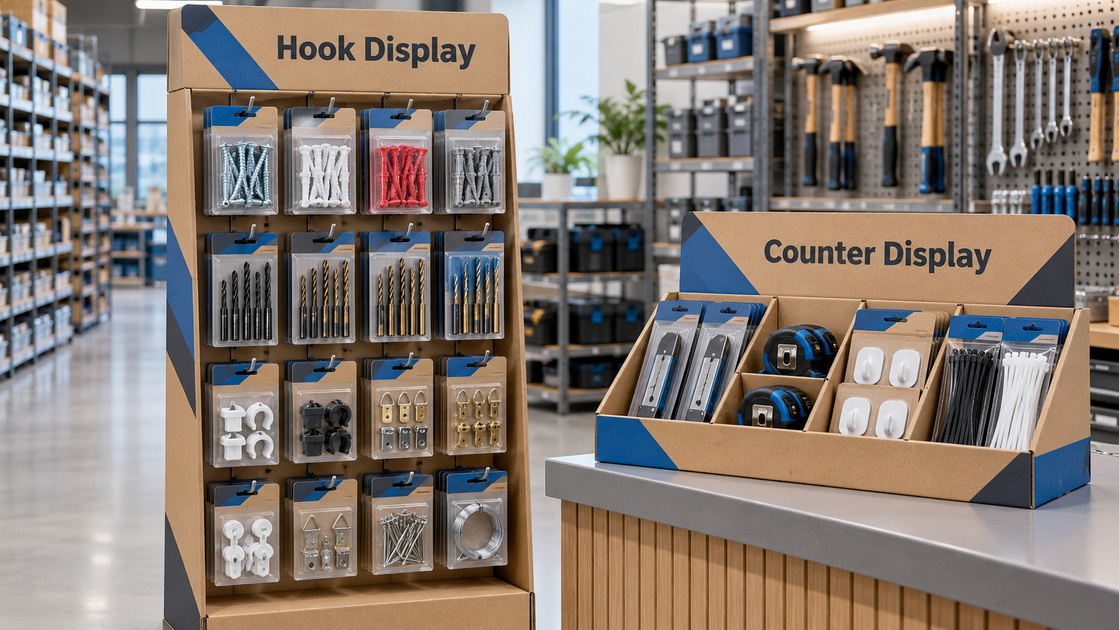
A hook display stand is a point-of-purchase display designed to hold products on peg hooks, euro hooks, or hanging rails. In hardware retail, it is commonly used for blister packs, clamshell packages, header-card packs, bagged accessories, and lightweight boxed products.
The display can be freestanding, countertop-sized, shelf-mounted, sidekick-style, or built into a floor display. Its defining feature is the hanging merchandising method: each product is suspended from a hook rather than stacked in a tray.
For small hardware accessories, hook displays make it easier to separate products by type, size, application, finish, or price point. A shopper can visually compare a 20 mm screw, 30 mm screw, wall plug, drill bit, cable tie, or picture hook without digging through a mixed bin.
A custom hook display stand can work well for:
- Screws, nails, bolts, and nuts in small packs
- Wall plugs and anchors
- Drill bits and driver-bit sets
- Picture-hanging kits
- Cable clips and cable-management accessories
- Adhesive hooks
- Door stops and furniture pads
- Small locks and padlocks
- Utility blades and replacement blades
- Fasteners, clips, brackets, and connectors
- Work-glove packs and protective accessories
- Plumbing seals, washers, and repair accessories
The merchandising advantage is visual order. Shoppers can identify the package they need quickly, and retail staff can spot empty hooks before the entire display becomes disorganized.
A counter display, also known as a countertop display unit or CDU, is a compact point-of-purchase fixture placed on a checkout counter, customer-service desk, trade counter, cash wrap, or other high-traffic surface.
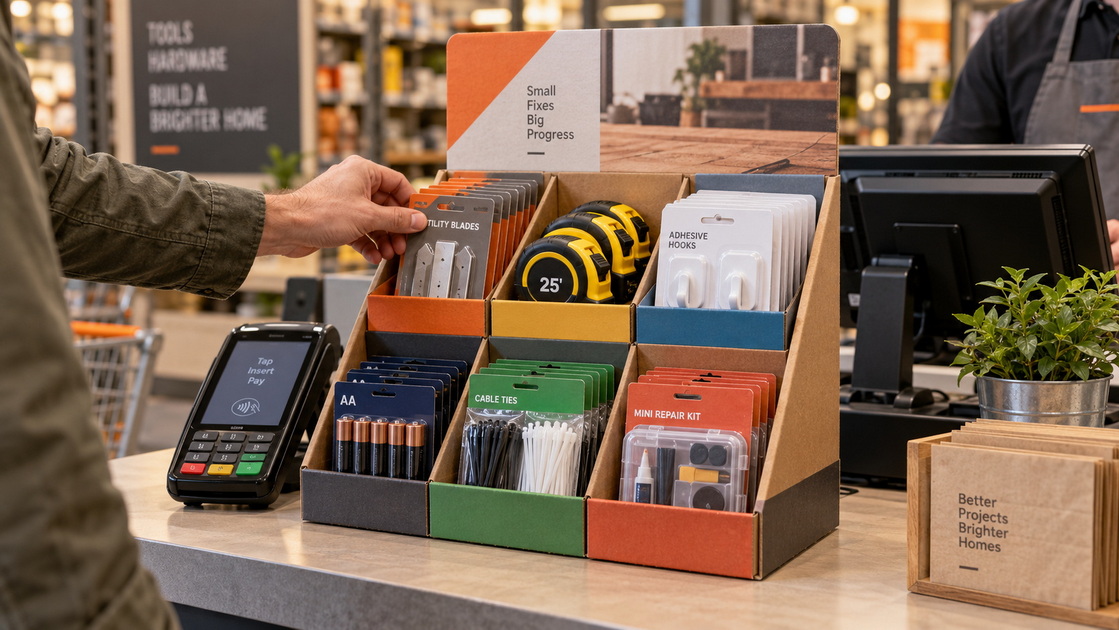
For hardware brands, a cardboard counter display is typically used for small products that are easy to understand, easy to carry, and inexpensive enough to be added to an existing purchase. Examples include utility blades, small tape measures, batteries, hooks, cable ties, adhesive pads, mini repair kits, and compact fastener packs.
Counter displays work because they place products in the shopper's path during a high-attention moment: waiting to pay, speaking with a store associate, collecting an order, or checking out. Retail merchandising guidance consistently identifies checkout and high-traffic locations as important opportunities for small add-on items, provided the display is clean, visible, and easy to shop.
Countertop cardboard displays are often suitable for:
- Compact screwdriver sets
- Utility knife blades
- Mini tape measures
- Adhesive hooks and strips
- Cable ties
- Small batteries
- Key rings and key accessories
- Furniture repair pads
- Small glue tubes
- Repair patches
- Small flashlight accessories
- Fastener refill packs
- Compact automotive accessories
A counter display should not try to hold every SKU in a product range. Its job is to create a fast, simple decision. Too much choice can slow the shopper, reduce visual clarity, and make replenishment harder.
Retail principle: A counter display should encourage an "I can use this" purchase within a few seconds, not require detailed technical comparison.
Both types of cardboard display can be effective. The right selection depends on product packaging, SKU depth, store location, replenishment process, and intended shopper behavior.
| Comparison Factor | Hook Display Stand | Counter Display |
|---|---|---|
| Primary retail purpose | Product organization, assortment display, and aisle visibility | Add-on sales, quick selection, and checkout visibility |
| Best location | Hardware aisle, endcap, shelf side, gondola side, trade counter wall | Checkout counter, cash wrap, service desk, trade counter |
| Product presentation | Hanging packs on hooks | Products in trays, bins, shelves, or small compartments |
| Best for SKU quantity | Medium to high SKU variety | Low to medium SKU variety |
| Best package type | Blister packs, clamshells, poly bags, header-card packs | Small boxes, pouches, cards, mini packs, loose packaged items |
| Product comparison | Excellent; shoppers can compare labels side by side | Limited; should prioritize rapid choice |
| Product capacity | Often higher, depending on hook count and load rating | Usually lower because counter space is limited |
| Retail footprint | Requires aisle, shelf, endcap, or wall space | Uses limited countertop space |
| Shopper interaction | Browse, compare, and select | See, grab, and add to basket |
| Best product value | Suitable for a wider price range | Best for low-to-medium price impulse-friendly products |
| Replenishment | Requires hook-facing and SKU organization | Fast refill if trays are designed well |
| Branding area | Strong header card, side panel, and base graphics | Strong front panel, header, and tray branding |
| Main risk | Overcrowded hooks can hide products and labels | Too many products can clutter the checkout area |
The comparison shows that the display format should match the purchase journey. A hook display supports category navigation. A counter display supports purchase conversion at the last moment.
Choose a hook display stand when customers need to compare accessories before buying. This is particularly important for hardware products because small differences in size, thread type, material, load rating, finish, or installation method can determine whether the item is suitable.
For example, a shopper looking for wall anchors may need to compare pack quantity, drill-hole size, wall type, screw diameter, and load guidance. A hanging display can present these options in a logical sequence rather than mixing them together in a dump bin.
A hook display stand is normally the better solution when:
- You have multiple related SKUs.
- Product packs include hanging holes or can use header cards.
- Customers need to compare sizes, specifications, or applications.
- The display will be installed in an aisle or on a gondola.
- You need clear stock visibility for store staff.
- Packaging needs to remain front-facing.
- Products are lightweight but have enough depth for a hook system.
- You want to create a "shop by project" assortment.
A well-designed cardboard hook display should consider more than the graphic appearance. Long Win Display evaluates structural and retail-use factors before confirming a production solution.
Important design variables include:
- Hook load capacity: The cardboard back panel, hook mounting area, and reinforcement must support the total weight of fully stocked products.
- Hook spacing: Products must not overlap so heavily that shoppers cannot read the package fronts.
- Hook length: Longer hooks increase capacity but can make it harder to reach the final products.
- Display depth: The unit should not obstruct the aisle or breach retailer fixture rules.
- Header visibility: The brand message should be readable from a realistic shopper distance.
- Planogram logic: Group products by application, size, color, or project type.
- Refill access: Store staff should be able to replenish stock without removing the display.
- Retail safety: Avoid sharp edges, unstable protrusions, or hook layouts that create snagging risks.
Research on merchandising presentation supports keeping displays neat, avoiding overcrowding, grouping complementary products, and making small items easy to inspect without staff assistance.
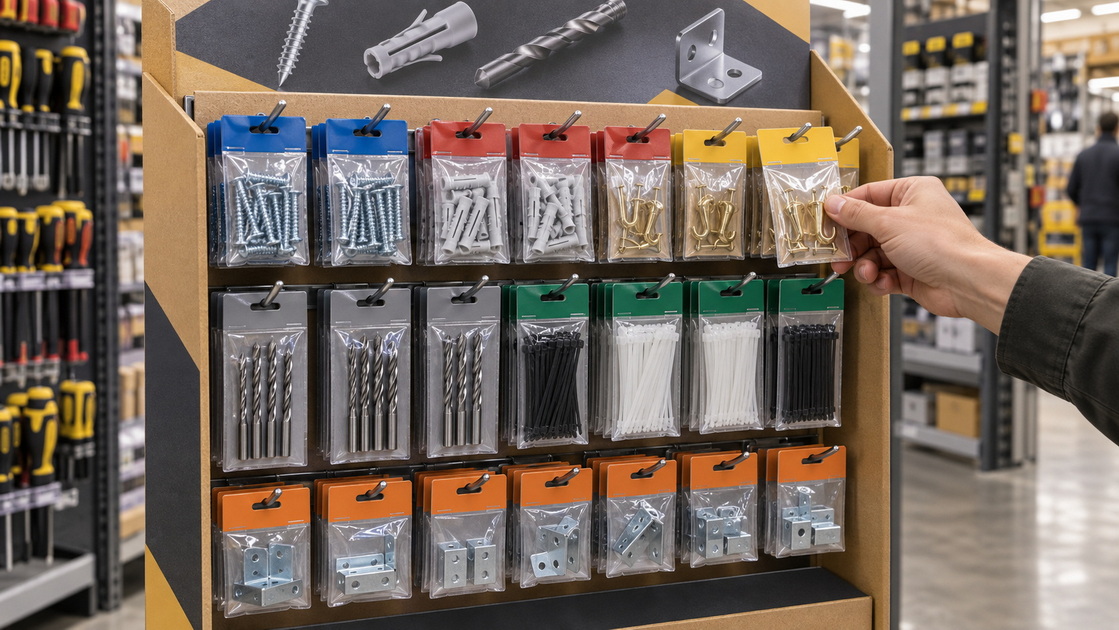
Choose a counter display when the product is simple, compact, convenient, and suitable for an unplanned or last-minute purchase.
Counter displays are especially valuable for hardware accessories that solve a small immediate problem. A customer buying a frame may remember they need picture hooks. A shopper purchasing a tool may add replacement blades. Someone buying a phone charger may add cable clips. The best counter-display products have a clear purpose and low decision complexity.
A cardboard counter display is usually the right choice when:
- The product is small and lightweight.
- The product offers a clear, immediate use case.
- The price is low enough for an add-on purchase.
- The product has healthy margin potential.
- Retailers have limited counter space.
- You want to test a new product range in selected stores.
- You need a low-footprint promotional unit.
- You want to bundle complementary accessories.
Checkout areas are often used for products that can be picked up quickly while customers are already in a buying mindset. Retail guidance recommends using these locations for small, accessible accessories and keeping the selection simple rather than overcrowded.
An effective counter display does not need excessive copy. It needs immediate clarity.
Use these practical rules:
1. Limit the assortment. Three to eight SKUs often create a clearer choice than a mixed display of 20 products.
2. Make the price easy to locate. Retailers and shoppers should not need to search for price communication.
3. Use one main message. Examples include "Quick Fix," "Home Essentials," "Toolbox Refill," or "Ready When You Need It."
4. Protect the product. Hardware packs can be small, heavy, sharp, or easy to displace. Tray walls and dividers should match the product profile.
5. Design for staff refill. The display should allow rapid replenishment during busy retail hours.
6. Consider checkout ergonomics. Avoid a footprint that blocks payment terminals, bags, or sightlines.
7. Use a clear callout. A small "Add To Your Project" message can be more effective than a large amount of technical copy.
The packaging format often decides whether a hook display or counter display will perform better.
A hook display requires packaging with a reliable hanging point. This may be a euro slot, round hanging hole, reinforced header card, or blister-card format. The package must remain stable when suspended, even when customers browse, remove adjacent items, or return products to the hook.
A counter display is more flexible in packaging format. It can hold small cartons, blister packs, bags, pouches, flow-wrap packs, or compact jars. However, the display trays must prevent products from tipping, sliding, or becoming mixed.
| Packaging Situation | Recommended Display Type | Why It Works |
|---|---|---|
| Many blister-packed SKUs in several sizes | Hook display stand | Supports visible product comparison and organized assortment |
| Small packs of screws, bolts, or anchors | Hook display stand | Keeps pack types separated and easy to browse |
| Compact utility blade refill packs | Counter display | Supports fast grab-and-go purchasing near checkout |
| Picture-hanging kits | Either format | Use hooks for range comparison; use a counter unit for simple add-on packs |
| Heavy fastener packs | Reinforced hook display or tray display | Requires structural testing and secure product retention |
| Mixed mini repair accessories | Counter display with dividers | Helps create a compact, easy-to-shop assortment |
| Long, narrow packaged drill bits | Hook display stand | Uses vertical space efficiently and keeps packs visible |
| Premium hardware gift set | Counter display or shelf-ready tray | Better for a limited, curated presentation than high-density hanging |
A supplier should review actual product samples, packaging dimensions, unit weight, carton count, and target store environment before producing the final display structure.
The retail location changes the role of the display.
A hook display in the hardware aisle supports a shopper who is already looking for a solution. The customer may be comparing fasteners, evaluating a repair option, or matching an accessory to a planned project. The display should make browsing easy and reduce confusion.
A counter display reaches a shopper later in the journey. The customer may not have planned to buy the product, but a visible accessory can prompt a useful add-on purchase.
Research examining in-store displays has found that display location and type can influence purchase behavior, with the impact varying according to how close the display is to the relevant category and how the product is presented in-store.
Use the following framework when planning a custom POP display:
- Place hook displays near the relevant category. For example, position wall anchors near drilling tools, screws, or hanging hardware.
- Place counter displays near a natural add-on moment. Examples include utility blades near tool counters or cable clips near electrical-service checkouts.
- Create project-based pairings. Put picture hooks with hanging kits, cable ties with electrical accessories, and blades with utility knives.
- Use high-traffic areas carefully. The display should attract attention without blocking customer movement.
- Test the display location. Compare sales before and after placement, then adjust the assortment or message based on results.
- Keep stock full and organized. An empty hook or disordered tray can reduce perceived product availability and brand quality.
For many brands, cardboard POP displays are attractive because they combine strong branding surfaces with efficient logistics. Corrugated cardboard displays can be shipped flat, pre-packed with products, or pre-assembled depending on retailer requirements, display complexity, installation labor, and delivery method.
The cost of a hook display stand can be affected by:
- Number and type of hooks
- Hook material and finish
- Back-panel reinforcement
- Display dimensions
- Printed graphics
- Product weight and loading requirements
- Floor base or shelf-mounting system
- Retail fixture requirements
- Packing method and assembly needs
A display carrying many heavy fastener packs may require reinforced board grades, additional internal supports, and more robust hook mounting. This increases material cost but helps protect the display's stability and brand presentation in-store.
Counter display costs are influenced by:
- Number of trays or compartments
- Product dimensions
- Display footprint
- Sidewall and front-lip height
- Header card design
- Structural inserts
- Pre-pack requirements
- Retailer counter-space limitations
- Quantity and production scale
Counter displays can be highly cost-effective when they use a simple die-cut structure and a standardized product arrangement. They are also useful for seasonal promotions, product launches, and retail tests because they require relatively little floor space.
Sustainability is more credible when it is built into the display specification rather than added as a vague marketing claim.
Ask your display manufacturer about:
- FSC-certified paper options, where applicable
- Recyclable corrugated board
- Water-based inks and coatings
- Reduced use of mixed materials
- Flat-pack shipping efficiency
- Retail-ready pre-packing
- Material optimization to reduce waste
- Clear recycling instructions, if required by the retailer
A display that is structurally durable enough to survive the campaign but not over-engineered can improve both material efficiency and logistics performance.
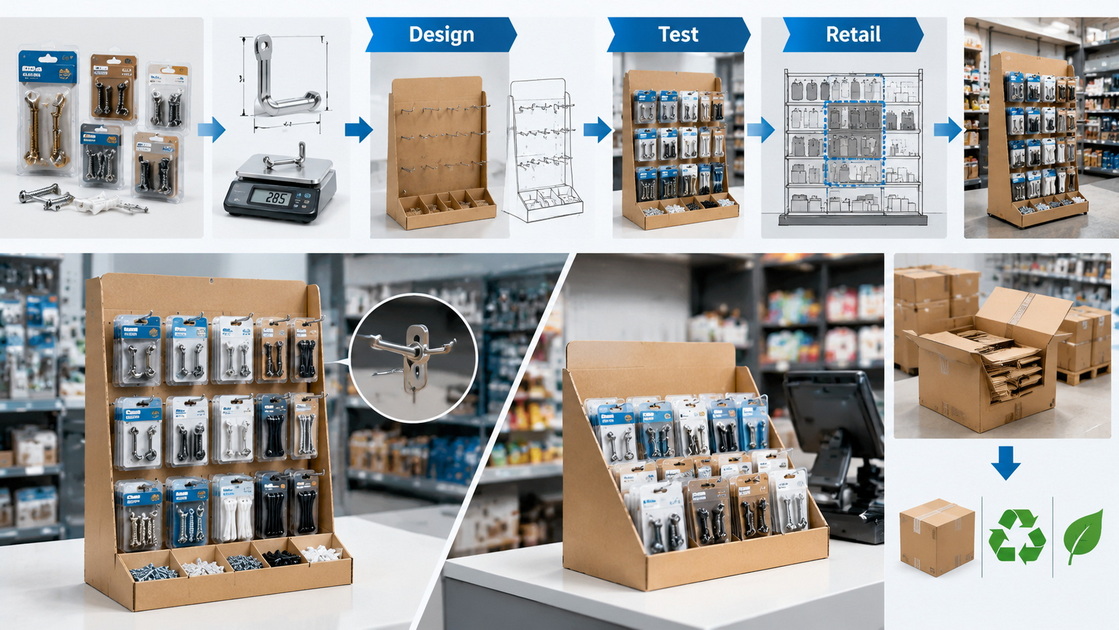
Before choosing between a hook display stand and a counter display, use a structured evaluation process.
1. Define the buying behavior. Decide whether the product requires comparison or encourages a quick add-on purchase.
2. Review product and package data. Measure the unit dimensions, package thickness, hanging-hole strength, unit weight, and number of SKUs.
3. Confirm retail placement. Identify the exact aisle, endcap, checkout counter, service desk, or trade-counter location.
4. Create a planogram. Determine product order, hook count, tray capacity, facing quantity, brand-message hierarchy, and refill process.
5. Prototype and test. Conduct structural testing, loading tests, transport tests, assembly checks, and in-store review before mass production.
At Long Win Display, this process helps reduce avoidable problems such as hooks tearing through cardboard, overcrowded product facings, trays that are too shallow, unclear product hierarchy, and displays that do not fit retailer fixture requirements.
For small hardware accessories, a hook display stand is usually the better choice when product comparison, SKU organization, category visibility, and hanging packaging are the priorities. It is particularly effective for fasteners, drill bits, wall anchors, cable clips, hanging kits, and other accessories with multiple sizes or technical options.
A counter display is usually the better choice when products are compact, easy to understand, and suitable for a quick add-on purchase. It works especially well for utility blades, tape measures, adhesive hooks, small repair kits, batteries, and everyday hardware essentials.
The highest-performing POP display programs often use both formats together. A hook display can build category visibility and support planned purchases in the aisle. A counter display can convert a small selection of best-selling accessories into checkout add-ons.
The best display depends on the product and retail location. A hook display stand is generally better for a wider assortment of packaged accessories that customers need to compare. A counter display is better for small, simple, fast-moving products that can be purchased as checkout add-ons.
Yes, but the structure must be engineered for the product load. Heavy fastener packs may require reinforced corrugated board, stronger hook mounting, shorter hook lengths, internal supports, and load testing before production. Always provide the display manufacturer with actual unit weights and full-load requirements.
There is no universal number, but a counter display usually performs best when it offers a focused selection rather than a full category range. Three to eight complementary SKUs is often a practical starting point, depending on the counter footprint, package size, and shopper decision complexity.
Yes. A hook display can be designed as an endcap unit, sidekick display, shelf-mounted panel, or freestanding floor display. The design must match the retailer's fixture dimensions, aisle-clearance requirements, display depth rules, and load limits.
A well-positioned counter display can help encourage add-on purchases because it puts compact, useful products near checkout or service interactions. Its effectiveness depends on product relevance, price, packaging clarity, display visibility, stock availability, and the amount of counter space available.
1. ScienceDirect. "Impact of Different Types of In-Store Displays on Consumer Purchase Behavior." Academic research examining how retail display formats influence consumer purchase behavior. [Read the research]. [sciencedirect]
2. McIntyre Displays. "How Effective Are Retail Counter Displays for Impulse Buys?" Discusses checkout display use for compact products, including small hardware items such as screws, nails, and blades. [Read the article]. [mcintyredisplays]
3. True Brands. "Encourage Impulse Buys with Counter Displays." Provides practical guidance on counter-display placement, product selection, concise signage, product rotation, and avoiding overcrowding. [Read the article]. [truebrands]
4. Frank Mayer and Associates. "Increase Sales with POP Displays." Summarizes POP display research and discusses the influence of display placement, horizontal assortment processing, and display-led sales performance. [Read the article]. [frankmayer]
5. European Journal of Accounting, Auditing and Finance Research. "Retail Store Merchandise Assortment and Display and Their Influence on Consumer Impulse Buying Behaviour." Discusses display organization, complementary-product grouping, product visibility, and the need to avoid overcrowded merchandising. [Read the study]. [eajournals]
6. ShopPOPDisplays. "How to Encourage Impulse Buying with Point-of-Purchase Displays." Covers high-traffic placement, checkout positioning, strong visual presentation, and product adjacency. [Read the article]. [shoppopdisplays]
7. Tokinomo. "Point of Purchase Displays: Learn Everything." Provides an overview of POP display purpose, strategic placement, concise communication, display durability, testing, and retail compliance. [Read the guide]. [tokinomo]


