
Views: 260 Author: Long Win Display Publish Time: 2026-07-17 Origin: Site


Content Menu
● The Real Role Of POP And Pallet Displays In Modern Retail
● Seven Common Mistakes With POP Retail Displays (And Why They Still Happen)
>> Mistake 1: Treating Displays As A Design Project, Not A Retail System
>> Mistake 2: Overcrowding Displays And Confusing Shoppers
>> Mistake 3: Poor Placement And Ignoring Store Flow
>> Mistake 4: Weak Or Misaligned Messaging And Signage
>> Mistake 5: Poor Maintenance, Empty Shelves And Broken Fixtures
>> Mistake 6: Failing To Track Performance And Learn From Each Campaign
>> Mistake 7: Ignoring Operational Realities Of Pallet Displays
● A Practical Framework For High‑Performing POP And Pallet Programs
>> Step 1: Define Objectives And Constraints Together
>> Step 2: Co‑Design Structures With Manufacturing And Retail Partners
>> Step 3: Build A Compliance And Measurement Loop
● Where Experienced Manufacturers Like Long Win Display Fit In
In modern retail, POP retail displays and pallet display stands are often the only touchpoints that turn a shopper's casual glance into an unplanned purchase. As someone who has spent years walking store floors with category managers, merchandisers, and display manufacturers, I've seen beautifully printed campaigns underperform simply because fixtures were poorly planned, installed in the wrong place, or never properly maintained. [linkedin]
When brands treat POP and pallet displays as last‑minute add‑ons instead of strategic tools, they lose margin, waste marketing budget, and frustrate store staff. The good news: most failures follow predictable patterns—and they are avoidable with structured planning, clear measurement, and collaboration with experienced display partners such as Long Win Display. [exactec]

POP displays and retail‑ready pallet displays serve three critical functions: visibility, navigation, and conversion at the shelf or aisle. [cardboard-display-stand]
- They cut through visual noise so shoppers can notice a specific brand or range in seconds. [creativedisplaysnow]
- They simplify decision‑making by grouping products, highlighting benefits, or clarifying price points. [exactec]
- They compress complex trade marketing plans into a single physical experience that fits the store's traffic and space constraints. [spc-retail]
Industry sources consistently show that effective in‑store merchandising and POP displays can add several percentage points to category sales during promotion windows. Yet many brands still underestimate the operational discipline required to make those gains repeatable across hundreds or thousands of locations. [medallionretail]
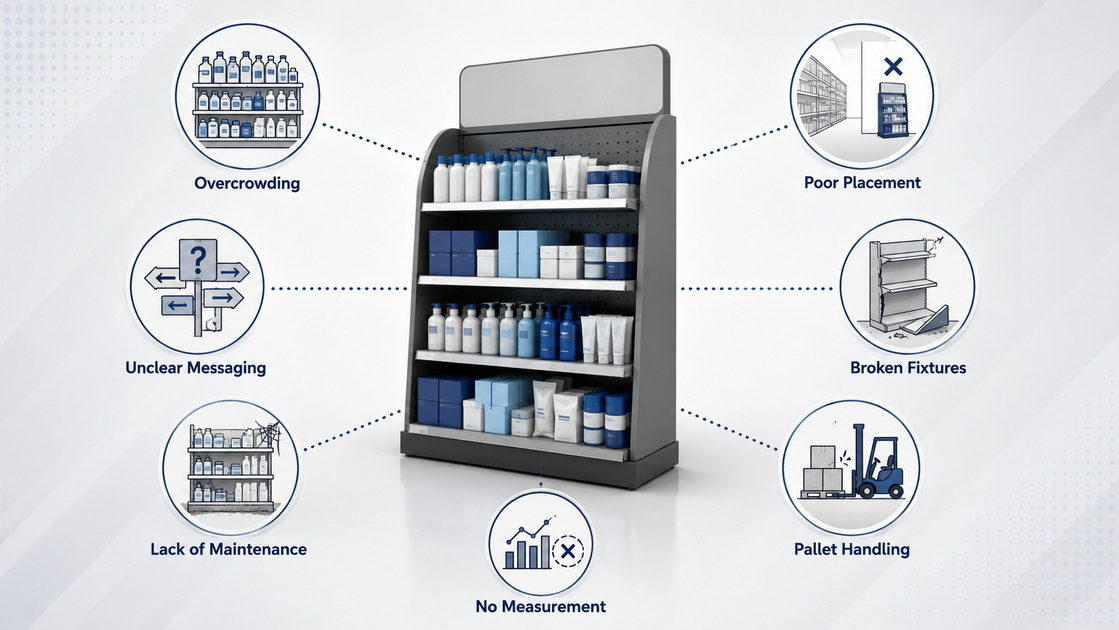
The original article rightly highlighted lack of planning as a primary issue, but in practice the problem is deeper: teams optimize for visuals without mapping the full retail system. [bpkc]
Typical symptoms:
- No documented objectives beyond "increase visibility"
- No alignment with store layout, traffic patterns, or category strategy [spc-retail]
- No operational plan for installation, replenishment, and removal
The result is a display that looks good on a design board but fails once it meets real shoppers, real store staff, and tight aisle spaces. [creativedisplaysnow]
Expert perspective: High‑performing brands now build POP and pallet programs with cross‑functional input from trade marketing, sales, supply chain, and key retail partners before any artwork is finalized. [medallionretail]
Retailers frequently try to show "everything" on a single fixture, especially during promotions. Overcrowded displays cause: [exactec]
- Visual clutter and decision fatigue
- Poor product blocking and weak brand blocking
- Difficult replenishment and higher risk of mis‑placements
Studies and expert commentaries note that simpler displays with a focused SKU set convert better, particularly in impulse zones. From experience, when we reduce a pallet display from 12 SKUs to 4–6 well‑blocked SKUs, store staff find it easier to keep it neat—and shoppers understand it faster. [longwindisplay]
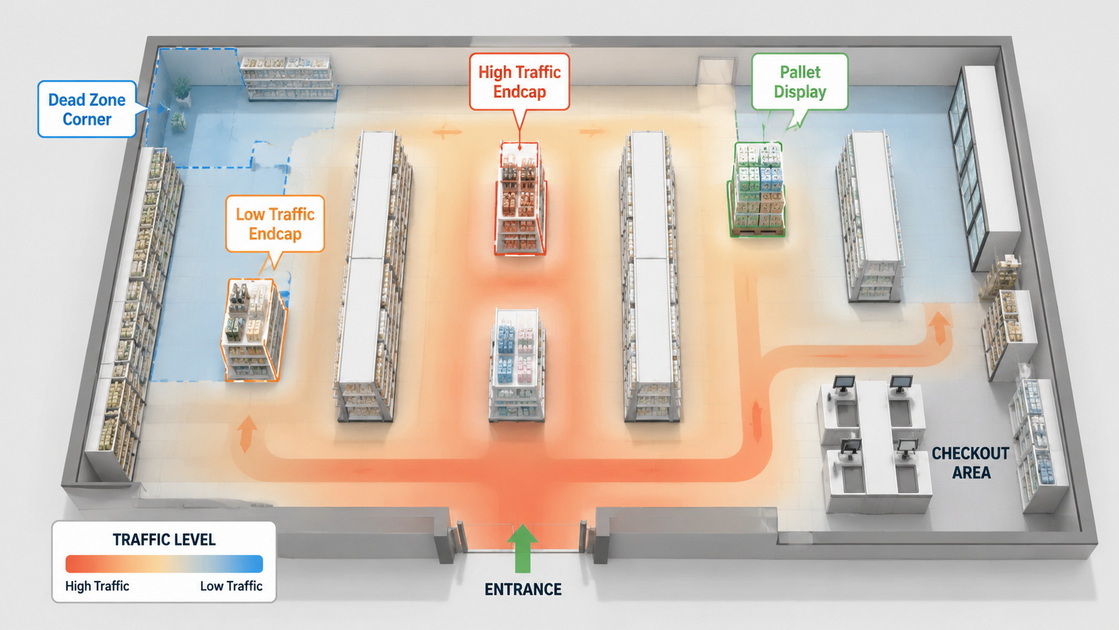
Original guidance often mentions "bad placement," but the operational reality is nuanced. Common errors include: [bpkc]
- Placing POP units in low‑traffic corners or "dead zones"
- Blocking sightlines at the store entrance or main pathways [spc-retail]
- Ignoring the "decompression zone" where shoppers are not yet ready to make decisions [rumisinterior]
Data from retail layout studies shows that aisle congestion and blocked sightlines directly reduce dwell time and basket size. Effective placement focuses on: [creativedisplaysnow]
- High‑traffic points of purchase (main checkouts, key aisle intersections) [exactec]
- Clear sightline strategies that use lower fixtures at the front and taller ones deeper inside the store [spc-retail]
- Logical adjacency to related categories (e.g., sun care near seasonal displays) [rumisinterior]
Many POP displays suffer from unclear communication: shoppers see the physical structure but do not understand what is being offered or why it matters. [medallionretail]
Typical issues:
- Overly generic headlines that do not mention the offer or product benefit
- Missing or inconsistent price communication, causing hesitation at the shelf [linkedin]
- Signage that conflicts with adjacent shelf labels or promotional tags
Experts advise concise, benefit‑oriented messaging, supported by consistent price and promotion signage. In practice, this means: [medallionretail]
- One primary call‑out (benefit or promotion) at eye level
- Complementary secondary messages (e.g., usage or feature) near product contact
- Clear price tags aligned with store systems to avoid checkout surprises [linkedin]
Even the best‑designed display fails if it is dusty, half empty, or damaged. Field audits often show: [rumisinterior]
- Pallet displays with collapsed corners due to improper handling
- POP units with missing components or broken hooks
- Units left in stores long after the promotion has ended, creating customer dissatisfaction when prices do not match. [linkedin]
Industry guidance emphasizes maintenance and cleanliness as core success factors. Brands that invest in simple maintenance checklists and assign responsibility—either to field reps or store teams—see sustained uplift and fewer customer complaints. [rumisinterior]
The original article identified lack of measurement as a major gap, and this remains accurate. Many POP and pallet programs end with only anecdotal feedback, no structured data. [bpkc]
Common omissions:
- No capture of pre‑ vs post‑promotion sales at store or cluster level
- No record of compliance (how many stores installed the display, where, and when) [linkedin]
- No standardized photo or video documentation for future benchmarking
Expert practice now uses simple dashboards combining:
- Store‑level sell‑out vs planned uplift
- Installation rate and timing vs promotional calendar [medallionretail]
- Qualitative feedback from store staff and field teams
This transforms POP and pallet displays from one‑off creative projects into continuous improvement engines. [longwindisplay]
Retail‑ready pallet displays add a logistical dimension that many marketing teams underestimate. Common mistakes include: [cardboard-display-stand]
- Designing pallets that are difficult to handle with standard equipment
- Failing to account for different pallet sizes across regions (e.g., 48x40 vs 1200x1000) [cardboard-display-stand]
- Not aligning packaging and labeling with retailer expectations, causing rework or rejection at receiving docks. [cardboard-display-stand]
Specialist guides stress that pallet displays must balance mechanical stability, visual impact, and operational simplicity. Experienced manufacturers such as Long Win Display incorporate retailer‑specific constraints—including aisle width, warehouse handling practices, and modular packaging—into the structural design from the start. [longwindisplay]
To move beyond fixing mistakes, leading brands now follow a repeatable framework for planning and executing POP and pallet campaigns.
Before any design work, cross‑functional teams should align on:
1. Commercial objectives – volume uplift, mix targets, and margin expectations per store cluster. [medallionretail]
2. Retail constraints – store layouts, maximum footprint, sightline rules, and safety requirements. [creativedisplaysnow]
3. Operational parameters – installation responsibility, replenishment routines, and removal dates. [rumisinterior]
This pre‑work reduces misalignment and provides a clear brief for display designers and manufacturers. [longwindisplay]
Effective POP and pallet displays are engineered as much as they are designed. [longwindisplay]
Best practices include:
- Early involvement of manufacturing partners to validate feasibility, material choices, and cost drivers. [cardboard-display-stand]
- Collaboration with key retailers to check store‑level rules for fixtures, pallet handling, and signage. [spc-retail]
- Use of physical prototypes and pilot installations in a small store panel before full rollout. [exactec]
Manufacturers such as Long Win Display bring experience from multiple markets and retailers, helping brands avoid repeating known structural or operational mistakes. [longwindisplay]
Finally, high‑performing teams treat every POP and pallet campaign as a learnable experiment. [longwindisplay]
Key elements:
- Store‑level installation tracking (which display went where, and when) [linkedin]
- Standardized photo uploads from field reps or store associates to document setup quality. [rumisinterior]
- Simple performance metrics: uplift vs baseline, by store type and placement type. [spc-retail]
Over time, this data highlights which combinations of structure, placement, and messaging consistently deliver results—and where programs need redesign. [longwindisplay]
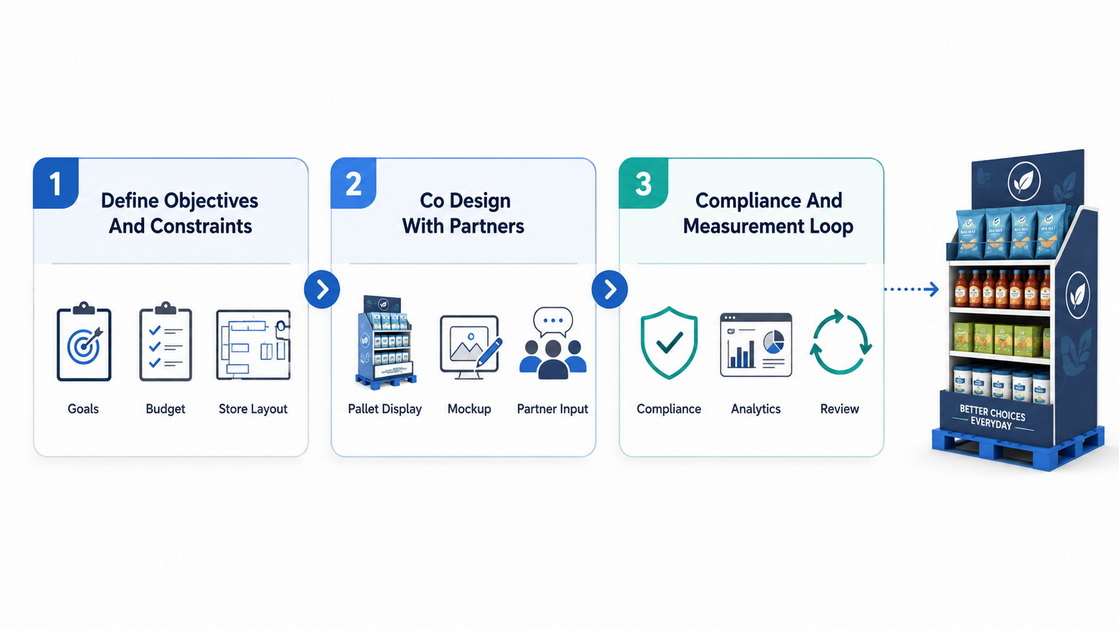
From a practitioner's standpoint, the difference between average and consistently successful POP and pallet programs often comes down to the manufacturer's ability to integrate design, engineering, and operations. [cardboard-display-stand]
Long Win Display, for example, specializes in pallet display stands and other POP fixtures, combining structural design, printing, pre‑packing, and export logistics. With experience across major FMCG and retail sectors, such partners help: [longwindisplay]
- Translate trade marketing briefs into workable, retail‑ready display structures
- Design corrugated and multi‑material pallet solutions that respect retailer handling and safety rules [creativedisplaysnow]
- Support pilots, documentation, and continuous improvement based on campaign feedback [longwindisplay]
For brands, working closely with this type of partner reduces the risk of the seven mistakes discussed above and shortens the learning curve across multiple markets. [longwindisplay]
1. How can I quickly diagnose why a current POP display is underperforming?
Start with a structured audit: check placement quality, product blocking, signage clarity, and maintenance status, then compare sales uplift against similar stores where the display is correctly implemented. This reveals whether the issue is design‑related or execution‑related. [linkedin]
2. Are pallet displays always the best choice for volume promotions?
Not necessarily. Pallet displays excel in warehouse clubs and large format stores where bulk buying is common and space is available. In smaller formats, well‑designed floor stands or end‑caps may achieve similar impact without blocking traffic or sightlines. [spc-retail]
3. How often should POP displays be refreshed to avoid shopper fatigue?
Industry practice suggests refreshing seasonal or promotional POP programs at least quarterly, with shorter cycles in highly competitive categories. For semi‑permanent fixtures, structural refresh can be less frequent, but messaging and product mix should evolve as ranges and shopper behavior change. [exactec]
4. What data sources should we use to measure POP effectiveness beyond sales uplift?
In addition to sell‑out, teams can track dwell time, basket composition, and shopper path data where available, plus qualitative feedback from store staff and field reps. Combined, these metrics provide a richer view of how displays influence shopper behavior. [rumisinterior]
5. How do I align global display concepts with local retailer constraints?
Use a "global concept, local adaptation" approach: define core visual and structural principles centrally, then work with regional manufacturing partners and key retailers to tailor sizes, materials, and handling features to local rules. Pilot programs in representative stores before scaling help avoid costly redesigns. [longwindisplay]
1. BPKC. "7 Common Mistakes With POP Retail Displays". Available at: ] [bpkc]
2. POP Display ME. "7 Common Mistakes With POP Retail Displays". Available at: [popdisplay]
3. Exactec. "Point‑of‑Purchase Display Mistakes – And How To Fix Them". Available at: [exactec]
4. Medallion Retail. "10 Mistakes to Avoid When Building a Point of Purchase Display". Available at: [medallionretail]
5. SPC Retail. "7 Store Layout Mistakes Retailers Are Making". Available at: [spc-retail]
6. Creative Displays Now." Common Retail Display Mistakes & How to Fix Them". Available at: [creativedisplaysnow]
7. Cardboard Display Stand." A Practical Guide to Retail‑Ready Pallet Displays – Cases". Available at: [cardboard-display-stand]
8. Long Win Display." Retail Display Mistakes That Quietly Kill Sales (And How POP Cardboard Displays Fix Them)". Available at: [longwindisplay]
9. Long Win Display. "Our Company – POP Display Designer and Manufacturer in China". Available at: [longwindisplay]
10. Rumis Interior." Why Your Display in Retail is Failing: 7 Critical Errors & Fixes". Available at: [rumisinterior]
11. Ronny Diricx (LinkedIn). "7 Errors That Prevent Your POP‑Display Being a Selling Machine". Available at: [linkedin]


