
Views: 233 Author: Long Win Display Publish Time: 2026-11-18 Origin: Site


Content Menu
● What Is the Difference Between a Floor Display and a Pallet Display?
● When a Freestanding Floor Display Is the Better Choice
● When a Pallet Display Fits a Warehouse Club Promotion
● Compare Cost per Sellable Unit, Not Just Display Price
● Shop the Display Down to Its Last Layer
● What to Include in a Warehouse Club Display Brief
>> 1. Can a floor display be shipped on a pallet?
>> 2. Is a full-pallet display always cheaper than multiple small displays?
>> 3. Can I put multiple SKUs on the same promotional pallet?
>> 4. Should a prototype use real product or dummy weights?
>> 5. Does passing a transit test mean the display is ready for the sales floor?
In a floor display vs pallet display comparison, start with one question: Can the product reach the sales floor in the same configuration in which it was shipped? If the warehouse club accepts a loaded pallet that associates can position and open with minimal handling, a pallet display is usually the stronger starting point. A freestanding floor display is often a better choice when the promotion needs a smaller footprint, separate compartments for variants, or more space to explain the product—and the retailer approves the setup and replenishment work.
Costco's fiscal 2025 annual report illustrates why this distinction matters: the retailer says it generally displays merchandise on pallets holding large quantities, reducing the labor required. That describes an operating model, not a universal approval rule. The right format still depends on the retailer's current instructions, the pack design, and what happens after shoppers start removing units.
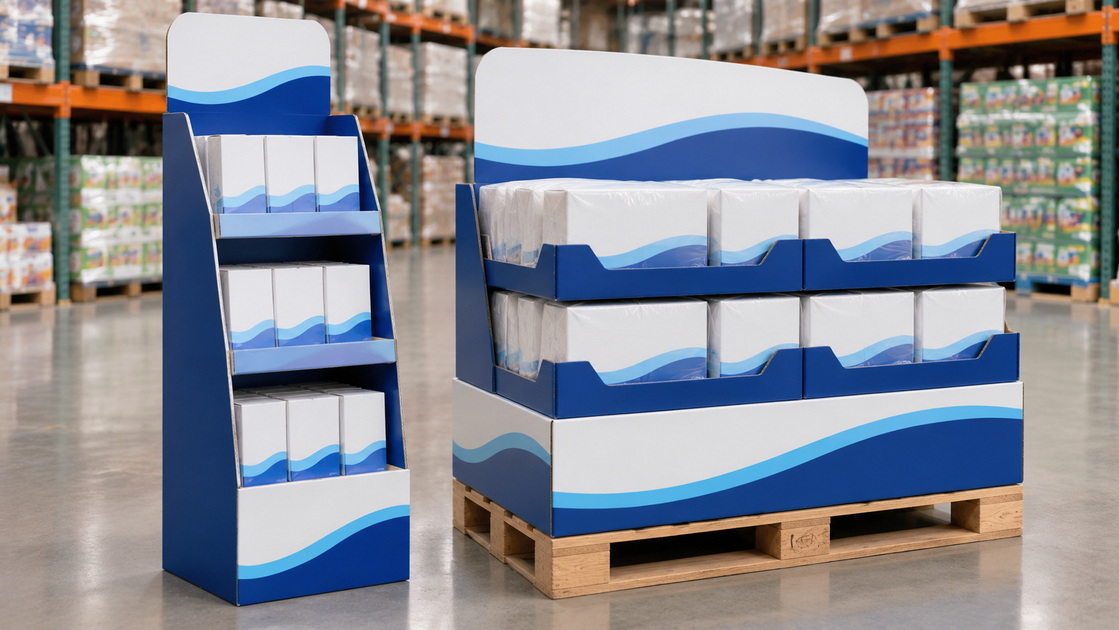
A freestanding floor display is a fixture that sits directly on the sales floor. It may use shelves, trays, or bins to present products. Here, "floor display" means a standalone fixture rather than every display placed at floor level. It can arrive flat-packed for assembly, preassembled but empty, or prepacked with merchandise. It may ship on a transport pallet without using that pallet as part of the selling fixture.
A pallet display presents merchandise on a pallet that remains under the load during the promotion. It can be as simple as stacked retail-ready trays with a branded skirt, or it can incorporate dividers, structural supports, and a header. A ship-ready pallet is designed so staff can position it and remove the specified transit protection without rebuilding the display. A pallet-sized fixture is not necessarily ship-ready.
| Decision factor | Freestanding floor display | Pallet display |
|---|---|---|
| Typical use | Product education, organized variants, or an approved compact placement | High-volume club packs and bulk promotions |
| Sales-floor setup | May require assembly, loading, and placement | Can reduce setup if the shipped configuration is approved for direct placement |
| Replenishment | Staff usually refill shelves or bins from reserve stock | Staff may replace the pallet or replenish trays, depending on club policy |
| Branding | Header, shelf fronts, and side panels can explain the offer | Skirts, tray fronts, and headers can identify the offer from the aisle |
| Freight trade-off | Flat-packed fixtures take less space than assembled ones, but require setup | Loaded displays must be evaluated for cube, stackability, and protection |
| Main design risk | Shelf deflection, tipping, or awkward access as stock runs down | Load shift in transit, packaging compression, or instability after opening |
Choose a floor display when how shoppers find and select the product matters more than how many units the fixture holds. A small kitchen accessory, for example, might need three clearly separated variants and a short compatibility guide. A compact shelf display can make that decision easier than a deep stack of nearly identical cartons.
Before choosing it, walk through the work the store has to do. Who assembles the display? Where is reserve stock kept? Can associates refill the fixture without removing the header or lifting product over a high sidewall? If the answer depends on labor or backroom space the retailer has not agreed to provide, simplify the design or quote a prepacked alternative.
Material selection should follow the job. For a temporary corrugated display, review shelf spans, product weight, and expected humidity with the manufacturer. For a fixture intended for repeated use, compare the extra cost of a more durable structure with the actual number of planned deployments. A display that is never collected or redeployed generates no reuse savings.
A pallet display is a natural starting point for a fast-moving club pack when the retailer accepts the footprint and can move the load with its handling equipment. It works particularly well when retail-ready trays keep units organized and shoppers can identify the offer without an associate explaining it.
Ask the retailer for the accepted pallet type and dimensions, loaded height and weight limits, permitted overhang, handling access, label placement, and any restrictions on headers. Confirm which sides shoppers can access and whether the club expects a full pallet exchange or allows tray replenishment. Do not assume a half- or quarter-pallet display is approved simply because it fits the space. Ask whether it must travel on a larger carrier pallet and who separates the units before placement.
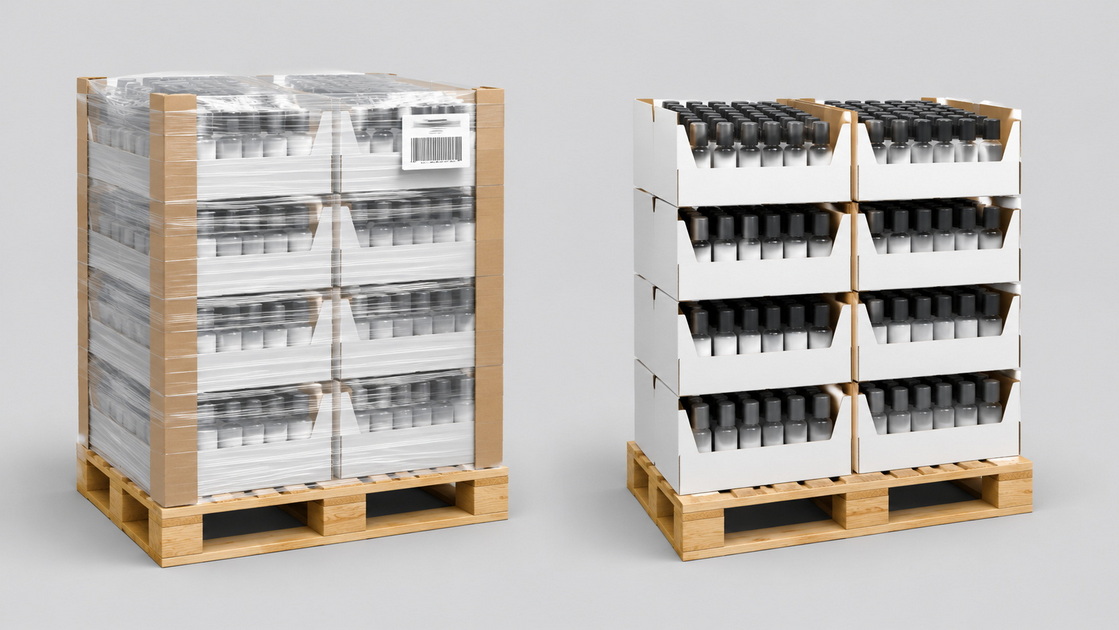
Design the shipping and selling configurations together. Stretch wrap and corner protection may help stabilize a load in transit, but once removed, they cannot support the selling display. Keep fork openings clear of skirts and headers out of handling paths. If the receiver requires a GS1 Logistic Label, coordinate placement with both the wrap and the graphics so the logistics barcode is accessible at the required scan point. A logistics-unit identifier is not the same as a product barcode.
The lowest fixture quote does not always produce the lowest campaign cost. Compare both designs from packing through setup and replenishment. Include fixture cost, packing labor, incremental freight, receiving or setup labor, and expected product or packaging damage. Divide the total by the number of units expected to arrive in sellable condition.
The following figures are hypothetical. They illustrate how a cheaper fixture can cost more to deploy; they are not market rates or damage benchmarks.
| Cost per 240 units shipped | Floor display | Pallet display |
|---|---|---|
| Fixture and shipping materials | $52 | $70 |
| Packing and incremental freight | $68 | $84 |
| Store setup and replenishment labor | $72 | $24 |
| Total deployment cost | $192 | $178 |
| Expected sellable units on arrival | 236 | 238 |
| Deployment cost per sellable unit | $0.81 | $0.75 |
In this example, the floor display costs $18 less to make and pack with shipping materials, but labor reverses the result. If the shipment travels a longer route and the pallet cannot be stacked, freight could reverse it again. Keep product loss value and campaign teardown or disposal in a separate line if they differ materially. After a pilot, replace your estimates with observed freight, setup time, damage, and refill frequency before committing to the rollout.
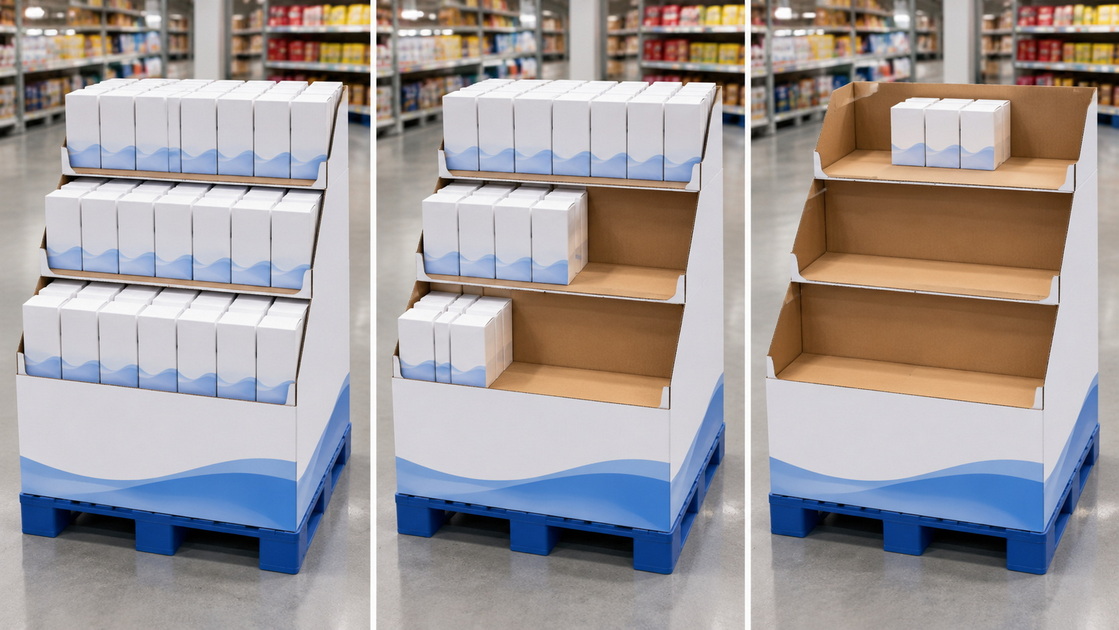
A full prototype can look stable because adjacent packs support one another. The weaknesses often become visible only after shoppers remove stock from one side. A tray may shift, a tall carton may lean, or the remaining units may end up so far back that customers cannot reach them comfortably.
Run this check on a production-equivalent sample before approving the order:
1. Start with the fully packed unit. Record the stack pattern, dimensions, gross weight, and protective materials. If a transit test is required, test the complete shipping configuration using a protocol appropriate to the route and retailer.
2. Time the conversion to selling mode. Have someone who did not design the display follow the setup instructions. Record unpacking time, tools required, and any protective material that must be removed or discarded.
3. Remove product unevenly. Check the fixture at full, half-full, and nearly empty states, including one-sided depletion. Look for movement, leaning packages, exposed edges, blocked signage, and units that are hard to retrieve.
4. Replenish it as the store would. If trays will be refilled, measure the time and check whether refilling obscures graphics or creates an unstable stack. If the plan is a pallet exchange, rehearse how the outgoing unit is cleared.
5. Agree on acceptance criteria before production. Define unacceptable damage, allowable setup time, required barcode access, and how the display must behave as stock runs down. Record the approved configuration with photos and a packing diagram.
ISTA Procedure 3E can help evaluate the protective performance and stability of unitized loads of similar packaged products traveling by full truckload. It does not replace an in-store depletion check, and it does not automatically represent every distribution route or retailer requirement.
Give the display manufacturer the operating requirements before issuing a request for quotation. That makes it possible to compare a standalone floor fixture, a prepacked floor display, and a pallet concept on the same basis.
- Retailer and placement: Current retailer instructions, approved footprint, aisle-facing sides, promotional dates, and the responsible approval contact.
- Product and pack: Unit and carton dimensions, weight, orientation limits, variant mix, barcode locations, and target quantity per display.
- Distribution: Shipping origin, handling points, stackability requirements, unpacking instructions, and whether preassembly or product loading is in scope.
- Store operations: Who sets up the display, the replenishment method, expected selling duration, and how the fixture will be removed.
- Sample approval: Structural prototype, printed proof, production-equivalent loaded sample, and any required test report.
Long Win Display is a China-based point-of-purchase display manufacturer offering custom design, production, and preassembly.
Yes. The transport pallet may simply carry the fixture to the destination and be removed before setup. If the pallet remains under the product and serves as the selling base, specify it as a pallet display and confirm the retailer accepts the complete configuration.
No. A full pallet may reduce setup touches but can occupy more selling space and tie up more stock at one location. Compare freight, labor, stock per placement, and expected sales velocity. Include the cost of removing unsold inventory when the promotion ends.
Potentially, if the retailer accepts the assortment and receiving configuration. Define the assortment by tray or compartment, confirm how units will be identified and replenished, and check whether the remaining load stays stable when one variant sells faster than the others.
Use real product and production packaging for final validation wherever possible. Dummy weights may be useful for an early structural check, but weight alone does not recreate the way retail packs compress, slide, or support neighboring units. Agree on any substitutes with the party approving the test.
No. Transit testing evaluates the packed configuration against a defined distribution scenario. Separately verify setup, access, barcode visibility, and stability after protective materials and products are removed. Obtain retailer approval for the intended placement and replenishment method.
1. Costco Wholesale Corporation. [Fiscal 2025 Annual Report on Form 10-K]. Source for Costco's description of pallet merchandising and reduced handling labor. [sec]
2. International Safe Transit Association. [ISTA Procedure 3E Overview: Similar Packaged-Products in Unitized Loads for Truckload Shipment]. Source for the scope and limitations of the unitized-load transit test. [ista]
3. GS1. [GS1 Logistic Label Guideline]. Source for logistics-unit identification and pallet label placement. [gs1]
4. U.S. Occupational Safety and Health Administration. [29 CFR 1910.176: Handling Materials—General]. U.S. workplace context for stable storage and material handling; not a retailer display approval standard. [osha]


