
Views: 255 Author: Long Win Display Publish Time: 2026-08-23 Origin: Site


Content Menu
● Why Seasonal Supermarket Displays Need a Clear Retail Plan
>> Main Benefits of Dump Bin Displays
>> Limitations of Dump Bin Displays
>> Main Benefits of Floor Displays
>> Limitations of Floor Displays
● Dump Bin vs Floor Display Comparison
● When a Dump Bin Is the Better Choice
● When a Floor Display Is the Better Choice
>> Floor Display Design Guidelines
● Seasonal Placement Strategy for Supermarkets
● How to Choose the Right Display Format
>> Step 1: Define the Campaign Objective
>> Step 2: Review Product Characteristics
>> Step 3: Match the Display to Campaign Duration
>> Step 4: Consider Store Operations
● Pallet Display Stands for Large Seasonal Rollouts
● How to Improve Store Execution
● How to Measure Seasonal Display Performance
● Expert Design Considerations for Supermarket Displays
>> Design for the Complete Display Journey
>> Design for Partial Product Stock
>> Design for Stability and Safety
>> 1. What is the main difference between a dump bin and a floor display?
>> 2. Are dump bins suitable for seasonal supermarket promotions?
>> 3. Are floor displays better for premium seasonal products?
>> 4. Can a dump bin be placed on a pallet base?
>> 5. How long should a seasonal supermarket display remain in store?
Seasonal supermarket promotions depend on strong product visibility, fast replenishment, and practical in-store execution. The choice between a dump bin and a floor display can influence how shoppers discover products, how easily store teams maintain stock, and how effectively a campaign supports seasonal sales.
For high-volume seasonal products, a dump bin can create an accessible and energetic shopping experience. For gift sets, bundles, premium items, and structured product ranges, a floor display can provide stronger organization and a more complete brand presentation.
At Long Win Display, we design, customize, manufacture, and pre-assemble pallet display stands and other retail display solutions for supermarket programs. From a production and store-execution perspective, the most effective display is not simply the most visually attractive. It must also work during transport, store installation, daily replenishment, shopper interaction, and campaign removal.

Seasonal promotions create a short but important selling window. Supermarkets prepare for major shopping periods such as spring events, summer promotions, back-to-school campaigns, Halloween, Christmas, Lunar New Year, and regional holidays.
During these periods, stores become more visually competitive. Retailers may use entrances, endcaps, promotional aisles, checkout areas, feature tables, and floor locations to present limited-time products.
A successful seasonal display should help brands achieve several goals:
- Attract shopper attention quickly
- Communicate the seasonal theme clearly
- Hold enough stock for peak demand
- Make products easy to browse
- Support fast store replenishment
- Fit approved supermarket floor space
- Stay stable in high-traffic areas
- Maintain a consistent brand presentation
A seasonal supermarket display should not create additional work for store employees. It should be easy to install, simple to stock, and clear for shoppers to understand.
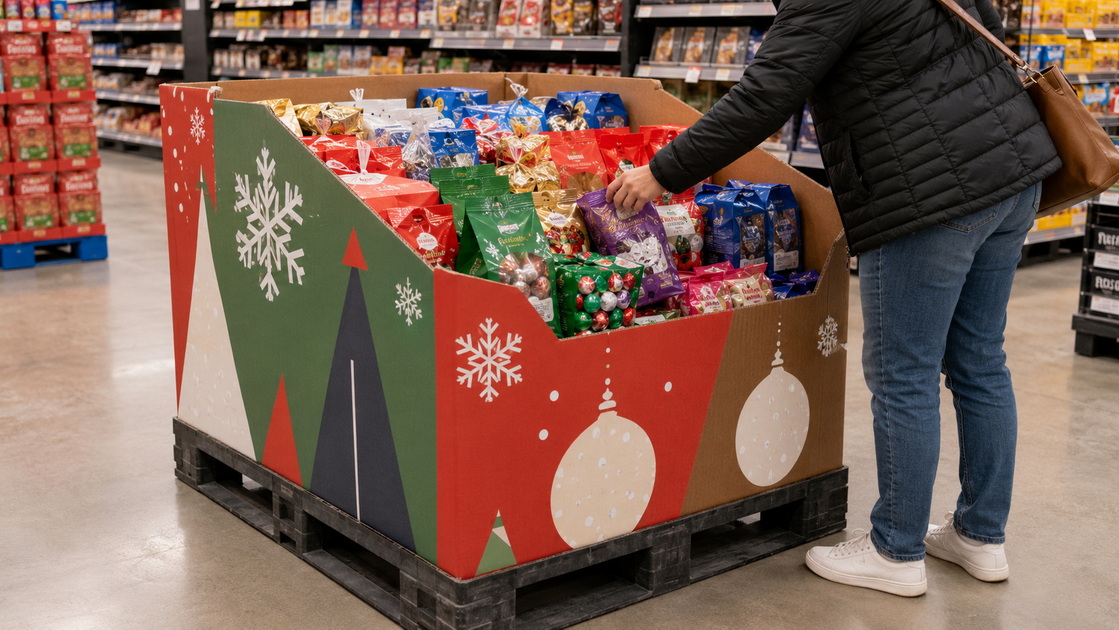
A dump bin display is an open-top retail container designed to hold products in a loose and accessible format. It is commonly made from corrugated cardboard, though plastic, metal, and hybrid materials may also be used.
Products are usually placed directly into the bin. Shoppers can browse, pick up, compare, and select items without following a fixed shelf arrangement.
Common dump bin formats include:
- Square dump bins
- Octagonal dump bins
- Cardboard dump bins
- Half-pallet dump bins
- Full-pallet dump bins
- Pop-up dump bins
- Retail-ready dump bins
- Gravity-feed dump bins
- Modular dump bin units
- Multi-bin promotional displays
Dump bins are commonly used for snacks, confectionery, toys, novelty products, seasonal accessories, pet treats, beauty items, small household products, and lightweight packaged goods.
Easy shopper access. Dump bins allow shoppers to browse products freely. The open layout encourages quick product handling and supports impulse purchases.
High-volume product capacity. A dump bin can hold a large number of products. This makes it useful for promotions with fast sales velocity and frequent shopper demand.
Quick replenishment. Store staff can refill a dump bin quickly by placing products directly into the open structure. This is useful during busy supermarket hours.
Flexible product assortment. A dump bin can hold several colors, flavors, product sizes, or seasonal variations. It works well for mixed merchandise and limited-edition packaging.
Strong value perception. A full dump bin can create a sense of abundance. This is especially effective for affordable products, multi-buy offers, and promotional seasonal items.
Simple installation. Many cardboard dump bins can be shipped flat-packed or supplied in a retail-ready format. This helps reduce installation time and simplifies store deployment.
A dump bin may become less visually organized after frequent shopper interaction. Loose products can shift, packaging may become damaged, and small items can become difficult to see when stock levels change.
Potential limitations include:
- Products may become mixed together
- Packaging can look untidy after browsing
- Small products may fall to the bottom
- Brand messaging space may be limited
- Premium products may appear less refined
- Frequent tidying may be required
- Heavy items may stress the display structure
- Product access may decline if the bin is too deep
These concerns can be reduced through practical structural design. Adjustable dividers, controlled bin depth, reinforced bases, graphic headers, product trays, and internal product supports can improve both presentation and usability.
A floor display is a freestanding retail fixture positioned directly on the supermarket floor. It can be made from corrugated cardboard, paperboard, plastic, metal, wood, or a combination of materials.
Unlike a dump bin, a floor display normally presents products in a more structured format. Products may be placed on shelves, trays, hooks, dividers, product channels, or tiered platforms.
Common floor display formats include:
- Corrugated floor display stands
- Pallet display stands
- Quarter-pallet displays
- Half-pallet displays
- Full-pallet displays
- Shelf-style product displays
- Multi-tier floor stands
- Pegboard displays
- Endcap-ready floor displays
- Retail-ready pallet displays
Floor displays are commonly used for beverages, packaged foods, gift sets, snacks, personal care products, household products, toys, electronics accessories, and seasonal promotional bundles.
Stronger seasonal storytelling. A floor display provides larger surfaces for seasonal artwork, product benefits, campaign messages, and brand identity.
Better product organization. Shelves, trays, product channels, and dividers help keep items in place. This creates a cleaner and more intentional presentation.
Improved product visibility. Products can be displayed at different heights. This helps shoppers see more of the assortment without searching through loose stock.
Higher perceived value. A structured display can make products feel more premium, especially when promoting gift sets, bundles, limited-edition products, or higher-priced items.
Flexible merchandising options. A floor display can combine multiple product types, pricing zones, cross-selling areas, product descriptions, and seasonal graphics.
Better product protection. Shelves and trays can reduce product movement during store handling. This may help protect packaging and maintain a more polished retail appearance.
Floor displays may require more detailed planning and production. They can also need more time for store setup and replenishment.
Potential limitations include:
- More complex structural design
- More detailed assembly instructions
- Larger shipping volume for some formats
- More precise product-facing requirements
- Greater dependence on regular replenishment
- Higher production cost for complex structures
- More retailer approval requirements
- Less flexibility for loose mixed products
A floor display should be designed around actual supermarket conditions. Retail footprint, product weight, shelf spacing, pallet dimensions, store traffic, and staff access all affect performance.
| Decision Factor | Dump Bin Display | Floor Display |
|---|---|---|
| Product presentation | Loose, open, and browse-friendly | Structured, organized, and front-facing |
| Best product type | Small, lightweight, high-volume items | Packaged products, bundles, gift sets, and multi-SKU ranges |
| Shopper interaction | High-touch and exploratory | Guided and organized |
| Product capacity | High for loose product loading | High, depending on shelves, trays, and pallet structure |
| Brand communication | Moderate | Strong |
| Seasonal graphic space | Moderate | Large |
| Replenishment speed | Very fast | Moderate to fast |
| Product organization | Can become mixed after browsing | Easier to maintain |
| Perceived product value | Best for value-driven items | Better for premium and giftable products |
| Product protection | Limited for loose products | Better through shelves, trays, and dividers |
| Setup requirements | Usually simple | May require more detailed assembly |
| Retail footprint | Compact to large | Usually medium to large |
| Best campaign purpose | Fast-moving impulse promotions | Structured, branded, multi-product campaigns |
A dump bin is often the best choice when a supermarket promotion needs high product volume, quick access, and fast replenishment.
It is especially suitable for:
- Seasonal confectionery
- Halloween candy
- Promotional snack packs
- Small toys
- Novelty gifts
- Back-to-school stationery
- Pet treats
- Summer travel accessories
- Low-cost beauty products
- Festival-themed items
- Small household accessories
- Mixed-color or mixed-flavor product ranges
A dump bin works best when shoppers can understand the product quickly. It is particularly effective for low-cost products, familiar product categories, and playful seasonal merchandise.
For example, a Halloween promotion can use an orange-and-black cardboard dump bin filled with seasonal candy bags, themed snack packs, and small novelty items. The open structure allows shoppers to browse different products quickly and choose several items at once.
A strong dump bin should remain easy to shop throughout the campaign.
Important design details include:
- A clear front panel
- A highly visible header card
- A controlled bin depth
- A reinforced base
- Wide product access
- Strong seasonal color blocking
- Internal dividers for mixed SKUs
- Pallet-ready dimensions
- Simple refill access
- Stable floor contact points
The bin should look full without becoming difficult to browse. Excessive depth can hide products and reduce shopper access. A shallow, well-organized bin may perform better than a large, overcrowded container.
A floor display is often the better choice when a seasonal supermarket campaign needs stronger brand communication, product organization, and a more premium presentation.
It is especially suitable for:
- Holiday gift sets
- Seasonal beverage displays
- Premium snack collections
- Barbecue product bundles
- Christmas food gifts
- Personal care gift packs
- Beauty bundles
- Limited-edition launches
- Family-size product promotions
- Cross-category merchandising programs
- Seasonal cooking solutions
- Back-to-school product collections
A floor display can create a complete shopping solution. It allows a brand to group related products and present them in a logical order.
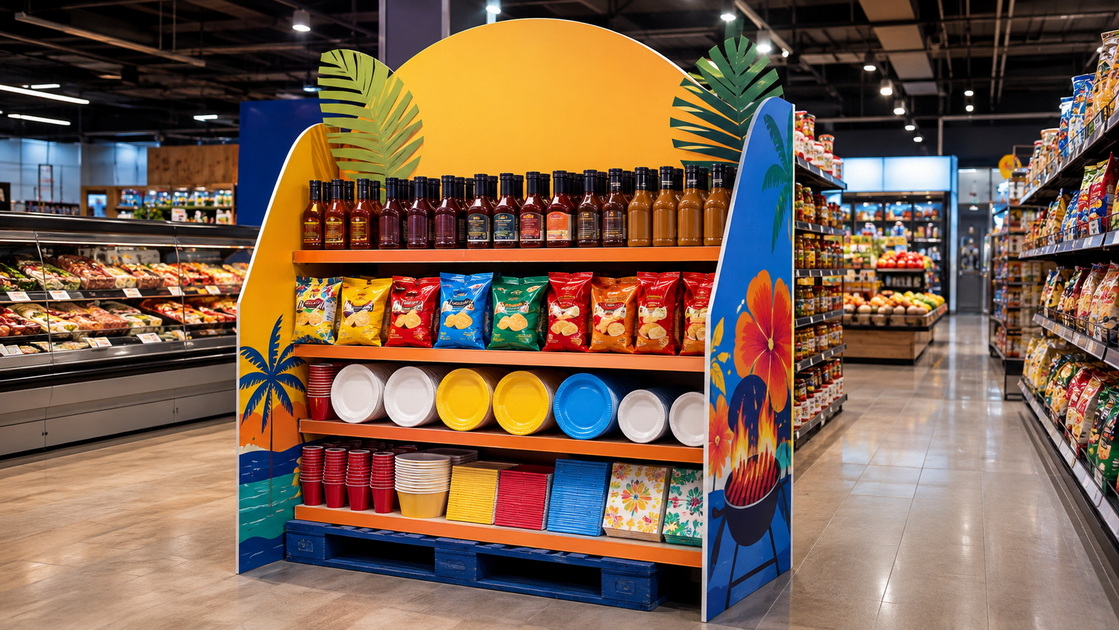
For example, a summer barbecue floor display may include sauces, marinades, snacks, disposable plates, and grilling accessories. The display can use separate shelves for each category, helping shoppers build a complete seasonal purchase.
A well-designed floor display should remain stable, visible, and easy to replenish.
Important design details include:
- Large branded header cards
- Strong side panels
- Clearly visible product shelves
- Secure product front lips
- Dedicated price-label areas
- Stable pallet or base structures
- Shelf spacing based on real product dimensions
- Simple staff-side replenishment
- Retailer-approved footprint
- Strong shipping and handling performance
The structure should continue to look organized even when products are partially sold. Angled shelves, shallow trays, and strong graphic panels can help maintain visual impact as stock decreases.
Display placement affects shopper attention and product movement. A strong display in a weak location may underperform, while a well-placed display can increase product discovery.
Useful seasonal locations include:
- Store entrances
- Main aisle intersections
- Promotional zones
- Endcap areas
- Seasonal event sections
- Checkout queues
- Fresh food transition areas
- Beverage sections
- Bakery and deli areas
- Household product aisles
- Family shopping zones
Dump bins often work well near entrances, aisle intersections, and checkout queues. These locations support quick discovery and impulse purchase.
Floor displays often work well in seasonal zones, endcaps, themed product areas, and wider aisle spaces. They allow shoppers to browse a more organized product range.
Product category should guide final placement.
For example:
- Seasonal candy can work near entrances or checkout lanes.
- Barbecue products can work near beverages, sauces, fresh food, or outdoor dining products.
- Back-to-school products can work near stationery, snacks, and family shopping areas.
- Holiday gift sets can work in dedicated seasonal zones or high-visibility aisles.
The right display format should support the product, campaign, supermarket environment, and operational requirements.
Start by identifying the primary goal.
Possible goals include:
- Increasing impulse purchases
- Launching a seasonal item
- Promoting a limited-edition product
- Supporting a multi-buy offer
- Increasing basket size
- Creating a giftable presentation
- Clearing seasonal inventory
- Introducing a product range
- Supporting a retailer event
- Building brand recognition
Dump bins are often effective for impulse buying and large product movement. Floor displays are often more suitable for multi-product storytelling and premium retail presentation.
Before selecting a display, review:
- Product size
- Product weight
- Packaging strength
- Number of SKUs
- Product price point
- Seasonal packaging
- Required product capacity
- Replenishment frequency
- Risk of packaging damage
- Need for product separation
- Need for premium presentation
Loose, lightweight, durable items often work well in dump bins. Gift sets, fragile packaging, bundles, and premium products usually perform better in structured floor displays.
| Expected Campaign Duration | Suitable Starting Format |
|---|---|
| One to four weeks | Dump bin or compact floor display |
| Four to eight weeks | Dump bin, pallet display, or floor display |
| Two to four months | Reinforced floor display or pallet display stand |
| Annual recurring campaign | Reusable structure with replaceable seasonal graphics |
| Large retail event | Pallet display stand, floor display, or promotional display island |
A retail display should be practical for store teams.
Ask the following questions:
1. Can one employee set it up quickly?
2. Can staff refill it during busy periods?
3. Does it fit through store entrances and backroom spaces?
4. Is it stable when only half stocked?
5. Can it be moved safely if store layout changes?
6. Does it require tools or special installation steps?
7. Does it interfere with shopper traffic?
8. Can staff understand the required product arrangement?
A simple display is more likely to remain fully stocked, correctly positioned, and visually appealing during the full seasonal campaign.

A pallet display stand can provide a practical solution for high-volume supermarket campaigns. It combines strong floor stability, large product capacity, efficient logistics, and visible seasonal branding.
Pallet display stands can be designed as:
- Quarter-pallet displays
- Half-pallet displays
- Full-pallet displays
- Pallet dump bins
- Pallet floor displays
- Multi-tier pallet stands
- Retail-ready pallet display systems
- Mixed shelf-and-bin display structures
A pallet display stand can support a large amount of product while remaining compatible with supermarket logistics. It can also reduce store setup time when supplied in a pre-assembled or retail-ready format.
For example, a large seasonal beverage promotion may use a half-pallet display stand with reinforced trays, a tall header card, and branded side panels. The display can hold high product volume while creating a strong presence near a main aisle or promotional zone.
A seasonal display only performs well when it remains installed, stocked, stable, and visually clear throughout the promotion.
To support store execution, focus on practical details.
Useful solutions include:
- Clear assembly instructions
- Product-loading diagrams
- Visible placement labels
- Retailer-approved dimensions
- Strong outer shipping cartons
- Easy-to-identify display components
- Simple replenishment instructions
- Pre-assembled display options
- Built-in pallet bases
- Clear campaign dates
- Product-facing guides
Displays with fewer setup steps are easier for retail teams to install correctly. Structures with clear product positions are more likely to remain tidy and appealing.
Seasonal campaigns should be measured by more than total product shipment. In-store performance provides more useful information for future display planning.
Track the following:
- Sales per store per week
- Product sell-through rate
- Replenishment frequency
- Out-of-stock time
- Display damage rate
- Store placement consistency
- Display condition
- Product visibility
- Shopper interaction
- Cross-selling performance
- Incremental sales compared with standard shelf placement
A useful approach is to compare stores using the display with similar stores using normal shelf placement. This can help identify whether the display improved product discovery and sales beyond seasonal demand or promotional pricing.
The results can guide future decisions on display size, product capacity, placement, material choice, artwork, and campaign duration.
Seasonal supermarket displays must perform under real retail conditions. They are transported, loaded, moved, bumped, restocked, and shopped by many people every day.
A display should be planned from production to final store removal.
The complete journey includes:
1. Product loading
2. Display assembly or pre-assembly
3. Warehouse handling
4. Transportation
5. Store delivery
6. Retail installation
7. Daily replenishment
8. Shopper interaction
9. Campaign removal
10. Reuse, recycling, or disposal planning
Each stage influences the final store appearance and operational success.
Many displays look attractive when fully stocked but become less effective after products sell down. Seasonal display structures should remain visually clear even at lower stock levels.
Useful design features include:
- Angled shelves
- Product trays
- Shallow product compartments
- Adjustable dividers
- Raised product platforms
- Strong front graphics
- Product pusher systems
- Clear product-facing rows
A display should maintain product visibility without relying on a full load of inventory.
Supermarket floor displays need stable construction. They may be exposed to shopping trolleys, baskets, children, cleaning equipment, and high foot traffic.
Important safety considerations include:
- Wide and stable bases
- Strong pallet structures
- Secure display-to-pallet connection
- Suitable product weight distribution
- Protected edges
- Appropriate display height
- Anti-tip design
- Clear walking space around the display
A display should support a smooth shopping experience without blocking aisles or creating obstacles.
A dump bin display is often the strongest choice for fast-moving, lightweight, affordable, and high-volume seasonal products. It supports quick shopper access, easy replenishment, and a strong sense of product abundance.
A floor display is often the better choice for premium seasonal products, gift sets, product bundles, multi-SKU campaigns, and promotions that need stronger brand communication and organized product presentation.
A pallet display stand can be highly effective for large supermarket rollouts that require strong product capacity, stable floor placement, efficient logistics, and prominent seasonal branding.
Long Win Display provides custom dump bins, floor display stands, pallet display stands, retail-ready structures, pre-assembly, printing, quality control, and export manufacturing support for supermarket display programs. Share your product details, retailer requirements, expected campaign duration, and order quantity to develop a display solution that supports your seasonal retail goals.
A dump bin is an open-top retail container that holds products in a loose and accessible arrangement. A floor display is a freestanding structure that presents products on shelves, trays, hooks, dividers, or organized product channels.
Yes. Dump bins are suitable for lightweight, affordable, colorful, and high-volume seasonal items. They encourage browsing and can be replenished quickly during busy supermarket periods.
In many cases, yes. Floor displays provide better product organization, more graphic space, stronger brand communication, and a more refined presentation. They are often suitable for gift sets, bundles, premium snacks, personal care products, and limited-edition items.
Yes. A pallet dump bin can combine open product access with stronger stability and efficient supermarket logistics. It is often a practical option for large retail programs and high-volume seasonal promotions.
The duration depends on the campaign. Some promotions run for one to four weeks, while major seasonal programs may remain in stores for several months. The structure and material should be selected according to the expected in-store duration.
1. Food Industry Association. "Seasonal Merchandising: A Grocer's Secret to Success."
2. IMS Retail. "Retail Compliance."
[https://www.imsretail.com/merchandising-technology/retail-compliance/]
3. Natural Food Retailers. "The Power of In-Store Displays: Driving Sales in Food Retailers."
4. Cayuga Displays. "How Grocery Displays Affect Customer Behavior."
[https://cayugadisplays.com/us/blog/how-grocery-displays-affect-customer-behavior]
5. Peachtree Packaging. "Boost Seasonal Sales: How to Use POP Displays Effectively."
[https://www.peachtreepackaging.com/post/boost-seasonal-sales-how-to-use-pop-displays-effectively]
6. InContext Solutions. "The Science of Shopping: Analyzing the Effectiveness of Supermarket Merchandising Techniques."
[https://incontextsolutions.com/blog/supermarket-merchandising-techniques/]


