
Views: 233 Author: Long Win Display Publish Time: 2026-10-22 Origin: Site


Content Menu
● Customized Shipping Boxes vs Corrugated Mailers at a Glance
● What Fragile Products Need From Shipping Packaging
>> Separate Cosmetic Damage From Functional Damage
● When Customized Shipping Boxes Are the Stronger Option
>> The Advantage Is Design Freedom, Not Automatic Strength
>> When to Consider Double Boxing
● When Corrugated Mailers Make More Sense
>> Compact Packaging Can Improve Handling Efficiency
>> Check Closures Under Real Conditions
● Why Flute Type Is Not Enough
>> Match the Test to the Question
● Inserts Often Matter More Than the Outer Box Style
>> Avoid Loading the Most Delicate Feature
● Smaller Packaging Can Remove the Protection You Need
>> Optimize After Establishing a Protective Baseline
● Compare Total Cost, Not Just the Box Price
>> Check Actual Billing Dimensions
● How to Validate Packaging for Fragile Products
>> Test the Complete Shipping Configuration
● A Practical Selection Guide for Three Product Types
>> Ceramic Mug
● Working With Long Win Display
>> 1. Can corrugated mailers safely ship glass products?
>> 2. Is double-wall corrugated always necessary?
>> 3. Should a gift box also serve as the shipping box?
>> 4. Can paper inserts replace foam?
>> 5. Does one successful drop test qualify the packaging?
Customized shipping boxes usually offer greater flexibility for heavy, unusually shaped, or highly fragile products. Corrugated mailers can work well for compact, lighter products when their structure, inserts, and closures are designed and tested together.
However, the categories overlap. A corrugated mailer can also be a customized shipping box.
For this comparison, "customized shipping boxes" means conventional shipping cartons tailored to the product, including designs with separate presentation packaging. "Corrugated mailers" means typically hinged, folding corrugated boxes with tuck or locking features.
The deciding factor is not the box name. It is the complete protection system: product, cushioning, outer structure, closure, and distribution environment.
At Long Win Display, our stated services cover custom gift packaging, POP displays, production, and preassembly. From that packaging-development perspective, the strongest solution balances transit performance with packing efficiency and the customer's opening experience.
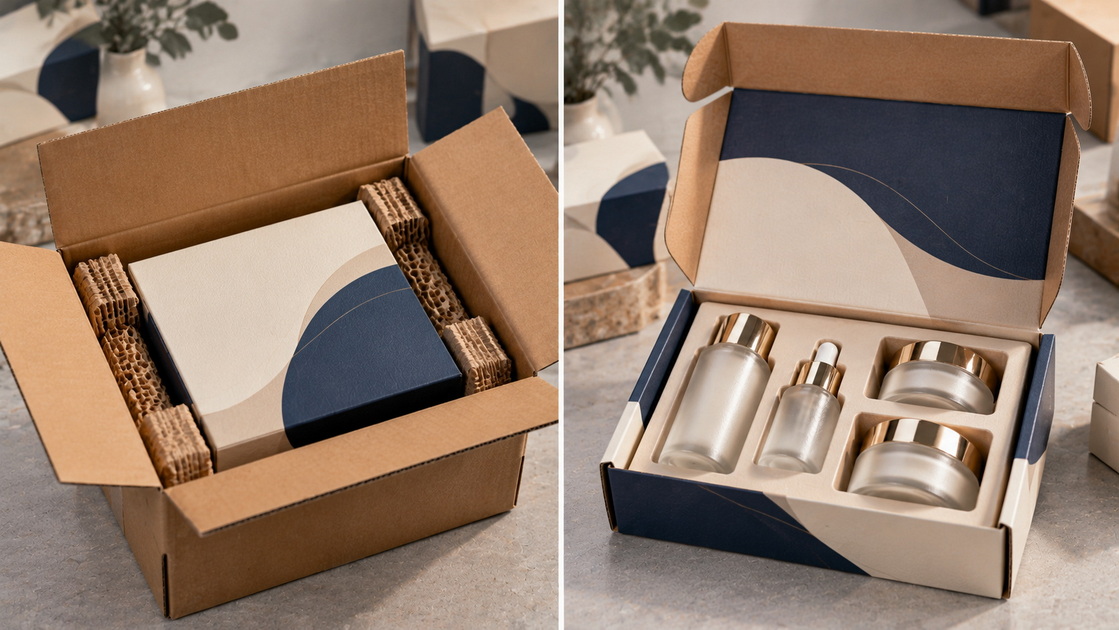
| Buying consideration | Customized shipping cartons | Corrugated mailers |
|---|---|---|
| Typical structure | Separate flaps, taped closures, or other engineered designs | Hinged lid with folding and locking features |
| Suitable applications | Heavy, mixed, irregular, or highly fragile products | Compact products with controlled movement |
| Cushioning flexibility | Can accommodate larger protective systems | Often uses fitted inserts within a compact structure |
| Gift presentation | May protect a separate inner gift box | Can combine shipping and presentation |
| Packing operations | May require carton erection and taping | May simplify packing, depending on assembly |
| Freight efficiency | Depends on dimensions and cushioning allowance | Compact designs can reduce unused space |
| Main risk | Oversizing or poorly controlled void fill | Assuming a neat fit provides sufficient cushioning |
| Validation priority | Packed-product performance under expected handling | Insert performance, closure retention, and packed-product testing |
Neither format guarantees lower damage rates. Those outcomes require evidence from representative tests and actual distribution.
Fragility is more specific than "made of glass."
A product may fail through breakage, scratching, deformation, leakage, component separation, or damage to its finish. Packaging should address the actual failure mode.
Before selecting a structure, document:
- Product dimensions and weight.
- Delicate projections and unsupported areas.
- Surface sensitivity.
- Permitted orientation, if relevant.
- Product-to-product contact risks.
- Distribution route and storage conditions.
- What counts as unacceptable damage.
A ceramic mug, a glass skincare bottle, and a delicate gift figurine may weigh the same but require different support.
A product can remain functional while its presentation becomes unacceptable.
For premium gifts, scuffed surfaces or a crushed inner box may trigger a return even when the product is intact.
Define acceptance criteria for the product, presentation packaging, and outer shipper separately. This prevents a test from being called successful simply because nothing shattered.
Conventional shipping cartons offer design space for cushioning, dividers, suspension arrangements, or an inner presentation box.
They are worth evaluating for:
- Heavier fragile items.
- Products with irregular geometry.
- Multiple components requiring separation.
- Gift sets with different product weights.
- Presentation boxes needing external protection.
- Routes involving demanding handling or stacking.
A larger carton can provide room for cushioning, but unused space alone does not absorb impact effectively.
Poorly supported products can move inside an oversized box. Loose fill may also behave differently from an engineered insert.
Specify how the product is supported, how movement is restricted, and where impact energy is intended to be managed.
Double boxing can protect a presentation package and add separation between the product and external handling.
Carrier guidance recommends it for fragile items, together with cushioning around the inner box.
That guidance is a starting point, not proof that every double-boxed product will survive. Cushioning material, thickness, product mass, and distribution conditions still require evaluation.
Corrugated mailers are attractive when the product and protective insert fit within a compact, repeatable structure.
Potential applications include small accessories, carefully supported cosmetic containers, and lightweight gift products.
Their appeal is the possibility of combining an organized opening experience with a shipping function.
A well-designed mailer may reduce unnecessary space and simplify the number of components used during packing.
However, folding complexity varies. Some mailers require more assembly than expected, especially when inserts must be positioned manually.
Time the actual packing operation before assuming that one-piece construction means faster fulfillment.
A locking tab that works on a hand-built sample may behave differently after repeated handling, compression, or production variation.
Confirm whether the mailer requires tape, an adhesive strip, or another seal.
Also review label placement and whether the recipient can open the package without damaging the product or struggling with excessive sealing.
E-flute, B-flute, or double-wall construction describes part of a board's architecture. It does not provide a complete performance specification.
Two boxes with similar appearance can use different liners, fluting medium, adhesives, and manufacturing controls.
For a meaningful quotation, specify:
- Board construction.
- Relevant paper properties or agreed material grades.
- Thickness and dimensional tolerances.
- Appropriate strength requirements.
- Printing and coatings.
- Joint and closure design.
- Intended conditioning and test methods.
Edge crush testing evaluates the board's edgewise compression performance.
Box compression testing evaluates the finished container under compression.
Transit testing evaluates the packed system against selected distribution hazards.
These tests answer different questions. A strong board result cannot establish that an unsupported glass component will survive impact.
Moisture also matters. Corrugated packaging can lose compression performance as its moisture content increases, so test conditions should reflect the expected environment.
For fragile products, a fitted insert can separate components and direct support toward more robust areas.
Possible materials include corrugated board, folded paperboard, molded pulp, and suitable foams. Selection depends on cushioning behavior, geometry, finish compatibility, cost, and disposal requirements.
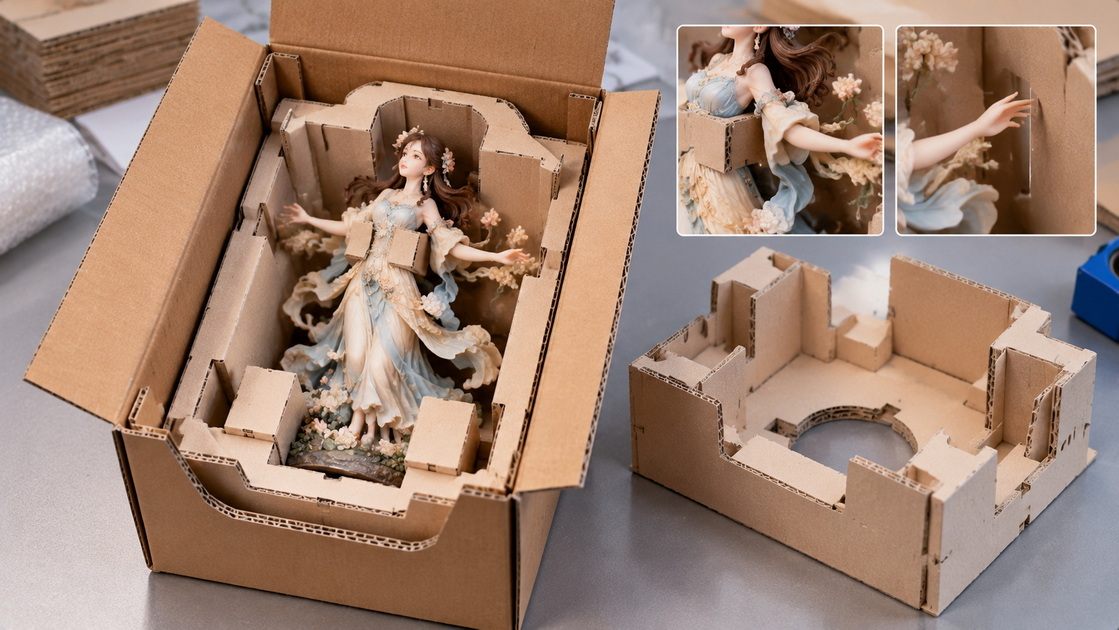
An insert may look secure while supporting a figurine by a thin arm or pressing against a glass bottle's vulnerable neck.
Identify strong support zones first. Then check retention without excessive local pressure.
A useful design review asks:
1. Where does the product contact the insert?
2. Can it move during handling?
3. Does the insert deform as intended?
4. Can cushioning bottom out?
5. Can the product contact the outer wall?
6. Will removal damage a fragile feature?
A tight fit is not the same as effective cushioning.
Reducing external dimensions can lower freight volume. But aggressive downsizing may remove cushioning travel or increase contact forces.
This creates a common purchasing conflict: the most compact sample looks commercially attractive, while the slightly larger design may better manage transit shock.
Start with a design that meets the agreed protection requirement.
Then reduce dimensions or material in controlled steps, retesting significant changes.
Do not approve a smaller production version simply because the original prototype passed. Changes to cavity size, cushioning, closure, or product placement can change performance.
This applies equally to customized shipping cartons and corrugated mailers.
The cheaper box can become the more expensive packaging system after labor, freight, replacements, and customer support are included.
Compare these cost categories:
| Cost category | What to measure |
|---|---|
| Packaging purchase | Box, insert, printing, and sealing components |
| Setup | Tooling, artwork, samples, and testing |
| Fulfillment | Assembly, product placement, sealing, and labeling |
| Logistics | Storage footprint and carrier billing dimensions |
| Damage | Replacement product, reshipping, and handling |
| Returns | Recovery, inspection, repacking, or disposal |
A useful planning framework is:
Expected cost per shipment=Packaging+Packing labor+Freight+Expected damage and return costs
Use your own operating data. Do not insert an assumed industry damage rate and present the result as a forecast.
Carrier dimensional-weight rules vary by service and market.
Measure the completed package, including any bulging, and apply the relevant carrier's current rules.
A design that saves a small amount of board may still increase freight cost if its finished dimensions cross a billing threshold.
Choose a test plan based on the actual distribution route rather than selecting the most familiar test name.
ISTA 3A is a general simulation procedure for individual packaged products distributed through parcel systems within its stated weight scope.
Other routes or customer requirements may need different procedures.

Use representative:
- Products and accessories.
- Inserts.
- Presentation boxes.
- Outer packaging.
- Sealing methods.
- Labels and relevant attachments.
Agree on failure criteria before testing.
If appearance is commercially important, assess scratches, print damage, crushed corners, and opening performance—not only breakage.
Record the tested drawing revision and bill of materials so production can reproduce the qualified configuration.
The following examples illustrate selection logic, not reported customer results.
Evaluate separation between containers, leakage consequences, surface protection, and the inner presentation box.
A mailer with validated inserts may work for a compact set. A separate outer carton may be appropriate when the gift presentation requires additional protection.
Review the handle and rim as distinct vulnerable features.
Do not select by mug weight alone. Compare product support, cushioning, closure, and representative packed-product testing.
Identify thin projections and safe support areas.
A gift box inside a cushioned shipping carton is a candidate worth testing when the presentation box alone cannot protect those features.
Long Win Display's combination of gift packaging and retail display services creates a starting point for coordinating presentation and distribution requirements.
For a useful development brief, provide:
- Product samples or accurate drawings.
- Fragile areas and damage history.
- Expected quantities.
- Sales and distribution channels.
- Presentation requirements.
- Packing process and available labor.
- Destination and deadline.
- Testing expectations.
Ask for alternative structures and an itemized comparison. Confirm which design, testing, production, and preassembly activities are included rather than assuming they form one standard service.
Customized shipping boxes offer flexibility for demanding protective systems. Corrugated mailers can provide compact presentation and efficient handling for suitable products.
The right choice depends on the packed product, not the category name.
Yes, when an appropriate structure, insert, closure, and packed-product test support that application. The mailer format alone does not establish safety.
No. Material selection depends on product mass, geometry, stacking, handling, and protection requirements. A suitable single-wall system may outperform a poorly designed double-wall package.
Only if it is designed and validated for that purpose. Premium presentation construction does not automatically provide adequate transit protection.
Sometimes. Performance depends on the product and protective design. Compare representative systems rather than assuming materials are interchangeable.
It provides limited evidence. Qualification should use an agreed test plan, representative samples, and defined acceptance criteria appropriate to the distribution environment.
1. FedEx. [Packing Breakables 101]. Carrier guidance on box selection, double boxing, cushioning, separation, and restricting product movement. Its recommendations are not treated as product-specific validation. [fedex]
2. FedEx. [General Packaging Guidelines]. Guidance on inner and outer packaging, individual wrapping, closures, and cushioning. [fedex]
3. International Safe Transit Association. [Test Procedures] and [Procedure 3A Overview]. Official background on general simulation testing and parcel-delivery applications. [ista]
4. FEFCO. [Testing Methods and Recommendations]. Industry methods covering edgewise crush resistance, compression, water absorption, drop testing, and vibration. [fefco]
5. FEFCO. [FEFCO Code]. Standardized references for corrugated structures. Supports distinguishing box style from complete material and performance specifications. [fefco]
6. Clemson University. [Relative Humidity Effects on the Compression Strength of Corrugated Boxes]. Research supporting the relationship between moisture conditions and compression performance. [open.clemson]
7. Long Win Display. [Our Company]. Background on the company's stated packaging, display, design, production, and preassembly services. No product-specific damage reduction or test capability is asserted without verification. [longwindisplay]


