
Views: 234 Author: Long Win Display Publish Time: 2026-07-21 Origin: Site


Content Menu
● Why Costco Display Boxes Matter
● Designing From the Pallet Up
● Structural Strength and Corrugated Board Selection
● Shoppability: Five Seconds at Five Feet
● Multi‑Side Branding and Information Layout
● Retail‑Ready Display Boxes and Tear‑Away Features
● Labeling, Logistics, and Operational Clarity
● Sustainability and Material Efficiency
● Practical Case Pattern for Costco Display Boxes
● How a POP Display Manufacturer Adds Value
Designing Costco‑ready display boxes is very different from designing standard retail packaging. As a POP display designer and manufacturer in China working with global brands, we see every day that success at club stores depends on structural compliance, shoppability, and clear value communication directly on the pallet.
Costco merchandises many products directly on the sales floor, often on full pallets. Your display box is therefore both a protective shipping container and the primary in‑store presentation.
Well‑engineered Costco display boxes:
- Protect bulk products through transport and clamp‑truck handling.
- Present products clearly from several feet away in a busy warehouse environment.
- Make it easy for staff to move pallets from truck to floor with minimal rework.
Brands that treat the display box as a miniature retail stage—not just a carton—consistently achieve stronger engagement and better reorders.
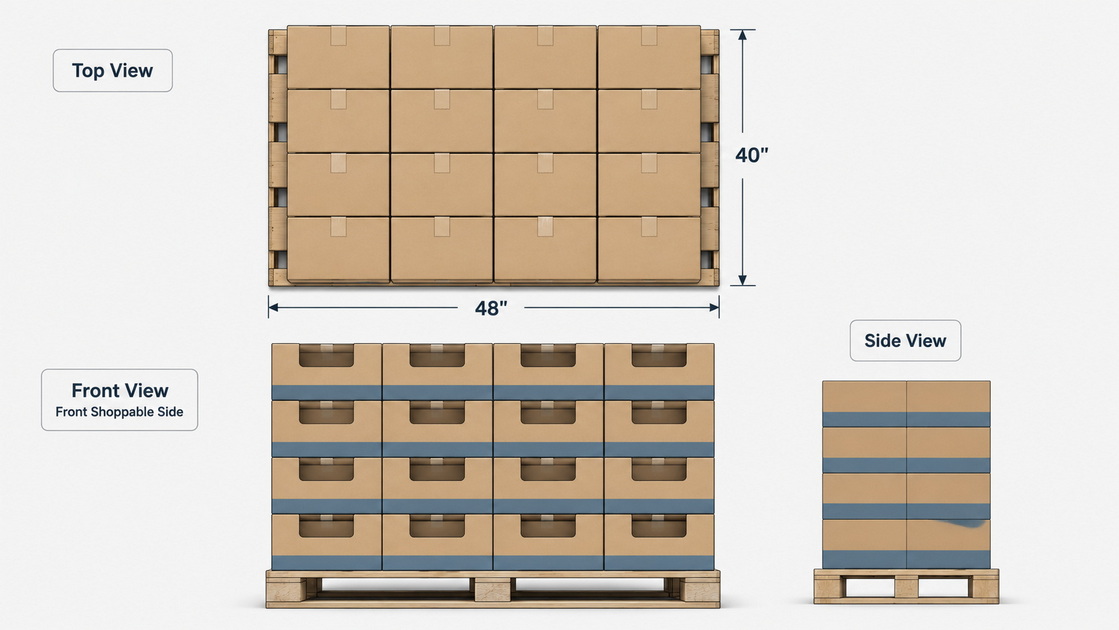
For North American warehouses, Costco typically works with a 48″ × 40″ pallet footprint and strict height and overhang rules. Designing from the pallet up ensures your display boxes are structurally compliant and visually coherent.
Key principles:
- Plan display box dimensions around pallet load size and height to avoid overhang and unsafe stacking.
- Keep total load height within common warehouse limits to support safe double‑stacking and efficient transport.
- Think in terms of pallet pattern: how many display boxes per layer and how many layers per pallet.
In our projects, we start by sketching the pallet first, then nesting display boxes inside that geometry. This prevents late‑stage surprises when prototypes meet real warehouse constraints and helps align structure, branding, and operations from day one.
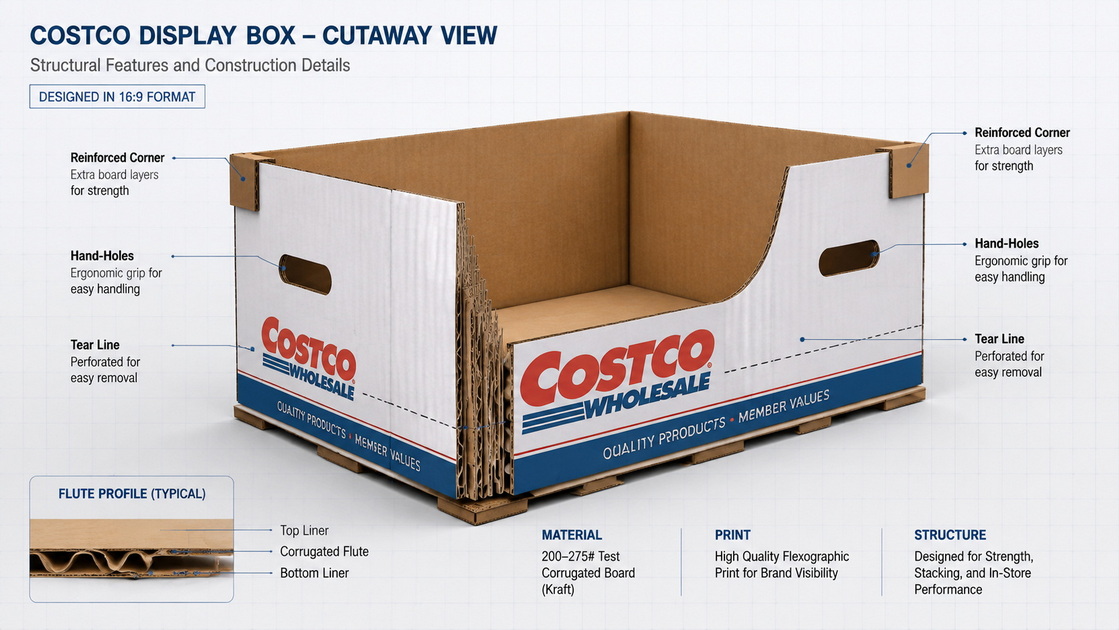
Costco pallets must survive clamp trucks, cross‑docks, and extended floor time. Thin or fragile boxes risk tearing, crushing, and product loss.
When designing display boxes:
- Choose corrugated flute and board grade according to total weight and stacking height.
- Add layer sheets or caps to distribute load and resist crushing.
- Reinforce critical stress points such as corners, hand‑holes, and tear‑away panels.
In our factory, we regularly run unitized load tests. We stack sample boxes on pallets, apply simulated clamp pressure, and check for deformation. Investing in strong structure up front reduces damage claims, protects product, and maintains a clean brand impression in the club environment.
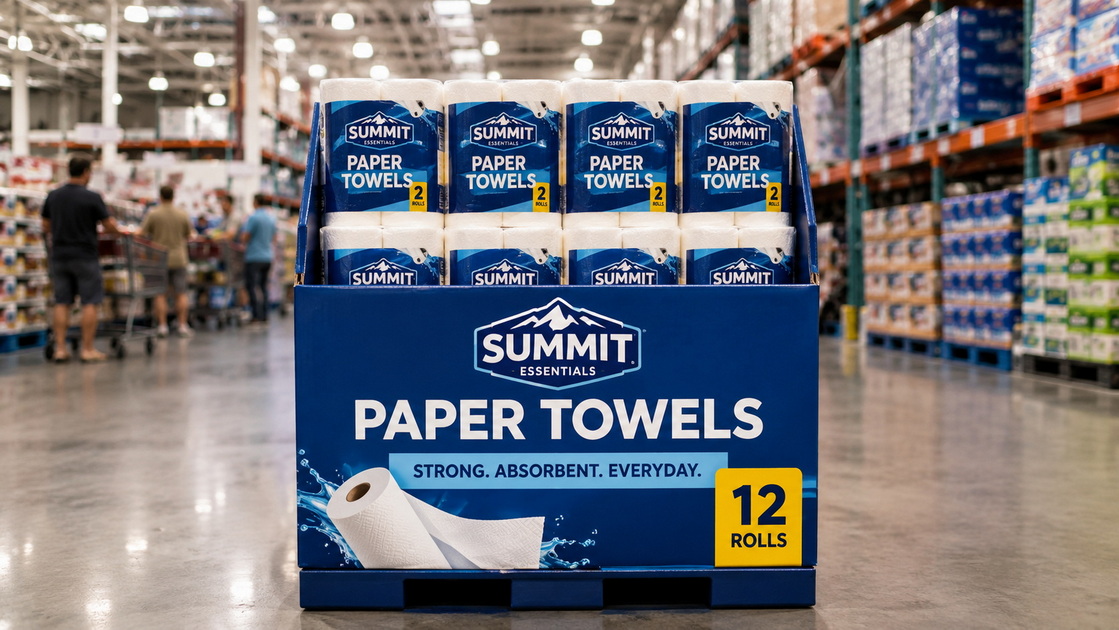
Costco members often stand several feet away from pallets and make decisions quickly. Display boxes must communicate value within about five seconds at five feet.
Practical guidance:
- Use large, legible type for product name and core benefit.
- Highlight a single key value statement (for example, "24‑Pack Family Size" or "90‑Day Supply") instead of crowding the face with multiple badges.
- Make product count and value cues immediately visible, avoiding small or low‑contrast text.
We recommend building mock‑ups and placing them in a corridor at eye level to test readability from a distance. If the main benefit and product type are not obvious at a glance, the design should be simplified until the message is clear and fast.
Pallets on the warehouse floor are visible from multiple angles, and boxes may be rotated during handling. Effective display boxes use multi‑side branding so the product remains identifiable in varied orientations.
Best practices:
- Place the logo and product name on at least three sides of the display box.
- Align key information (count, variant, main benefit) consistently on each visible side.
- Position barcodes and operational labels where staff can scan without tearing graphics or covering critical brand elements.
When we design larger display boxes or unusual structures, we assume the pallet may be rotated and the box may be handled in different ways. By mapping several possible rotations, we ensure branding and essential information remain visible, no matter how the pallet is placed on the floor.
Club‑store packaging must be retail‑ready, moving from trailer to floor with minimal repacking. Display boxes should function as shelf‑ready units or pallet display units that staff can open quickly and cleanly.
To achieve this:
- Integrate tear‑away fronts or tops so staff can open the box without tools, following simple perforation paths.
- Design trays that hold products securely yet allow easy access for shoppers.
- Avoid loose, unstructured interior packing; use dividers or cells for multi‑unit loads.
As a POP display manufacturer, we frequently pre‑pack products into display boxes at the factory. This reduces labor at distribution centers, improves consistency, and ensures every pallet arrives floor‑ready with minimal risk of mis‑packing or presentation errors.
Club stores rely on fast scanning and reliable inventory control. Display boxes must support operational needs without compromising presentation.
Consider:
- Clear product labels on the front and sides with brand name, product description, and count.
- Master carton and pallet labels positioned where staff can scan through stretch wrap.
- Handling pictograms on large or heavy loads to guide clamp‑truck pressure and stacking rules.
We encourage brands to standardize label placement and information hierarchy across product families. This reduces training time for warehouse teams and makes it easier for staff to recognize and process pallets quickly.
Retailers and shoppers are increasingly attentive to packaging reduction and recyclability. Display boxes that demonstrate genuine sustainability gains can improve acceptance and strengthen brand perception.
Relevant steps:
- Reduce unnecessary plastics, foils, and non‑recyclable coatings wherever possible.
- Right‑weight corrugate: make it strong enough for the load, but avoid excessive board grades that add cost and waste.
- Call out recyclability or relevant certifications in a concise way that supports rather than dominates the design.
Recent club‑store floors show that many high‑volume categories have moved toward leaner packaging forms that still deliver strong shelf presence. Display boxes that visibly use less material while maintaining durability are viewed positively, especially for family‑sized and bulk items.
To turn guidelines into a repeatable workflow, consider a simplified case pattern:
1. Define Pallet Strategy
- Decide whether the pallet will be shoppable on one, two, or three sides.
- Set target total height and weight based on buyer input and category norms.
2. Design Display Box Structure
- Select corrugate grade and flute according to unit weight and stacking plan.
- Add tear‑away fronts plus internal dividers or cells for multi‑pack units.
3. Build Visual Hierarchy
- Place brand and product name at the top of the visual hierarchy.
- Use one main benefit line and clear count/value indicators visible at five feet.
4. Validate in a Realistic Environment
- Test mock‑ups from several feet away in a busy aisle or warehouse setting.
- Run basic stacking and handling simulations to check integrity and ease of opening.
This four‑step pattern helps teams balance design, engineering, and operations, especially when working with a POP display specialist who can design, test, and produce the complete solution.
Partnering with a dedicated POP display manufacturer can significantly streamline the journey from concept to compliant pallet.
A specialist team typically:
- Provides structural design support, translating retailer specifications into pallet and box plans that work in real warehouses.
- Develops multiple structural and graphic options per project that consider category behavior, shopper expectations, and brand guidelines.
- Manages prototype, testing, printing, production, and preloading within one integrated process, shortening timelines and reducing hand‑offs.
In our experience, the most successful projects begin with open sharing of category data—velocity, unit price, preferred pack sizes, and promotional plans. This allows the design and engineering team to tailor display boxes to real performance targets, not just aesthetic preferences.
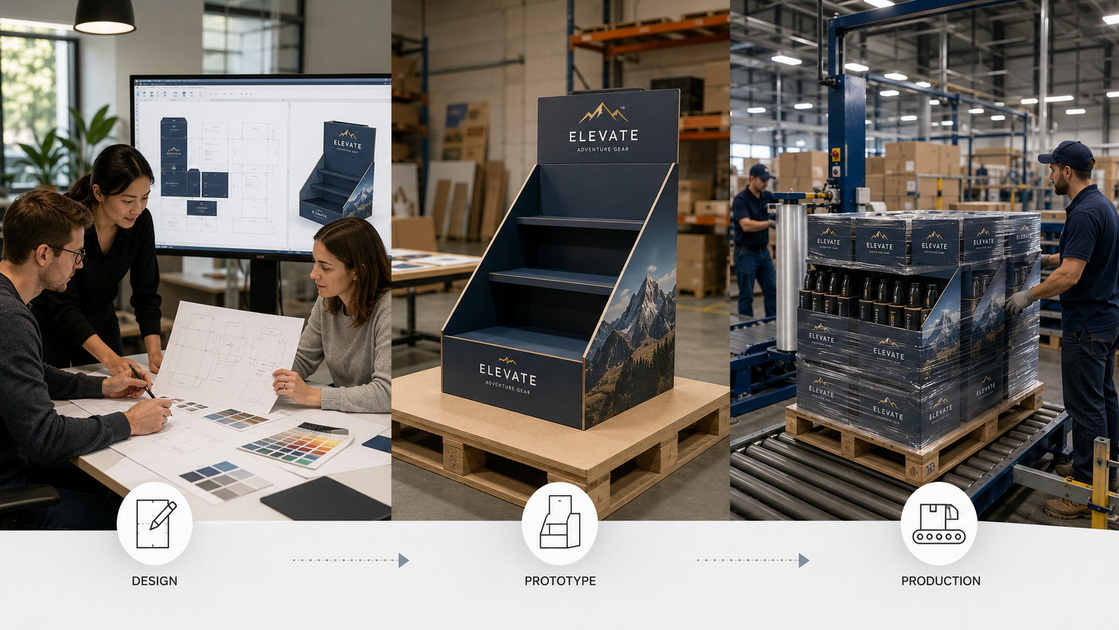
The path to successful Costco display boxes is a combination of pallet‑level planning, robust structure, simple value communication, and operational awareness. When brands design from the pallet up, reinforce boxes correctly, and focus on fast readability, they are better positioned to meet specifications and move units quickly.
Working closely with an experienced POP display manufacturer that can handle design, customization, production, and preloading offers a practical way to turn concepts into pallets that perform consistently across markets. This integrated approach reduces risk, strengthens in‑store execution, and supports long‑term relationships with club‑store buyers.
1. What is the main difference between standard packaging and Costco display boxes?
Standard packaging often focuses on individual shelf presence, while Costco display boxes must function as both transport packaging and in‑store presentation on full pallets, with defined structural and size requirements.
2. Why is designing from the pallet up so important for club stores?
Pallet dimensions, height limits, and handling methods determine how many display boxes can be safely stacked and shopped. Starting with pallet strategy ensures stability, compliance, and consistent floor presentation.
3. How can I improve shoppability for Costco members?
Use large, clear type, one strong benefit message, and prominent count/value information. Reduce visual clutter and make sure logos and product names appear on multiple sides so shoppers can recognize the product quickly from different angles.
4. What role does sustainability play in club‑store display box decisions?
Retailers increasingly favor packaging that reduces material use and is easy to recycle. Display boxes that right‑weight corrugate, minimize plastics, and communicate recyclability clearly can gain preference and support brand reputation.
5. How can a POP display manufacturer support my Costco project?
A POP display manufacturer can interpret retailer specs, design compliant structures, develop graphics, run tests, produce the display boxes, and even preload products. This helps brands move from concept to floor‑ready pallets with fewer iterations and a more reliable outcome.
1. Bennett Packaging – "7 Design Tips For Costco Packaging". https://bpkc.com/blogs/blog/7-design-tips-for-costco-packaging
2. Long-Win Display – Company and Services Overview. https://www.longwindisplay.com/
3. Long-Win Display – POP Display Manufacturer Profile. https://www.longwindisplay.com/our-company.html
4. Holidaypac – "7 Design Tips for Costco Packaging (2025 Guide)". https://www.holidaypac.com/blog/7-design-tips-for-costco-packaging-2025-guide-holidaypac.html
5. SmashBrand – "Why Costco Packaging Design Demands a New Playbook". https://www.smashbrand.com/articles/costco-packaging-design/
6. YouTube – "How to Design Packaging for Costco an Expert Guide". https://www.youtube.com/watch?v=6lY2w73t_Kk
7. YouTube – "Best of the best (from a packaging perspective) as we walked the Costco floor throughout Q1". https://www.youtube.com/watch?v=Qmg7gj4nnik
8. Greendot Packaging – "Costco Packaging Guide". https://greendotpackaging.com/pinned/costco-packaging-requirements/


