
Views: 248 Author: Long Win Display Publish Time: 2026-10-26 Origin: Site


Content Menu
● What Are Corrugated Retail POP Displays?
>> What the Original Article Needed to Clarify
● Main Types of Cardboard Display Stands
>> POP and POS Are Related Terms
● How Corrugated Display Construction Affects Performance
>> Board Grade Is Only One Variable
>> ECT Does Not Establish Shelf Capacity
● Define Load Capacity Before Approving the Artwork
>> Evaluate Different Stocking Conditions
● Humidity and Long Term Loading: Two Overlooked Risks
>> Avoid Universal Slot Allowances
>> Check Performance Over Time
● Flat Packed vs Preassembled vs Product Filled Displays
● Retailer Requirements and Accessibility
>> Obtain the Actual Specification
>> Keep Logistics Dimensions Separate From Display Dimensions
>> Do Not Turn Reach Guidance Into a Universal Shelf Rule
● Printing and Retail Graphics
● Validate Shipping and Selling Configurations Separately
● Sustainability Claims Need Specific Evidence
● Measuring Display Performance Without Inventing Sales Claims
● Working With Long Win Display
● FAQ
>> 1. How Much Weight Can a Cardboard Display Stand Hold?
>> 2. Is Double Wall Board Always Necessary?
>> 3. Can One Display Be Used Across Multiple Retailers?
>> 4. Should We Approve a Printed Sample or an Unprinted Prototype?
>> 5. What Should a Wholesale Purchase Order Specify?
Corrugated retail POP displays are merchandising fixtures made primarily from fluted paperboard. They help brands organize products, communicate an offer, and create additional selling locations in stores. A custom cardboard display stand can support a product launch, seasonal promotion, or retail rollout—but only when its structure and operating requirements match the assignment.
From a procurement perspective, my first question is not, "How impressive does the rendering look?" It is, "Can this display arrive intact, assemble correctly, and hold the intended merchandise throughout the campaign?"
That focus on execution connects creative design with measurable purchasing requirements.
This guide explains display formats, structural specifications, shipping options, and sample approval. It also addresses weaknesses in the original article, including universal dimensional assumptions and unsupported performance promises.
No customer reviews were supplied. This article does not invent testimonials, factory observations, or customer results. Long Win Display's company description is based on the information provided for this assignment.

A corrugated retail point-of-purchase display is a merchandising structure made primarily from corrugated fiberboard: flat linerboard bonded to a fluted medium.
These displays can hold merchandise, communicate promotional messages, or combine both functions.
They are not limited to freestanding floor units. Countertop displays, hanging sidekicks, shelf-ready trays, and pallet displays can also use corrugated construction.
They commonly support temporary or campaign-based merchandising. However, usable life depends on load, environment, handling, and construction—not a universal replacement schedule.
The original article identifies useful topics, including footprint, humidity, and structural strength. However, several recommendations need qualification:
- A 48 × 40-inch pallet is not a mandatory footprint for every floor display.
- A fixed 1 mm slot allowance cannot guarantee assembly across all boards and climates.
- Accessibility requirements cannot be reduced to one universal merchandise-height rule.
- Double-wall board does not automatically correct an unsuitable structure.
- Sales improvements and damage reductions require project-specific evidence.
A stronger purchasing guide replaces absolute promises with defined specifications and validation.
| Display Format | Typical Application | Main Design Question |
|---|---|---|
| Floor display | Dedicated promotional placement | Does the footprint, stability, and capacity fit the approved location? |
| Countertop display | Small products near service or checkout areas | Does it preserve required operating space and access? |
| Sidekick or power wing | Hanging merchandise beside compatible fixtures | Are mounting hardware and loaded weight approved? |
| Pallet display | Higher-volume merchandising | Does the assembled load fit handling and retailer requirements? |
| Dump bin | Loose or individually packaged merchandise | Can shoppers access products without destabilizing the unit? |
| Shelf-ready tray | Transport-to-shelf presentation | Does the opening method preserve appearance and product support? |
Choose the format after confirming the placement. A visually attractive structure is not useful if the retailer cannot accommodate it.
POP refers to the point of purchase; POS refers to the point of sale.
Suppliers sometimes use the terms interchangeably, but the label does not define the engineering requirements. Specify the actual location, dimensions, merchandise, and handling process.
Flute profile, liner properties, board construction, and manufacturing quality influence performance.
However, the finished structure also depends on:
- Shelf span.
- Supports and dividers.
- Cutouts and access openings.
- Fold and score positions.
- Joint design.
- Load distribution.
- Assembly accuracy.
Two displays made from nominally similar board can perform differently.
The edge crush test measures a board specimen's resistance to edgewise compression under specified conditions.
It is useful material information, but it does not independently establish how much merchandise a display shelf can hold.
Shelf bending, joint failure, local crushing, and instability require assessment of the complete design.
FEFCO publishes separate methods for properties including edgewise crush resistance and compression resistance. Select tests that answer the actual engineering question.
Double-wall construction may be appropriate for some loads or environments.
It can also add material, weight, and assembly complexity. A better support arrangement may sometimes solve the problem more efficiently.
Ask the manufacturer to explain the proposed load path rather than recommending a board upgrade without structural reasoning.
"Strong enough for retail" is not a usable specification.
For each shelf, define:
1. Product dimensions and weight.
2. Number of units.
3. Product arrangement.
4. Maximum replenishment quantity.
5. Intended campaign duration.
6. Operating environment.
7. Acceptable deflection or damage.
Suppose a shelf holds 12 packages weighing 0.5 kg each. Its merchandise load is 6 kg.
That figure alone is insufficient. A concentrated row of products near the front edge may load the structure differently from evenly distributed merchandise.
Also test the arrangement that store staff are likely to create during replenishment—not only the ideal arrangement shown in the rendering.
Review the display when:
- Fully stocked.
- Partially depleted.
- Unevenly loaded.
- Being replenished.
These conditions can change stability and shopper access.
A strong shelf does not compensate for a narrow or unstable base.

Corrugated board dimensions and behavior can change with environmental conditions.
However, no single slot adjustment suits every flute, finish, joint, and destination. Excess clearance can create a loose connection; insufficient clearance can cause assembly damage.
Evaluate prototype joints using representative production material and relevant conditioning.
A display that holds its load briefly may develop unacceptable deformation during a longer campaign.
Specify how long the loaded prototype should be observed, under what conditions, and what constitutes failure.
Include shelf sag, leaning, damaged joints, and loss of product retention in the assessment.
Where stores may expose the base to wet cleaning, discuss appropriate protection and placement instructions. Do not interpret a coated surface as proof that the entire display is waterproof.
| Supply Format | Potential Advantage | Main Tradeoff |
|---|---|---|
| Flat packed | Lower shipping volume | Assembly labor moves downstream |
| Preassembled | Less setup at destination | Higher transport volume and protection needs |
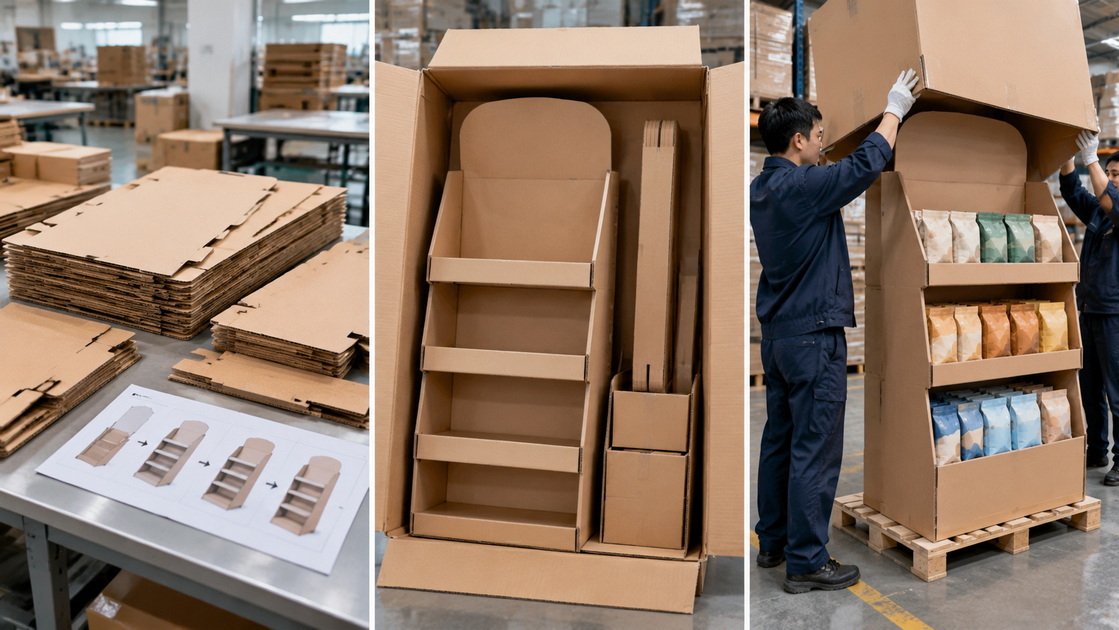
| Product filled | Can simplify store deployment | Requires coordinated packing, restraint, and transport validation |
Flat packing can improve freight efficiency, but complicated instructions may transfer cost to a warehouse or store.
Test assembly with someone unfamiliar with the design. Record time, errors, and whether tools are needed.
Preassembly can reduce store-level tasks. Nevertheless, the display still needs protection during transit.
Confirm whether removable headers or other vulnerable parts are shipped separately.
A product-filled display can arrive closer to its selling configuration.
It must also survive distribution with merchandise inside. Define how the products are restrained, how the structure is protected, and what staff must remove before placement.
"Store ready" should describe a verified sequence, not an undefined marketing claim.
Before structural development, request the retailer's current requirements for:
- Footprint and height.
- Product quantities.
- Pallet configuration.
- Labels and identification.
- Assembly.
- Store placement.
- Delivery appointments and routing.
Do not assume that acceptance by one retail chain establishes acceptance elsewhere.
A pallet footprint and a merchandising footprint are related, but not necessarily identical.
The approved format depends on the retailer, region, handling equipment, and shipment configuration.
Confirm the required dimensions rather than treating one North American pallet size as a global rule.
Accessibility requirements vary by jurisdiction and application.
For example, U.S. standards address accessible sales and service counters through specific provisions. Those requirements should not be converted into an unsupported claim that every merchandise shelf must fall within one height range.
Coordinate placement with the retailer and qualified advisers where needed. Do not obstruct accessible routes, emergency exits, or required operating areas.
A display should communicate clearly at its intended viewing distance.
Prioritize:
- Product category.
- Main message.
- Brand identification.
- Essential selection information.
- Price or promotion where applicable.
Use a full-size proof to review legibility. A detailed screen rendering can conceal text that becomes difficult to read in store.
Also confirm dielines, bleed, fold positions, and color references before production.
Avoid placing essential information across folds, shelf edges, or areas hidden by merchandise.
A display can have different structural roles before and after arrival.
Transport packaging may provide protection that disappears when staff remove a sleeve, lid, or securing component.
Therefore, approve both:
1. The complete shipping configuration.
2. The final merchandising configuration.
Do not assume that a transit compression result establishes shelf performance—or that a stable shop-floor prototype will survive transport.
ISTA Procedure 3E addresses similar packaged products in unitized loads shipped through a full-truckload distribution system. It is not a universal test for every display shipment.
Ask the testing provider to select a protocol appropriate to the actual route and retailer requirements.
Corrugated construction can support material recovery, but recyclability depends on the finished design and receiving system.
Evaluate coatings, laminates, plastic windows, permanent attachments, and ease of separation.
FEFCO's recyclability guidance considers the effect of treatments and non-fiber components. Its updated annex provides a structured assessment approach.
Avoid treating "paper based" as proof that every component is recyclable everywhere.
For procurement, request clear material identification and practical disassembly instructions where mixed materials are used.
A display does not guarantee a sales uplift.
Results can be influenced by placement, price, promotion, availability, and store traffic.
Useful operational measures include:
- Percentage of delivered units actually installed.
- Assembly time.
- Damage and replacement rates.
- Days in position.
- Replenishment frequency.
- Out-of-stock periods.
Where possible, compare campaign results with suitable stores or periods while acknowledging other influences.
This is more informative than attributing every sales change to the display structure.
According to the company information supplied, Long Win Display is a China-based designer and manufacturer specializing in customized cardboard display stands, production, and preassembly.
For a project inquiry, provide:
- Product dimensions and weights.
- Planned quantities per shelf.
- Retailer specifications.
- Campaign duration.
- Shipping destination and route.
- Required supply format.
- Artwork status and launch deadline.
Request a structural proposal, representative sample, and documented approval process.
Confirm testing, material traceability, inspection criteria, and handling of specification changes before bulk production. Company experience should support that discussion, not replace project-specific evidence.
A successful corrugated retail POP display connects merchandising goals with structural performance and practical deployment.
Start with the product and approved store location. Then define loads, assembly, environmental conditions, shipping protection, and acceptance criteria.
There is no universal rating. Capacity depends on the board, shelf span, supports, load arrangement, environment, and duration. Request testing of the actual configuration.
No. Select construction around measured requirements. Reinforcement or a revised support system may be more effective than increasing board thickness alone.
Sometimes, but confirm each retailer's specifications. Differences in footprint, labeling, handling, or placement may require separate versions.
Ideally, review both structural performance and final appearance. An early unprinted prototype can reveal design problems; a representative printed sample confirms the finished execution.
Include the approved drawing revision, materials, printing references, product loading, packing method, inspection criteria, delivery milestones, and written change-control requirements.
1. [PopDisplay — What Are Corrugated Retail POP Displays?]. Original article reviewed and restructured. Its universal dimensional rules, fixed slot allowance, and unsupported outcome claims were not adopted. [popdisplay]
2. [FEFCO — Testing Methods and Recommendations]. Describes distinct tests for corrugated-board properties and finished-package performance. [fefco]
3. [ISTA — Test Procedures]. Defines the application of distribution test procedures, including Procedure 3E for relevant unitized truckload shipments. [ista]
4. [U.S. Access Board — ADA Accessibility Standards]. Official requirements covering accessible routes, counters, reach ranges, and other applicable elements. [access-board]
5. [U.S. Access Board — Chapter 9: Built-In Elements]. Specific provisions for accessible sales and service counters. [access-board]
6. [FEFCO — Standards and Guidelines]. Includes recyclability guidance and the updated assessment annex addressing coatings and non-fiber materials. [fefco]


