
Views: 207 Author: Long Win Display Publish Time: 2026-08-20 Origin: Site


Content Menu
● Cardboard POP Display vs Metal Display at a Glance
● Why Heavy Beverage Promotions Need Special Display Engineering
● What Is a Cardboard POP Display?
>> Advantages of Cardboard POP Displays
>> Limitations of Cardboard POP Displays
>> Advantages of Metal Displays
>> Limitations of Metal Displays
● Load Capacity and Structural Safety
>> Cardboard Display Load Design
● Cardboard POP Display vs Metal Display by Beverage Type
● Cost Comparison: Initial Cost and Program Value
● Branding and Shopper Visibility
● Sustainability and End-of-Life Planning
● How to Choose the Right Beverage Display
>> 1. Calculate the Full Product Load
>> 2. Define the Campaign Duration
>> 4. Define the Brand Objective
>> 5. Develop and Test a Prototype
● Hybrid Displays for Heavy Beverage Promotions
>> 1. Can a Cardboard POP Display Hold Heavy Beverage Products?
>> 2. Is a Metal Display Better for Glass Bottles?
>> 3. Which Display Is Better for a Short Beverage Promotion?
>> 4. Which Display Is More Sustainable: Cardboard or Metal?
>> 5. How Do I Calculate Beverage Display Load Capacity?
Choosing between a cardboard POP display and a metal display for heavy beverage promotions is not simply a material decision. It affects load safety, retail visibility, shipping cost, assembly time, campaign flexibility, and the customer experience.
For short-term launches, seasonal promotions, and high-visibility store activations, a reinforced cardboard POP display can provide strong graphics and efficient distribution. For long-term beverage merchandising, repeated replenishment, glass bottles, and high-load environments, a metal display can provide greater durability and structural stability.
The right display should be engineered around beverage weight, pack format, store conditions, campaign duration, replenishment frequency, and available retail space.

| Factor | Cardboard POP Display | Metal Display |
|---|---|---|
| Best use | Short-term campaigns and seasonal promotions | Long-term and repeatable retail programs |
| Main material | Corrugated board and printed paperboard | Steel, wire, aluminum, sheet metal, or tubing |
| Branding flexibility | Excellent with full-surface graphics | Good with headers, panels, decals, and inserts |
| Load potential | Strong when reinforced and properly tested | Strong for consistently heavy loads and repeated restocking |
| Shipping format | Often flat-packed or partially pre-assembled | Often heavier and bulkier to ship |
| Assembly | Fast and often tool-free | May require tools, hardware, or more store setup |
| Retail lifespan | Days, weeks, or months | Months or years |
| Visual style | Promotional, colorful, campaign-driven | Durable, premium, permanent, or industrial |
| Sustainability route | Recyclable corrugated-material options | Reusable long-life material options |
| Cost profile | Lower initial cost for campaign distribution | Higher initial cost with long-term reuse potential |
Cardboard POP displays are strong in campaign flexibility, graphics, and efficient shipping. Metal displays are strong in repeated use, long-term durability, and heavy-load performance.
Beverages place demanding loads on retail display stands. Liquid is dense, and bottles, cans, cartons, and multipacks can create substantial weight on shelves, trays, bases, and support panels.
A display must handle more than product weight when standing still. It must also withstand warehouse handling, transportation vibration, retail stocking, customer interaction, accidental impacts, uneven loading, and possible moisture exposure.
Heavy beverage promotions often include:
- Glass bottles
- PET bottles
- Aluminum cans
- Beverage cartons
- Ready-to-drink coffee
- Energy drinks
- Sparkling water
- Beer and cider
- Wine
- Spirits
- Functional beverages
- Six-packs and twelve-packs
- Shrink-wrapped multipacks
- Large-volume water cases
The first design question should be:
What is the maximum fully loaded weight of the display?
This calculation should include the weight of every product unit, product tray, shelf, base, and a reasonable structural safety margin.
A cardboard POP display is a retail promotional fixture made mainly from corrugated board, paperboard, printed wrap sheets, and internal support structures. POP means Point of Purchase, referring to retail displays placed where shoppers can see and purchase promoted products.
Cardboard POP displays are widely used in supermarkets, convenience stores, pharmacies, specialty shops, department stores, and event retail locations.
Common formats include:
- Countertop display stands
- Floor display stands
- Sidekick displays
- End-cap displays
- Pallet displays
- Dump bins
- Shelf-ready displays
- Display trays
- Power wings
- Clip strips
- Promotional islands
For beverages, the most common choices are floor stands, pallet displays, reinforced display trays, dump bins, and end-cap promotions.
The major advantage of cardboard is visual flexibility. Its large printable surfaces can carry strong campaign messages and create instant product visibility.
A cardboard beverage display can include:
- Full-color graphics
- Product photography
- Brand colors
- Flavor messaging
- Seasonal campaigns
- Limited-edition promotions
- Promotional-price areas
- QR code placement
- Retailer-specific design
- Lifestyle imagery
- New-product messaging
Cardboard can also support fast retail campaigns because it is often flat-packed or partially assembled before delivery.
For heavy beverage promotions, cardboard displays can be strengthened with:
- Double-wall corrugated board
- High-strength flute combinations
- Internal support partitions
- Reinforced shelf lips
- Locked shelf tabs
- Multi-layer shelf panels
- Hidden support bars
- Full-height back panels
- Cross-bracing structures
- Pallet-compatible bases
- Moisture-resistant coatings
- Product trays that distribute the load evenly
A well-designed cardboard display can support demanding beverage loads when the structure, board grade, product layout, and load testing are matched correctly.
Cardboard displays are not suitable for every retail environment.
Their performance may be affected by:
- High humidity
- Water spills
- Condensation
- Wet floor conditions
- Repeated product impacts
- Uneven restocking
- Frequent movement
- Excessive overloading
- Long-term retail exposure
- Poor assembly practices
A cardboard display should never be selected based only on price. For heavy beverage products, shelf span, support structure, base size, board grade, and the real product load must all be considered.
A metal display is a retail fixture made from materials such as steel wire, tubular steel, sheet metal, aluminum, or other metal components.
Metal displays are often selected for heavy beverage promotions that require long-term use, frequent restocking, consistent shelf strength, or a premium retail appearance.
Common metal display formats include:
- Wire beverage racks
- Steel floor display stands
- Bottle display racks
- Metal pallet frames
- Countertop metal racks
- Freestanding beverage towers
- End-cap fixtures
- Gravity-feed displays
- Metal basket displays
- Wheeled beverage stands
- Custom branded retail fixtures
The main advantage of metal is durability.
Metal display stands can be engineered for repeated loading, frequent product replenishment, and longer retail programs. They are especially useful for products with higher unit weight, including glass bottles, canned multipacks, bottled water, wine, spirits, and larger beverage cartons.
Metal displays can offer:
- Strong long-term load support
- Stable shelf performance
- Better resistance to repeated use
- Reusable structure
- Premium brand presentation
- Strong resistance to impacts
- Flexible shelf layouts
- Durable powder-coated surfaces
- Compatibility with wire baskets and dividers
- Strong support for bottles and multipacks
Metal displays can be especially suitable for premium beverage categories such as wine, spirits, craft beer, imported drinks, specialty coffee, and high-end functional beverages.
Metal displays can involve a higher initial investment than cardboard displays.
Other considerations include:
- Higher shipping weight
- More complex packaging
- Larger storage requirements
- Longer fabrication cycles
- More difficult graphic updates
- Potential scratches during transportation
- Corrosion risk without suitable finishing
- More complex store assembly in some designs
For short seasonal promotions, a custom metal display may provide more durability than the program needs.
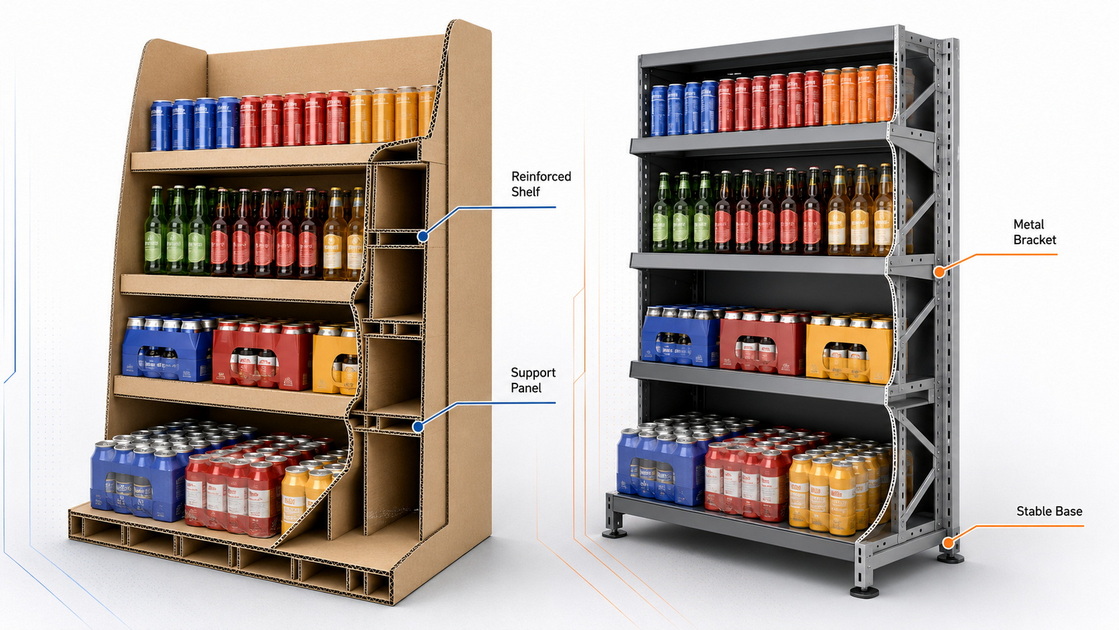
For beverage retail displays, load capacity should always be treated as a design requirement rather than a general assumption.
A display should be evaluated by its structure, not only by its material. A poorly designed metal stand can be unstable. A properly engineered cardboard POP display can provide dependable support within its planned load range.
Important design factors include:
- Total product weight
- Weight per shelf
- Shelf width and depth
- Shelf span
- Display height
- Base footprint
- Product center of gravity
- Number of shelves
- Product pack format
- Material thickness or board grade
- Internal reinforcements
- Store replenishment method
- Campaign duration
- Expected customer interaction
- Transport and delivery method
For cardboard beverage displays, the goal is to distribute load across the structure rather than placing too much pressure on a single shelf panel.
Strong cardboard display designs may include:
- Double-wall corrugated board
- Laminated shelf panels
- Folded support beams
- Interlocking shelf structures
- Reinforced bottom trays
- Divider partitions
- Strong back panels
- Wide base panels
- Moisture-resistant finishes
- Product trays that spread weight evenly
The design should be tested with real beverage products. A display loaded with single cans will behave differently from a display loaded with glass bottles, shrink-wrapped multipacks, or large beverage cartons.
For metal beverage displays, the engineering focus includes structural strength, shelf support, finish quality, and stability.
A metal structure may require:
- Correct steel thickness
- Suitable tube diameter
- Reliable welding
- Reinforced shelf brackets
- Cross-bar support
- Wide and stable base geometry
- Anti-tip features
- Powder coating
- Adjustable feet
- Protective shelf surfaces
- Locking casters for mobile applications
Metal is usually the stronger choice for long-term and refill-heavy beverage programs. However, every design should still have clear shelf-load limits and appropriate stability testing.
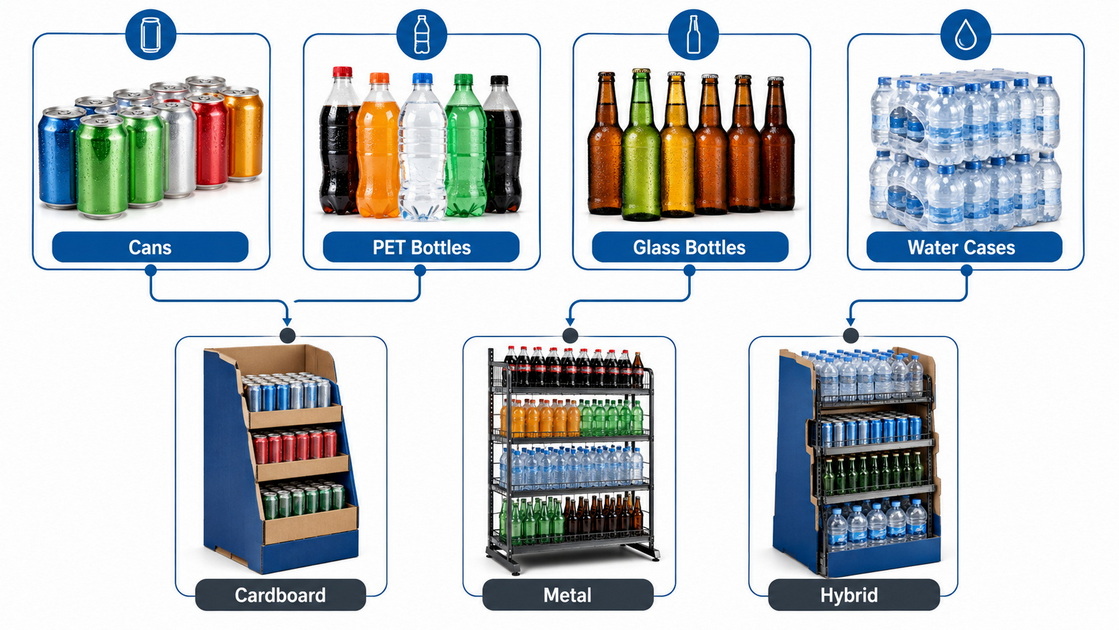
| Beverage Type | Recommended Display Direction | Reason |
|---|---|---|
| Single aluminum cans | Cardboard or metal | Moderate unit weight and strong promotional potential |
| Small PET bottles | Cardboard or metal | Suitable for branded floor stands and tray displays |
| Glass beer bottles | Reinforced cardboard or metal | Requires stable shelves and strong base support |
| Wine bottles | Metal or premium reinforced cardboard | High unit weight and premium retail presentation |
| Spirits | Metal for long programs; cardboard for launches | Heavy glass and strong brand-presentation needs |
| Energy drink multipacks | Reinforced cardboard or metal | Dense packs require strong shelves and bases |
| Bottled-water cases | Metal or pallet-based cardboard display | High total load and frequent replenishment |
| Ready-to-drink coffee | Cardboard for promotions; metal for permanent racks | Depends on pack weight and campaign duration |
| Large beverage cartons | Reinforced cardboard or metal | Requires wide shelves and even load distribution |
The product format should guide the display structure. A single can, a six-pack, a glass bottle, and a water case all place different demands on shelves and bases.
A cardboard POP display usually has a lower initial cost than a custom metal display. It can also reduce freight cost when shipped flat-packed.
Cardboard is often suitable for:
- National retail launches
- Seasonal beverage promotions
- New flavor introductions
- Limited-time retail programs
- Retailer-specific campaigns
- High-volume distribution
- Event promotions
- Price-driven product activation
Metal displays often have a higher upfront cost. However, they can be reused through multiple retail cycles and product updates.
Metal is often suitable for:
- Permanent or semi-permanent retail placement
- Refillable beverage programs
- Long-running promotions
- Premium beverage brands
- High-traffic retail environments
- Displays with frequent restocking
- Multi-season merchandising programs
The key question is not only which material costs less at the beginning.
Which display provides the best total value over the planned retail lifecycle?
Cardboard POP displays can transform a retail fixture into a large-format brand communication tool.
The display can use its header, side panels, shelf edges, front panels, and base as a unified visual campaign.
Cardboard graphics can communicate:
- Brand identity
- Product features
- Flavor options
- Pricing information
- Seasonal messaging
- New-product launches
- Limited-time offers
- Product photography
- Lifestyle visuals
- Retail promotions
Metal displays use a different branding approach. Their visual impact often comes from the structure, material finish, and targeted graphic components.
Common metal-display branding elements include:
- Printed headers
- Magnetic panels
- Replaceable graphic inserts
- Powder-coated brand colors
- Vinyl graphics
- Laser-cut logos
- Shelf strips
- Product trays
- Hanging signs
Cardboard is often the better choice for fast campaign updates and visual storytelling. Metal is often the better choice for a premium and durable retail presence.
The material decision should consider the complete retail lifecycle.
Cardboard display stands can support recyclable retail programs when they are made from recyclable corrugated materials, use appropriate inks, and avoid unnecessary mixed-material construction.
Metal displays can support reusable retail programs. A well-built metal fixture can remain in use through multiple product launches, seasonal campaigns, and store refreshes.
Choose cardboard when the priority is:
- Lightweight distribution
- Campaign-specific graphics
- Fast replacement
- High-volume retail deployment
- Recyclable material options
- Short-to-medium campaign duration
Choose metal when the priority is:
- Long service life
- Reuse across multiple campaigns
- Frequent restocking
- High-load performance
- Durable premium presentation
- Reduced replacement frequency
A responsible display solution considers materials, shipment volume, assembly needs, reuse potential, retail lifespan, and end-of-life handling.
A structured decision process helps avoid costly redesigns and retail issues.
Calculate the total product weight when the display is completely stocked.
Include:
- Product unit weight
- Pack weight
- Number of products per shelf
- Number of shelves
- Product trays
- Promotional accessories
- Shelf load
- Total display load
- Structural safety margin
Do not estimate based on one product unit. Use the fully loaded display condition.
The expected retail period affects the best material choice.
- A two-week launch may favor cardboard.
- A three-month seasonal campaign may use reinforced cardboard or metal.
- A year-round display program often favors metal.
Consider the retail environment before selecting materials.
- Is the display near refrigeration units?
- Is there a risk of water, condensation, or spills?
- Will store staff move the display frequently?
- Is the floor uneven?
- Is the display placed in a busy aisle?
- Will customers remove products from more than one side?
- Will the stand be restocked daily?
- Does the retailer require a specific footprint?
These conditions directly influence display material, structure, coating, base design, and packaging.
Choose cardboard when the campaign needs bold graphics, fast production, and frequent creative updates.
Choose metal when the program needs a durable fixture, premium appearance, and long-term reuse.
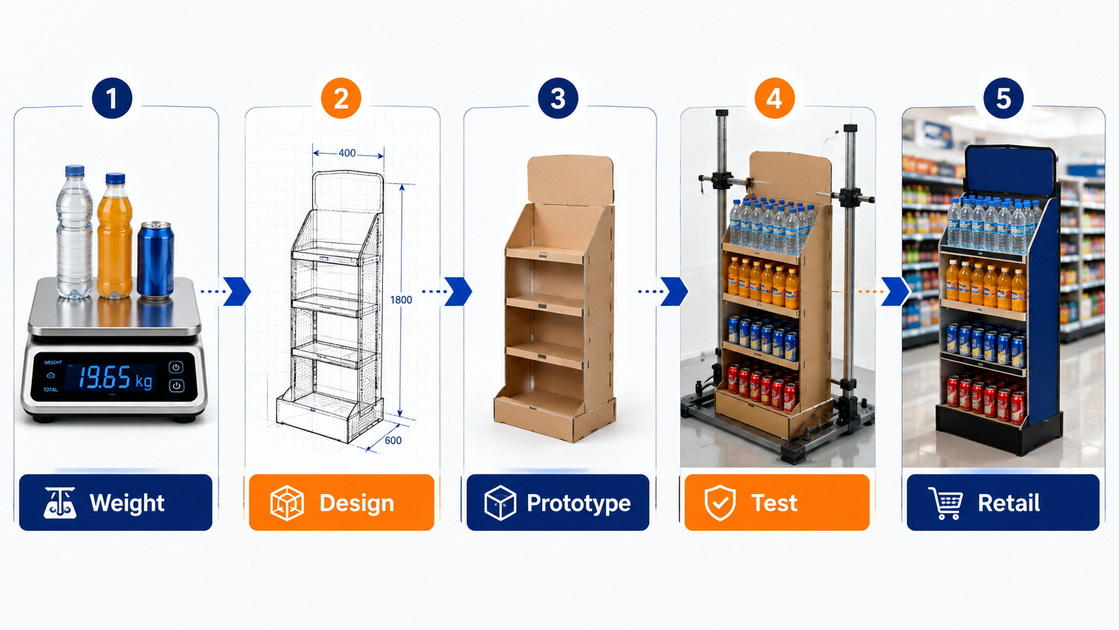
Prototype testing is essential for heavy beverage displays.
A practical test process includes:
1. Load the display with actual products
2. Verify each shelf at maximum capacity
3. Check uneven product loading
4. Test base stability and tipping resistance
5. Simulate replenishment and customer use
6. Review delivery and packaging conditions
7. Check moisture resistance when needed
8. Confirm the final version before production
A hybrid display can combine the graphic advantages of cardboard with the structural advantages of metal.
A hybrid beverage display may include:
- Metal base frame
- Metal shelf supports
- Printed cardboard headers
- Replaceable cardboard graphic panels
- Corrugated product trays
- Metal wire dividers
- Interchangeable promotional inserts
This design approach is useful when a brand needs a strong display structure but wants to update product graphics for new flavors, retail partners, seasonal launches, or promotional events.
The metal structure can remain in use while cardboard graphics or product trays are replaced. This can help reduce the cost and lead time of future campaign updates.
A beverage display must work in real store conditions, not only in a controlled production environment.
Retail staff may restock quickly. Products may be placed unevenly. Customers may pull bottles from one side. Shopping carts may hit the display. Floors may be wet or uneven.
Strong beverage-display development should include:
- Product-weight verification
- Shelf-load review
- Base-stability assessment
- Material selection
- Structural design
- Prototype development
- Full-load testing
- Packaging validation
- Store-assembly planning
- Retailer requirement review
Long Win Display designs, customizes, manufactures, and pre-assembles cardboard display stands, countertop display stands, floor displays, pallet displays, metal displays, and hybrid POP display fixtures. Each project can be developed around product weight, campaign duration, retail environment, branding needs, shipment requirements, and store-execution goals.
A reinforced cardboard POP display is often the better option for short-term, graphic-led, high-volume beverage promotions. It supports strong visual communication, quick campaign changes, flat-packed shipping, and flexible retail deployment.
A metal display is often the better option for long-term, high-load, refill-heavy, or premium beverage programs. It provides durability, reusable value, and more consistent performance in demanding retail environments.
The strongest display solution starts with real product data. Test the structure with actual beverage products, expected restocking behavior, realistic shipping conditions, and the planned retail lifespan before full production.
Long Win Display supports beverage brands and retailers with custom cardboard, metal, countertop, floor-standing, pallet, and hybrid display solutions. Share the beverage type, product weight, pack format, display quantity, retail environment, campaign timing, and brand requirements to develop a display program that balances load strength, shopper visibility, and long-term value.
Yes. A cardboard POP display can hold heavy beverage products when it uses the correct corrugated board grade, shelf reinforcements, support geometry, base structure, and full-load testing. Heavy glass bottles, multipacks, and large cartons normally require reinforced design features.
Metal is often a strong option for glass bottles because it can support higher weight, repeated replenishment, and long-term retail use. Reinforced cardboard can also be suitable for temporary glass-bottle promotions when it is engineered and tested correctly.
Cardboard POP displays are often better for short promotions because they offer lower initial cost, fast graphic customization, efficient shipping, and easy replacement after the campaign.
Both materials can support responsible retail programs. Cardboard can be recyclable and lightweight for shipment. Metal can be reused across multiple campaigns. The better option depends on campaign duration, transportation, reuse planning, material choices, and end-of-life handling.
Calculate the total weight of every product unit on each shelf and across the entire display. Add the weight of product trays and a structural safety margin. Then test a prototype using actual product packaging, uneven loading conditions, and realistic restocking behavior.
1. Supermarket News. [Study: Point-of-Purchase Display Impact Increases]
2. Marvolus. [Advantages of Having Metal Rack Displays in Retail Stores]
3. POP Display. [Best Cardboard Display Ideas for Beverages]
4. The MRL Group. [Custom Metal Beverage Displays]
5. Frank Mayer and Associates. [Increase Sales With POP Displays]
6. Titans of Print. [Cardboard POP Displays: Fast Tool-Less Retail Stands]
7. Abbott-Action. [Custom Corrugated POP Displays]


