
Views: 237 Author: Long Win Display Publish Time: 2026-10-26 Origin: Site


Content Menu
● Cardboard Fruit Boxes vs Plastic Crates at a Glance
● 1. Product Protection: Match the Package to the Produce
>> Corrugated Boxes Offer Flexible Internal Design
>> Plastic Crates Provide a Rigid Structure
● 2. Moisture Resistance and Cold Chain Performance
>> Humidity Can Reduce Corrugated Strength
>> Plastic Crates Have Advantages in Wet Operations
● 3. Ventilation: Cooling and Strength Must Be Designed Together
>> More Open Area Is Not Automatically Better
● 4. Palletization and Container Utilization
● 5. Hygiene and Food Contact Requirements
>> New Corrugated Packaging Still Needs Protection
>> Reusable Crates Need a Managed Sanitation Process
● 6. One Way Export vs Closed Loop Distribution
>> Corrugated Often Simplifies One Way Logistics
>> Reusable Crates Need a Real Return System
● 7. Total Cost: Compare Saleable Produce, Not Empty Containers
● 8. Sustainability Depends on the Distribution System
● Dry Strength Can Hide a Weak Export Design
>> Build Validation Around the Route
● Retail Presentation and Custom Printing
● How Long Win Display Can Support Packaging Development
● FAQ
>> 1. Are Double Wall Fruit Boxes Always Better Than Single Wall Boxes?
>> 2. Can Plastic Crates Be Used for One Way Export?
>> 3. Should Exporters Choose the Box With the Most Ventilation?
>> 4. Does a Moisture Resistant Coating Make a Fruit Box Recyclable?
>> 5. What Should Buyers Approve Before a Bulk Packaging Order?
Cardboard fruit boxes vs plastic crates for fresh produce export is not simply a choice between paper and plastic. It is a decision about product protection, cooling performance, moisture exposure, return logistics, and the condition in which produce reaches the customer.
Corrugated fruit boxes can suit one-way export shipments and retail presentation. Reusable plastic crates can suit wet handling and controlled return systems. Neither option is automatically better for every fruit, destination, or distribution route.
My starting point is arrival: which packaging system delivers saleable produce at an acceptable total cost?
This guide compares both options and explains how exporters can turn packaging requirements into a practical purchasing specification.
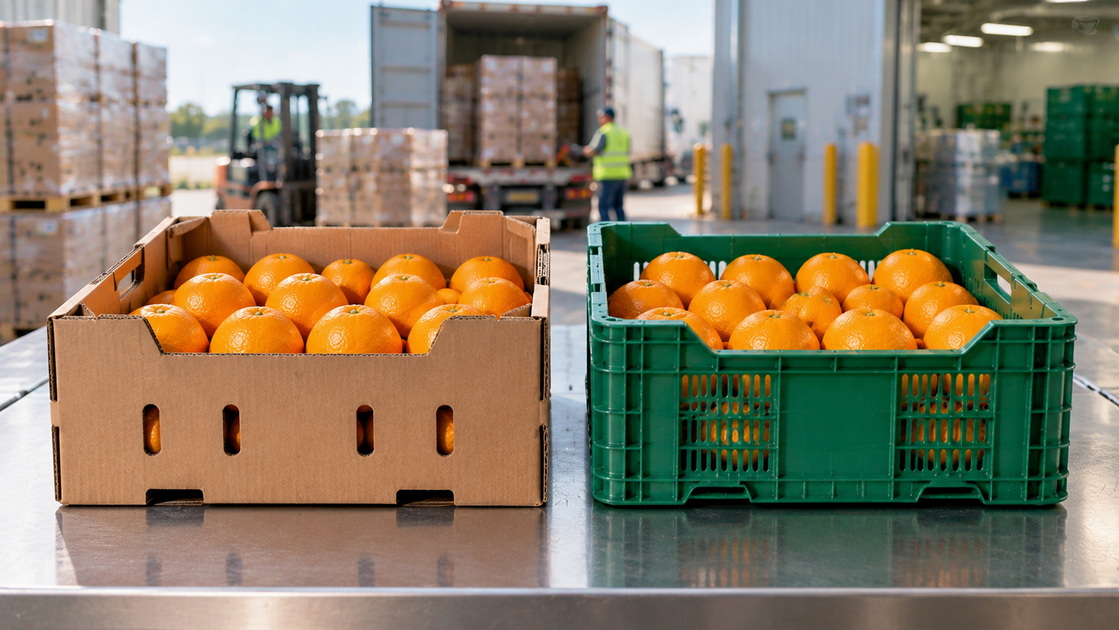
In this article, "cardboard fruit boxes" means corrugated fiberboard transport packaging, not lightweight folding cartons. "Plastic crates" primarily means rigid or collapsible reusable produce containers.
| Comparison Factor | Corrugated Fruit Boxes | Reusable Plastic Crates |
|---|---|---|
| Typical distribution fit | One-way shipments and customized presentation | Managed loops with reliable recovery |
| Moisture resistance | Depends on board, adhesive, coating, and exposure | Generally better suited to wet handling |
| Compression performance | Sensitive to humidity, design, and stacking | Depends on structure, condition, and load |
| Cooling | Requires engineered ventilation | Often incorporates extensive openings |
| Customization | Flexible dimensions, printing, and structures | Usually constrained by existing tooling |
| Hygiene management | Clean storage and appropriate single-use handling | Inspection, cleaning, and sanitizing between uses |
| Return logistics | Usually unnecessary | Essential to reuse economics |
| Environmental assessment | Depends on material and recovery system | Depends heavily on reuse and return efficiency |
A single-use plastic crate is a different purchasing proposition from a reusable crate pool. Confirm which system is actually being offered.
Corrugated packaging can accommodate partitions, trays, pads, and other protective components.
This flexibility is useful when fruit needs separation, controlled movement, or a particular presentation. However, protection depends on the complete design—not simply board thickness.
Check:
- Fruit size and packing pattern.
- Headspace and fill level.
- Contact points.
- Internal movement.
- Closure and stacking arrangement.
Too much empty space can allow movement. Overfilling can transfer stacking pressure to the fruit.
Plastic crates can provide durable walls and repeatable stacking interfaces. Their geometry may work well in standardized handling systems.
However, rigid surfaces do not eliminate bruising. Crate edges, overfilling, vibration, and unsuitable internal dimensions can still damage produce.
Validate the actual pack, including any liners or cushioning, rather than approving an empty container alone.
Fresh produce often requires a humid storage environment, while corrugated fiberboard can lose strength as it absorbs moisture.
NC State Extension's 2025 produce-packaging guidance warns that moisture exposure can substantially reduce fiberboard strength. Its discussion includes losses of up to 75% for containers without suitable treatment—a warning about possible deterioration, not a prediction for every box.
Ask suppliers for compression performance after conditioning representative of the intended route.
A dry warehouse test does not establish performance after extended refrigerated storage.
Plastic crates are often practical where packaging encounters washing, hydrocooling, or significant free water.
However, resistance to water does not prove resistance to every handling condition. Check drainage, damage, dimensional stability, and compatibility with the cleaning process.
For corrugated alternatives, moisture-resistant treatments may be available. Evaluate their performance and their effect on food-contact suitability and local recycling acceptance.
"Water resistant" should not be interpreted as "waterproof."
Fresh produce continues to respire after harvest. Packaging must allow appropriate heat removal, but ventilation openings also affect structural performance.
NC State Extension identifies approximately 5%–7% of the package face area as an optimal range in its general discussion of produce-container ventilation. This is a design reference, not a universal prescription for every fruit or cooling system.
The important variables include opening location, shape, airflow direction, and the complete pallet arrangement.
A well-ventilated individual box can perform poorly if its openings are blocked after stacking.
Check alignment among:
- Adjacent packages.
- Internal trays and liners.
- Pallet layers.
- Pallet decks.
- Stretch wrap or other securing materials.
Plastic crates may provide cooling advantages in particular configurations. FAO reports faster precooling for certain tropical fruits in reusable plastic containers than in the corrugated containers studied.
That finding should not be generalized into a claim that every plastic crate cools every product faster.
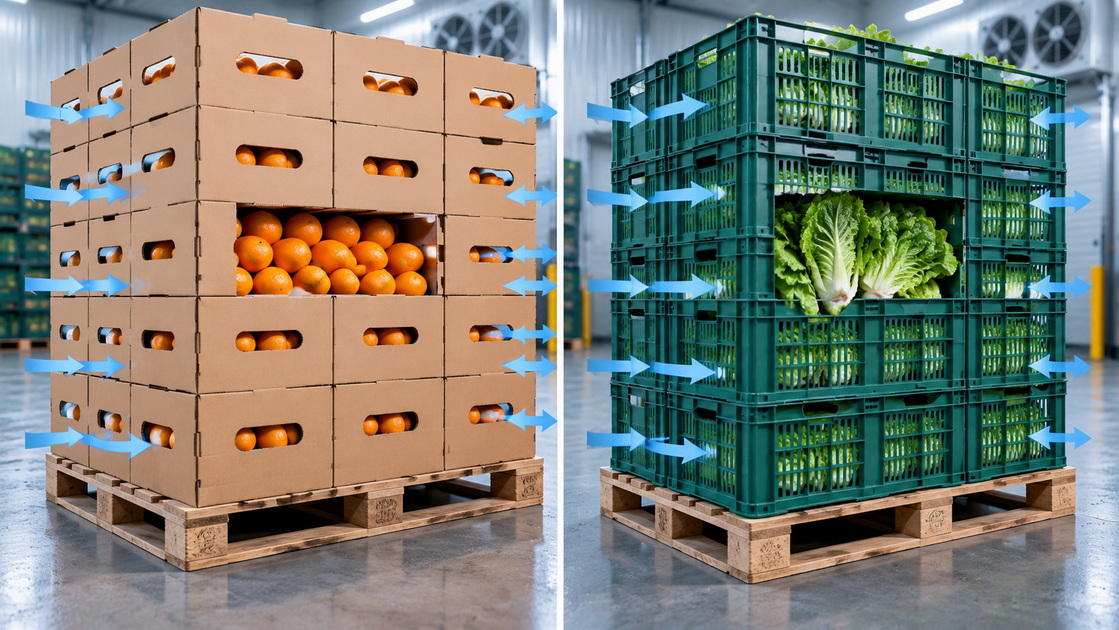
Packaging dimensions influence pallet fit, loading stability, and the number of saleable kilograms shipped.
Corrugated boxes can be designed around a required footprint, although retailer standards and converting constraints may limit the options.
Plastic crates usually require selection from existing formats unless new tooling is commercially justified.
Compare:
1. Units per layer.
2. Layers per pallet.
3. Net produce weight per pallet.
4. Loaded height.
5. Stability and securing method.
6. Compatibility with destination handling.
Avoid pallet overhang. Also verify that stacking loads travel through the intended structural features rather than through unsupported panels or fruit.
The package that holds more fruit individually may still produce a less efficient pallet.
Single-use packaging avoids a previous-use cleaning cycle, but it is not automatically sterile.
Store boxes away from moisture, pests, chemicals, and contaminated surfaces. Confirm suitability for the intended food contact, including relevant inks, coatings, adhesives, and liners.
Reusable containers require more than a rinse.
A crate program should define inspection, cleaning, sanitizing where appropriate, drying, storage, and rejection of damaged units.
FDA guidance emphasizes cleaning repeatedly used harvest containers before reuse and appropriate cleaning and sanitizing of containers used for ready-to-eat produce.
Ask who operates the process and how effectiveness is verified. A sound crate design does not compensate for poorly managed sanitation.
For an overseas customer without a return arrangement, corrugated packaging can avoid empty-container recovery, deposits, and repositioning.
It may also support destination-specific graphics without committing the buyer to a standardized crate format.
Confirm that the customer can manage the packaging after use. Recycling access and acceptance vary.
Crate economics depend on recovery.
Before approving the system, establish:
- Ownership and deposits.
- Return deadlines.
- Collection responsibility.
- Cleaning locations.
- Lost-crate charges.
- Empty-crate transport.
- Cross-border and customs arrangements.
Collapsible crates reduce empty volume, but they do not eliminate return costs.
A crate designed for many trips delivers little reuse value if it disappears after the first shipment.
The relevant metric is packaging-system cost per saleable kilogram delivered.
Include:
- Packaging purchase or rental.
- Assembly and packing labor.
- Protective inserts.
- Transport weight and space.
- Cooling implications.
- Product damage and rejection.
- Returns, cleaning, and losses.
- Destination handling.
Suppose two packaging systems carry the same shipment weight. One has a lower packaging price but more rejected fruit.
Calculate the total relevant cost for each system, then divide it by the kilograms accepted for sale.
This approach reveals why a cheaper container can be the more expensive choice.
For reusable crates, allocate acquisition cost across realistic completed trips—not the manufacturer's maximum possible service life.
Deposits also deserve separate treatment: a refundable deposit is not necessarily a permanent expense, but it affects working capital and loss exposure.
Avoid blanket statements that cardboard is always greener or reusable plastic is always more sustainable.
A meaningful comparison includes:
- Manufacturing inputs.
- Package weight.
- Number of completed uses.
- Cleaning energy and water.
- Return distance.
- Loss and replacement.
- End-of-life treatment.
- Produce losses.
Published life-cycle studies show that transport and reuse assumptions can materially affect results. Some studies are commissioned by packaging-sector organizations, making transparent assumptions especially important.
Do not borrow an environmental break-even number from a different route and present it as a universal threshold.
Request a comparison based on the actual export system.
A corrugated box can perform well immediately after production and still fail after humid storage, vibration, and sustained stacking.
Similarly, a new plastic crate can appear satisfactory while damaged hinges, worn interlocks, or inconsistent inspection create problems in later use.
The lesson is to approve a conditioned system, not an attractive sample.
A practical qualification plan includes:
1. Define fruit, pack weight, route, duration, and environmental exposure.
2. Condition packaging to relevant temperature and humidity.
3. Assess the filled package under representative stacking.
4. Check ventilation in the palletized configuration.
5. Evaluate handling and transport effects.
6. Inspect produce and packaging after a pilot shipment.
Agree on acceptance criteria before testing.
For corrugated boxes, edge crush data alone does not replace assessment of the finished box. Vent holes, dimensions, joints, and manufacturing quality affect the complete structure.
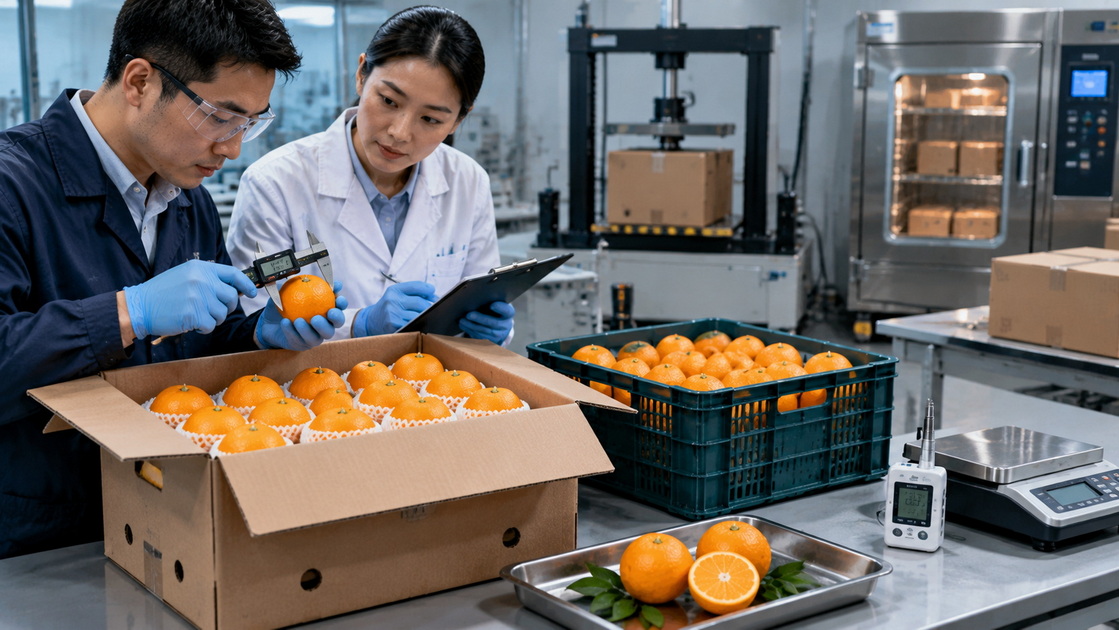
Corrugated fruit boxes can combine transport protection with branding, traceability information, and shelf-ready presentation.
Useful features may include printed handling information, removable sections, or configurations that reduce repacking.
However, opening a transport box for display can change its structural behavior. Evaluate the display configuration separately.
Plastic crates may suit retailers operating standardized pools. Their branding opportunities and labeling rules depend on the system.
Confirm retailer requirements before finalizing either option.
Based on the company information supplied for this article, Long Win Display is a China-based designer and manufacturer of packaging boxes and point-of-purchase displays, with customization, production, and preassembly services.
That background is relevant when exporters need packaging aligned with retail presentation.
However, general packaging and display experience should not be treated as proof of validated fresh-produce export performance.
For a fruit-box project, ask Long Win Display to confirm:
- Available food-contact documentation.
- Moisture-resistant construction options.
- Ventilation and compression-testing arrangements.
- Pallet compatibility.
- Printing and preassembly capabilities.
- Sample and pilot-order procedures.
Provide the fruit specification, net weight, cooling method, route, retailer requirements, and destination before requesting a design.
Choose corrugated fruit boxes when one-way logistics, customized dimensions, and branded presentation fit the route—and moisture-conditioned performance has been demonstrated.
Choose reusable plastic crates when wet handling, standardized operations, and reliable recovery support the investment.
For either option, validate cooling, stacking, hygiene, and produce quality together.
No. Performance depends on board specification, dimensions, moisture exposure, and structural design. Select against the required finished-package performance rather than wall count alone.
Yes, but confirm whether the purchase price, destination handling, and end-of-life arrangements make sense. Do not assume reusable-system economics apply without returns.
Not automatically. Openings must support cooling without unacceptable strength loss. Assess the filled pallet and ensure liners or wrapping do not block airflow.
Not necessarily. Acceptance depends on the treatment and receiving recycling system. Request specific information rather than relying on a general recyclable claim.
Approve drawings, materials, dimensions, food-contact requirements, print files, performance criteria, pallet layout, and a representative sample. Include change-control rules and defect-handling terms.
1. [NC State Extension — Chapter 9: Produce Packaging]. Published in 2025; discusses ventilation, humidity, compression performance, and produce-container design. [content.ces.ncsu]
2. [FAO — Packaging of Fruit, Vegetables and Root Crops]. Explains protective packaging, moisture limitations, ventilation, and airflow through stacked packages. [fao]
3. [FAO — Good Practice in the Design, Management and Operation of a Fresh Produce Packing House]. Covers cooling, moisture exposure, container selection, and vent alignment. [fao]
4. [FAO — Management of Reusable Plastic Crates in Fresh Produce Supply Chains]. Discusses reusable-crate operations, handling, and packaging requirements. [fao]
5. [FAO — Fresh Produce Handling Guidance]. Includes precooling comparisons for selected tropical fruits and container configurations. [fao]
6. [FDA — Guide to Minimize Microbial Food Safety Hazards for Fresh Fruits and Vegetables]. Addresses container cleanliness and sanitation. [fda]
7. [FDA — Food Packaging and Other Food Contact Substances]. Provides food-contact regulatory context. [fda]
8. [Quantis — Comparative Life Cycle Assessment of Corrugated Containers and Reusable Plastic Containers]. Industry-commissioned comparative assessment; illustrates the importance of transport and system assumptions. [fibrebox]


