
Views: 255 Author: Long Win Display Publish Time: 2026-11-03 Origin: Site


Content Menu
● Cardboard Display vs Acrylic Display
● What Makes a Retail Display Sustainable?
● Cardboard Display Stands: Advantages and Limitations
>> Custom Branding for Promotional Campaigns
>> Structural Design Matters More Than Appearance
>> Recovery Depends on the Finished Construction
● Acrylic Displays: Advantages and Limitations
>> Transparency and Reusable Merchandising
>> Fabrication and Maintenance Affect Service Life
>> Acrylic Recycling Requires a Specific Route
● What the Numbers Actually Tell You
>> Responsible Sourcing Is a Separate Consideration
● Compare Total Cost, Not Just the Display Price
>> An Illustrative Cost-per-Campaign Example
● Three Practical Ways to Improve Your Decision
>> 1. Compare the Same Retail Service
>> 2. Measure Store Execution in a Pilot
>> 3. Make Every Environmental Claim Specific
● Which Display Should Your Brand Choose?
>> Choose Cardboard for Campaign-Specific Merchandising
>> Choose Acrylic for Managed Reuse
>> Consider a Hybrid Only When Separation Is Practical
● Plan Your Next Display with Long Win Display
>> 1. Is a cardboard display more sustainable than an acrylic display?
>> 2. Can cardboard display stands hold heavy products?
>> 3. Are acrylic displays recyclable?
>> 4. Does FSC certification mean a display is recyclable?
>> 5. Which display is better for seasonal promotions?
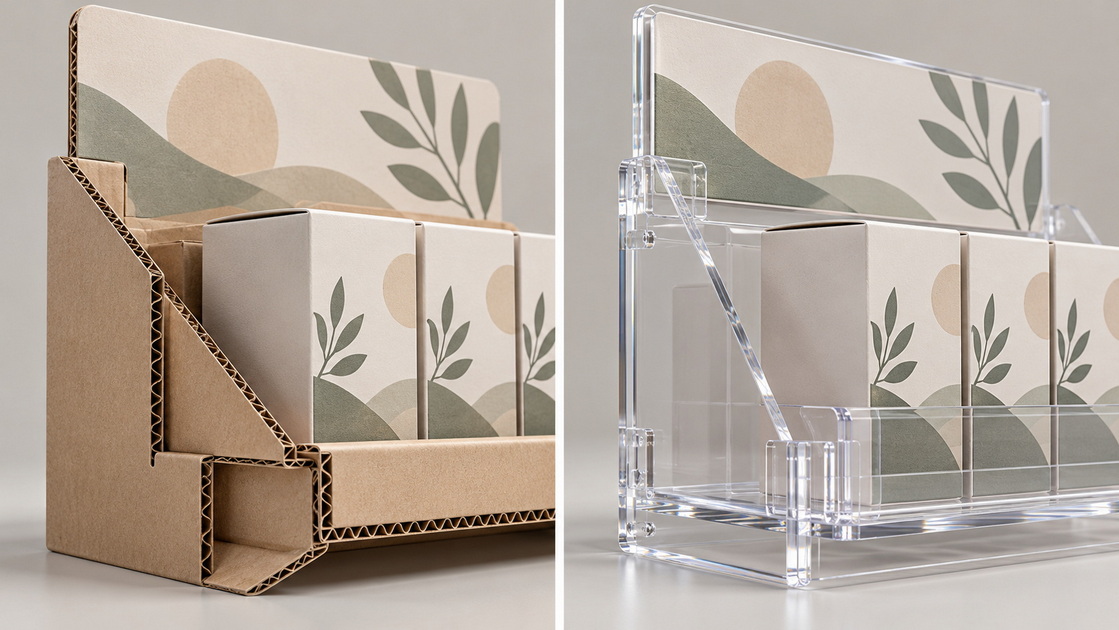
Choosing between a cardboard display vs acrylic display for sustainable retail requires more than comparing paper with plastic. A custom cardboard display stand can suit a short promotional campaign, while a reusable acrylic fixture may serve a permanent counter more effectively. The better choice depends on product weight, campaign duration, shipping requirements, maintenance, and what actually happens after use.
At Long Win Display, our focus is designing, customizing, manufacturing, and preassembling cardboard point-of-purchase displays for retail environments. Our recommendation is to prioritize fit-for-purpose design: specify the least material needed to deliver the required retail performance, then plan its next use or recovery route.
This guide compares both materials without assuming that either is automatically sustainable.

The following table provides a starting point, not a substitute for testing a finished display.
| Decision factor | Cardboard display | Acrylic display |
|---|---|---|
| Typical application | Seasonal promotions, product launches, branded floor displays | Reusable countertop fixtures, transparent product holders |
| Material | Paper-based board, commonly corrugated | Polymethyl methacrylate, or PMMA |
| Visual character | Large printable surfaces and customizable shapes | Transparency, polished edges, visible merchandise |
| Structural performance | Depends on board grade, geometry, humidity, and reinforcement | Depends on sheet thickness, joints, geometry, and loading |
| Graphic updates | Replaceable headers or newly printed components | Replaceable inserts can preserve the main fixture |
| Shipping | Flat-pack designs can reduce packed volume | Knock-down construction may reduce packed volume |
| End-of-life route | Paper recovery where the finished construction is accepted | Specialist PMMA recovery where available |
| Main sustainability risk | Short service life or coatings that complicate recovery | Single-use deployment without a realistic reuse or collection plan |
A sustainable retail display must perform its merchandising role without unnecessary material consumption, replacement, or disposal.
Looking only at the raw material misses important trade-offs. A lightweight display that fails before a promotion ends may require replacement production and shipping. A durable fixture that is discarded after one event may never realize its reuse potential.
A useful assessment considers:
- Material sourcing and manufacturing.
- Packed dimensions and transport.
- Assembly, maintenance, and damage.
- Actual service life and completed reuse cycles.
- Disassembly and locally available recovery.
Life-cycle assessment provides a framework for examining these stages. However, a credible comparison needs matching assumptions. Compare displays that provide equivalent product capacity and service—not an empty cardboard stand against a much larger acrylic fixture.
Cardboard provides broad surfaces for printed branding, promotional messages, and product education. Designers can integrate headers, shelves, side panels, and product-shaped structures into one merchandising concept.
This makes custom cardboard display stands worth considering when artwork changes frequently. Rather than investing in a permanent fixture that becomes visually outdated, brands can match the structure to a specific campaign.
Our design priority would be clear shopper communication: visible products, readable messages, and straightforward replenishment. Additional panels should earn their place through function rather than decoration alone.
A cardboard floor display is an engineered structure, not simply a printed box.
Shelf performance depends on board specification, unsupported span, product placement, joints, and environmental conditions. Reinforcement may improve performance, but unnecessary reinforcement adds material and can complicate assembly.
Before approval, test a production-representative sample with:
1. The actual products and intended shelf quantities.
2. Uneven loading and realistic replenishment patterns.
3. The expected campaign duration.
4. Relevant humidity and handling conditions.
5. The proposed shipping configuration.
Avoid accepting a general "heavy-duty" claim without a defined load, test method, and acceptance criteria.
Paper-based material does not make every finished display equally recyclable.
Plastic laminates, mixed-material accessories, contamination, and difficult-to-remove components can affect acceptance. Ask the receiving recycler about the complete construction rather than relying on the recyclability of the base board.
Where practical, use removable accessories and provide clear dismantling instructions. A simple recovery route is more useful than an ambitious environmental statement that store employees cannot implement.
Acrylic displays can make sense when product visibility and repeated use are central requirements. Transparent risers, holders, and trays can present merchandise without surrounding it with large printed panels.
For a long-running countertop program, replaceable graphic inserts may allow the same fixture to support multiple campaigns.
However, durability creates an opportunity for reuse—not proof that reuse will happen. A credible plan needs an owner, storage space, cleaning procedures, and a defined next deployment.
An acrylic display's performance depends on more than sheet thickness. Joint design, edge finishing, stress concentrations, and handling also matter.
Ask suppliers to identify suitable cleaning methods and validate the fixture under expected store conditions. Cosmetic damage can shorten commercial service life even when a display remains structurally usable.
For reusable programs, consider replaceable components. Replacing one damaged tray may preserve more value than discarding an entire bonded assembly.
Acrylic is not inherently unrecyclable. Manufacturer ACRYLITE describes mechanical reprocessing options for some grades and depolymerization that returns PMMA to its original monomer, MMA.
That technical capability does not guarantee collection for a particular store.
Before specifying a recyclable acrylic display, identify:
- A processor accepting the relevant PMMA grade.
- Requirements for removing adhesives and other materials.
- Minimum collection quantities.
- Return transport arrangements.
- Evidence of the material's actual destination.
A documented take-back arrangement is stronger than a recycling symbol alone.
The U.S. Environmental Protection Agency reports that approximately 46 million tons of paper and paperboard were recycled in 2018, representing a 68.2% recycling rate.
This is useful historical context, but it is not a recycling rate for cardboard retail displays. It also should not be presented as a current-year measurement or applied to every export destination.
Similarly, an acrylic manufacturer's recycling information demonstrates available processing technologies, not universal local collection.
The practical lesson is to separate three questions:
1. Can the material technically be recycled?
2. Will the local collection system accept this finished display?
3. Will the retailer actually separate and send it for recovery?
Only the third question confirms what happens in a specific program.
For paper-based displays, sourcing documentation can strengthen purchasing decisions.
FSC Recycled identifies verified reclaimed material. FSC Mix is a different claim involving eligible combinations of certified, recycled, and controlled inputs.
Neither label should be treated as proof that a finished display will be recycled after use. Ask for documentation relevant to the supplied product and verify any proposed label use. Do not assume that a supplier's general sourcing statement applies to every order.
A cardboard display may look economical on a quotation, while an acrylic fixture may appear expensive. Neither figure reveals the full program cost.
Calculate:
Total program cost = display production + freight + assembly + maintenance + replacements + storage + return transport + end-of-life handling.
Then divide by a meaningful service measure, such as completed campaigns or successful store-weeks.
Suppose a cardboard display costs $24 delivered and supports one campaign. An acrylic fixture costs $96 delivered and completes six campaigns.
The simplified fixture cost is:
- Cardboard: $24 per campaign.
- Acrylic: $16 per campaign before cleaning, storage, returns, and losses.
If the acrylic fixture completes only three campaigns, its fixture cost becomes $32 per campaign.
These are hypothetical figures, not Long Win Display quotations or environmental measurements. They illustrate why achieved reuse matters more than promised reuse.
A financial break-even point is not a carbon break-even point. Environmental comparisons require separate material, energy, transport, and end-of-life data.

Write a shared performance brief before requesting competing designs.
For example: display the same product quantity, within the same footprint, for the same number of selling weeks.
Then compare:
- Finished material weight.
- Packed volume and shipment quantity.
- Setup time.
- Product accessibility.
- Damage and replacement rates.
- Confirmed recovery arrangements.
This prevents a cheaper but underperforming design from appearing artificially superior.
A display only creates value when stores can deploy it correctly.
Run a pilot and record assembly time, missing parts, shelf deformation, damaged products, replenishment difficulties, and disposal behavior.
For preassembled cardboard displays, also test the complete shipping configuration. Faster store setup may be valuable, but assess it alongside freight volume and transit protection.
Use pilot evidence to refine the design before a wider rollout.
Avoid broad statements such as "completely green" or "zero environmental impact."
Prefer narrow, verifiable descriptions:
- "Paper components accepted by the named recovery partner."
- "Reusable fixture with replaceable campaign graphics."
- "Verified recycled content supported by supplier documentation."
U.S. Federal Trade Commission guidance emphasizes substantiation and qualification of environmental claims. Its Green Guides explain that unqualified recyclable claims depend partly on access to appropriate recycling facilities.
For international programs, review the rules and infrastructure in the destination market rather than assuming one statement works everywhere.
A cardboard display is a strong candidate when the campaign is temporary, branding changes frequently, indoor conditions are suitable, and the retailer has a confirmed paper-recovery route.
Prioritize a tested structure, efficient packed dimensions, and finishes compatible with that route.
An acrylic display is worth evaluating when transparency matters, the fixture will remain useful across campaigns, and the business can manage cleaning, storage, repairs, and recovery.
Do not justify the purchase with hypothetical reuse that nobody is responsible for delivering.
A reusable base with replaceable cardboard graphics may combine fixture longevity with campaign flexibility.
However, permanently bonding different materials can complicate recovery. Specify separable components, clear material identification, and a realistic replacement process.
Long Win Display specializes in the design, customization, production, and preassembly of cardboard POP displays.
The objective is not simply to replace plastic with paper. It is to create a retail display that performs reliably with material use matched to the job.
Not automatically. Compare equivalent retail service, material use, transport, replacement frequency, achieved reuse, and actual recovery. Neither material wins in every application.
Some designs can, but capacity depends on construction and conditions. Require testing with the actual products, intended loading pattern, and relevant campaign duration.
PMMA can be recycled through suitable processes. Confirm that a named processor accepts the finished display and establish how stores will collect and return it.
No. FSC claims address relevant sourcing and chain-of-custody requirements. Recyclability depends on the finished construction and available collection and processing systems.
Cardboard is often worth evaluating for campaign-specific graphics and temporary merchandising. A reusable acrylic fixture may be preferable when seasonal changes require only new inserts.
1. U.S. Environmental Protection Agency. [Paper and Paperboard: Material-Specific Data]. Source for the historical 2018 recycling figures and their material-category scope. [epa]
2. International Organization for Standardization. [ISO 14040:2006—Environmental Management: Life Cycle Assessment—Principles and Framework]. Basis for the life-cycle assessment discussion; not a comparative study of these two display types. [iso]
3. ACRYLITE. [Sustainability]. Manufacturer information on PMMA reprocessing and depolymerization; not evidence of universal collection availability. [acrylite]
4. Forest Stewardship Council. [FSC Claims, Labels, and Logo]. Source for distinctions between FSC Recycled and FSC Mix. [my.fsc]
5. Forest Stewardship Council UK. [Recycled Materials]. Explanation of verification requirements and the scope of FSC Recycled claims. [uk.fsc]
6. U.S. Federal Trade Commission. [Guides for the Use of Environmental Marketing Claims]. Basis for discussion of substantiation, recyclability, and claim qualification. [search.ftc]


