
Views: 230 Author: Long Win Display Publish Time: 2026-10-30 Origin: Site


Content Menu
● Why Request a Custom Cardboard Display Sample?
● Which Cardboard Display Sample Do You Need?
>> Unprinted Structural Samples
>> Printed Samples and Color Proofs
● What to Provide When Requesting a Display Sample
>> Confirm the Complete Footprint
● Are Custom Cardboard Display Samples Free?
>> How Long Does Sampling Take?
● How to Inspect a Custom Cardboard Display Sample
>> Check Dimensions and Product Fit
>> Assemble It Like Store Staff Would
>> Inspect the Full and Partially Depleted Display
● Board Strength Is Not Finished-Display Performance
>> Do Not Convert ECT Into a Shelf Rating
● A Hand-Finished Prototype Can Hide Production Problems
● Why Printed Samples May Differ From Production
>> Material Color Is Not a Complete Specification
● Evaluate the Shipped Configuration
● How to Approve a Sample Without Creating Ambiguity
>> Use Conditional Approval Carefully
● Requesting a Sample From Long Win Display
● FAQ
>> 1. Can I approve a display from photographs alone?
>> 2. Does a white sample need to use the final production board?
>> 3. Will the printed sample exactly match production color?
>> 4. Should I request another sample after changing product weight?
>> 5. What happens if production differs from the approved sample?
Can I Get a Sample of My Custom Cardboard Display? Yes. You can request a sample of your custom cardboard display before mass production. The right sample may be an unprinted structural prototype, a printed mock-up, a production-representative sample, or a pilot unit, depending on what you need to evaluate.
However, receiving a sample is not the same as validating the finished display.
My recommendation is to define the sample's purpose before discussing its price or delivery date. A white prototype can help assess fit and assembly, but it cannot establish final print quality. A printed mock-up can communicate appearance without reproducing every production process.
This guide explains how to request, inspect, and approve cardboard display samples. It also addresses gaps in the original article, including sample limitations, approval responsibilities, and the difference between early prototypes and production qualification.
No verified customer reviews were supplied. The following framework is practical purchasing guidance, not a report of firsthand testing or audited customer results.
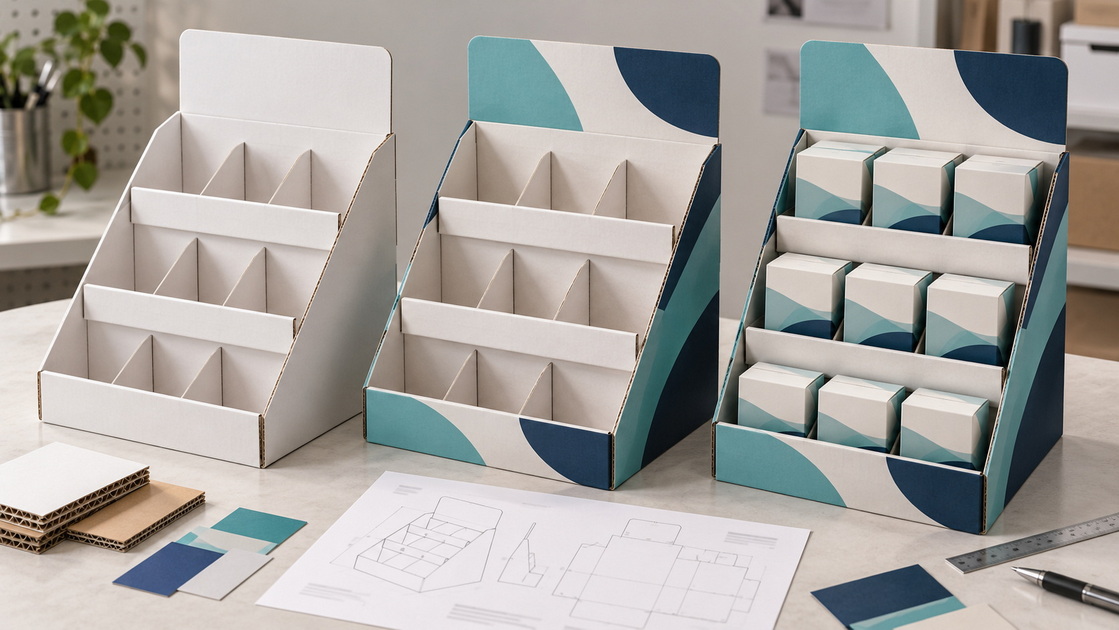
A physical sample helps turn a design proposal into something buyers, packers, and store staff can evaluate.
It can reveal problems that are difficult to judge from a rendering:
- Products do not fit comfortably.
- Shelves obstruct labels.
- Tabs are difficult to engage.
- Supports increase the footprint unexpectedly.
- Headers interfere with fixtures.
- Packaging is difficult to reopen.
- The display becomes awkward as stock decreases.
A sample does not guarantee that every production unit will be correct. Its value comes from connecting physical observations to a controlled specification and approval process.
Supplier terminology varies. Agree on what the sample represents rather than relying on its name.
| Sample type | Main purpose | Important limitation |
|---|---|---|
| Digital rendering | Review concept, branding, and overall proportions | Does not demonstrate physical performance |
| Unprinted structural sample | Check dimensions, folds, assembly, and product fit | Does not establish final graphics or finish |
| Printed mock-up | Evaluate layout, message placement, and appearance | May use different printing or finishing processes |
| Production-representative sample | Assess specified materials and manufacturing methods | Still requires a defined test and inspection plan |
| Pilot batch | Evaluate repeatability, assembly, and packing across multiple units | Is not a substitute for ongoing production control |
Often called white samples, these are useful early in development.
They can help evaluate a counter display, PDQ tray, floor unit, or standee before final artwork is complete.
However, confirm whether the board, reinforcement, adhesives, and joints match the proposed production specification. "White sample" does not automatically mean production-equivalent construction.
A printed sample helps assess graphic hierarchy, product visibility, and alignment with folds or cut edges.
Ask whether it is digitally printed, litho-laminated, or made using another method. Also identify whether a separate color proof will be used.
A desktop printout, monitor image, and production print are not interchangeable approval references.
A useful request begins with product and placement information.
Send the supplier:
1. Product dimensions and filled weights.
2. Physical products where practical.
3. SKU quantities and arrangement.
4. Intended retail placement.
5. Retailer specifications.
6. Campaign duration.
7. Artwork or branding requirements.
8. Delivery format.
9. Destination and required arrival date.
Include dimensional variation if your packaging is flexible or inconsistent.
For example, a soft pouch can behave differently from a rigid carton with the same nominal dimensions. The sample should reflect how products actually sit, lean, and move.
Ask for assembled width, depth, and height, including supports, headers, feet, and projecting components.
There is no universal pallet footprint or retail dimension that applies to every display.
Likewise, shrinking a floor display does not automatically create a suitable counter display. Product access, support geometry, and retailer requirements need separate evaluation.
There is no universal rule.
Sample charges can reflect design complexity, material use, printing, manual assembly, tooling, packing, and shipping.
Some suppliers may credit selected development charges against a later order. Others treat sampling as a separate service.
Request written confirmation of:
- What the sample fee includes.
- How many versions are included.
- Whether revisions cost extra.
- Whether freight is included.
- Whether any fee is refundable or creditable.
- Who owns the final files and tooling.
Do not assume that a free sample includes unlimited redesign or production-level testing.
Timing depends on the information available and the work required.
Separate the schedule into design, material sourcing, cutting, printing, assembly, inspection, and dispatch.
A quoted production time may begin only after the structure or artwork is approved. International delivery and customs clearance add separate uncertainty.
For an important launch, plan backward from the required store-arrival date rather than the factory completion date.
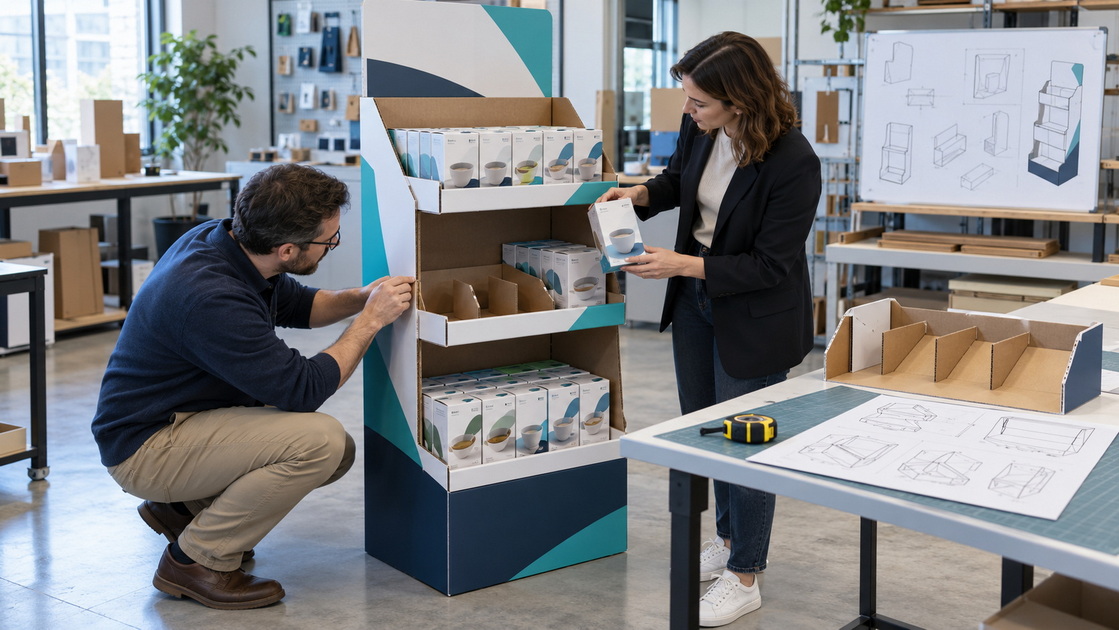
Measure the assembled sample and compare it with the approved drawing.
Load the intended products and inspect:
- Product clearance.
- Label visibility.
- Shelf opening height.
- Retaining lips.
- Dividers.
- Access to the final row.
Products should not require excessive force to insert or remove.
Provide the proposed instructions to someone unfamiliar with the design.
Observe where clarification is needed. Record missing parts, difficult folds, ambiguous steps, and tools required.
Do not treat an engineer's demonstration as proof that ordinary store installation will be straightforward.
If assembly time matters, define how it will be measured. Avoid adopting an unsupported universal assembly-time target.
A fully stocked display can conceal practical problems.
Remove products progressively and check whether the remaining packs stay accessible and presentable.
Evaluate replenishment as well as initial loading. Staff may need to refill the display without dismantling it.
A board specification provides useful information, but it does not establish the load capacity of the completed structure.
Shelf span, folds, joints, load distribution, reinforcement, humidity, and service duration all matter.
For a relevant test, agree on:
- Actual or representative products.
- Loading arrangement.
- Intended duration.
- Environmental conditions.
- Acceptable deflection.
- Stability and access requirements.
- Conditions requiring rejection.
A short test cannot automatically demonstrate performance throughout a long promotion.
Edge crush testing evaluates a property of corrugated board. It is not a direct universal rating for shelf capacity or resistance to tipping.
Similarly, upgrading board does not establish a fixed percentage improvement in display stability.
Test the completed design against its actual requirements rather than translating one material number into a broad performance promise.
An early sample may be manually trimmed, adjusted, or assembled with extra care.
That is useful for development, but it can make the prototype easier to assemble than routine production units.
Before final approval, ask:
1. Was anything manually modified?
2. Are the cutting and crease settings representative?
3. Does the board match the production specification?
4. Will production use the same reinforcement and adhesives?
5. Are opening features and perforations representative?
For critical programs, request a production-representative sample or pilot batch after the structure is finalized.
A prototype should help resolve problems—not hide differences that return during mass manufacturing.
Color appearance depends on the substrate, printing process, ink system, finish, and viewing conditions.
A white structural board and a laminated printed surface can also behave differently during folding and assembly.
Agree on separate approval criteria for:
- Artwork content.
- Color expectations.
- Print registration.
- Surface finish.
- Structural dimensions.
- Folding and assembly.
Do not use one vague "approved" email to cover every attribute.
The original article presents grey-backed board as a single definitive grade. In practice, the appearance of the reverse side alone does not establish composition, recycled content, or suitability.
Request the actual board specification and any relevant sourcing claim.
No paper grade should be assumed to eliminate warping or guarantee print quality in every construction.
The display sample and its shipping package are related but separate approval subjects.
Confirm whether the commercial units will travel:
- Flat-packed.
- Assembled and empty.
- Prefilled with products.
- Individually boxed.
- In a palletized load.
ISTA guidance emphasizes understanding the distribution environment and selecting an appropriate test.
It also recommends representative products and packaging. Early prototypes can support development, but they may not adequately represent final production for qualification.
Do not treat one successful courier delivery as proof that every future shipment will survive.
Ask the supplier or test laboratory to explain the selected procedure, sample configuration, and acceptance criteria.
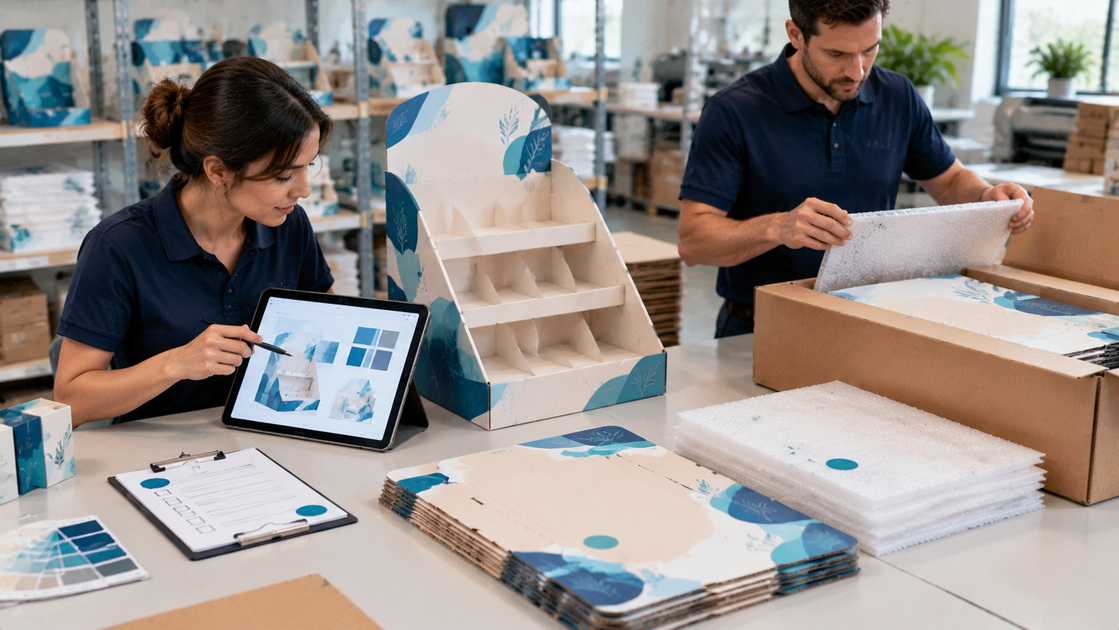
Use a written approval record linked to the exact sample and files.
| Approval field | What to record |
|---|---|
| Sample reference | Unique identification and date |
| Drawing revision | Exact structural version |
| Artwork revision | Approved graphics |
| Materials | Board, finishes, reinforcement, and adhesives |
| Product arrangement | Quantities, positions, and weights |
| Accepted characteristics | Dimensions, appearance, and function |
| Open issues | Changes still required |
| Packing | Approved shipping configuration |
| Authorization | Named approver and production-release status |
A statement such as "approved subject to a stronger shelf" leaves a critical change unresolved.
Identify the modification, update the drawing, and decide whether a new physical sample is required.
For structural changes, approval of the revised construction is usually more meaningful than assuming the earlier sample remains representative.
Keep an approved reference sample where practical.
Based on company-provided information, Long Win Display designs, customizes, manufactures, and preassembles cardboard POP displays for international customers.
For a useful sampling discussion, provide your products, retailer requirements, target dimensions, quantity, artwork, intended service period, and delivery format.
Ask Long Win Display to propose:
- The appropriate sample stage.
- Materials and structural assumptions.
- Sample charges and revision terms.
- Evaluation requirements.
- Production-release criteria.
- Packing and shipping arrangements.
No specific free-sample policy, guaranteed turnaround, or independent test results were supplied for this article. Confirm those details in the project quotation.
Requesting a sample of your custom cardboard display is a sensible step before production.
The important question is what that sample can demonstrate.
Separate structural development, graphic approval, production representation, and transport validation. Record the approved specifications and reassess meaningful changes.
Photographs can support decisions, but they cannot fully demonstrate assembly, product access, loading, or material behavior. For important projects, arrange physical evaluation or a clearly defined third-party inspection.
Not necessarily during early development. However, any difference should be disclosed. Final structural validation should use appropriately representative materials and construction.
Not automatically. Confirm the proofing method, substrate, finish, reference, and acceptance criteria. Different printing processes can produce visible differences.
Assess the change before proceeding. Increased weight or a different load arrangement can affect shelves, joints, stability, and transport performance.
Compare the shipment against the controlled specification and agreed inspection criteria. Document deviations and follow the contract's investigation, correction, replacement, or rejection process.
1. PopDisplay. "Can I Get a Sample of My Custom Cardboard Display?" Original article reviewed. The rewrite retains the physical-prototyping theme but does not adopt its unverified personal cases, numerical performance claims, universal dimensional assumptions, or guaranteed outcomes. [popdisplay]
2. International Safe Transit Association. "Test Procedures." Explains the distinction between screening tests and distribution simulations, and the importance of selecting a procedure suited to the objective. [ista]
3. International Safe Transit Association. "Getting Started With Design & Testing." Guidance on distribution environments, test objectives, representative samples, and the role of trial shipments. [ista]
4. International Safe Transit Association. "Guidelines for Selecting and Using ISTA Test Procedures and Projects." Discusses representative production samples, distribution hazards, and replicate testing. [ista]
5. International Safe Transit Association. "Project 3L Overview." Includes a specific warning about the limitations of handmade or one-off prototypes for final testing under that procedure. It is not presented as the required protocol for every display project. [ista]
6. Esko. "Pack Proof 18 User Guide." Technical context for controlled proofing, color data, and verification. It does not establish that every physical mock-up is a production color standard. [docs.esko]


