
Views: 235 Author: Long Win Display Publish Time: 2026-11-24 Origin: Site


Content Menu
● Apparel Display vs Mannequin Display at a Glance
● What Non-Mannequin Apparel Displays Do Well
>> Make Merchandise Easier to Shop
>> Support Campaign Graphics and Product Grouping
● What Mannequin Displays Do Well
>> Show How Garments Work Together
>> Create a Visual Focal Point
● Compare Shopper Experience and Product Accessibility
>> Apparel Displays Help Customers Complete the Selection
>> Mannequins Need a Clear Route to Available Stock
● Compare Space, Capacity, and Store Operations
>> Measure the Working Footprint
>> Account for Maintenance Throughout the Day
● Compare Total Cost, Not Just the Purchase Price
● When Cardboard Apparel Displays Make Sense
>> Validate the Structure With Real Merchandise
● The Overlooked Issue: Displays Change as Products Sell
● Three Practical Fashion Retail Scenarios
>> A Seasonal Accessories Promotion
● How to Test Apparel Displays Against Mannequin Displays
● Sustainability Requires a Project-Level Comparison
● Choose the Display Around the Shopping Task
>> 1. Is a Mannequin Display Different From an Apparel Display?
>> 2. Which Option Is Better for a Small Clothing Store?
>> 3. Can Cardboard Displays Hold Clothing?
>> 4. Do Mannequins Guarantee Higher Sales?
>> 5. Should We Choose Full-Body or Torso Mannequins?
The apparel display vs mannequin display decision comes down to the job you need the presentation to perform. Merchandise fixtures help customers find, compare, and select clothing. Mannequins help communicate silhouette, styling, and outfit combinations. Many stores benefit from using both together.
There is also an important distinction: a mannequin display is technically one type of apparel display. For this comparison, "apparel display" refers to non-mannequin fixtures such as racks, tables, shelves, cardboard display stands, and accessory units.
At Long Win Display, we design, customize, manufacture, and preassemble cardboard POP displays for retail brands. Our manufacturing perspective starts with the merchandise and store workflow—not the assumption that one display format is always better.
This guide compares both approaches across shopper experience, capacity, cost, maintenance, and campaign execution.
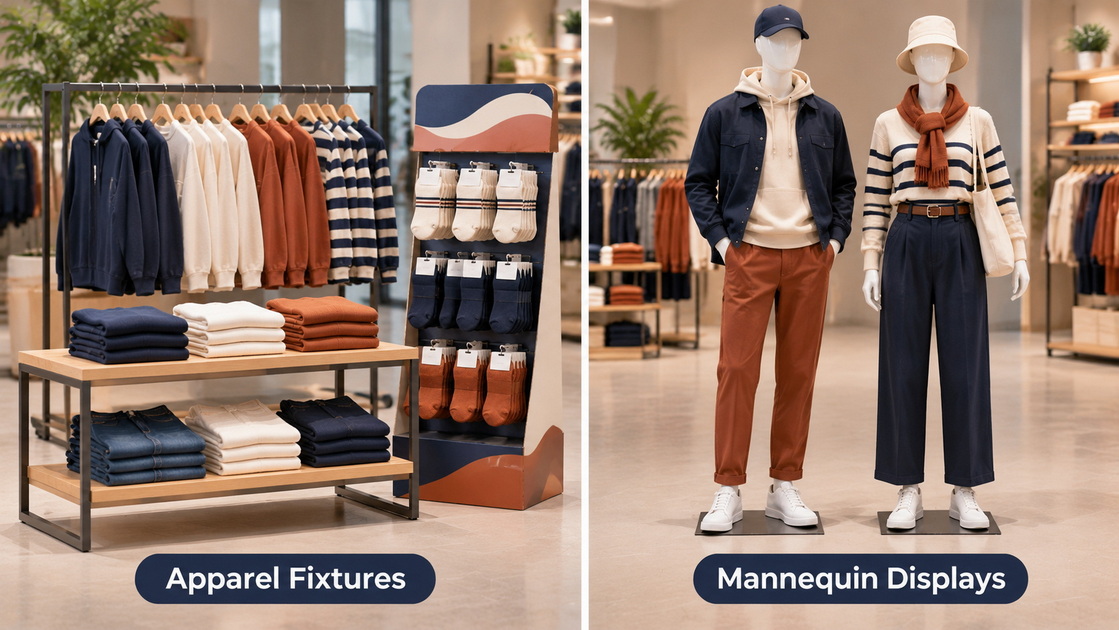
Choose non-mannequin apparel displays when customers need convenient access to sizes, colors, and packaged products. Choose mannequins when the priority is communicating a coordinated look.
| Comparison factor | Non-mannequin apparel display | Mannequin display |
|---|---|---|
| Primary role | Product organization and selection | Outfit presentation and visual storytelling |
| Typical formats | Racks, tables, shelves, bins, cardboard stands | Full-body, torso, abstract, or articulated forms |
| Merchandise capacity | Can accommodate multiple sellable units | Primarily presents selected garments |
| Customer interaction | Browsing, touching, comparing, selecting | Viewing styling and garment presentation |
| Daily workload | Folding, facing, replenishment | Dressing, cleaning, outfit maintenance |
| Best campaign fit | Product launches, promotions, size-led shopping | Collection introductions and complete looks |
| Main risk | Clutter or poor product organization | Inspiring interest without clear stock access |
| Combined use | Holds merchandise featured on the mannequin | Directs attention toward nearby merchandise |
Neither format guarantees higher sales. Effectiveness depends on placement, assortment, availability, and execution.
A useful apparel display answers practical questions:
- Which sizes are available?
- Where is the price?
- What colors can I choose?
- Can I pick up the product without disturbing everything?
- Where should I look for related items?
Racks can support hanging garments. Tables can present folded collections. Smaller countertop and floor displays can organize packaged accessories.
Cardboard display stands can suit campaign-based presentations for socks, hosiery, packaged underwear, and other appropriately sized merchandise.
However, suitability depends on the design and load. A lightweight promotional stand should not be assumed capable of replacing a permanent garment rail.
Printed displays provide space for collection names, product benefits, prices, and navigation.
This can help when the product needs explanation—for example, distinguishing multipack sizes or organizing accessories around a seasonal theme.
Keep the message hierarchy simple. Large graphics cannot compensate for hidden merchandise or confusing labels.
The display must remain shoppable after customers remove products, not just when it is freshly stocked.
A mannequin presents relationships that are harder to communicate through folded products alone: layering, proportion, coordinated accessories, and the overall silhouette.
It can show a jacket worn open over knitwear or explain how a bag complements an outfit.
However, it does not reproduce every customer's fit. Garment clipping, pose, and mannequin proportions influence appearance.
Treat the display as a styling reference, not a promise that the garment will look identical on everyone.
Mannequins can anchor an entrance, window, or collection zone.
Their effectiveness still depends on context. Academic research has examined how mannequin presentation conditions—including display height and distance—relate to mental simulation and purchase intention.
That evidence supports considering presentation carefully. It does not establish a universal sales increase or prove that mannequins outperform all other fixtures.
Avoid choosing a mannequin solely because its pose looks dramatic in a supplier photograph. Consider sightlines, available space, and the merchandise being presented.
Non-mannequin fixtures hold the stock customers usually purchase.
Their organization should support the shopping task. Separate sizes clearly, keep price information visible, and avoid overfilling shelves or hooks.
A tightly packed rack may hold more garments while making them harder to browse. A large folded stack can look abundant but require repeated recovery after handling.
Capacity and accessibility should therefore be evaluated together.
An attractive outfit becomes frustrating when shoppers cannot locate its components.
Place related merchandise nearby where appropriate, and make the connection understandable through layout, signage, or consistent styling.
Staff should also know which products appear on the mannequin.
The important question is not simply whether shoppers notice the outfit. It is whether they can move from inspiration to selection without unnecessary effort.
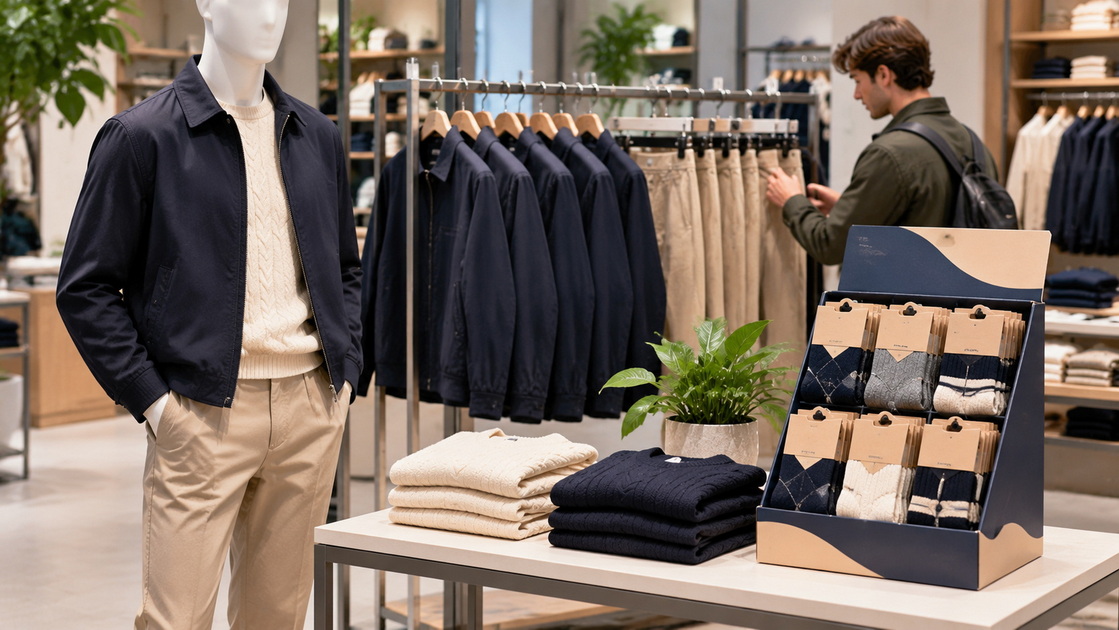
Do not compare only the base dimensions of a mannequin and a fixture.
Consider:
- Shopper circulation.
- Clearance for browsing.
- Door and fitting-room access.
- Staff replenishment space.
- Garments or accessories extending beyond the base.
- Visibility of neighboring merchandise.
Maintain access and circulation in accordance with applicable local requirements.
For countertop displays, also consider payment equipment, staff sightlines, and the space customers need to complete transactions.
Every display creates work.
Tables need refolding. Racks need size recovery. Accessory stands need facing and replenishment. Mannequins need dressing, cleaning, and checks for displaced garments.
A complex outfit may take longer to change than expected, particularly if the pose or construction limits access.
Before rollout, ask store staff to assemble, replenish, or restyle the proposed presentation. Their observations often reveal practical problems that a design review misses.
A cardboard stand, permanent rack, and mannequin have different cost structures.
| Cost category | What to include |
|---|---|
| Development | Drawings, samples, artwork, tooling |
| Procurement | Display, mannequin, bases, fittings |
| Distribution | Freight, protective packaging, storage |
| Setup | Assembly, dressing, product loading |
| Maintenance | Cleaning, recovery, replenishment, repairs |
| Campaign changes | New graphics, outfit changes, replacement parts |
| End of use | Storage, collection, reuse, disposal |
A lower unit price does not automatically produce lower campaign cost.
Likewise, a reusable mannequin is not automatically more economical than a campaign-specific display. The comparison depends on actual reuse, labor, storage, and transport.
For purchasing decisions, calculate total cost per store and per campaign. Where reliable sales data exist, compare the incremental contribution generated rather than gross revenue alone.
Custom cardboard displays deserve consideration when a brand needs campaign-specific graphics, a defined assortment, and coordinated distribution.
Possible applications include:
- Seasonal sock collections.
- Packaged fashion accessories.
- Promotional multipacks.
- Small branded product launches.
- Temporary shop-in-shop presentations.
Confirm product dimensions, weight, packaging, and expected handling before selecting the structure.
Test a representative prototype using the intended products.
Check shelf deflection, hook attachment, base stability, assembly clarity, and replenishment access.
Also inspect features that could damage apparel: exposed fasteners, rough edges, uncured adhesives, or poorly positioned components.
Preassembled delivery can reduce destination assembly, but may increase shipping volume. Compare that trade-off against flat-packed delivery and local labor.
Long Win Display supports discussion of these design, production, and preassembly choices. The appropriate configuration remains project-specific.
A presentation should be evaluated in its depleted condition—not only fully stocked.
Removing merchandise can reveal missing graphics, awkward gaps, or weak category organization. Uneven loading can also affect some stand designs.
Mannequins create a related problem: the outfit may remain on display after key sizes or colors sell out.
Use a simple availability rule:
1. Identify the products featured in the presentation.
2. Check their sellable stock regularly.
3. Define when signage, assortment, or styling must change.
4. Assign responsibility for that decision.
A display that promotes unavailable products can waste attention, even if it remains visually attractive.

These are planning examples, not measured customer case studies.
A retailer introduces packaged socks and hosiery across multiple stores.
A printed cardboard fixture may be the more relevant starting point because the project requires organized stock, visible prices, and campaign graphics.
A mannequin could support styling, but it would not replace the merchandise-holding function.
A store launches coordinated jackets, trousers, and shirts.
A mannequin can communicate the complete look. Nearby racks then provide sizes, alternative colors, and individual pieces.
The strongest solution connects the styled presentation to clearly available merchandise.
A temporary store has limited selling and storage space.
One focal mannequin may introduce the collection, while compact fixtures support browsing. Alternatively, product imagery and merchandise displays may be more practical if mannequin transport and dressing are difficult.
The right answer depends on assortment and operational constraints.
Define the commercial objective before installing either option.
Useful measures include:
- Purchases of the featured products.
- Outfit attachment rate.
- Stock availability.
- Staff recovery time.
- Setup compliance.
- Damage or replenishment issues.
Outfit attachment rate means the proportion of relevant transactions containing more than one featured outfit component.
Where possible, compare similar stores over the same period. Control or record differences in price, promotions, stock, traffic, and opening hours.
Do not attribute every sales change to the display. A popular product or discount can affect results independently.
Use pilot findings to improve execution before a wider rollout.
Neither cardboard nor reusable mannequins are automatically the lower-impact choice in every situation.
Consider material sourcing, manufacturing, transport, service life, actual reuse, repair, and end-of-use arrangements.
A mannequin stored unused between campaigns may deliver less value than planned. A paper-based display with difficult-to-separate components may face recycling limitations.
Ask suppliers for specific evidence rather than broad "eco-friendly" claims.
For cardboard displays, discuss material reduction, separable components, and local collection compatibility. For mannequins, assess repairability, replacement parts, refurbishment, and realistic reuse plans.
Non-mannequin apparel displays support selection and stock access. Mannequin displays support styling and visual interpretation.
For many fashion retailers, the most effective approach is a coordinated system: a compelling outfit, nearby merchandise, clear pricing, and a practical replenishment plan.
Long Win Display designs and manufactures customized cardboard POP displays for retail campaigns.
A mannequin display is one category of apparel display. This comparison uses "apparel display" to mean non-mannequin merchandise fixtures, including racks, tables, shelves, and cardboard stands.
Prioritize merchandise access and circulation first. A carefully placed mannequin may add styling value, but should not displace essential stock or obstruct shopping. Review the complete working footprint.
They can be designed for suitable garments and packaged accessories. Capacity depends on construction, product weight, load distribution, and use conditions. Validate the intended arrangement with a representative prototype.
No. They can communicate styling, but results depend on assortment, customer response, placement, pricing, and availability. Research findings about purchase intention should not be treated as guaranteed sales outcomes.
Choose according to what needs explanation. Full-body forms can present complete proportions, while torso forms can focus attention on upper-body garments. Check dimensions, stability, dressing access, and garment compatibility.
1. "Exploring the Impact of the Physical Conditions of Mannequin Displays on Consumers' Shopping Motivations." Journal of Retailing and Consumer Services. Research addressing mannequin display height, distance, mental simulation, and purchase intention. It does not provide a universal sales-uplift guarantee. [sciencedirect]
2. University of South Carolina. "An Investigation of Mannequins' Effect on Consumer Attitude and Intention." Research using an online convenience sample of 165 respondents to examine mannequin type, envisioning, display attitudes, and purchase intention. [scholarcommons.sc]
3. The Retail Factory. "The Benefits of Mannequins in Fashion Retail: Showcasing Trends Effectively." Practitioner guidance on outfit coordination, layering, focal presentations, and mannequin styling. Commercial performance statements have not been adopted as guaranteed results. [theretailfactory.co]
4. Long Win Display Shenzhen Limited. "Our Company." Background on cardboard display design, production, customization, and preloading services. Company capabilities are supplier-reported rather than independently audited for this article. [longwindisplay])
5. Association of Plastic Recyclers. "APR Design Guide Overview." Supports the broader distinction between material selection, complete-product design, and functioning recycling systems. Its technical guidance concerns plastic packaging and is not a certification method for cardboard displays or mannequins. [plasticsrecycling]
Content Menu
● Apparel Display vs Mannequin Display at a Glance
● What Non-Mannequin Apparel Displays Do Well
>> Make Merchandise Easier to Shop
>> Support Campaign Graphics and Product Grouping
● What Mannequin Displays Do Well
>> Show How Garments Work Together
>> Create a Visual Focal Point
● Compare Shopper Experience and Product Accessibility
>> Apparel Displays Help Customers Complete the Selection
>> Mannequins Need a Clear Route to Available Stock
● Compare Space, Capacity, and Store Operations
>> Measure the Working Footprint
>> Account for Maintenance Throughout the Day
● Compare Total Cost, Not Just the Purchase Price
● When Cardboard Apparel Displays Make Sense
>> Validate the Structure With Real Merchandise
● The Overlooked Issue: Displays Change as Products Sell
● Three Practical Fashion Retail Scenarios
>> A Seasonal Accessories Promotion
● How to Test Apparel Displays Against Mannequin Displays
● Sustainability Requires a Project-Level Comparison
● Choose the Display Around the Shopping Task
>> 1. Is a Mannequin Display Different From an Apparel Display?
>> 2. Which Option Is Better for a Small Clothing Store?
>> 3. Can Cardboard Displays Hold Clothing?
>> 4. Do Mannequins Guarantee Higher Sales?
>> 5. Should We Choose Full-Body or Torso Mannequins?
The apparel display vs mannequin display decision comes down to the job you need the presentation to perform. Merchandise fixtures help customers find, compare, and select clothing. Mannequins help communicate silhouette, styling, and outfit combinations. Many stores benefit from using both together.
There is also an important distinction: a mannequin display is technically one type of apparel display. For this comparison, "apparel display" refers to non-mannequin fixtures such as racks, tables, shelves, cardboard display stands, and accessory units.
At Long Win Display, we design, customize, manufacture, and preassemble cardboard POP displays for retail brands. Our manufacturing perspective starts with the merchandise and store workflow—not the assumption that one display format is always better.
This guide compares both approaches across shopper experience, capacity, cost, maintenance, and campaign execution.
Choose non-mannequin apparel displays when customers need convenient access to sizes, colors, and packaged products. Choose mannequins when the priority is communicating a coordinated look.
| Comparison factor | Non-mannequin apparel display | Mannequin display |
|---|---|---|
| Primary role | Product organization and selection | Outfit presentation and visual storytelling |
| Typical formats | Racks, tables, shelves, bins, cardboard stands | Full-body, torso, abstract, or articulated forms |
| Merchandise capacity | Can accommodate multiple sellable units | Primarily presents selected garments |
| Customer interaction | Browsing, touching, comparing, selecting | Viewing styling and garment presentation |
| Daily workload | Folding, facing, replenishment | Dressing, cleaning, outfit maintenance |
| Best campaign fit | Product launches, promotions, size-led shopping | Collection introductions and complete looks |
| Main risk | Clutter or poor product organization | Inspiring interest without clear stock access |
| Combined use | Holds merchandise featured on the mannequin | Directs attention toward nearby merchandise |
Neither format guarantees higher sales. Effectiveness depends on placement, assortment, availability, and execution.
A useful apparel display answers practical questions:
- Which sizes are available?
- Where is the price?
- What colors can I choose?
- Can I pick up the product without disturbing everything?
- Where should I look for related items?
Racks can support hanging garments. Tables can present folded collections. Smaller countertop and floor displays can organize packaged accessories.
Cardboard display stands can suit campaign-based presentations for socks, hosiery, packaged underwear, and other appropriately sized merchandise.
However, suitability depends on the design and load. A lightweight promotional stand should not be assumed capable of replacing a permanent garment rail.
Printed displays provide space for collection names, product benefits, prices, and navigation.
This can help when the product needs explanation—for example, distinguishing multipack sizes or organizing accessories around a seasonal theme.
Keep the message hierarchy simple. Large graphics cannot compensate for hidden merchandise or confusing labels.
The display must remain shoppable after customers remove products, not just when it is freshly stocked.
A mannequin presents relationships that are harder to communicate through folded products alone: layering, proportion, coordinated accessories, and the overall silhouette.
It can show a jacket worn open over knitwear or explain how a bag complements an outfit.
However, it does not reproduce every customer's fit. Garment clipping, pose, and mannequin proportions influence appearance.
Treat the display as a styling reference, not a promise that the garment will look identical on everyone.
Mannequins can anchor an entrance, window, or collection zone.
Their effectiveness still depends on context. Academic research has examined how mannequin presentation conditions—including display height and distance—relate to mental simulation and purchase intention.
That evidence supports considering presentation carefully. It does not establish a universal sales increase or prove that mannequins outperform all other fixtures.
Avoid choosing a mannequin solely because its pose looks dramatic in a supplier photograph. Consider sightlines, available space, and the merchandise being presented.
Non-mannequin fixtures hold the stock customers usually purchase.
Their organization should support the shopping task. Separate sizes clearly, keep price information visible, and avoid overfilling shelves or hooks.
A tightly packed rack may hold more garments while making them harder to browse. A large folded stack can look abundant but require repeated recovery after handling.
Capacity and accessibility should therefore be evaluated together.
An attractive outfit becomes frustrating when shoppers cannot locate its components.
Place related merchandise nearby where appropriate, and make the connection understandable through layout, signage, or consistent styling.
Staff should also know which products appear on the mannequin.
The important question is not simply whether shoppers notice the outfit. It is whether they can move from inspiration to selection without unnecessary effort.
Do not compare only the base dimensions of a mannequin and a fixture.
Consider:
- Shopper circulation.
- Clearance for browsing.
- Door and fitting-room access.
- Staff replenishment space.
- Garments or accessories extending beyond the base.
- Visibility of neighboring merchandise.
Maintain access and circulation in accordance with applicable local requirements.
For countertop displays, also consider payment equipment, staff sightlines, and the space customers need to complete transactions.
Every display creates work.
Tables need refolding. Racks need size recovery. Accessory stands need facing and replenishment. Mannequins need dressing, cleaning, and checks for displaced garments.
A complex outfit may take longer to change than expected, particularly if the pose or construction limits access.
Before rollout, ask store staff to assemble, replenish, or restyle the proposed presentation. Their observations often reveal practical problems that a design review misses.
A cardboard stand, permanent rack, and mannequin have different cost structures.
| Cost category | What to include |
|---|---|
| Development | Drawings, samples, artwork, tooling |
| Procurement | Display, mannequin, bases, fittings |
| Distribution | Freight, protective packaging, storage |
| Setup | Assembly, dressing, product loading |
| Maintenance | Cleaning, recovery, replenishment, repairs |
| Campaign changes | New graphics, outfit changes, replacement parts |
| End of use | Storage, collection, reuse, disposal |
A lower unit price does not automatically produce lower campaign cost.
Likewise, a reusable mannequin is not automatically more economical than a campaign-specific display. The comparison depends on actual reuse, labor, storage, and transport.
For purchasing decisions, calculate total cost per store and per campaign. Where reliable sales data exist, compare the incremental contribution generated rather than gross revenue alone.
Custom cardboard displays deserve consideration when a brand needs campaign-specific graphics, a defined assortment, and coordinated distribution.
Possible applications include:
- Seasonal sock collections.
- Packaged fashion accessories.
- Promotional multipacks.
- Small branded product launches.
- Temporary shop-in-shop presentations.
Confirm product dimensions, weight, packaging, and expected handling before selecting the structure.
Test a representative prototype using the intended products.
Check shelf deflection, hook attachment, base stability, assembly clarity, and replenishment access.
Also inspect features that could damage apparel: exposed fasteners, rough edges, uncured adhesives, or poorly positioned components.
Preassembled delivery can reduce destination assembly, but may increase shipping volume. Compare that trade-off against flat-packed delivery and local labor.
Long Win Display supports discussion of these design, production, and preassembly choices. The appropriate configuration remains project-specific.
A presentation should be evaluated in its depleted condition—not only fully stocked.
Removing merchandise can reveal missing graphics, awkward gaps, or weak category organization. Uneven loading can also affect some stand designs.
Mannequins create a related problem: the outfit may remain on display after key sizes or colors sell out.
Use a simple availability rule:
1. Identify the products featured in the presentation.
2. Check their sellable stock regularly.
3. Define when signage, assortment, or styling must change.
4. Assign responsibility for that decision.
A display that promotes unavailable products can waste attention, even if it remains visually attractive.
These are planning examples, not measured customer case studies.
A retailer introduces packaged socks and hosiery across multiple stores.
A printed cardboard fixture may be the more relevant starting point because the project requires organized stock, visible prices, and campaign graphics.
A mannequin could support styling, but it would not replace the merchandise-holding function.
A store launches coordinated jackets, trousers, and shirts.
A mannequin can communicate the complete look. Nearby racks then provide sizes, alternative colors, and individual pieces.
The strongest solution connects the styled presentation to clearly available merchandise.
A temporary store has limited selling and storage space.
One focal mannequin may introduce the collection, while compact fixtures support browsing. Alternatively, product imagery and merchandise displays may be more practical if mannequin transport and dressing are difficult.
The right answer depends on assortment and operational constraints.
Define the commercial objective before installing either option.
Useful measures include:
- Purchases of the featured products.
- Outfit attachment rate.
- Stock availability.
- Staff recovery time.
- Setup compliance.
- Damage or replenishment issues.
Outfit attachment rate means the proportion of relevant transactions containing more than one featured outfit component.
Where possible, compare similar stores over the same period. Control or record differences in price, promotions, stock, traffic, and opening hours.
Do not attribute every sales change to the display. A popular product or discount can affect results independently.
Use pilot findings to improve execution before a wider rollout.
Neither cardboard nor reusable mannequins are automatically the lower-impact choice in every situation.
Consider material sourcing, manufacturing, transport, service life, actual reuse, repair, and end-of-use arrangements.
A mannequin stored unused between campaigns may deliver less value than planned. A paper-based display with difficult-to-separate components may face recycling limitations.
Ask suppliers for specific evidence rather than broad "eco-friendly" claims.
For cardboard displays, discuss material reduction, separable components, and local collection compatibility. For mannequins, assess repairability, replacement parts, refurbishment, and realistic reuse plans.
Non-mannequin apparel displays support selection and stock access. Mannequin displays support styling and visual interpretation.
For many fashion retailers, the most effective approach is a coordinated system: a compelling outfit, nearby merchandise, clear pricing, and a practical replenishment plan.
Long Win Display designs and manufactures customized cardboard POP displays for retail campaigns.
A mannequin display is one category of apparel display. This comparison uses "apparel display" to mean non-mannequin merchandise fixtures, including racks, tables, shelves, and cardboard stands.
Prioritize merchandise access and circulation first. A carefully placed mannequin may add styling value, but should not displace essential stock or obstruct shopping. Review the complete working footprint.
They can be designed for suitable garments and packaged accessories. Capacity depends on construction, product weight, load distribution, and use conditions. Validate the intended arrangement with a representative prototype.
No. They can communicate styling, but results depend on assortment, customer response, placement, pricing, and availability. Research findings about purchase intention should not be treated as guaranteed sales outcomes.
Choose according to what needs explanation. Full-body forms can present complete proportions, while torso forms can focus attention on upper-body garments. Check dimensions, stability, dressing access, and garment compatibility.
1. "Exploring the Impact of the Physical Conditions of Mannequin Displays on Consumers' Shopping Motivations." Journal of Retailing and Consumer Services. Research addressing mannequin display height, distance, mental simulation, and purchase intention. It does not provide a universal sales-uplift guarantee. [sciencedirect]
2. University of South Carolina. "An Investigation of Mannequins' Effect on Consumer Attitude and Intention." Research using an online convenience sample of 165 respondents to examine mannequin type, envisioning, display attitudes, and purchase intention. [scholarcommons.sc]
3. The Retail Factory. "The Benefits of Mannequins in Fashion Retail: Showcasing Trends Effectively." Practitioner guidance on outfit coordination, layering, focal presentations, and mannequin styling. Commercial performance statements have not been adopted as guaranteed results. [theretailfactory.co]
4. Long Win Display Shenzhen Limited. "Our Company." Background on cardboard display design, production, customization, and preloading services. Company capabilities are supplier-reported rather than independently audited for this article. [longwindisplay])
5. Association of Plastic Recyclers. "APR Design Guide Overview." Supports the broader distinction between material selection, complete-product design, and functioning recycling systems. Its technical guidance concerns plastic packaging and is not a certification method for cardboard displays or mannequins. [plasticsrecycling]


