
Views: 280 Author: Long Win Display Publish Time: 2026-10-27 Origin: Site


Content Menu
● Acrylic vs Metal Display Stands at a Glance
● What Is an Acrylic Display Stand?
>> Where Acrylic Supports Luxury Presentation
● What Is a Metal Display Stand?
>> Define the Metal and Finish Separately
● Which Display Looks More Luxurious?
>> Acrylic: Letting the Product Lead
>> Metal: Creating a Defined Visual Frame
● Strength, Load Capacity, and Countertop Stability
>> Test the Actual Arrangement
● Surface Durability and Daily Cleaning
>> Acrylic Cleaning Requires Grade-Specific Instructions
>> Metal Care Depends on the Finish
● Product Contact Matters More Than Buyers Expect
● Customization and Brand Updates
>> Separate Permanent and Campaign Components
● Acrylic vs Metal Display Stand Cost
>> Compare Total Ownership Cost
● Sustainability: Avoid Material-Based Shortcuts
● Three Practical Scenarios for Luxury Countertop Displays
>> Scenario 1: A Fragrance Launch With Frequent Graphic Changes
>> Scenario 2: A Long-Term Watch Presentation
>> Scenario 3: A Seasonal Cosmetics Promotion
● A Better Sample Approval Process
● How Long Win Display Can Support the Comparison
>> 1. Is acrylic or metal better for luxury products?
>> 2. Will an acrylic display stand scratch?
>> 3. Is a metal stand always stronger?
>> 4. Can stores use their usual cleaner on acrylic displays?
>> 5. Which option is cheaper for bulk orders?
An acrylic display stand vs metal display stand comparison starts with one practical question: should the fixture visually disappear behind the product, or become part of the brand presentation? Acrylic often supports a light, transparent appearance. Metal offers opportunities for slim frames, substantial bases, and distinctive surface finishes.
Neither material is automatically more luxurious. For jewelry, watches, fragrances, and premium cosmetics, the right countertop display stand must balance appearance, stability, maintenance, customization, and total ownership cost.
From a procurement perspective, the most reliable decision comes from comparing complete constructions—not material names alone.

The central consideration is fit: the relationship between the product, retail environment, display structure, and intended service life.
| Evaluation area | Acrylic display stand | Metal display stand |
|---|---|---|
| Visual direction | Transparent, translucent, colored, or opaque | Brushed, polished, painted, plated, or coated |
| Product presentation | Can minimize visual obstruction | Can frame the product with a stronger structural presence |
| Construction | Cut panels, bends, bonded joints, or assembled components | Formed sheet, frames, welded parts, or mechanical assemblies |
| Surface concerns | Scratches, haze, chemical compatibility | Scratches, dents, coating damage, fingerprints |
| Maintenance | Requires grade-compatible cleaning | Depends on alloy and finish |
| Customization | Printed graphics, shaped panels, interchangeable inserts | Formed details, engraving, coatings, replaceable components |
| Procurement priority | Grade, thickness, joints, edge finish | Alloy, thickness, joints, surface treatment |
| Best evaluation method | Production-representative sample | Production-representative sample |
These are comparison categories rather than universal performance rankings. A poorly designed metal stand can perform worse than a well-engineered acrylic alternative.
Acrylic display stands commonly use polymethyl methacrylate, or PMMA. They may feature clear risers, colored plinths, product holders, branded back panels, or combinations of these elements.
Clear acrylic is especially relevant when the display should reveal the product from several directions.
For context, clear-transparent PLEXIGLAS products can transmit up to 92% of visible light. This is a manufacturer-reported property of applicable products—not a guarantee for every acrylic grade or finished fixture.
Acrylic is worth evaluating when the brief calls for:
- A visually light countertop arrangement.
- Clear separation between individual products.
- Transparent product supports.
- Colored branding panels.
- Replaceable graphic or product inserts.
However, transparency also makes construction details visible. Buyers should inspect exposed edges, joint appearance, dust traps, and the view through the assembled stand.
A material sample alone cannot establish how the complete display will look.
"Metal" is a broad category, not a purchasing specification.
A supplier might propose stainless steel, aluminum, coated carbon steel, or a combination. These options should not be treated as interchangeable.
Likewise, "gold finish" describes an appearance, not necessarily a solid material or a particular coating system.
A useful specification identifies:
1. The base metal or alloy.
2. Material thickness.
3. Structural construction.
4. Surface preparation.
5. Coating or decorative finish.
6. Approved color and gloss reference.
For luxury products, surface consistency may be as important as structural strength. Review corners, weld locations, exposed fasteners, and transitions between components.
Do not approve a polished sample if mass production will use a different finish without reviewing that change.
Luxury perception depends on execution and context.
A clear acrylic riser may suit a fragrance bottle with a distinctive silhouette. A dark metal frame may complement a watch collection. Either can look inappropriate if the proportions, lighting, or finish conflict with the merchandise.
Acrylic can support a "floating" visual effect, particularly where transparent supports reduce obstruction.
Nevertheless, reflections and visible edges may compete with packaging graphics. Evaluate the fixture beneath representative store lighting rather than only in a supplier's studio.
Metal can introduce a contrasting border, architectural form, or deliberate sense of weight.
The design challenge is restraint. A highly reflective or elaborate stand may draw attention away from the product.
For both materials, photograph the proposed fixture from normal shopper positions with actual merchandise installed. This provides a more useful comparison than isolated beauty shots.
There is no defensible universal statement that one display material supports every luxury product better.
Load performance depends on dimensions, span, thickness, joints, reinforcement, and the location of the merchandise.
Acrylic thickness alone is not a load rating. Metal construction also requires review; a thin panel or weak connection can undermine an otherwise substantial-looking fixture.
For a countertop display, ask the supplier to evaluate:
- Fully stocked and partially stocked conditions.
- Uneven loading.
- Customer removal and replacement of products.
- Contact with projecting panels.
- Sliding on the intended counter surface.
- Assembly and fastener retention.
A display may behave differently after customers remove products from one side. Include this condition in the sample review.
Agree on project-specific acceptance criteria rather than relying on an undefined "heavy-duty" description.
Luxury displays are judged repeatedly at close range. Surface deterioration can therefore become a brand-presentation problem before the structure stops functioning.
Published acrylic care instructions recommend mild soap and water or a suitable acrylic cleaner with a soft, lint-free cloth. They warn against incompatible cleaners and abrasive wiping.
However, specialty abrasion-resistant acrylic grades may have different surface properties and cleaning compatibility from standard sheet. The applicable manufacturer's instructions should control.
Ask for written guidance covering the exact sheet, coating, printing, and adhesive system used.
Do not assume every metallic-looking surface can tolerate the same cleaner.
For procurement, request finish-specific maintenance instructions and test the actual retail cleaning product on an approved sample.
Include printed logos, protective coatings, feet, and adhesive components in the review. A compatible cleaner for the base material may still affect another part of the assembly.
The area where merchandise touches the display deserves its own specification.
For watches, jewelry, polished packaging, and coated bottles, the contact surface may differ from the visible structural material.
Possible design approaches include removable cushions, fitted trays, liners, or pads. Their suitability depends on the product.

During sampling, examine whether the contact system:
- Holds the product securely.
- Leaves pressure marks.
- Transfers color or residue.
- Interferes with labels or closures.
- Can be cleaned or replaced.
- Remains attached during repeated use.
These are recommended evaluation points, not claims that every product needs the same liner.
A luxury fixture should protect the merchandise as carefully as it presents it.
Both acrylic and metal displays can form part of a modular design.
Instead of replacing the complete fixture for every campaign, buyers can request interchangeable graphics, inserts, or product holders.
A useful design brief distinguishes:
| Component | Suggested purchasing question |
|---|---|
| Main structure | How long should it remain in service? |
| Branding panel | Can it be replaced without specialist tools? |
| Product insert | Can it accommodate future SKU changes? |
| Contact lining | Is it replaceable separately? |
| Fasteners | Are replacements available? |
| Packaging | Can it support storage or redeployment? |
Modularity is not automatically cheaper. Additional joints and components introduce their own costs. Ask for a lifecycle comparison against a simpler fixed design.
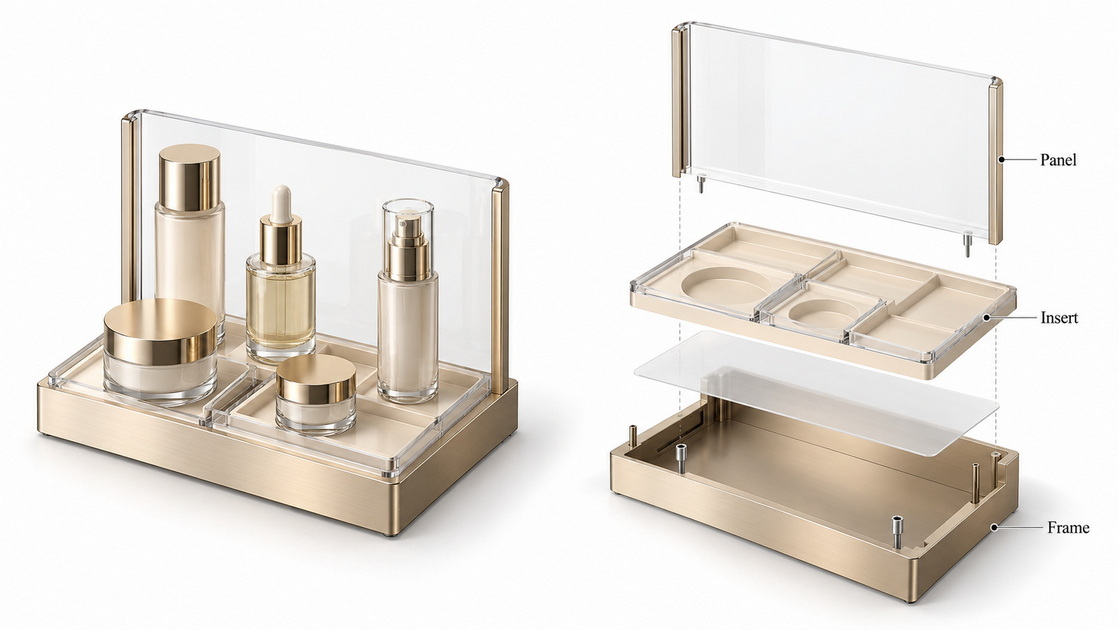
Neither material is always the lower-cost option.
A small acrylic construction may require limited assembly, while a complex bonded design can involve substantial finishing. A metal fixture may require forming, welding, surface preparation, and coating—or use a comparatively simple construction.
Evaluate:
- Design and tooling.
- Prototype development.
- Production.
- Surface finishing.
- Packaging.
- Freight.
- Installation.
- Cleaning.
- Replacement parts.
- Refurbishment or disposal.
Do not compare quotations with different dimensions, finishes, packaging, or customization levels.
Also ask whether samples use the same material and process planned for production. Otherwise, a visually convincing sample may support an inaccurate cost comparison.
Calling acrylic "plastic" or metal "recyclable" does not establish the environmental outcome of a complete fixture.
For responsible purchasing, ask what evidence supports the proposed claim.
Relevant questions include:
- Is recycled content documented?
- Can different materials be separated?
- Are replacement parts available?
- Can the display be reused?
- Does a local recovery route accept the finished construction?
- What packaging is required?
Treat recyclability, recycled content, and actual recycling as separate questions.
A long service life is useful only if the fixture remains suitable for future merchandising requirements.
The following are decision examples, not reported customer projects.
Consider an acrylic or hybrid system with replaceable campaign panels.
Evaluate cleaner compatibility, bottle contact areas, and graphic replacement before selecting the material.
Consider a metal framework with replaceable product cushions or trays.
Review contact protection, finish consistency, security requirements, and the ability to accommodate different watch sizes.
Compare a compact acrylic construction against a lightweight metal or mixed-material option.
Prioritize pack-out dimensions, installation simplicity, and whether the fixture will be reused. A material chosen for prestige alone may not fit a short campaign.
Approve the project in stages.
1. Structural review: Confirm footprint, capacity, access, and stability.
2. Finish review: Approve material, color, texture, and visible joints.
3. Product trial: Install actual merchandise.
4. Cleaning trial: Use the proposed maintenance procedure.
5. Packing review: Inspect protection and unpacking.
6. Pilot review: Where practical, evaluate a small rollout before expansion.
Retain the approved sample and a signed specification.
Document acceptable cosmetic variation and require authorization for substitutions. This is particularly important when several suppliers contribute different components.
Long Win Display is a China-based POP display design and manufacturing business serving custom retail-display projects.
Its public website describes acrylic and metal display offerings. It also states that certain semi-permanent and permanent displays are supplied through cooperating factories. Buyers should therefore confirm the production arrangement for their specific project rather than assume every process takes place in one facility.
For a luxury countertop display inquiry, request a side-by-side proposal using the same footprint, merchandise, branding requirements, and delivery destination.
Ask the team to identify:
- Proposed materials and finishes.
- Available customization.
- Sample stages.
- Production responsibilities.
- Inspection arrangements.
- Preassembly or preloading feasibility.
- Packing and shipping scope.
This creates a commercially useful comparison without assuming that acrylic or metal must win.
Neither is universally better. Acrylic may suit a visually light presentation; metal may suit a defined structural frame. Evaluate the actual merchandise, construction, finish, and maintenance requirements.
Standard acrylic requires careful handling and appropriate cleaning. Abrasion-resistant grades are available, but buyers should verify the specific grade and its performance claims.
No. Finished performance depends on design, dimensions, connections, and loading. Request evaluation of the assembled fixture rather than inferring capacity from the material name.
Not without checking compatibility. Obtain written instructions for the actual acrylic grade and finished assembly, then review the proposed cleaner against those instructions.
Only matched quotations can answer that. Compare equivalent dimensions, customization, finish, packing, and delivery terms, then consider maintenance and replacement costs.
1. [PLEXIGLAS — Light Transmission]. Manufacturer information supporting the stated visible-light transmission of applicable clear-transparent products.
2. [ACRYLITE AR Abrasion Resistant Acrylic Sheet — Manufacturer Sell Sheet]. Supports the distinction between standard acrylic and specialty abrasion- and chemical-resistant grades. Manufacturer document hosted by a distributor.
3. [Care and Cleaning Instructions for Acrylic]. Supports the cleaning discussion. These instructions are product-specific guidance, not a universal chemical-compatibility table.
4. [Long Win Display — Acrylic Display]. Company information on acrylic display offerings.
5. [Long Win Display — Metal Display]. Company information on metal display offerings.
6. [Long Win Display — Official Website]. Source for the stated use of cooperating factories for certain alternative-material displays.


