
Views: 207 Author: Long Win Display Publish Time: 2026-10-28 Origin: Site


Content Menu
● Acrylic Display Stand vs Cardboard Display
● How Acrylic and Cardboard Countertop Displays Differ
>> Acrylic Display Stands: Product Visibility and Repeat Use
>> Cardboard Displays: Campaign Communication and Customization
● Which Display Creates Stronger Promotional Impact?
>> Choose Acrylic When the Product Should Dominate
>> Choose Cardboard When the Campaign Needs Explanation
● Compare the Campaign, Not the Factory Price
>> Why Theoretical Reuse Can Mislead Buyers
● Match the Structure to the Store
>> Acrylic Needs Protection From Scratching and Impact
>> Cardboard Needs Control of Load and Moisture
● Flat Packed, Preassembled, or Preloaded?
● Three Often-Overlooked Decisions
>> 1. Design the First Minute in the Store
>> 2. Plan for Partial Sell-Through
>> 3. Separate Permanent and Temporary Components
● Avoid Simple Material Labels
● A Practical Supplier Approval Process
● Which Display Should You Choose?
● FAQ
>> 1. Is cardboard suitable for a promotion lasting several months?
>> 2. Will acrylic always look more premium?
>> 3. Which material has the lower minimum order quantity?
>> 4. Can we ship products already loaded into the display?
>> 5. How should we compare sales performance fairly?
An acrylic display stand offers a polished, reusable presentation, while a cardboard display offers campaign-specific graphics and convenient rollout options. For limited-time promotions, the better choice depends on more than appearance. Your decision should reflect campaign duration, product weight, store conditions, installation requirements, and the likelihood of actual reuse.
My starting point when evaluating this comparison is simple: execution matters more than material prestige. A premium fixture delivers little value if it arrives late, occupies too much counter space, or remains in storage after the first campaign.
This guide compares acrylic and cardboard countertop displays from a purchasing and retail-design perspective. It also explains where Long Win Display's custom design, manufacturing, and preloading services fit into a practical promotional program.

Neither material wins every category. The following comparison assumes properly engineered indoor countertop displays.
| Decision factor | Acrylic display stand | Cardboard display |
|---|---|---|
| Visual presentation | Transparent or colored surfaces emphasize products | Printed surfaces emphasize campaign messages |
| Typical campaign fit | Recurring promotions and maintained fixtures | Seasonal launches and campaign-specific rollouts |
| Initial investment | Fabrication and protective packing can increase cost | Often economical for lightweight promotional structures |
| Graphic updates | Replaceable inserts help preserve the fixture | Entire printed structure can match each campaign |
| Freight efficiency | Depends on construction and protective packaging | Flat-packed designs can reduce shipping volume |
| Store installation | Some designs arrive ready to use | Flat-packed versions require assembly; preloaded units reduce setup |
| Moisture exposure | Does not absorb water like paperboard | Requires appropriate material selection and protection |
| Maintenance | Needs compatible cleaning and scratch control | Usually replaced rather than repeatedly cleaned |
| Reuse | Practical when retrieval and storage are organized | Possible within the approved service conditions |
| End of life | Confirm local collection or specialist recycling | Confirm acceptance of the complete printed structure |
Treat these as design tendencies, not guaranteed results. A complex cardboard fixture can cost more than a simple acrylic holder, and a poorly packaged acrylic unit can lose its expected reuse advantage.
Acrylic, commonly called PMMA, is used for transparent holders, risers, trays, and branded retail fixtures. Fabricated acrylic can provide clear sightlines around small products and a relatively unobtrusive presentation.
That makes it worth considering for cosmetics, accessories, collectible products, and other merchandise where shoppers benefit from seeing the package without a large printed structure around it.
However, acrylic is not maintenance-free. Surface appearance depends on handling, cleaning, packaging, and storage. Scratches and incompatible cleaners can reduce clarity or damage the surface.
The purchasing implication is straightforward: specify the maintenance instructions alongside the fixture, not after stores begin cleaning it.
A cardboard countertop display typically combines a structural base, product compartments, and printed branding. Depending on the design, it can incorporate stepped shelves, dividers, a header, or a removable shipping cover.
Its advantage is the ability to make the entire structure part of the promotion. Seasonal colors, product education, pricing messages, and launch graphics can be integrated into one coordinated unit.
Long Win Display describes capabilities spanning structural design, prototyping, printing, production, and delivery. Its preloading services are relevant when brands want products and displays prepared together before distribution.
For procurement teams, the important distinction is between a display designed only to look attractive and one designed to survive shipping, stocking, and everyday customer interaction.
A transparent acrylic display stand can keep attention on the merchandise. This is useful when packaging already communicates the brand clearly or when the store environment favors a restrained presentation.
Acrylic may also support recurring promotions when the base fixture remains unchanged and campaign information moves to replaceable inserts.
Before approving that approach, check whether staff can replace those inserts without tools and whether the graphics remain readable under store lighting.
A cardboard display provides printable surfaces for communicating a new product, bundle, seasonal offer, or usage benefit.
That additional space is valuable only when the message is disciplined.
I recommend organizing the design around three questions:
1. What is the product?
2. Why is it relevant now?
3. What should the shopper do next?
A crowded header rarely solves a communication problem. Prioritize one campaign message, then use secondary panels for supporting information.
Neither acrylic nor cardboard automatically produces higher sales. Product selection, placement, availability, pricing, and message clarity must be evaluated alongside the fixture.
A unit-price comparison leaves out several expenses that can change the decision.
Assess:
- Design and prototype development.
- Tooling and printing preparation.
- Protective packaging.
- Freight and destination handling.
- Store assembly.
- Installation failures or missing components.
- Cleaning and maintenance.
- Retrieval, storage, and redeployment.
- Replacement and disposal.
For a single promotion, calculate:
"Activated" should mean installed, stocked, and ready for shoppers—not merely delivered.
For reusable fixtures, compare costs across completed campaigns. Do not divide the purchase price by an optimistic number of future uses unless the retrieval, storage, and refurbishment process is funded.
Consider two hypothetical programs.
One uses acrylic fixtures intended for four campaigns, but the retailer does not return or store them. The other uses cardboard displays supplied for one campaign and installed consistently.
The acrylic program cannot claim a four-use cost advantage unless those later uses happen.
This is a planning example, not a reported customer result. Its purpose is to separate a material's physical durability from an organization's ability to reuse it.
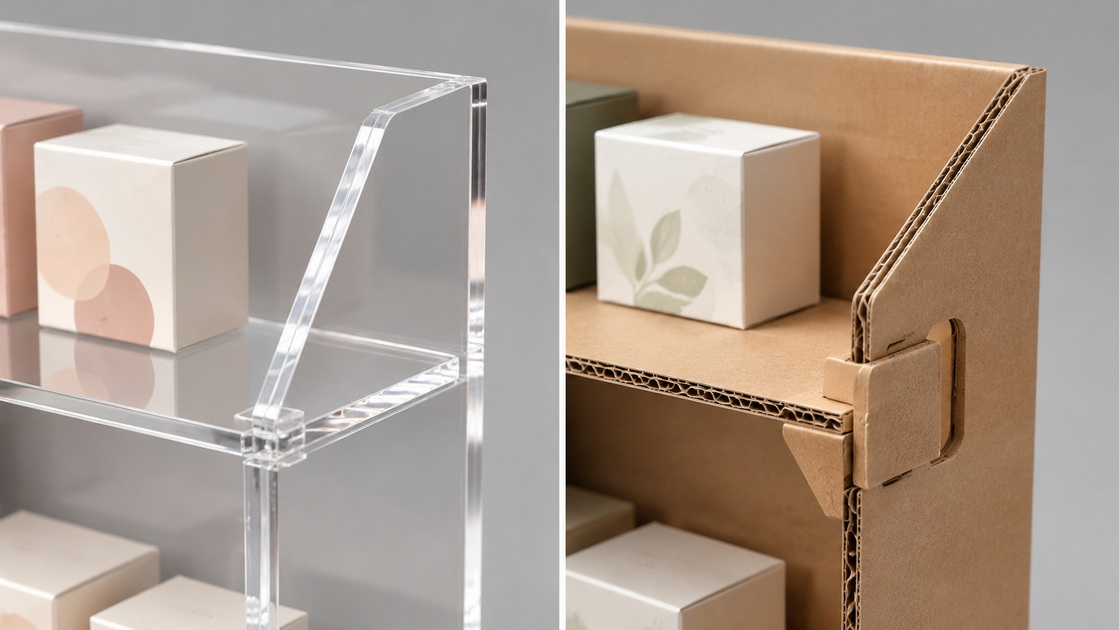
Acrylic is suitable for many indoor retail applications, but exposed edges, joints, and surfaces still require careful engineering.
Request:
- Smooth, finished edges.
- Stable bases and appropriate compartment dimensions.
- Protected contact points in transit.
- Assembly instructions where relevant.
- Approved cleaning guidance.
ACRYLITE's care instructions recommend mild detergent, lukewarm water, and soft cleaning materials. They also warn against several common solvents and abrasive products.
If stores routinely use a particular cleaner, ask the fabricator to confirm compatibility before rollout.
A cardboard display should be evaluated with the actual products, not empty compartments.
Check shelf span, product distribution, reinforcement, locking tabs, and base stability. Pay particular attention to the heaviest loading condition and to partially depleted displays, where balance may change.
Moisture is another design input. Cleaning spills, damp countertops, and condensation can affect paper-based structures.
A coating may help with a particular exposure, but it should not be treated as proof that the entire display is waterproof. Test the proposed construction under representative conditions and consider how added materials affect disposal.
Material choice and fulfillment format are separate decisions.
| Format | Main advantage | Main trade-off |
|---|---|---|
| Flat packed | Efficient transport and storage | Store labor and assembly consistency |
| Preassembled | Reduced structural setup | More shipping volume |
| Preloaded | Products and fixture arrive as a coordinated unit | More demanding packing and transit validation |
A preloaded cardboard countertop display can reduce store tasks, but its value depends on the packing design. Products need restraint during transport, while store staff need an obvious opening and setup sequence.
Acrylic fixtures may arrive assembled, but they can still require unpacking, removal of protective films, placement of inserts, and product loading.
The appropriate comparison is therefore the complete opening-to-selling workflow.
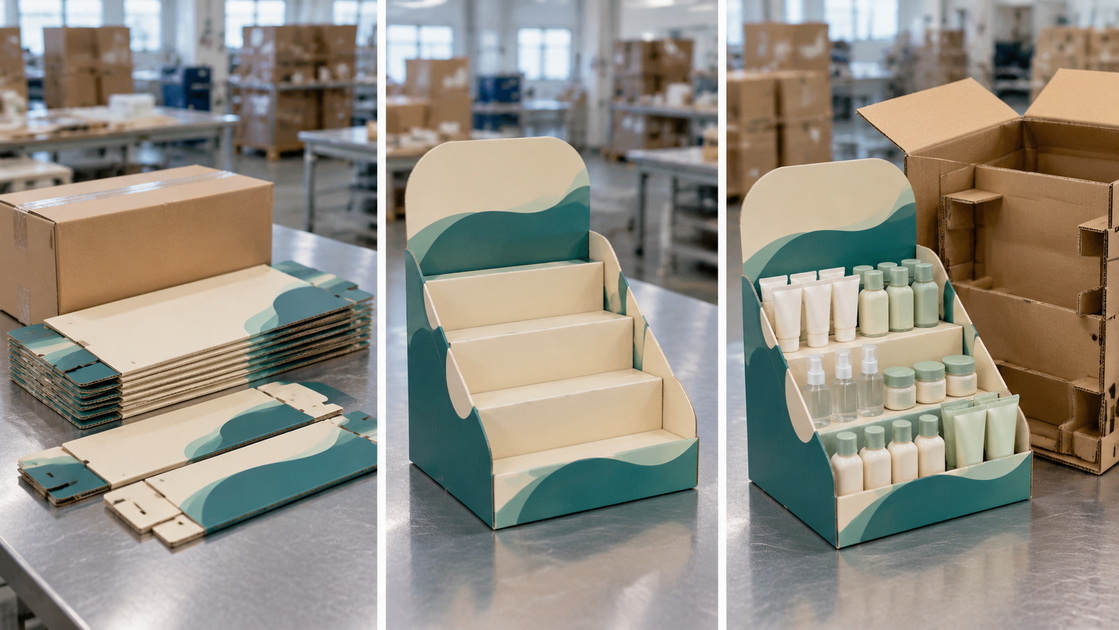
Ask someone unfamiliar with the project to unpack and install the prototype.
Observe whether they can identify:
- Which side faces shoppers.
- Which panels remain attached.
- Where the products belong.
- How the header locks into position.
- What packaging should be discarded.
Record the problems and revise the design. A simple installation trial can reveal issues that drawings do not.
A display should still work when some products are missing.
Evaluate it fully stocked, half stocked, and nearly empty. Check whether products fall forward, remaining stock becomes hidden, or the fixture loses balance.
For cardboard, dividers and stepped compartments may help maintain order. For acrylic, compartment depth and product supports deserve equal attention.
A hybrid display may be appropriate when a retailer wants a reusable base but frequent campaign changes.
Examples include:
- An acrylic holder with replaceable printed messaging.
- A reusable fixture with a removable cardboard tray.
- A durable base with campaign-specific dividers.
This approach adds components and coordination, so it is not automatically cheaper or more sustainable. Evaluate assembly, replacement availability, material separation, and actual reuse before choosing it.
"Reusable" and "recyclable" describe different things.
Acrylic may remain useful across multiple campaigns, but the benefit depends on reuse actually occurring. Buyers should confirm local collection options rather than assume every municipal program accepts acrylic fixtures.
Corrugated cardboard benefits from established paper-recycling systems in many markets. FEFCO reports that recycled paper supplies 88% of the raw material used for new European corrugated packaging.
That industry figure is not the recycled-content percentage of a particular display, nor does it prove that a complete display will be recycled.
Lamination, adhesives, mixed-material fittings, contamination, and local collection rules can affect the disposal route. Ask for a material breakdown and market-specific instructions.
A defensible comparison considers material use, freight, service life, maintenance, and end-of-life arrangements—not appearance alone.
Before authorizing mass production, follow this sequence:
1. Define the campaign dates, stores, products, and selling environment.
2. Confirm the maximum countertop footprint with the retailer.
3. Approve a structural prototype with actual merchandise.
4. Review graphics at realistic viewing distance.
5. Test unpacking, assembly, loading, and replenishment.
6. Validate the agreed transit and in-store conditions.
7. Approve a production-representative sample.
8. Lock the materials, dimensions, packing method, and inspection criteria.
For either material, document substitutions and require approval before changing structural components.
This prevents a visually similar production unit from being treated as equivalent when its construction differs from the approved sample.
Choose cardboard when campaign-specific graphics, lightweight merchandise, transport efficiency, and coordinated promotional rollout are the main priorities.
Choose acrylic when product visibility, routine cleaning, and a credible multi-campaign reuse plan justify the fabrication and handling requirements.
Consider a hybrid when the fixture can genuinely remain in service while campaign components change.
For a short promotion, I would begin by evaluating a cardboard solution—not because it always wins, but because it provides a useful baseline for campaign-specific customization. I would then test whether acrylic delivers enough additional presentation value or completed reuse to justify the alternative.
Possibly. Suitability depends on construction, product loading, handling, moisture, and store conditions. Validate the proposed design for the intended service period rather than relying on a general lifespan claim.
No. Presentation depends on design, fabrication quality, cleanliness, product packaging, and the retail environment. A scratched acrylic fixture may appear less professional than a well-designed printed cardboard display.
There is no universal answer. Minimum quantities depend on fabrication, printing, tooling, assembly, and supplier economics. Request quotations against the same functional brief.
Yes, where the structure and protective packing are designed for it. Confirm product restraint, transit performance, opening instructions, and the retailer's receiving process before approval.
Use comparable stores, products, prices, campaign dates, and stock availability. Track correct installation alongside sales. Otherwise, the comparison may measure execution differences rather than display effectiveness.
1. Long Win Display. Company profile, design-to-production services, packaging capabilities, and preloading background. Used for company-specific descriptions, not independent performance comparisons. [longwindisplay]
2. ACRYLITE. Technical information on acrylic's clarity and suitability for fabricated signs and displays. [acrylite]
3. ACRYLITE. Caring for ACRYLITE, technical care instructions hosted by EM Plastic. Used for cleaning, scratch prevention, and solvent precautions. [emplastic]
4. FEFCO. Circular by Nature — Easy to Recycle. Source of the European corrugated-sector recycled-material figure; not a product-specific environmental assessment. [fefco]
5. FEFCO. Corrugated Cardboard Recycling Rate Study. Context for distinguishing corrugated-specific recycling methodology from broad paper-packaging claims. [fefco]
6. Packaging Warehouse. New Recycling Guidelines by FEFCO. Supporting discussion of complete packaging structures and collection infrastructure. [packaging-warehouse]


