
Views: 222 Author: Long Win Display Publish Time: 2026-06-03 Origin: Site


Content Menu
● What Is A Pallet Display Stand?
● Why Pallet Displays Work So Well On The Retail Floor
>> Benefit 1: Faster, Lower‑Cost Deployment From Warehouse To Aisle
>> Benefit 2: Highly Customizable Structures For Any Product Mix
>> Benefit 3: Bigger Branding Canvas And Storytelling Power
>> Benefit 4: Built‑In Cross‑Merchandising And Basket‑Size Growth
>> Benefit 5: Stronger Retailer Compliance And Easier Store Operations
>> Benefit 6: Measurable Impact On Shopper Attention And Sales
>> Benefit 7: Sustainability And Brand Perception Advantages
● How To Design An Effective Pallet Display (Step‑By‑Step)
>> Step 1: Define commercial and UX goals
>> Step 2: Choose the right pallet format
>> Step 3: Align structure with product and safety
>> Step 4: Maximize visual hierarchy and messaging
>> Step 5: Plan for maintenance and end‑of‑life
● Real‑World Use Cases Where Pallet Displays Excel
>> Seasonal and holiday campaigns
>> Category reinvention and cross‑category platforms
● Pallet Displays vs. Other POP Display Types
● When To Partner With A Specialist Manufacturer
● FAQ
In modern retail, pallet display stands are one of the most reliable ways to win shopper attention, move inventory faster, and keep retailers happy—all without exploding your merchandising budget. As a China‑based POP display designer who has helped global brands launch everything from FMCG to seasonal promotions, I have seen well‑designed pallet displays outperform standard shelf placements by a wide margin in both sell‑through and retailer compliance. [bcipkg]
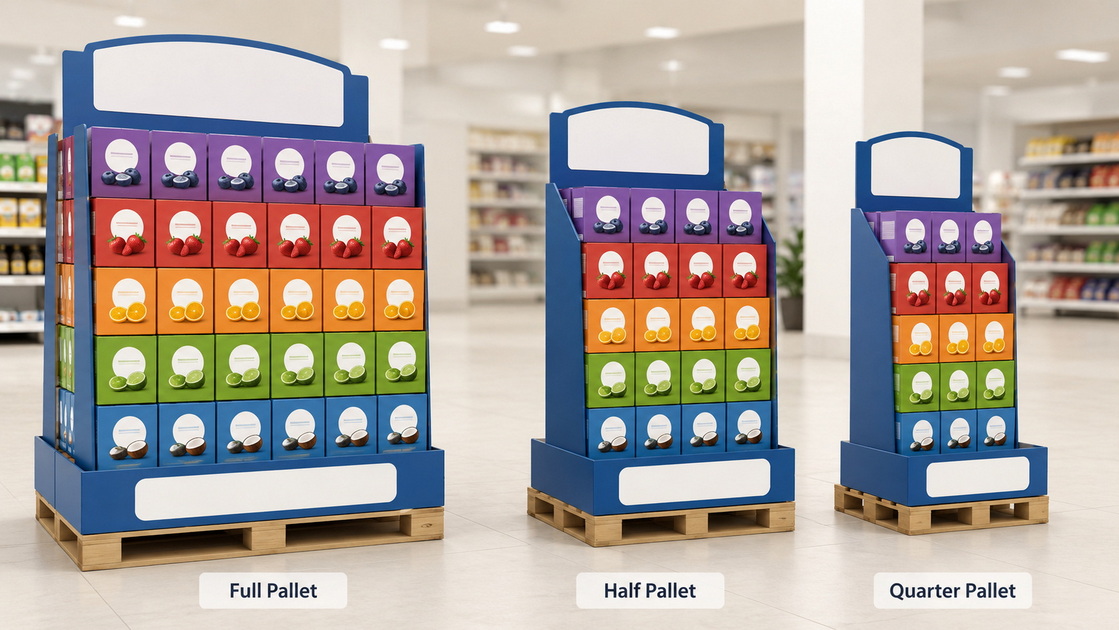
A pallet display stand is a pre‑assembled or easy‑to‑assemble display unit designed to sit directly on a standard pallet and be placed on the retail floor without additional fixtures. Most are made from corrugated cardboard or a mix of cardboard with permanent materials like metal or acrylic, and they are often pre‑loaded with products at the factory for rapid in‑store deployment. [palletmarketing]
Common formats include: [palletmarketing]
- Full pallet display – Typically around 40" x 48", used for major launches and warehouse club promotions where you need maximum presence. [palletmarketing]
- Half pallet display – Roughly 48" x 20", useful for tighter aisles or secondary placements near category adjacencies. [palletmarketing]
- Quarter pallet display – Around 24" x 20", excellent for impulse zones, seasonal islands, and convenience formats. [palletmarketing]
Because the structure is independent of the retailer's shelf system, you can design the display around your product and brand, not the other way around. [palletmarketing]
From a practical point of view, retailers love any solution that is fast to place, easy to maintain, and safe for shoppers and staff. From a brand's perspective, pallet displays provide extra real estate for storytelling, cross‑merchandising, and limited‑time campaigns that traditional shelves simply cannot offer. [creativedisplaysnow]
In my work with category managers and visual merchandisers in grocery, warehouse clubs, and DIY, three performance drivers come up repeatedly:
- High visibility at a distance
- Speed from warehouse to selling floor
- Flexibility to meet different retailer guidelines without rebuilding your entire concept
The seven benefits below reflect these real‑world priorities rather than theory alone. [bcipkg]
One of the biggest operational wins of pallet display stands is how they simplify logistics and store labor. [bcipkg]
Most retailers and brands use two main approaches: [palletmarketing]
1. Fully assembled, pre‑packed pallet displays
- Built and loaded at the manufacturer's facility
- Shipped as a complete unit, often stretch‑wrapped
- Store staff remove the wrap, move the pallet by jack or forklift, and place it on the floor in minutes [bcipkg]
2. KDF (Knocked Down Flat) pallet displays
- Shipped flat to reduce freight volume and cost
- Assembled in store using printed instructions or a QR‑code video guide
- Products are then loaded locally [bcipkg]
For retailers struggling with labor shortages, a "drop‑and‑go" pre‑packed pallet can be the difference between a campaign launching on time or sitting in the back room for a week. At Long Win Display, we typically recommend pre‑packed options for national launches and KDF versions for regional programs with tighter freight budgets. [bcipkg]
Unlike static metal shelving, pallet displays let you tailor structure and layout to product behavior. In practice, that means you can design: [creativedisplaysnow]
- Open shelving for high‑touch products like snacks, beverages, or beauty items
- Compartmentalized bays for multiple SKUs and flavors
- Bins or dump bins for promotional packs and irregular shapes
- Lockable or covered sections for higher‑value items or controlled goods [bcipkg]
From an expert design standpoint, what matters is that the structure matches how shoppers actually shop that category. For example:
- In confectionery, waist‑height open shelves with clear facings reduce friction and increase impulse grabs.
- In DIY, reinforced shelves with clear load‑bearing specs are crucial to support heavier items safely. [creativedisplaysnow]
Long Win Display's mixed‑material solutions (cardboard plus metal or acrylic) are particularly effective when you need premium feel plus durability, such as beauty or small appliance displays that must survive a full season.
Every visible surface of a pallet display is potential marketing real estate. Compared with standard planar shelf talkers, you can print: [colateral]
- 360‑degree branded side panels
- High‑impact header cards with campaign messaging
- Shelf strips, wobblers, and callouts highlighting USPs
- Interactive zones with QR codes, AR triggers, or short usage tips [bcipkg]
A particularly undervalued element is the pallet skirt—a printed wrap that covers the pallet base and acts as a mini billboard at floor level. This is where bold color blocking, a simple benefit statement, and price communication can grab attention from 10–20 feet away, even in a busy hypermarket. [colateral]

One of the most powerful (and often under‑used) features of pallet displays is their ability to host multiple complementary SKUs in one footprint. [palletmarketing]
Practical examples include:
- Beverage plus snack combinations for tailgate or sports events
- Shampoo, conditioner, and treatment bundles in personal care
- Tool bodies alongside batteries and accessories in DIY
By curating the mix within a single pallet display, brands create ready‑made solutions rather than single products—which consistently drives higher average transaction value in controlled tests reported by retailers. Structurally, this means: [faire]
- Tiered layouts that highlight hero SKUs at eye level
- Side bays for add‑ons or limited editions
- Clear visual grouping supported by color blocking and simple signage [colateral]
As a manufacturer, we often design pallet displays with modular trays so that different product mixes can be slotted in for various retailers or seasons without changing the overall structure.
From the retailer's perspective, the "perfect" POP solution is:
- Easy to approve
- Safe and compliant
- Simple to place, refill, and remove
- Visually consistent across locations [colateral]
Well‑engineered pallet displays tick all four boxes. When you supply:
- Exact footprint and height specifications
- Clear load‑bearing and safety data
- Step‑by‑step assembly and teardown guides
- Planograms and visual examples for store teams
you turn your display into a low‑risk, high‑impact plug‑and‑play solution for the retailer. This is one reason big‑box chains often prefer pallet displays for seasonal and promotional programs—they minimize ambiguity and keep aisles tidy. [creativedisplaysnow]
At Long Win Display, we support buyers with retailer‑ready spec sheets, 3D renderings, and test samples so that internal approvals (merchandising, safety, and operations) move faster and more smoothly.
Around 70% of the information humans process is visual, which makes well‑designed physical displays a powerful lever for influencing purchase decisions in store. When you place a bold, correctly targeted pallet display in a high‑traffic zone: [faire]
- Shoppers can see it from multiple angles and distances
- The structure naturally interrupts automatic walking patterns
- Product access is straightforward, which reduces friction at the grab stage [creativedisplaysnow]
Retailers that consistently track the results of POP programs report that feature displays and end‑of‑aisle placements drive higher lift versus standard shelf placements, especially when supported by price promotions or limited‑time offers. [colateral]
The key is to treat your pallet display as a testable asset:
- Align placement with clear goals (e.g., trial for new SKU, stock‑up for seasonal packs)
- Track sales by location and by time window
- Use shopper or store feedback to iterate design, messaging, and facings [faire]
Today's shoppers and retailers are increasingly focused on sustainable materials and responsible supply chains. Corrugated pallet displays offer several advantages: [faire]
- They are typically made from high‑percentage recycled content and are recyclable in standard paper streams.
- Lightweight structures reduce freight weight compared with permanent fixtures.
- Modular designs allow re‑use of certain components across campaigns. [creativedisplaysnow]
Long Win Display supports brands with FSC‑compliant materials, water‑based inks, and optimized structural design to balance durability with material usage. For many of our global clients, sustainability data is now a must‑have in retailer pitch decks, not a "nice to have".
Drawing from both manufacturer and retailer best practices, here is a concise process you can follow to design a pallet display that actually delivers in store. [colateral]
- Decide if your priority is awareness, trial, stock‑up, or trade‑up.
- Clarify the target shopper, their missions (e.g., quick top‑up, weekly shop), and what would make them stop and pick up.
- Full pallet for national hero campaigns, warehouse clubs, and high‑volume promos.
- Half pallet for supermarkets, secondary placements, or shared displays.
- Quarter pallet for convenience, impulse zones, or tight aisles. [bcipkg]
- Match shelf strength and depth to product weight and pack size.
- Build in clear safety margins and stability checks.
- Ensure ADA / accessibility and local safety guidelines are met. [bcipkg]
- Place the main branding zone and hero SKU at shoppers' eye level.
- Use one main message and one supporting benefit, not a wall of text.
- Add price communication and QR codes where relevant. [creativedisplaysnow]
- Design for easy restocking from the back or sides.
- Avoid fragile decorative elements that fail after the first week.
- Specify how the display is recycled, compacted, or returned at campaign end. [creativedisplaysnow]

Based on current retail trends and brand programs, pallet displays are especially effective in the following scenarios. [faire]
- Halloween, Christmas, Lunar New Year, and back‑to‑school promotions benefit from thematic, highly decorated pallet islands near store entrances.
- Seasonal graphics and structural elements (arches, toppers) help create a sense of urgency and occasion. [faire]
- For new SKUs, you can combine education panels (how to use, key ingredients or technologies) with trial‑friendly pack sizes.
- Interactive elements such as QR codes linking to video demos or recipe content work particularly well here. [faire]
- Think breakfast solutions (cereal + coffee + spreads) or gaming nights (snacks + drinks).
- A pallet display can act as a temporary "store within a store", illustrating a lifestyle or usage moment rather than a single brand. [colateral]
Long Win Display regularly collaborates with brand and trade marketing teams to prototype such concepts before roll‑out, using 3D renders, white samples, and pilot tests.

From a strategic standpoint, pallet displays sit alongside floor stands and endcaps as core POP options. The table below summarizes key differences. [palletmarketing]
| POP type | Typical location | Best for | Strengths (selected) | Limitations (selected) |
|---|---|---|---|---|
| Pallet display stand | Aisles, front‑of‑store, seasonal zones | High‑volume promos, multi‑SKU offers | Fast to deploy, large branding area, strong cross‑merchandising potential (palletmarketing) | Needs pallet handling; footprint may be too large for small stores |
| Free‑standing display (FSDU) | Category aisles, near shelf | Category support, niche brands | Flexible footprint, good for narrow aisles, easy repositioning (creativedisplaysnow) | Smaller branding canvas and stock capacity |
| Endcap display | End of aisle | Promotions and price communication | Naturally high traffic, straightforward pricing and signage (creativedisplaysnow) | Limited depth and width; often tightly controlled by retailers |
Finally, while it is possible to manage simple pallet displays in‑house, complex, multi‑retailer or multi‑country campaigns almost always benefit from specialist support. [bcipkg]
An experienced POP display partner such as Long Win Display can help you with:
- Structural engineering for different weight loads and safety standards
- Rapid prototyping and testing (white samples, transit tests)
- Mixed‑material solutions (cardboard + metal/acrylic) for premium or semi‑permanent campaigns
- Artwork optimization for digital or offset printing at scale
- Pre‑packing and kitting services, including co‑packing and QC
For global buyers, the ability to consolidate design, production, and pre‑loading with one partner significantly reduces timeline risk and communication overhead.
If you are a brand, distributor, or retailer looking to launch or upgrade pallet display programs, consider partnering with a specialist team that has real‑world experience across FMCG, beauty, home, toys, and more.
Talk to a Long Win Display expert today to:
- Review your current in‑store execution and identify quick wins
- Co‑create a pallet display concept aligned with your category goals
- Get a realistic quote and lead‑time plan for your next campaign
You can reach Long Win Display via their official website contact form or directly by email or phone as listed on the site.
1. Are pallet displays only suitable for big‑box retailers?
No. While full pallets are common in warehouse clubs and hypermarkets, half and quarter pallet display stands are widely used in supermarkets, convenience formats, and specialty chains where space is tighter. [palletmarketing]
2. How long does it take to design and produce a custom pallet display?
Lead times vary with complexity and volume, but with an experienced manufacturer, brands often move from concept to mass production in a few weeks, especially when using existing structural "families" adjusted for specific campaigns. [bcipkg]
3. Can pallet displays support heavy products safely?
Yes, if engineered correctly. POP specialists calculate load‑bearing requirements, use reinforced corrugated grades or supplementary materials, and validate designs through prototyping and testing to ensure safe performance in store. [bcipkg]
4. How can we measure the success of a pallet display?
Typical KPIs include incremental sales lift vs. shelf baseline, sell‑through rate during the promotional window, attachment rates for cross‑merchandised items, and retailer feedback on setup time and compliance. [colateral]
5. Are sustainable pallet displays more expensive?
Not necessarily. Using recycled corrugate and water‑based inks can be cost‑neutral when optimized at design stage, and the improved brand perception and easier recycling at store level often offset any minor material cost differences. [faire]
1. Bennett Packaging. "5 Benefits Of Pallet Displays in Retail Stores." (Accessed 2026). [palletmarketing]
2. Long Win Display. "China Display Stand, Cardboard POP Displays, Creative Package Box Manufacturer." (Accessed 2026).
3. Creative Displays Now. "Best Practices for Setting Up Retail Displays." (2024‑02‑12). [creativedisplaysnow]
4. BCI Packaging. "10 Steps To Achieving Effective Pallet Displays." (2024‑02‑19). [bcipkg]
5. Faire. "Creative Retail Display Ideas To Try In Your Store." (2024‑10‑14). [faire]
6. Colateral. "What Makes A Good Retail Display? Tips and Examples." (2025‑04‑28). [colateral]


